Physical Address
304 North Cardinal St.
Dorchester Center, MA 02124
Physical Address
304 North Cardinal St.
Dorchester Center, MA 02124


Avoid costly DEX aggregator mistakes around routes, fees, slippage, and wallet safety.
A DEX aggregator is a DeFi tool that checks multiple decentralized exchanges and liquidity sources, then routes a wallet swap toward the best expected final result.
That final result is the important part. A DEX aggregator can show a better quote than one direct pool, but the trade still has to survive gas, slippage, MEV, token rules, wallet approvals, and live onchain execution.
A DEX aggregator is a route-finding tool for decentralized swaps. Instead of leaning on one DEX pool, it checks several sources and estimates which path should give the best net result.
Those sources can include an AMM pool, a direct DEX route, a market maker quote, an intent-based fill, or a route split across more than one pool. The user still signs from a wallet, so the aggregator does not turn the swap into a custodial exchange trade.
The catch is the word “best.” It should mean the amount that lands after costs and execution, not the biggest number on the first screen. Crypto interfaces love a confident number. The chain then grades the homework.
A decentralized exchange aggregator can improve the odds when liquidity is spread across many venues. It can also choose a route that looks good before gas, price movement, token transfer rules, or transaction failure hits the result.
Good DEX aggregator use starts with a few checks:
Use a direct DEX swap when one pool is already deep, cheap, and clear. The aggregator earns its place when route comparison improves the final result enough to justify the extra moving parts.
Before signing, ask more than “what is the quote?” Ask what minimum amount you can receive, what route you are signing, and what can change before confirmation.
A DEX aggregator, a DEX, and a wallet swap button sit in different layers. The DEX is usually the venue, the aggregator is the route-finder, and the wallet is the signing layer.
Wallet confusion is common because many wallet swap panels use aggregation behind the scenes. The wallet may display the quote, set route rules, add a service fee, or hide some detail. It still asks the user to approve and sign.
| Tool Or Layer | What It Does In The Swap |
|---|---|
| DEX | Provides one venue or protocol where liquidity sits |
| DEX Aggregator | Compares several liquidity sources for one swap |
| Wallet | Shows the transaction and signs from the user’s address |
| Bridge | Moves value or messages across chains |
| Cross-Chain Router | Combines swap logic with bridge or destination-chain steps |
This layered setup explains why one swap can involve several tools. A wallet may call a DEX aggregator. That aggregator may route through multiple DEX pools. A cross-chain route may add a bridge before the destination asset arrives.
This is also where approvals matter. If the wallet asks you to approve a token spend, that approval is tied to a contract and scope, not to a general feeling that the app looked friendly. Users learning the signing layer can start with CryptoProcent’s wallets category before treating every swap screen as equal.
The clean habit is to name each layer before signing. If you cannot tell which chain, token, route, approval, and destination are involved, the interface has not earned your click yet.
A DEX aggregator finds a route by asking where your token pair can trade, then comparing expected output after liquidity, fees, gas, and route complexity. This is a live estimate, not a guaranteed receipt.
The simple route is direct. For example, token A swaps into token B through one deep pool. A more complex route might hop from token A into a common asset, then into token B because that path has deeper liquidity.
Some routes also split the trade. One part may go through one pool and another part through a second pool. Split routing can reduce price impact when one pool cannot absorb the whole trade cleanly.
The main route ingredients usually look like this:
More steps do not automatically mean a better route. A route with five steps can increase gas, failure risk, and exposure to stale prices. A shorter path through one deep pool can beat a clever path that arrives late.
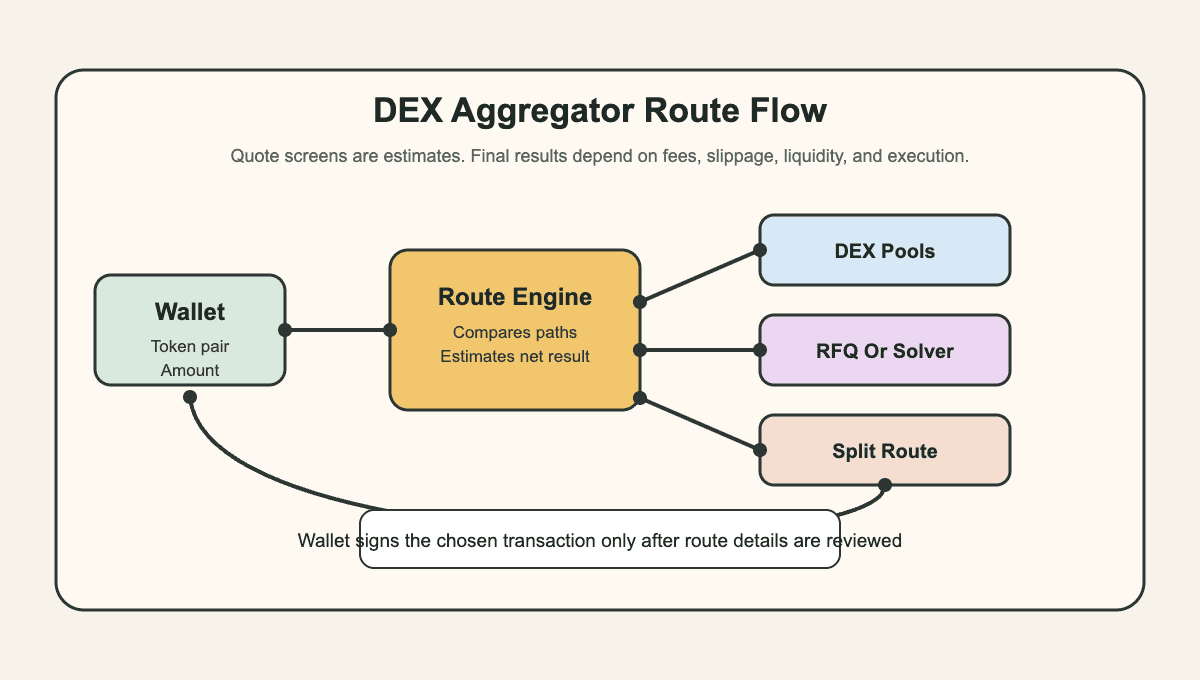
Use the diagram as the mental model. Your wallet asks for a swap, the route engine compares paths, and the final transaction comes back for review. The user still has to read the route and sign the actual transaction.
Advanced routes can sound intimidating, but the user check stays simple. Compare the expected output, minimum received, price impact, gas, and contracts involved. If one field looks strange, pause before the signature turns theory into history.
A DEX aggregator quote can change because the displayed number is an estimate for a live onchain trade. Between quote and confirmation, prices move, pools rebalance, gas changes, and other trades can land first.
The key field is minimum received. That is the lowest amount the swap should return before it fails under your slippage settings. If you ignore it, the headline quote can look charming while the real risk waits underneath.
| Quote-Screen Field | What It Means Before Signing |
|---|---|
| Expected Output | The app’s estimated received amount |
| Minimum Received | The lowest accepted amount after slippage |
| Price Impact | How much your trade moves the pool price |
| Slippage Tolerance | The movement you allow before failure |
| Network Fee | The chain cost to submit the transaction |
| Platform Fee | Any service fee charged by the interface |
| Route Steps | The pools, contracts, or fills used |
| Approval | Permission for a contract to spend a token |
The table separates quote language from execution reality. A clean interface may show fewer fields, but the trade still has those moving parts.
Take a stablecoin swap as an example. USDC to USDT should feel boring, but a bad route through thin liquidity can still create price impact. Add a platform fee, a priority fee, or a stale quote, and the final received amount can fall below what the first screen suggested.
Failed transactions add another irritation. A swap can fail because the price moved outside tolerance, the route became unavailable, the token contract behaved oddly, or gas was too low. The swap may not execute, but the network fee can still be spent.
Read the quote as an estimate and the minimum received as the guardrail. If the guardrail is ugly, the route is already telling you something.
A DEX aggregator helps most when liquidity is fragmented. If the same pair trades across many pools, one route-finder can compare options faster than a user jumping between tabs.
Large swaps are the clearest case. As trade size grows, one pool may produce heavy price impact. A split route can pull from several pools and reduce the damage, though it still cannot create liquidity that does not exist.
These situations are where aggregation can be worth checking:
Early-token markets deserve extra care. A DEX aggregator may find a route in the trenches, but that does not make the token cleaner, deeper, or safer. It only means a path exists.
Stablecoin routes are another useful case. Several pools can hold the same pair with different depths and fees, so checking routes can reduce needless spread. The win may look small, but it can matter when the amount is large.
Solana meme-coin trading also explains why users meet aggregators early. New pools appear fast, liquidity can move fast, and wallet interfaces often route through aggregation tools. The route can help find depth, but it cannot slow down a bad token.
Use the aggregator for route comparison, not blind trust. If it improves final received amount and shows a clear route, that is useful. If it merely makes a risky trade easier to enter, the convenience is doing suspiciously expensive work.
A DEX aggregator may not be better when the direct route is already deep, the swap is tiny, or the route adds more cost than it saves. Aggregation is a tool, not a coupon code from the chain.
Small swaps often lose to fixed costs. Gas, wallet fees, or minimum route charges can matter more than a tiny price improvement. This is how a small leftover balance can become leftover dust instead of a useful trade.
| Small Swap Problem | Large Swap Problem |
|---|---|
| Gas can exceed route savings | One pool can create heavy price impact |
| Service fees can dominate | Split routes may still be thin |
| The direct pool may be enough | Stale quotes can be expensive |
| Failed transactions waste fees | MEV risk can rise with size |
| Tiny balances may not be worth moving | Predatory liquidity can trap exits |
Large swaps have the opposite problem. The route may look good because it finds several pools, but thin markets can still move badly. Better routing cannot save a token where fresh buyers are mainly exit liquidity for earlier sellers.
Unsupported tokens, transfer-tax tokens, honeypot mechanics, and fake pairs can also break the neat story. If the route uses a token contract you did not verify, price stops being the only question. You also need to know whether the asset behaves like the token you think you are trading.
Compare final received amount across one direct DEX and one aggregator when the trade is important. If the gain is tiny and the route is messy, simple may be better.
DEX aggregator fees and slippage are separate, but users often feel them as one bad final number. Fees are explicit costs. Slippage is the gap between expected and actual execution.
A swap can show a low platform fee and still land poorly. Pool fees, gas, price impact, priority fees, and token rules all affect the final result. A “0.3% pool fee” does not mean the whole trade only costs 0.3%.
| Cost Layer | What To Check |
|---|---|
| Network Gas | The chain cost to submit the swap |
| Priority Fee | Extra fee used during busy execution |
| DEX Pool Fee | The pool’s trading fee |
| Aggregator Fee | Any fee charged by the routing interface |
| Wallet Fee | Any added wallet service fee |
| RFQ Spread | The market maker’s quoted spread |
| Bridge Fee | Cross-chain transfer or liquidity cost |
| Destination Gas | Gas needed after a cross-chain route lands |
| Token Transfer Tax | Buy, sell, or transfer tax in the token contract |
| Failed Transaction Cost | Gas spent even when the swap does not complete |
The table is a checklist, not a reason to panic. Most simple same-chain swaps only use some of these layers. Cross-chain routes and exotic tokens can use more.
Slippage tolerance is the setting users notice first. Set it too tight, and the transaction may fail. Set it too wide, and the trade can execute at a worse price than you expected. Thin liquidity makes that tradeoff sharper.
The boring check works. Read expected output, minimum received, price impact, and total fee. If the final received amount still looks acceptable after those fields, the route has earned more trust.
A DEX aggregator is usually non-custodial because the user keeps control of the wallet. That does not make every route safe, every approval harmless, or every token real.
The risk moves to what you sign. A swap may ask for a token approval before the trade. A malicious site, fake token, bad router, or overly broad approval can create damage without anyone “holding” your funds in the old exchange sense.
Use this pre-signing checklist before trusting a route:
Non-custodial safety also depends on token mechanics. A DEX aggregator cannot protect you from a token that blocks sells, changes fees, drains liquidity, or routes buyers into a malicious contract. That is why hard rug checks still belong in the workflow.
Fake tokens create another easy mistake. A popular ticker can exist on several chains or contracts. The route may trade a token with the right symbol and the wrong address. The symbol is the name tag. The contract is the identity document.
Start small, then size up. A test swap cannot remove all risk, but it can reveal the wrong token, bad fees, poor route display, or a route that fails before real size is involved.
A DEX aggregator can reduce some MEV risk, but it cannot erase it. MEV is value extracted from transaction ordering, timing, or routing while a trade moves toward confirmation.
A sandwich attack is the user-facing nightmare. A bot sees a pending swap, trades before it to move the price, lets the user’s swap execute worse, then trades after it. Wide slippage settings and thin pools make the setup easier.
Uniswap’s MEV protection guide, published in October 2025, groups user-side MEV defenses into five practical buckets: private mempools, intent-based execution, limit orders, tight slippage, and deep liquidity checks. Those are useful habits because they change how visible or exploitable the trade is before it lands.
Some DEX aggregators use private routing, RFQ quotes, solver competition, batch auctions, or intent-based execution. The shared goal is to improve execution quality, not only to flash the biggest first quote.
But MEV protection has limits:
This is why MEV belongs beside quote review, not above it. A protected route through thin liquidity can still be poor. A private route to the wrong token is still wrong, just quieter.
For everyday swaps, the best defense is practical. Use reputable interfaces, avoid wide slippage unless the asset truly needs it, prefer deeper pools, consider limit orders when available, and avoid rushing volatile meme-token swaps during obvious chaos.
A same-chain DEX aggregator route compares liquidity on one chain. Cross-chain swap routes add bridge or messaging assumptions, which changes the risk profile.
On one chain, the aggregator may compare DEX pools, RFQ quotes, and split routes. The wallet signs a transaction that executes on that chain. The main questions are route quality, gas, approvals, slippage, and token behavior.
Cross-chain routes can add extra questions:
A simple example shows the difference. Swapping ETH to USDC on Ethereum is a same-chain routing problem. Swapping ETH on Ethereum into SOL on Solana is no longer only a DEX aggregator question. It adds bridge logic, destination-chain liquidity, and settlement assumptions.
Cross-chain routes can also change the support problem. A same-chain swap either lands or fails on one network. A cross-chain route may need a refund, a relayer, a bridge message, or destination-chain gas before the user can move the asset again.
Cross-chain routes can be useful. Just do not compare them only by headline output. Time, support path, asset type, destination gas, and refund rules matter more once the route crosses chains.
Check a DEX aggregator by reading the route like a transaction, not like an ad. The interface should make the token, chain, route, costs, approval, and minimum received clear before you sign.
Start with identity. Open the official site, verify the app URL, and confirm the token contract from a trusted source. Then check whether the route uses normal pools, a market maker quote, a solver, a bridge, or several steps.
Use this quick pre-swap routine:
The “smaller size” rule is not glamorous, which is probably why it works. If a route cannot handle a tiny version cleanly, larger size should not be the experiment.
Do not chase every tiny quoted edge. If one route pays a little more but uses a contract you do not understand, a bridge you did not intend to use, or a token address you have not checked, the safer answer may be to walk away.
The best route is the one you can explain in one sentence before signing. If the sentence needs a flowchart, a prayer, and three tabs of panic, let the market keep its mystery.
No. A DEX is a trading venue or protocol, while a DEX aggregator compares several liquidity sources and tries to route the swap toward the best expected final result.
No. A DEX aggregator can improve the quote, but gas, slippage, price impact, route failure, platform fees, and market movement decide the final amount received.
A DEX aggregator does not take a losing trade on its own, but a user can still lose value through bad slippage, fake tokens, poor route choice, MEV, failed transactions, or a weak market.
Yes. Jupiter is best known as a Solana DEX aggregator and swap routing platform. Check current app details before relying on any specific fee, route, or product feature.
Yes. 1inch is known as a DEX aggregator, especially across EVM networks. Its broader product details can change, so verify the current route and app settings before trading.
Most wallet-based DEX aggregator swaps do not use exchange-style account onboarding, but front ends, onramps, wallets, sanctions controls, and local rules can still affect access.
Start with a small same-chain DEX aggregator swap on a route you can understand. Use it to learn the quote screen, minimum received field, approval flow, and final wallet result before real size enters the chat.
Build a calm routine:
Then size slowly. DEX aggregators are useful when liquidity is fragmented, but they are not safety blankets. They route trades. You still choose the token, route, wallet permission, slippage setting, and risk.
Keep a simple record of what happened on the first few swaps. Note the quoted amount, minimum received, route, fee, and final wallet balance. Patterns appear quickly when a route keeps missing the number it advertised.
Check the transaction after it lands. Compare the wallet balance with the quote and minimum received. If the result is consistently worse than expected, the route, liquidity, fee layer, or slippage setting needs another look before you add size.
For larger swaps, slow the workflow down further. Compare routes, wait for a calmer block or slot when possible, and split the trade only when the routing benefit beats the extra complexity. Bigger size rewards patience more than speed.
The goal is not to become a routing engineer. It is to know what you are signing, why the aggregator chose that path, and where the trade can go wrong before the wallet asks for approval.
Step away when the route becomes too complex to explain. A clear missed trade is cheaper than a confused signature.


