Physical Address
304 North Cardinal St.
Dorchester Center, MA 02124
Physical Address
304 North Cardinal St.
Dorchester Center, MA 02124

A beginner-friendly guide to crypto trenches, meme coin hype, and rug-pull risk.
Crypto trenches are the fast-moving corners of the market where traders hunt new meme coins before most users notice them. The phrase usually describes chaotic early token launches, private group chatter, thin liquidity, and the rush to exit before attention fades.
Trenches in crypto are the noisy, high-risk parts of the market where traders look for newly launched meme coins, micro-cap tokens, and social narratives before they become widely known. The term is slang, not a regulated market segment, a specific exchange category, or one blockchain.
People use “trenches” in a few different ways. It can mean the place where early token hunters spend time, the act of scanning new launches, or the mood of being surrounded by hype, losses, scams, and sudden wins. A user might say they are “in the trenches” after spending hours watching new Solana meme coins, Telegram calls, and chart alerts.
The phrase also carries a cultural signal. It suggests that the person is closer to the messy part of the market than someone buying a large coin on a major exchange. That can sound experienced, but it can also make reckless trading feel like a badge of honor.
A useful boundary is this: trenches are about early, attention-driven token markets where information is uneven and exits can disappear quickly. A token named Trenches, a social account using the word, or a private group with trench branding is not the same thing as the broader slang.
The word comes from the way meme coin traders talk about competition, losses, and speed. “In the trenches” borrows a war metaphor for sitting close to the action, taking hits, and trying to survive long enough to find the next runner.
That language fits meme coin culture because many launches are not evaluated like normal businesses. A token can move because a joke spreads, a wallet buys early, a Telegram group coordinates attention, or an influencer posts a chart. The story can change faster than careful research can keep up.
The same conversations often use this vocabulary:
| Term | Plain Meaning |
|---|---|
| Trenches | Fast, risky corners of early meme coin trading |
| Trenching | Scanning, buying, or discussing very new tokens |
| Trencher | Someone who spends time in those early markets |
| Degen | A high-risk trader who accepts extreme volatility |
| Ape | To buy quickly with little research |
| Jeet | Slang for someone who sells early or panic-sells |
| Rug Pull | A scam or exploit where buyers are left unable to recover value |
| PvP | A market where traders are effectively fighting each other for exits |
| Alpha | Supposed early information before the wider crowd sees it |
The metaphor can warn beginners that these markets are adversarial. It can also make repeated losses sound normal, noble, or funny. Losing money on a poor trade is different from being harmed by a malicious contract, a fake liquidity claim, or an organized dump.
Meme coin culture uses humor to soften risk. The jokes can be entertaining, but they do not change the mechanics underneath. Thin liquidity, concentrated holders, bots, and private groups can turn a public launch into a race where many late buyers become exit liquidity for someone earlier.
People in the trenches watch for attention before it becomes obvious on a large exchange or mainstream news site. The activity usually starts with social signals, then moves through launch tools, wallet checks, charts, group amplification, and fast exits.
That does not make trenching a repeatable beginner strategy. The workflow mainly explains why the market feels so fast. Tools such as DEX Screener, DEXTools, RugCheck, Phantom, Telegram, Discord, and X are often mentioned because they sit near the attention and execution layer. None of them makes a new token safe on its own.
A typical trench flow looks like this:
1. A meme, ticker, celebrity angle, or inside joke starts spreading on X, Telegram, or Discord. 2. A token appears on a launchpad or decentralized exchange. 3. Early wallets, bots, or private groups react before most public buyers notice. 4. Liquidity forms through a pool, bonding curve, or migration into broader trading. 5. Charts and screenshots spread as traders show gains or call the token early. 6. Late buyers chase the move after the first wave has already entered. 7. Early holders may sell, liquidity may thin out, or the token may collapse.
This sequence is a map, not a playbook. Public attention often arrives after the best entry has already passed. By the time a chart is circulating widely, the people sharing it may already hold a position.
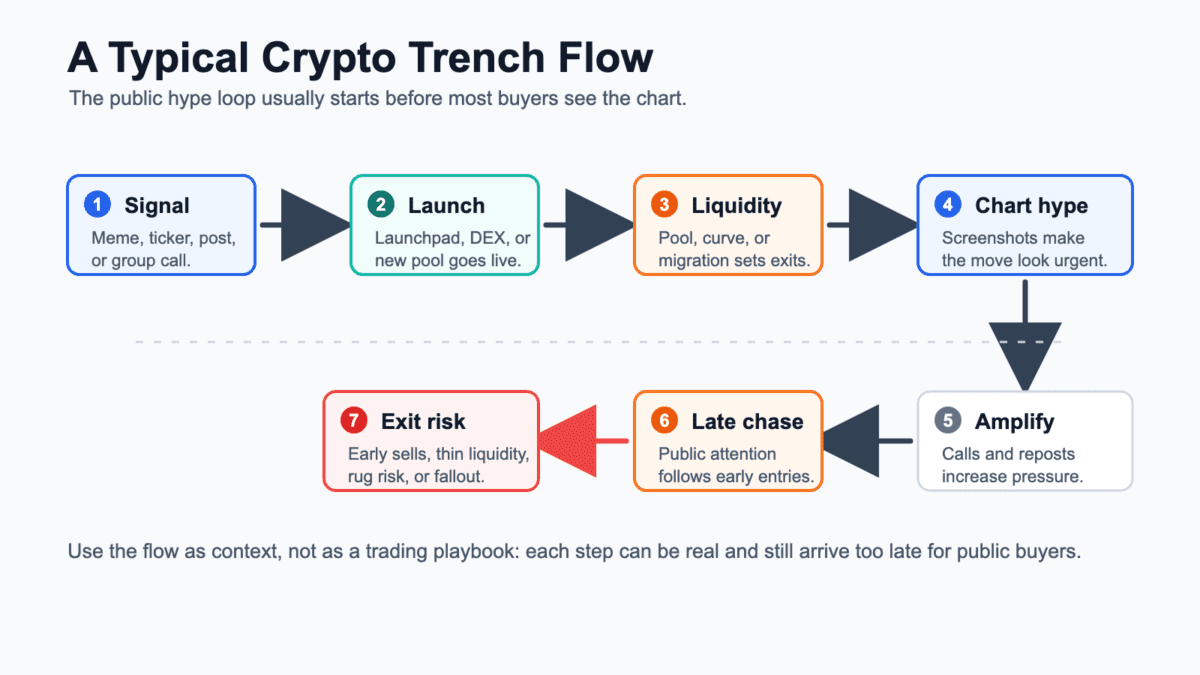
*A typical trench flow moves from social attention to launch mechanics, public hype, and exit risk.*
Some trench activity is observation rather than trading. Users may monitor wallet concentration, track whether liquidity is meaningful, compare the website with copied templates, or watch how quickly the same influencers rotate from one token to another.
The line between research and pressure can blur. A private group may present itself as an alpha source while mainly helping earlier members sell into later members. A screenshot of a large profit may be real and still be useless if the person posting it entered before the public call.
Trenches feel different because the main risk is not just price volatility. The risk stack includes thin liquidity, uneven information, insider concentration, execution pressure, and social manipulation.
Normal crypto investing can still be risky. Large-cap coins can fall sharply, exchanges can fail, and custody mistakes can be costly. The difference is that trench markets often compress the whole cycle into minutes or hours, with less reliable information and fewer ways to recover from a bad entry.
The contrast is easier to see side by side:
| Normal Crypto Investing | Trenches |
|---|---|
| Time horizon may be weeks, months, or years | Time horizon may be minutes, hours, or a few days |
| Liquidity is often deeper on major venues | Liquidity may be thin, new, or easy to drain |
| Information is easier to cross-check | Information often comes from chats, posts, and wallet traces |
| Counterparty behavior is less visible | Early holders, bots, and groups may shape the move |
| Research can include fundamentals and history | Research may be limited to contract checks and social signals |
| Exit risk is real but usually slower | Exit risk can appear before a user reacts |
| Emotional pressure builds over time | Emotional pressure is immediate and public |
Normal investment habits can fail in the trenches. Waiting for confirmation may mean entering late. Entering early may mean acting before basic facts are clear. Neither choice removes the risk.
The harshest part is that outcomes can look like skill after the fact. A trader who bought a runner early may appear disciplined, but the same behavior on another token can end in a rug, a honeypot, or a chart with no buyers left.
The main risks in the trenches are unfair information flow, malicious token design, weak liquidity, and social pressure that pushes users to act before they understand what they are signing or buying.
A bad trade is not the same as a scam. A bad trade means the market moved against the buyer. A scam can involve hidden control, fake liquidity, blocked selling, malicious approvals, or coordinated deception. Both can lose money, but the warning signs are different.
Recent market-manipulation data makes that distinction important. In a January 2025 analysis updated in February 2025, Chainalysis found that 3.59% of tokens launched in 2024 displayed patterns that may be linked to pump-and-dump schemes. The firm describes these as behavioral patterns, not proof of intent, so the checklist still needs caution.
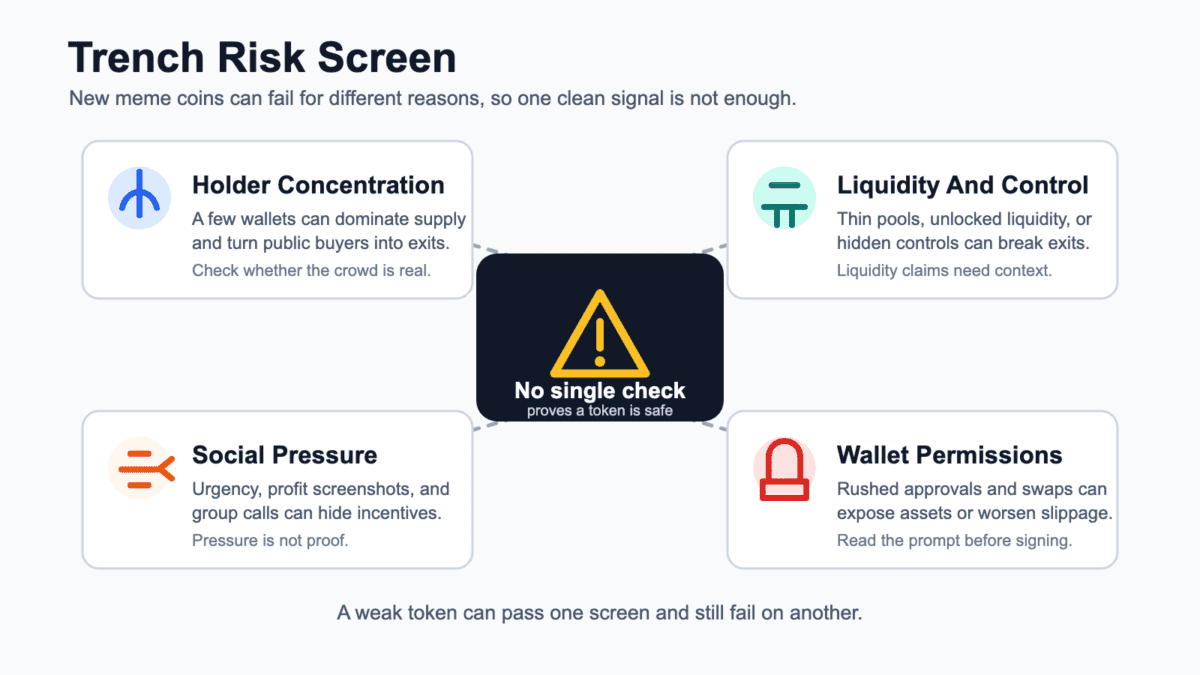
*Four risk checks that often matter before a new meme coin trade.*
Use this checklist as a risk screen, not as a guarantee:
No checklist catches everything. Scammers adapt when common warning signs become widely known, and legitimate-looking projects can still fail for ordinary market reasons. A tool can help users spot warning signs, but it cannot prove that a token is safe.
The social layer creates another risk. A group can call a token “community-owned” while a small number of wallets hold enough supply to dominate the market. A promoter can say liquidity is burned or locked while other control points still matter. A chart can show green candles while sell pressure is waiting above the current price.
Wallet risk deserves separate attention. In fast token markets, users may sign transactions while distracted by countdowns, group calls, or price movement. A rushed approval can expose assets, and a rushed swap can execute with worse slippage than expected.
Not every meme coin is fake. The trenches are built around speed, and speed rewards people with better information, better tools, or earlier access.
The trenches are not a fixed market, so they can cool down on one chain, move to another chain, or shift from one launch style to another. When users ask whether the trenches are dying, they are usually reacting to worse public opportunities, more rugs, lower liquidity, or stronger private-group advantages.
That question comes up after a hot period burns out. A launch format becomes crowded, bots arrive, influencers overuse the same playbook, and late buyers stop trusting every chart. Public attention can fade even while smaller private groups keep trading.
Several signals can make trenches feel weaker:
Those signals do not prove the culture has ended. They show that the advantage may have moved. Solana trenches can cool while Base, Ethereum, or another ecosystem gets a temporary wave. A launchpad can lose attention while a new format draws traders in.
Cycle awareness helps keep the slang in context. Trench culture survives because attention-driven trading keeps reappearing in new places. The exact venue changes, but the pressure points stay similar: early access, thin liquidity, narrative speed, and a crowd trying to avoid being last.
Trenches hype should be read as a pressure signal first. A loud post, fast chart, or private group call tells you attention is moving, but it does not prove the token is fair, safe, or early.
Screenshots are especially weak evidence. A profit screenshot can be selective, edited, delayed, or posted after the profitable exit already happened. Even a real screenshot does not show the failed trades that came before it.
Before trusting the hype, slow down and ask what the message is trying to make you ignore:
Legal language can also be misunderstood. In February 2025, SEC Corporation Finance staff published a staff statement on meme coins saying transactions in the types of meme coins described there generally do not involve securities offerings under federal securities laws. The same statement says it has no legal force and does not protect fraud or products using the label to evade the law.
For a beginner, that means a meme coin can be outside a securities-registration framework and still be risky, misleading, or subject to other enforcement paths. It does not mean a buyer has a simple recovery route after a rug or a private group dump.
Separate entertainment from exposure. Watching trench culture can teach users how narratives form. Funding a wallet and chasing the same narrative turns that observation into financial risk.
Key trench terms mostly describe speed, risk, liquidity, and execution. Knowing the vocabulary makes it easier to see when a post is describing a real mechanism and when it is just adding pressure.
These terms come up often around trench trading:
The shared theme is execution risk. These words describe why a token can look tradable from a distance but still behave badly when a real user tries to buy, sell, or protect funds.
Not every term is unique to meme coins. Liquidity pools, DEXs, slippage, and wallet approvals also matter in ordinary DeFi. In the trenches, they become more dangerous because users are acting faster and with less reliable information.
In the trenches means spending time around early, risky token markets where traders watch new launches, social hype, and fast price moves. The phrase usually points to meme coins, micro-caps, Telegram groups, X posts, and decentralized exchange charts.
Trenching is closely related to meme coin trading, but it is more specific. It usually means looking for very early, chaotic opportunities before a token has broad attention or deep liquidity.
Crypto trenches are not only scams, but scam risk is high because new tokens often have thin liquidity, anonymous teams, concentrated wallets, and rushed buyers. A token can also be legitimate and still collapse because attention disappears.
People say Solana trenches because Solana has been a popular venue for fast meme coin launches, wallet-based trading, and social token culture. The phrase can also appear on Ethereum, Base, or any chain where early meme coin trading is active.
A trencher is someone who spends time in the crypto trenches looking for early tokens, following group chatter, checking charts, or trading risky launches. The word can describe a trader, a meme identity, or a person deep in degen culture.
Regulation depends on the token, the conduct, and the jurisdiction. Some meme coin activity may not be treated as a securities offering, but fraud, market manipulation, misleading promotion, and theft can still create legal or enforcement risk.
The next useful step is broader beginner education, not a shopping list. Terms like liquidity, slippage, wallets, and decentralized exchanges become easier to parse with a wider base of crypto guides behind them.
Use the CryptoProcent guide library for more beginner explainers before acting on fast social signals.
A user who understands trench slang still needs stronger context around wallets, decentralized trading, liquidity, and crypto risk before deciding whether any fast-moving token conversation deserves attention.
Before following another trench call, slow down and check the basics:
Avoid treating read-next links as a shortcut to buying. With trench culture, the useful follow-up is slower learning: understand the terms, recognize pressure tactics, and keep entertainment separate from funds you cannot afford to lose.