Physical Address
304 North Cardinal St.
Dorchester Center, MA 02124
Physical Address
304 North Cardinal St.
Dorchester Center, MA 02124


Liquidity burn explained for traders checking LP-burned token labels.
A liquidity burn in crypto happens when LP tokens, or another liquidity-position claim, get destroyed so the original holder can no longer withdraw that pool share.
The label sounds safer than it is. A burned-LP badge can reduce one obvious rug route, but it does not prove fair launch, clean token controls, honest insiders, strong demand, or enough pool depth for your trade.
Liquidity burn in crypto means the claim on a liquidity pool is destroyed or sent somewhere unrecoverable. The pool can still exist, and traders can still buy and sell through it.
The burned object is usually an LP token, LP token mint balance, or position claim. That claim represents the right to withdraw a share of the pooled assets later. If the claim is truly gone, the original holder should not be able to pull that share back out.
This is where many token buyers get tripped up. A scanner may show “LP burned,” “liquidity burned,” “100% LP burned,” or “burned liquidity.” Those labels do not usually mean the project burned the tradable token supply. They also do not mean the SOL, ETH, or stablecoin inside the pool was destroyed.
The label is mostly about control. Can the person who added the initial pool liquidity still remove it? If they can, buyers face a classic liquidity-drain risk. If they cannot, that route gets harder.
But harder is not the same as safe.
Use the label as a starting signal. Then check what was burned, how much was burned, who controls any remaining pool claim, and whether the token itself still has dangerous permissions.
Read the signal narrowly. Liquidity burn answers a withdrawal-control question first. It should never replace checks on holder supply, token settings, pool depth, or whether anyone besides insiders wants the coin.
A liquidity burn works by separating the pool assets from the claim that controls them. The token and paired asset go into the pool first. The liquidity provider then receives a claim that represents their share.
For Uniswap v2-style pools, Uniswap Developers explain that deposits mint liquidity tokens. Providers then burn those tokens when they retrieve their underlying pool share. That accounting model helps explain most LP-burn labels.
The flow usually looks like this:
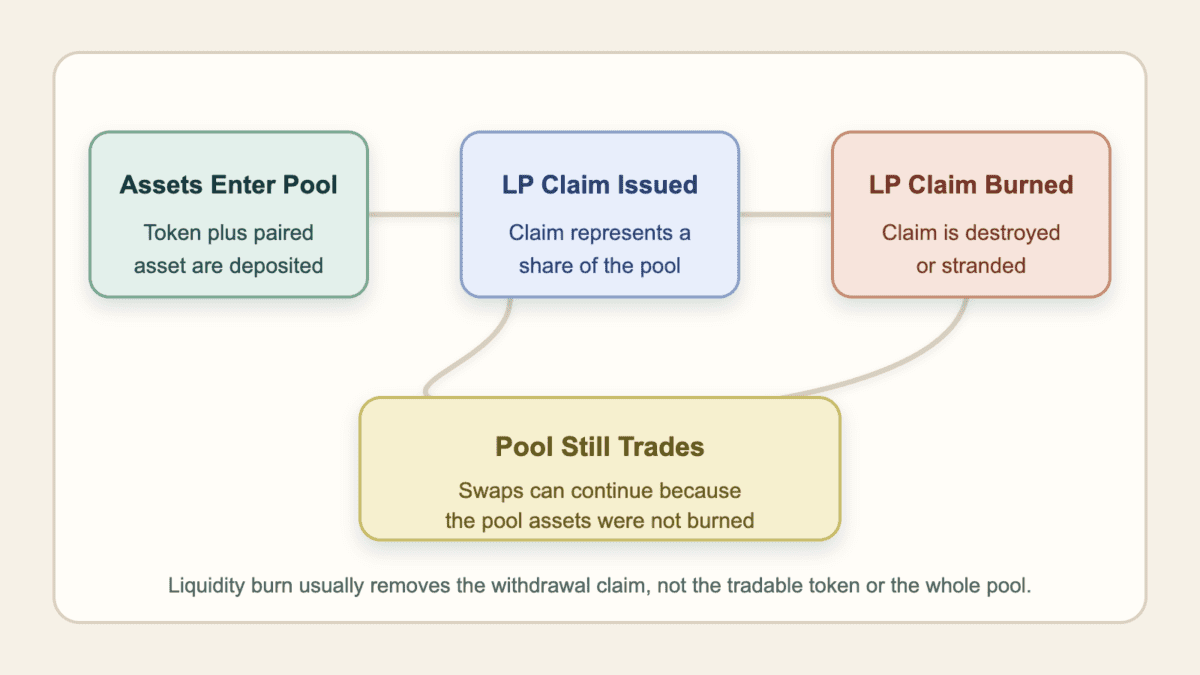
Removing liquidity and burning liquidity are different actions. Removing liquidity uses the claim to take assets out of the pool. Burning liquidity destroys the claim, so that withdrawal route should no longer be open to the burner.
Concentrated liquidity adds a wrinkle. Some pools use position NFTs or CLMM-style positions instead of simple fungible LP tokens. The verification question stays similar: who controls the position that can withdraw assets, and did that control really become unrecoverable?
For buyers, control beats wording. The real question is whether any wallet still holds a usable claim on the pool.
Liquidity burn and token burn sound similar, but they change different things. One is about pool-withdrawal control. The other is about token supply.
The clearest way to avoid confusion is to ask what object was burned. If the burned object is an LP token or liquidity position, the burn affects control over pooled liquidity. If the burned object is the tradable token itself, the burn affects circulating or total supply depending on the token design.
| Burn Type | What It Actually Changes |
|---|---|
| Liquidity burn | Destroys or strands the LP claim that could withdraw pool assets |
| Token supply burn | Removes regular tokens from circulation or from a known supply bucket |
| Buyback and burn | Uses market buys or treasury funds, then burns the purchased tokens |
| Routine LP-token burn | Happens when a normal liquidity provider withdraws from a pool |
The last row is easy to miss. Some protocols use the word “burn” as routine accounting when an LP exits. That is not the same as a project burning its initial LP claim to show it cannot later drain the launch pool.
Price effects split too. A token burn may reduce supply, but demand still decides whether that lower supply helps. A liquidity burn may improve trust around pool control, but it does not create buyers by itself.
So when someone says “burned,” ask the boring follow-up. Burned what?
Liquidity burn and locked liquidity both answer a trust question: can the pool creator remove the liquidity soon? They answer it in different ways.
Burning is usually more permanent. The claim is destroyed or sent to a dead address, so the original holder should lose the ability to withdraw that pool share. Locking keeps the claim alive but places it under a locker contract until a release time or condition.
| Signal | Main Tradeoff |
|---|---|
| Liquidity burn | Stronger permanence, but less flexibility if the pool needs migration later |
| Locked liquidity | Easier to schedule and verify, but expiry and locker trust become part of the risk |
| Partial burn | Better than no signal, but remaining LP control can still be meaningful |
| Lock plus burn wording | Can be useful, but only if the actual pool claim and percentages match the claim |
Neither signal fixes an ugly token. A locked pool can still sit beside concentrated insider wallets. A burned pool can still have mint authority, freeze authority, transfer traps, or no real demand behind it.
Burning can also be awkward for legitimate teams. If a pool needs migration, incentives change, or a better DEX route appears, a permanent burn can limit options. Locking may preserve more flexibility, but then buyers must care about who controls the locker and when the lock expires.
That is why “burned is always safer” and “locked is always smarter” are both too neat. Crypto loves tidy slogans. Markets invoice you for them later.
A liquidity burn can protect against one specific pool-withdrawal path. If the creator truly burned the LP claim for the main pool, they should not be able to use that same claim later to pull the paired asset out.
That is useful because many DEX launches rely on one main pool. Buyers need pool depth so swaps can happen. If a creator keeps the LP tokens, they may be able to remove the pool liquidity and leave holders with a token that is hard or impossible to sell at a fair price.
This is the classic hard rug route a real liquidity burn can narrow. It does not erase every hard-rug pattern, but it can reduce the simplest “pull the pool” version when the burn is full and verifiable.
A good burn signal can show a few narrow things:
Those checks help. They are still not the whole safety story.
The strongest version is a full burn of the relevant pool claim, with no meaningful LP balance left in creator-linked wallets. A cosmetic burn of a tiny share should not impress you. A badge that ignores another large pool should impress you even less.
A liquidity burn leaves plenty of risks untouched. It mainly limits one withdrawal route from one pool.
Insiders can still sell their own token balances. Snipers can still dump early entries. Bundled wallets can still distribute supply across many addresses. A token can still have weak demand, thin pool depth, ugly taxes, blacklist logic, mint authority, freeze authority, or mutable metadata.
> A burned-LP badge is not a character reference. It is one on-chain control check, and sometimes a narrow one.
Exit liquidity risk can survive a burn. Later buyers may still provide the demand that lets earlier wallets sell. The pool claim may be gone, but sell pressure can still travel through ordinary swaps.
A liquidity burn also does not prevent a soft rug. A team can abandon communication, miss promises, let demand fade, or sell over time without ever pulling liquidity. That can damage holders without one dramatic pool-withdrawal event.
After any LP-burn label, check the risks that still shape price or sellability:
The badge answers one question. The rest of the checklist still decides whether the setup can survive normal market pressure.
To check if liquidity burn is real, start with the pool, not the marketing post. You need the chain, token address, pool address, and the object that controls withdrawal rights.
On an EVM-style AMM, that object is often an LP token. On Solana or CLMM-style pools, it may be an LP token mint, position NFT, or platform-specific liquidity position. The interface may hide the difference, but the control object still drives the risk.
Work through the checks in order:
The burn percentage deserves a close look. “100% LP burned” should mean the relevant LP claim is fully gone for the pool being discussed. “Liquidity burned” without a percentage may hide a partial burn, a different pool, or a stale scanner label.
Pool type changes the verification work too. A simple constant-product pool may be easier to verify than a concentrated liquidity position. A CLMM position can have ranges, NFTs, and platform-specific controls. If you cannot identify the withdrawal claim, you do not yet know what was burned.
Then widen the check beyond the pool. Burn status means less if the token has dangerous owner powers or if a few wallets can overwhelm public demand. A clean LP burn beside filthy holder distribution is still a filthy setup, just with a nicer badge.
Use scanners as summaries, not verdicts. A scanner can save time, but the explorer gives you the transaction trail. When those two disagree, slow down.
A liquidity burn token can still crash because normal selling still changes pool balances. The burn may stop the original LP holder from withdrawing liquidity, but it does not stop swaps.
Picture a simple token/SOL pool. Buyers trade SOL into the pool and receive the token. Sellers trade the token back into the pool and receive SOL. If enough holders sell and few buyers arrive, the pool gives out more SOL while taking in more of the weakening token.
The automated market maker is doing exactly what it was built to do.
The crash path can look boring until it hurts:
This can turn into PVP trading even without a liquidity pull. One trader’s exit becomes another trader’s bad entry. The burned LP claim did not rug the pool, but the market can still punish late demand.
Meme-token launches make this easy to see. A token may migrate from a launch curve to a DEX pool, display an LP-burned badge, and still collapse if attention fades or insiders sell. The pool remains tradable. The price just follows supply and demand.
So burned liquidity does not create a floor under price. It only changes who can withdraw the pool claim. Demand, distribution, slippage, and selling pressure still run the trade.
A liquidity burn should make you check a token more carefully, not trust it automatically. It is a positive control signal only when the burn is real, relevant, and paired with cleaner risk checks.
Start with pool depth. A token can show burned liquidity and still have so little paired asset that your trade size moves the price badly. Then check volume. A pool with no real flow may be hard to exit even if nobody can pull it.
Then ask whether the burn is the only clean signal. If every other line looks messy, the burn may be marketing cover for a weak launch.
Use the burn as one line in a wider review:
The last point deserves extra respect. A burned-LP badge is not a reason to full port. If one label can convince you to oversize, the problem is not only the token.
Good due diligence stays boring. Identify the pool, inspect the claim, check token controls, review holder distribution, and size the trade like the token can still fail. Because it can.
Liquidity burn in crypto usually means LP tokens or a liquidity-position claim were burned or sent somewhere unrecoverable. The goal is to prevent the original holder from using that claim to withdraw pool liquidity later.
No, liquidity burn is not the same as token burn. Liquidity burn affects the claim on pool assets, while token burn removes regular tokens from supply or from a known supply bucket.
Liquidity burn can stop one pool-withdrawal rug path if the relevant LP claim is fully and truly burned. It does not stop insider dumps, malicious token controls, hidden wallet clusters, or weak demand.
Yes, a token can still go near zero after liquidity is burned. Sellers can trade through the pool normally, and heavy selling can drain paired assets through ordinary swaps.
Check the pool address, LP token or position claim, burn transaction, burned percentage, remaining LP holders, token authorities, and top-holder concentration. Then compare scanner labels with the chain explorer.
Burned liquidity is more permanent, while locked liquidity can preserve more flexibility and has an expiry or locker-trust question. Neither signal makes a token safe by itself.