Physical Address
304 North Cardinal St.
Dorchester Center, MA 02124
Physical Address
304 North Cardinal St.
Dorchester Center, MA 02124


A practical guide to strategy vault yield, risk, and exits.
A strategy vault is a crypto vault where users deposit assets, receive a vault token or share, and let smart contracts, a curator, or a manager deploy those assets into predefined yield strategies.
The label sounds tidy, but the word “vault” can mislead. A strategy vault is a capital path: deposit, receipt token, strategy execution, yield or loss accounting, and an exit process that may not be instant.
You will see the term on DeFi earn pages, wallet integrations, protocol docs, and branded products. Before the APY pulls focus, ask one question: what is the strategy doing with your asset, and what has to keep working for you to get it back?
A strategy vault in crypto is a pooled onchain product that takes user deposits and routes them into a predefined investment or yield strategy. The vault may lend assets, provide liquidity, stake tokens, run a basis trade, sell options, or split capital across several protocols.
The vault usually issues a share token when you deposit. That share represents your claim on the vault’s assets after gains, losses, and fees. If the strategy performs well, each share should represent more value. If the strategy loses money, gets stuck, or pays heavy fees, the share value can fall.
So focus on the strategy before the vault branding.
A normal wallet stores assets and signs transactions. A strategy vault actively deploys assets under rules. Those rules can be hardcoded, controlled by a curator, adjusted by a manager, or routed through other DeFi protocols. That can save time, gas, and monitoring work. It becomes dangerous when the strategy is too vague to explain in one plain sentence.
Good vault pages answer these basic questions before asking for a deposit:
If those answers are hidden behind a huge APY number, slow down. A strategy vault should make execution easier. It should make the risk easier to see, too.
A strategy vault works by turning one user action into a managed sequence of DeFi steps. You deposit an asset, the vault gives you a share, and the vault routes pooled assets into the selected strategy.
The Yearn docs show this pattern in a multi-strategy vault model. Deposits create shares, managers allocate capital across strategies, reports update accounting, and withdrawals follow a queue. Yearn’s manager-set default withdrawal queue can hold a maximum of 10 active strategies.
That detail is a useful reminder: exits depend on how the vault routes assets behind the scenes. For users, the plain version is simple. The vault is an accounting wrapper around assets that are being moved for yield.
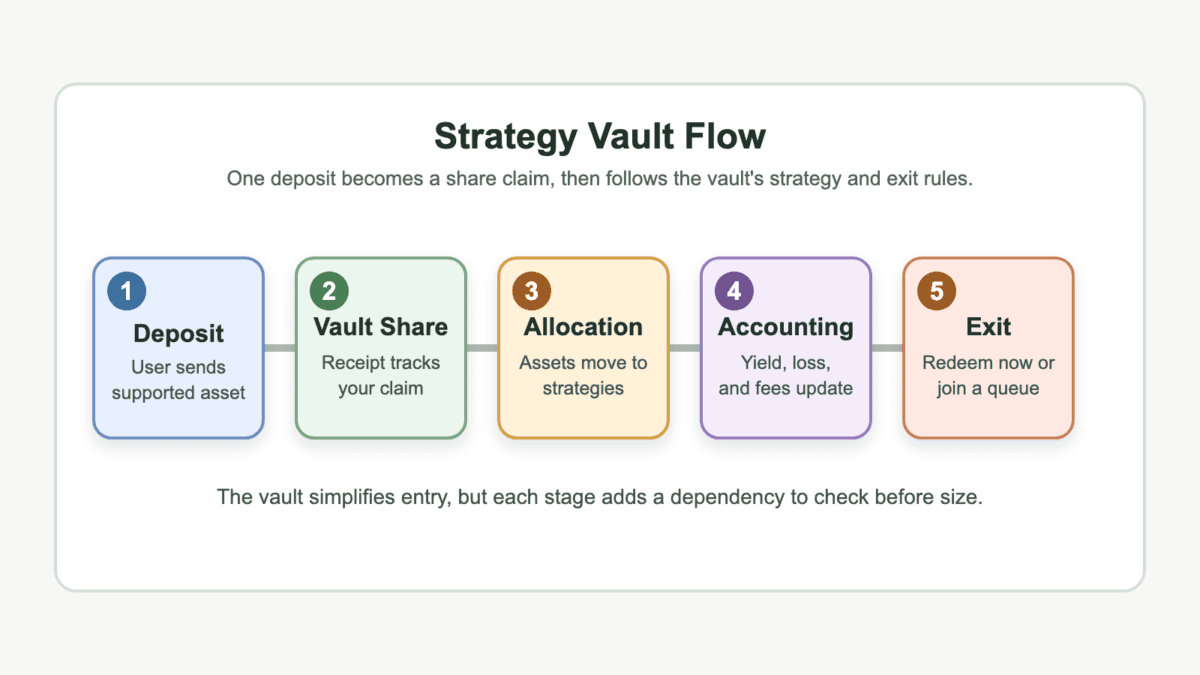
The flow usually looks like this:
The share token is where many users get tripped up. It can sit in your wallet while the underlying asset is working somewhere else. It represents a claim on the vault. If the vault has pending withdrawals, locked positions, bridge exposure, or a losing strategy, that claim may be worth less than the deposit you remember.
Withdrawals also vary by design. Some vaults keep enough liquidity for fast exits. Others need time to unwind loans, close LP positions, exit staking queues, or settle trading positions. A slow exit can be reasonable when the rules are clear before deposit. If the withdrawal path is vague, the product is asking for trust before earning it.
Strategy vault yield comes from the activity the vault performs, not from the wrapper itself. The wrapper can automate compounding, pooling, and routing, but it cannot make risk disappear with nicer math.
The first check is whether the yield source is durable or temporary. Lending interest can change when borrowing demand falls. Liquidity pool fees can shrink when volume dries up. Reward tokens and points can vanish after a campaign. Trading profit can turn into drawdown.
Use this quick APY check before a deposit:
| Displayed Yield Source | What To Check |
|---|---|
| Lending interest | Is there real borrower demand, or only short-term incentives? |
| LP fees | What happens if price moves and impermanent loss grows? |
| Staking rewards | Is the vault adding extra protocol risk on top of staking? |
| Options premium | What market move creates losses for the vault? |
| Funding-rate spread | Can funding flip or liquidity disappear under stress? |
| Rewards or points | Can the yield fall after the campaign ends? |
Opaque yield can also create bad timing. Late depositors may enter after rewards peak, when early users already captured the easy return. In weak designs, those late users can become exit liquidity for a strategy that looked best right before it got crowded.
High APY should feel less like a victory lap and more like a homework assignment with a blinking light.
Strategy vault types vary because the word covers many different products. A simple lending vault and a trading manager vault can both use the same label while exposing you to very different failure modes.
Single-asset lending vaults are usually the clearest starting point. You deposit one asset, and the vault lends it across markets or allocates it through a curator. The main questions are borrower demand, protocol risk, liquidation mechanics, and whether the curator can change allocations.
Liquidity pool vaults are more complex. They deposit assets into a DEX pool, earn fees, and may rebalance ranges or compound rewards. The risk is not only smart contracts. Price movement can create impermanent loss, and rebalancing can underperform a simple hold.
Here is the practical split:
| Vault Type | Main Risk To Understand |
|---|---|
| Single-asset lending vault | Underlying lending market, curator choices, and borrower stress |
| Liquidity pool vault | Impermanent loss, pool liquidity, and rebalancing quality |
| Liquid-staking vault | Validator, liquid-staking token, and withdrawal-queue risk |
| Delta-neutral vault | Funding-rate flips, hedge failure, and liquidation buffers |
| Leveraged looping vault | Liquidation risk and rising borrowing costs |
| RWA vault | Asset disclosure, legal structure, and redemption terms |
| Options vault | Tail-risk losses when volatility moves against the position |
| Trading strategy vault | Manager skill, drawdowns, fees, and position transparency |
Multi-strategy vaults add another layer. They can spread assets across several strategies to smooth returns, but they also create more dependencies to monitor. You are not just checking each protocol. You are checking the allocation logic that decides where capital goes next.
Trading strategy vaults deserve separate caution. A Hyperliquid-style vault, for example, can mean users are backing a manager’s trading system. That is not the same risk profile as passive lending yield. You are exposed to drawdowns, strategy capacity, fee terms, and manager behavior. The dashboard may look calm until the strategy starts taking punches.
Strategy vault risks start with smart contracts, but they do not end there. A vault can be non-custodial and still expose you to poor strategy design, bad incentives, delayed exits, or loss-making positions.
Smart contract risk is the obvious one. If the vault, strategy contract, oracle integration, or connected protocol has a bug, funds can be drained or mispriced. Audits help, but they are not insurance. They are a snapshot of what reviewers saw at a point in time.
The next layer is strategy risk. A lending vault can suffer if markets freeze. An LP vault can lose to price movement. A vault built around borrowed exposure can be liquidated. A stablecoin vault can still take peg, liquidity, and protocol risk. The word “stable” is doing less work than many dashboards imply.
Curator and admin control also matter. Some vaults let a manager adjust allocations, add strategies, change limits, or pause functions. That flexibility can protect users during stress. It can also create abuse risk if controls are weak. In the worst case, admin control and fund loss can resemble a hard rug rather than a normal failed investment.
Other risks usually sit one layer below the headline:
Some failures are slower. A vault may keep operating while rewards fade, communication weakens, liquidity dries up, or strategy performance decays. That pattern can look closer to a soft rug than a single dramatic exploit. The money may not vanish overnight, but confidence and exit liquidity can leak away.
Delta-neutral strategy vaults try to reduce directional price exposure. They often pair a long position with a short hedge, use funding-rate spreads, or balance exposures across venues.
Neutral can still break. Funding can flip. Borrowing costs can rise. Liquidity can thin out. Hedges can slip. Positions can be liquidated if collateral buffers are too small or if markets gap faster than the vault can adjust.
The phrase is useful only after you know what is being hedged, where the hedge lives, and what happens when the hedge stops behaving.
ERC-4626 is a tokenized vault standard that helps apps interact with vaults in a more consistent way. It can standardize deposits, withdrawals, shares, and asset accounting.
The strategy can still be unsafe. A vault can use a familiar interface while holding risky positions, depending on fragile oracles, or routing assets through protocols you would never choose manually.
Standards can improve readability and integration. They cannot bless the asset mix, the curator, or the market conditions inside the vault.
A strategy vault differs from staking, lending, wallets, and DIY DeFi because it bundles execution into a managed wrapper. That wrapper can save work, but it also adds another layer between you and the source of return.
Wallet confusion is the cleanest example. A wallet holds keys and signs transactions. A strategy vault takes deposited assets and uses them. If you want custody basics, the crypto wallets category is the better place to start. If you deposit into a vault, you are analyzing strategy exposure.
Here is the simple comparison:
| Option | What Changes Compared With A Strategy Vault |
|---|---|
| Wallet | You hold assets, but no yield strategy runs automatically. |
| Staking | Rewards come from network participation, not a vault manager’s allocation choices. |
| Lending | You may choose the market directly instead of using a curator. |
| Liquidity pool | You manage LP exposure yourself, including impermanent loss. |
| Yield farming | You chase rewards manually and handle claiming, moving, and compounding. |
| Exchange earn product | You may face platform custody risk instead of onchain vault risk. |
| DIY strategy | You control execution, but pay more attention, gas, and time. |
The tradeoff is outsourced execution versus direct control. A strategy vault may be worth the fee if it handles repetitive compounding, route selection, position sizing, or risk monitoring better than you would.
But if the vault only wraps a simple lending position you could understand and manage yourself, the extra layer needs to earn its keep. Convenience is useful. Mystery is expensive.
Checking a strategy vault before depositing means proving you understand the asset path, the risk path, and the exit path. If you cannot explain all three, you are early.
Start with the boring questions. Boring questions save money. A serious vault should make core facts easy to find before you connect a wallet or approve a token.
Use this checklist before any real size:
The last point is not decoration. Putting too much of a portfolio into one vault is the DeFi version of full porting with prettier formatting. A vault can be useful and still deserve a small allocation.
For large deposits, the standard should be harsher. You need clearer disclosures, slower sizing, and a reason the vault improves on simpler options. Calling a six-figure deposit into an opaque strategy “passive income” misses the point. It is concentrated operational risk wearing a yield badge.
A strategy vault makes sense when it performs useful work you would not do well, cheaply, or consistently on your own. The best case is not magic yield. It is disciplined execution.
Vaults can help when a strategy needs frequent compounding, gas-efficient pooling, careful rebalancing, or curator oversight. They can also help smaller users access strategies that would be annoying or costly to run manually.
They can also reduce small execution mistakes. Manual DeFi strategies often require claiming rewards, moving assets, updating positions, and watching rates across several apps. A vault can turn that maintenance into one position, provided the vault is honest about what it does.
Useful cases often look like this:
Stablecoin vaults can make sense too, but only when the yield source is clear. A simple, lower-yield vault with transparent lending demand may be more attractive than a higher-yield vault built on points, borrowed exposure, and hope wearing a blazer.
Run one harsh check: would you still use the vault if the APY dropped by half tomorrow? If the answer is no, you may be buying the headline number rather than the strategy.
Avoid a strategy vault when the product explains the reward faster than the risk. A good vault can be complex, but it should not be evasive.
The biggest red flag is an unclear yield source. If the page cannot separate base yield, incentives, trading profit, borrowing loops, and fees, users cannot judge whether the return is durable.
Another red flag is vague control. If the curator can move funds into new venues, add strategy contracts, or change limits without clear boundaries, you need to understand that power before you deposit. Flexibility can help during stress, but it can also make the original strategy harder to monitor.
Walk away or use only test size when you see these signals:
Also avoid treating vault dashboards like savings accounts. A clean interface can make risky positions feel calmer than they are. Markets do not care that the deposit button looked professional.
High yield should trigger more homework, not celebration. If the vault cannot survive basic questions, you do not need a sharper APY filter. You need the back button.
When in doubt, compare the vault with the boring alternative. If plain staking, direct lending, or doing nothing would meet your goal with fewer dependencies, the vault needs a clear reason to exist.
A strategy vault in crypto is a DeFi vault that accepts user deposits, issues shares, and deploys pooled assets into a predefined yield or trading strategy.
It can be simple, such as lending one asset, or complex, such as allocating across several protocols. The important point is that the vault is putting your assets to work, not simply storing them.
Yes, you can lose money in a strategy vault through strategy losses, smart contract failures, liquidity problems, peg breaks, liquidation, fees, or underlying protocol failures.
Non-custodial design does not remove those risks. It only means the vault may run through smart contracts instead of a traditional custodian.
No. A wallet stores keys and helps you sign transactions, while a strategy vault deploys deposited assets into a strategy.
You may hold the vault share token in your wallet, but that token is a claim on the vault. Strategy exposure comes with it.
Staking usually earns rewards for helping secure a network or delegating to validators. A strategy vault earns returns by routing assets through one or more DeFi or trading strategies.
Some vaults may use staking assets, such as liquid-staking tokens, inside a broader strategy. That adds more layers than basic staking.
ERC-4626 is a tokenized vault standard that can make deposits, withdrawals, and share accounting easier for apps to support.
It does not prove the strategy vault is safe. The standard describes the vault interface, not the quality of the strategy, curator, dependencies, or market risk.
A strategy vault APY may be high because of lending demand, LP fees, staking rewards, options premiums, funding spreads, trading profit, reward emissions, points, or a short campaign.
The source matters more than the number. If the yield depends on temporary rewards, borrowed exposure, or crowded trades, it can fall quickly or turn into a loss.
Start with a tiny test deposit before making any portfolio move. The first goal is to learn how the vault behaves: approvals, share token, dashboard accounting, yield updates, withdrawal flow, and timing.
Then read the strategy source. If you cannot describe where the deposited asset goes, who can change the allocation, and what breaks under stress, you are not ready for size.
After that, test the exit. A deposit flow only tells you how easy it is to get in. The withdrawal flow tells you whether the vault can return assets cleanly when you no longer like the risk.
Give yourself time between each step. If a small deposit feels confusing, a larger one will not become clearer under pressure. The best vault users are usually slower than the APY chart wants them to be.
Use these next actions:
A strategy vault can be a useful DeFi tool when the mechanics are clear and the size is controlled. When the mechanics are foggy, the vault is not simplifying your work. It is asking you to skip it.
Keep the final posture simple. Use vaults for strategies you can explain, with money you can afford to put at risk, and with an exit path you have checked before stress arrives.