Physical Address
304 North Cardinal St.
Dorchester Center, MA 02124
Physical Address
304 North Cardinal St.
Dorchester Center, MA 02124


Sub-1M market cap explained without blind FOMO.
Sub-1M market cap means a crypto token’s displayed market capitalization is below $1 million, usually in high-risk tiny-token trading.
The phrase shows up around meme coins, new DEX launches, and low-cap calls where traders want an early entry before wider attention arrives. That early-entry story can be real, but the number can also hide thin liquidity, future dilution, and a chart that looks richer than the market can actually support.
A useful read of Sub-1M market cap starts with the formula, then asks harder questions. Can ordinary holders sell without heavy slippage? Is the circulating supply honest? Could insiders, contract controls, or vesting schedules steer the trade? Those checks matter more than the thrill of seeing a tiny valuation on a screen.
Sub-1M market cap in crypto describes a token whose displayed market capitalization is under $1 million. Traders often shorten it to “sub 1M mcap” in group chats, DEX screens, and social posts.
The word “displayed” matters. Market data tools estimate market cap from token price and circulating supply, but tiny tokens often have messy data. A new token may have unclear circulation, thin pools, fake-looking volume, or supply that appears on-chain but is not meaningfully tradable.
That is why Sub-1M market cap is not the same as a formal finance category. It is a trader phrase. In practice, it often means “this token is still tiny enough to move violently if attention arrives.” It can also mean “this token is tiny because nobody wants it.”
The phrase is common in meme-coin hunting because small numbers make upside math look dramatic. A move from a $500,000 displayed cap to $5 million is a 10x move on paper. Paper is patient. Markets are not.
It also appears around early utility tokens, abandoned microcaps, and experimental launches that have not found broad demand. That range is why the phrase should trigger questions, not confidence.
Use the term as a starting label. It tells you the token is small by displayed valuation. It does not tell you whether the team is real, the market is liquid, the contract is clean, or the exit door is open.
Sub-1M market cap uses the basic crypto market-cap formula: token price multiplied by circulating supply. The formula is simple. The hard part is knowing whether the inputs are clean enough to trust.
Here is a simple example. If a token trades at $0.005 and has 100 million tokens counted as circulating, its displayed market cap is $500,000. That puts it below the $1 million threshold.
The key word is “valuation.” Market cap estimates what the circulating supply is worth at the current price. It does not show cash in a bank account, total money invested, or the amount holders can pull out at once.
That point is easy to miss because market cap looks clean. One number, one label, one tidy screenshot. Tiny-token markets are less tidy. A small buy can move the price, which raises the displayed market cap for every counted token. Then a sell can push the same number back down.
The supply input can be messy too. If a token page overstates circulation, misses locked supply, or updates slowly, the cap can look more precise than the market really is.
Sub-1M market cap can still be useful. It sizes the current valuation. But it should never be read alone. Once you know the cap, check liquidity, FDV, volume quality, holder concentration, and contract risk.
Sub-1M market cap is not the same as low token price. A token can cost a tiny fraction of a cent and still have a large valuation if the supply is huge.
This is the unit-price trap. Cheap-looking coins are easy to market because the number feels small. But valuation depends on price and supply together. A token at $0.000001 can be expensive by market cap, while another token at $0.50 can be smaller if fewer tokens circulate.
Use each number for a different job:
| What You See | What It Actually Tells You |
|---|---|
| Token price | The cost of one unit, not whether the whole token is cheap. |
| Circulating market cap | The current valuation of counted circulating supply. |
| FDV | The valuation if all possible supply were priced at today’s token price. |
| Liquidity | How much trading depth exists near the current price. |
| Volume | How much activity happened, not whether exits are deep. |
The table shows why price per coin is a weak shortcut. It is marketing-friendly, but it is not supply-aware.
For Sub-1M market cap tokens, ask what supports the displayed valuation. If the cap is low because the token is new, lightly discovered, and reasonably liquid, it may deserve more research. If it is low because liquidity is thin, supply data is unclear, or nobody is buying, the low cap is a warning, not a discount sticker.
Traders chase Sub-1M market cap crypto because the small denominator makes upside look huge. A token under $1 million does not need the same amount of new demand as a large-cap coin to show a big percentage move.
That logic is not fake. A tiny pool of attention can move a tiny token. If a meme catches, a niche product gets noticed, or a launch reaches the right crowd, the chart can reprice fast. That is why Sub-1M calls often come wrapped in phrases like “early,” “undiscovered,” and “before listings.”
The attraction usually comes from a few forces at once:
None of those forces proves quality. They explain why traders care.
The same small size works against you when sellers arrive. If the token moves because a small group bought at once, it can fall when a small group sells at once. That is the part that low-cap pick lists often skip. A 50x chart is less useful if the market cannot absorb your sell.
So the balanced view is simple. Sub-1M market cap can create dramatic upside, but the setup needs more than a low number. It needs real demand, enough liquidity, tolerable supply risk, and a reason for new buyers to keep showing up after the first hype burst.
Sub-1M market cap does not mean $1 million can exit the token. Market cap is a valuation estimate, not a sellable cash balance.
This is the most expensive misconception in tiny-token trading. A token can display an $800,000 market cap with only a thin liquidity pool underneath. If that pool cannot absorb meaningful sells, the number on the chart may collapse as soon as holders try to leave.
On a DEX, many tiny tokens trade through liquidity pools. The pool holds paired assets, and prices move as traders swap against that depth. If the pool is shallow, a modest buy can lift the price sharply. That higher price raises the displayed market cap. The reverse is also true.
Imagine a token with a displayed market cap near $900,000 and only $35,000 of real usable liquidity near the current price. A $2,000 buy may push the chart up enough to attract attention. A $7,000 sell may then create ugly slippage and scare away the next buyers.
That is where exit liquidity becomes real. Late buyers can become the demand that lets earlier wallets sell. In small pools, the handoff can happen quickly.
Volume does not fully solve this. High 24-hour volume can be concentrated, temporary, or circular. What matters is whether the market has enough depth on the venue you would actually use. Check expected slippage, pool size, buy and sell taxes, and whether volume keeps appearing after promotion cools.
The takeaway is blunt. Market cap can tell you what the token is valued at right now. Liquidity tells you whether your trade can survive contact with the exit.
Sub-1M market cap can look tiny while FDV tells a much larger story. FDV, or fully diluted valuation, estimates value if the full token supply were priced at the current token price.
The FDV gap changes the risk because circulating supply is only the supply counted today. Some tokens have locked team allocations, investor vesting, emissions, treasury reserves, or future minting. If those tokens can become sellable later, today’s low circulating market cap may understate future sell pressure.
Use a hypothetical example. A token shows a $700,000 circulating market cap because only 70 million tokens are counted at $0.01 each. But the total supply is 1 billion tokens. At the same price, the FDV is $10 million.
That does not automatically make the token bad. Some supply may be locked for a long time, tied to real incentives, or never likely to hit the market all at once. But the gap changes the question. You are no longer only asking whether a $700,000 token can grow. You are asking whether demand can absorb a much larger future valuation.
Sub-1M market cap hunters should look for the source of the gap. Who receives locked tokens? When can locked supply become sellable? Are emissions constant? Does the team explain supply clearly? Are insiders able to sell into public demand?
If those answers are vague, the tiny market cap may be a low-float mirage. The token looks small because only part of the supply is counted. Later, the market may have to digest much more supply than the early screenshot suggested.
Sub-1M market cap crypto usually trades before major exchange access. That often means DEXs, launchpads, smaller venues, and token screeners rather than Coinbase, Binance, or other large retail platforms.
The reason is simple. Very small tokens may not meet listing standards, volume requirements, liquidity expectations, or operational checks for major exchanges. Many are too new, too illiquid, too risky, or too obscure. Some are just experiments with a ticker.
This is why tiny-token discovery often happens in the trenches: fast chats, DEX charts, wallet trackers, new-pair feeds, launch platforms, and social posts that move faster than formal research. The speed can be useful, but it also lowers the quality filter.
DEX trading adds practical risk. You may need the exact contract address, the right chain, enough native gas token, and a wallet that can handle approvals. A fake token can copy a name and symbol. A rushed approval can expose more than the position you planned to risk.
Smaller centralized exchanges can reduce some wallet friction, but they do not remove valuation risk. A token can still have thin books, wide spreads, weak volume, and a fragile holder base.
Use venue quality as part of the risk assessment. If the only market is a tiny pool with unclear contract details, the token should clear a higher bar before you touch it. Early access is not always an advantage. Sometimes it just means you arrived before the guardrails did.
The biggest risks with Sub-1M market cap crypto come from fragility. The market is small, information is uneven, and a few wallets or contract settings can decide the outcome.
High risk does not mean every tiny token is a scam. It means the margin for error is thin. A large-cap asset can survive bad news, uneven volume, or one holder selling. A Sub-1M token may not.
Watch for risks that stack together:
The wider fraud backdrop is not theoretical: the FBI’s 2025 Internet Crime Report says cryptocurrency-related complaints produced more than $11 billion in reported losses in 2025. That does not make every tiny token a scam. It does make urgency, secrecy, and guaranteed-upside language worth checking before you trust the pitch.
A sudden hard rug is the obvious nightmare: liquidity disappears, sells fail, or abusive controls surface fast. But the slower version can hurt too. A token can fade through insider selling, weak execution, stale socials, and a community that keeps promising the next push.
Information asymmetry is the quiet risk. Early wallets may know more than public buyers. Private groups may enter before the call reaches a wider audience. Snipers may capture cheap supply at launch. By the time a token is posted as “early,” it may already be late on-chain.
Do not assume fraud. Require proof before excitement. If liquidity, contracts, holders, and supply all look weak, the tiny cap is not a reason to be brave. It is a reason to slow down.
A practical Sub-1M market cap checklist should reject weak setups before the upside math gets loud. Use it before buying, tracking, or giving the token more attention.
The goal is not to make a risky token safe. It is to avoid the obvious traps: unsellable contracts, thin exits, bad supply math, hidden concentration, and hype that depends on the next buyer being less careful than you.
| Check | Risk Signal |
|---|---|
| Liquidity depth | Shows whether entries and exits can clear without brutal slippage. |
| Slippage estimate | Reveals how much your own trade may move the price. |
| Volume quality | Separates steady demand from short promotion bursts. |
| Circulating supply | Explains what the displayed market cap is counting. |
| FDV gap | Flags future supply pressure that the current cap may hide. |
| Holder distribution | Shows whether a few wallets can dominate the chart. |
| Top wallet behavior | Helps spot early sellers, snipers, or insider-looking exits. |
| LP lock claims | Tests whether liquidity can vanish quickly. |
| Mint authority | Shows whether more supply can be created. |
| Blacklist or freeze controls | Flags wallet-level sell or transfer risk. |
| Tax settings | Shows whether buys or sells carry unusual costs. |
| Contract address | Confirms you are checking the real token. |
| Venue access | Shows where you can actually enter and exit. |
| Team or deployer history | Adds context around past launches and behavior. |
| Community quality | Separates real discussion from pure urgency. |
| Exit plan | Forces you to define what success and failure look like. |
The checklist works best when you look for clusters. One weak signal may be explainable. Several weak signals pointing in the same direction usually tell the story.
For example, a low cap with modest liquidity, clear supply, active builders, and normal contract controls is different from a low cap with thin liquidity, top-wallet dominance, vague supply, and only paid promotion. Both may trade under $1 million. Only one deserves more research.
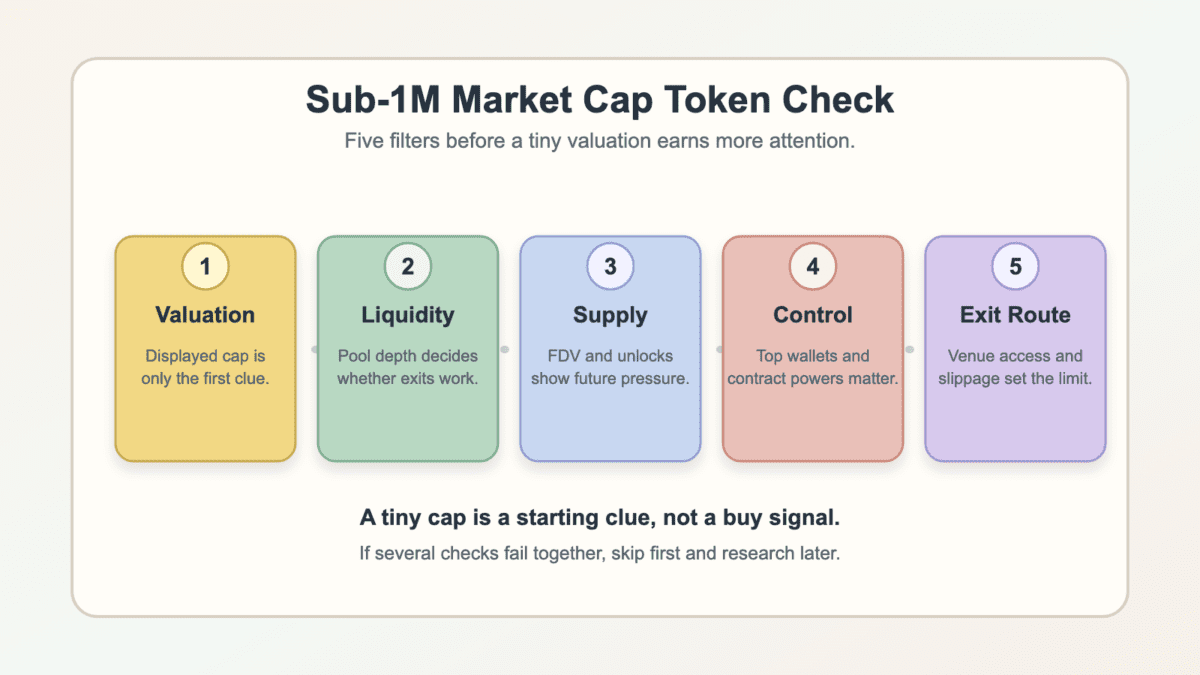
Skip a Sub-1M market cap token when the risk signals explain the low valuation better than the opportunity does. There will always be another tiny token. A clean exit is harder to replace.
Some skip signals are obvious. No meaningful liquidity, unknown contract details, broken sell tests, strange tax settings, and concentrated top wallets should stop the process early. Others are more social. If the only evidence is caller urgency, recycled profit screenshots, and pressure to ignore questions, the setup is asking you to supply demand, not judgment.
Common walk-away signals include:
A slow-fading token can become a soft-rug lesson before anyone admits it. The team gets quieter, liquidity thins, updates turn vague, and holders are told to wait for a comeback that never gets funded by real demand.
The late buyer then inherits bagholder risk: the token remains in the wallet, but the market has moved on. That is why skipping is a skill. In Sub-1M markets, avoiding one bad setup can matter more than catching the next loud chart.
Sub-1M market cap tokens sit near several crypto terms that explain the same risk stack from different angles. Knowing the terms helps you decode calls without accepting the pitch.
Exit liquidity means the later demand that lets earlier sellers leave. Tiny tokens can show a high paper value without enough buyers to absorb sells.
Trenches refers to the noisy, fast-moving discovery environment where traders watch new pairs, memes, wallet activity, and DEX charts. It is where many Sub-1M tokens get noticed before larger audiences see them.
Hard rug describes a sudden abusive failure, such as liquidity removal, blocked selling, or malicious controls. Soft rug describes a slower decline through abandonment, insider selling, or a story that fades while holders keep waiting.
Bagholder risk describes being left holding after price, attention, and liquidity move elsewhere. FDV, liquidity, slippage, holder concentration, and vesting schedules are the signals that help you avoid that role.
These terms point back to the same habit. A small market cap is only one clue. The real question is whether the token has enough honest demand, depth, and structure to survive sellers.
Sub-1M market cap means a crypto token’s displayed market capitalization is below $1 million. In trading chat, it usually signals an ultra-small, high-risk token that may be early, illiquid, or both. It is slang, not an official exchange category.
Sub-1M market cap is usually smaller and more specific than broad micro-cap crypto. Many sites use wider micro-cap ranges, while “Sub-1M” points to a displayed valuation under $1 million. Read it as a tiny-token phrase, not a standardized market tier.
No. Sub-1M market cap means the displayed valuation is small, not that the token is fairly priced. A token can still be risky, illiquid, diluted, controlled by insiders, or expensive compared with its real demand.
Sub-1M market cap tokens move fast because small markets need less demand to shift price. Thin liquidity can make buys lift the chart quickly. The same structure can also make sells crush the price quickly.
Liquidity usually matters more once you are thinking about entry and exit. Market cap estimates valuation. Liquidity shows whether trades can clear near the quoted price. A tiny cap with poor liquidity can be hard to sell.
Not always, but Sub-1M market cap tokens are high risk. Some are early experiments, some are weak projects, and some are scams. Check liquidity, holders, FDV, contract controls, and the reason buyers are arriving before trusting the label.