Physical Address
304 North Cardinal St.
Dorchester Center, MA 02124
Physical Address
304 North Cardinal St.
Dorchester Center, MA 02124


Batch auction swaps can be fairer, not risk-free.
A batch auction in crypto collects multiple orders over a short window and settles them together instead of executing one by one.
That design changes who gets an advantage. Instead of rewarding the fastest order in a strict line, a batch auction can let similar orders clear together, match opposite sides directly, or ask solvers to compete on the full batch. The goal is fairer price discovery and less ordering advantage, not guaranteed better fills.
A batch auction in crypto is a market-design method that groups orders, evaluates them together, and then settles the valid results in one coordinated process. It can appear in DeFi swaps, token sales, liquidations, buybacks, and research designs for fairer exchange.
The simplest contrast is a normal instant swap. In many AMM trades, your order hits a liquidity pool right away, using the pool price at that moment. In an order book, your order interacts with posted bids and asks. In a batch auction, the system waits for a small group of orders, then calculates the best acceptable settlement for that group. The core pieces are simple:
That waiting window is not there for drama. It reduces the value of being first by a few milliseconds. If several users want similar trades, the auction may settle them at a common clearing price, match compatible orders, or route them through competing solvers. For a trader, the useful split is simple: what does the auction protect against, and what new friction does it add?
Execution can also become less immediate. If the market moves during the batch window, the final fill may be worse than the quote you expected. If no solver or route can satisfy your limit, the order can fail or expire. So the plain-English version is this: a batch auction changes the race, but it does not remove the need to check price limits, venue quality, and market depth.
A batch auction works by collecting orders first, then choosing a settlement that satisfies the auction rules and each user’s limits. The exact design differs by protocol, but the user usually signs an order, intent, or auction bid before execution.
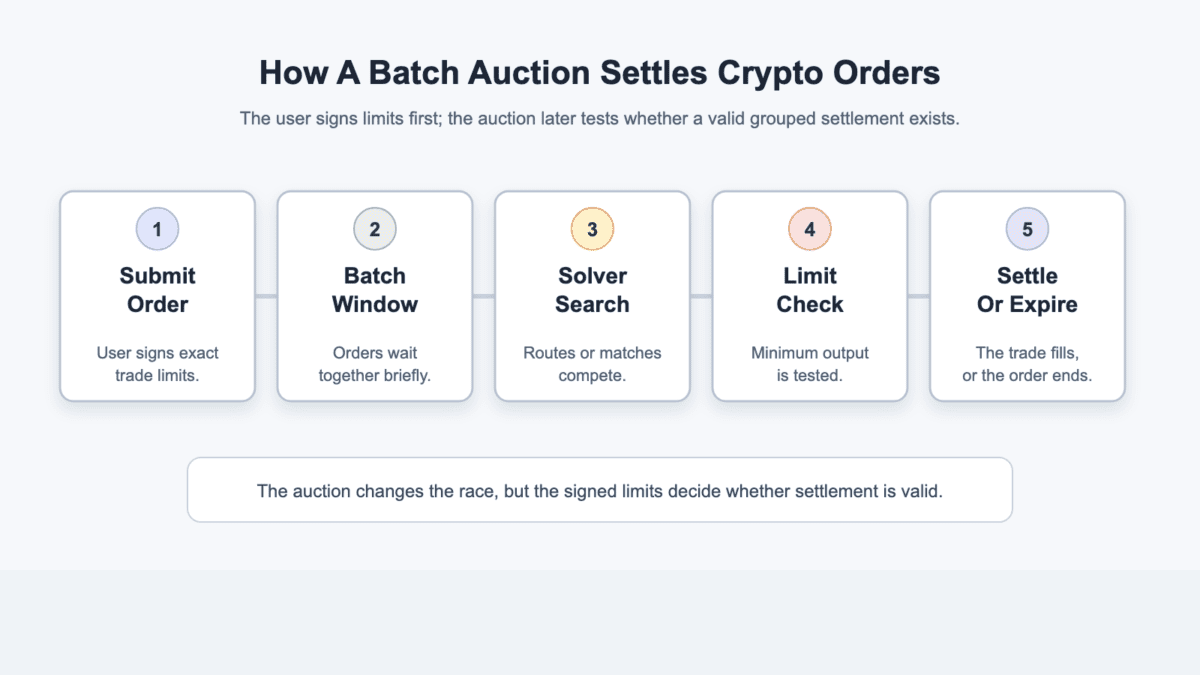
Imagine you want to swap ETH for USDC. Instead of pushing the swap straight into one pool, a batch-auction DeFi venue may place your signed order into a short batch with other orders. Some users may want the opposite trade. Others may need a route through several pools.
The broad lifecycle looks like this:
Solvers are important in many DeFi versions. A solver is an actor that tries to find a route or matching solution that satisfies orders in the batch. It may use on-chain liquidity, direct order matching, private liquidity, or a mix of sources.
A useful solver setup should make these details inspectable:
That solver layer is useful when liquidity is fragmented. One route may be worse than another because it crosses a thin pool, pays extra fees, or creates too much price impact. Solver competition tries to turn routing into a contest, where the winning route gives users the best acceptable result under the auction rules.
After that, the meaning splits by venue:
The shared idea stays the same. The auction evaluates a group, then settles the group under defined constraints.
That is the part to watch in your wallet. You are not just accepting a number on a screen. You are signing limits that decide whether the later settlement is valid. If the minimum received, expiry, token address, or recipient is wrong, the auction design cannot rescue a bad instruction.
A batch auction differs from an AMM, order book, and Dutch auction because it groups orders before settlement. The other models can be useful, but they organize time, price, and competition differently.
An AMM swap quotes against a liquidity pool. An order book matches posted bids and asks. A Dutch auction changes the price over time until demand accepts it. A batch auction waits for a group of orders, then resolves the group together. The comparison is easiest when each model gets one plain job:
| Market Model | Plain Difference |
|---|---|
| Batch auction | Groups orders, then settles valid matches or routes together. |
| AMM swap | Quotes continuously from pool reserves and a pricing formula. |
| Order book | Matches live bids and asks by price and priority. |
| Dutch auction | Starts from one price path and lets demand accept over time. |
The timing changes the risk. In an AMM, a large trade can move the pool and invite sandwich pressure if the order is visible and slippage is wide. In an order book, priority and queue position can matter. In a Dutch auction, waiting can get a lower price, but waiting too long can mean missing the allocation.
A batch auction tries to weaken strict order priority. If several orders can settle together, the fastest visible transaction may not get the same edge. That is useful in DeFi because bots often compete around transaction ordering, not just long-term price views. Use this quick filter before picking a venue:
But the model is not automatically better. AMMs can be faster and simpler for small, liquid swaps. Order books can be clearer for limit-order traders. Dutch auctions can be useful when a seller wants price discovery over a sale window. A batch auction earns its place when the grouped settlement reduces a specific execution problem.
A batch auction can reduce MEV when the attack depends on transaction ordering. If a bot can see your swap, jump ahead of it, move the price, and sell after it, your order can become part of the bot’s profit path.
The usual sandwich path looks like this:
Batching changes that game. If orders are settled together, the value of being one transaction earlier can drop. A uniform clearing price or solver-level route can make it harder for a bot to profit only from strict before-and-after placement.
That is one reason MEV-heavy markets can feel like PVP trading. Normal users want a swap. Searchers and routing systems may compete over the value around that swap. A batch auction tries to move the fight away from the user’s transaction order.
> Batching can reduce order-priority games. It cannot fix thin liquidity, reckless slippage, or a venue that exposes too much order data.
The protection is strongest when the venue can limit ordering games and enforce user constraints. If compatible orders can match directly, the batch may avoid touching an on-chain pool. If solvers compete, a route can draw from several liquidity sources instead of hammering one pool.
That warning is not fine print. A batch auction does not automatically hide your trade. It does not make every route private. It does not make bad liquidity deep. It does not make a reckless slippage limit wise. The user-facing split is useful:
So a batch auction can help with some MEV and sandwich patterns, especially those built around ordering. It is weaker against plain market movement, low liquidity, poor route design, vague signing screens, or venues where one solver effectively controls the path.
The best way to read a MEV-protection claim is narrow and practical. Ask what class of attack is reduced, what data remains visible, who chooses the route, and what happens if the route fails.
Batch auctions show up in crypto anywhere grouped settlement can make price discovery or execution fairer. The two common contexts are DEX execution and token-sale distribution, but the idea also appears in buybacks, liquidations, and market-design research.
The common settings are:
DEX and intent systems are the first modern use case most traders meet. A user signs an order or intent. The protocol groups orders. Solvers or matching logic compete to settle the batch within each user’s limits.
An arXiv paper on fair combinatorial auctions estimates that blockchain trade-intent auctions intermediate about USD 10 billion in trades each month. That is why solver design is more than academic plumbing.
CoW Protocol is one example. It uses a fair combinatorial batch auction model where solvers can bid on individual orders or groups of orders. The protocol then filters unfair batched bids and selects a winning combination based on user surplus and computational constraints.
Token launches are the second common meaning. In a token-sale batch auction, buyers submit demand during a sale window, and the auction finds a clearing result for distribution. That is different from a launch where late buyers become exit liquidity for earlier participants. A fair sale design cannot make a weak token good, but it can reduce some allocation games during the sale itself. Batch auctions can also appear in liquidation auctions, buyback programs, fragmented liquidity routing, and frequent batch auction research.
> Same phrase, different venue, different risk.
Frequent batch auctions repeat the batching process at regular intervals, aiming to reduce continuous-time speed races. For users, the context decides the risk. A DEX batch is about execution quality. A token-sale batch is about allocation and clearing. A liquidation batch is about collateral sale rules.
A batch auction can help traders when execution quality matters more than instant settlement. That often means larger DeFi swaps, stable or major pairs, fragmented liquidity, and trades exposed to ordering games.
The benefit is process. If a venue can group orders, match opposite sides, and make solvers compete, the user may get a cleaner route than a single rushed swap through one visible pool. The wait can be worth it when speed is exactly what bots exploit. Good-fit cases usually share a few traits:
Stablecoin routes are a simple example. If several users want to trade USDC, ETH, and other deep assets in opposite directions, a batch process may find better internal matches or routes. Token sales can also benefit when the sale process is designed around a clearing result instead of a pure speed race.
The best use case is not “batch auction good.” It is more specific: use a batch auction when the grouped process directly addresses the execution problem you face. If the trade is tiny, urgent, and deeply liquid elsewhere, the extra machinery may add little.
A batch auction can hurt traders when the delay, route opacity, or solver layer becomes more painful than the ordering protection. Fairer timing is useful only if the final execution still fits the market.
Delay is the obvious risk. During the batch window, prices can move. That is manageable for deep stable pairs. It is much less comfortable for thin tokens, memecoin breakouts, liquidation cascades, or any market where the quote gets stale quickly. This is where size makes mistakes louder. A user going full port into a volatile token can still get hurt, even if the venue uses a batch auction. The risk checks are straightforward:
| Risk | What To Check |
|---|---|
| Delayed execution | Does the order expiry match the market speed? |
| Thin liquidity | Can the route fill without heavy price impact? |
| Wide slippage | Is the minimum received tight enough? |
| Solver concentration | Are several credible solvers or routes available? |
| Opaque routing | Can you see the asset, chain, and final output? |
| Failed fill | What happens if no valid settlement appears? |
The table does not mean every risk is fatal. It means each risk needs a visible answer before you sign. If the interface hides the expiry, route, minimum output, or failure path, you are relying on trust instead of constraints.
Solver risk deserves special attention. A solver can be useful because it searches for routes. But if only one solver consistently fills orders, competition can weaken. Quote protection is also not the same as market depth. Your order may have a minimum received value, but that does not create more buyers, deeper pools, or calmer markets.
> A valid fill means the order met its constraints. It does not mean the market was deep, calm, or kind.
For fast meme-token trades, the delay can be the whole problem. The auction may still be fair by its own rules while the market moves away from you. In those cases, smaller tests and tighter limits matter more than the comforting label.
Check a batch auction before signing by reading the wallet prompt like a trade ticket. You need to know what you are selling, what you should receive, when the order expires, and what approval you are granting.
Start with minimum received. That number tells you the lowest acceptable output. If it is too loose, you may accept a poor fill. If it is too tight, the order may fail during normal movement. Neither setting is heroic. Before you approve, run this checklist:
The wallet layer also deserves attention. Batch-auction systems may ask for a token approval, an off-chain signature, or an intent-style message. Keep your crypto wallets separated by purpose, and do not sign vague permissions with a wallet holding long-term funds. Cancellation is easy to overlook, so check whether the order can be canceled, expires naturally, or stays valid until a deadline.
Also separate route quality from interface polish. A clean app can still route through weak liquidity. A technical interface can still enforce strong constraints. If you cannot explain the final token, final amount, deadline, approval scope, and failure path, reduce the size or skip the auction.
Related batch auction concepts help separate the mechanism from nearby crypto buzzwords. The most useful terms are MEV, sandwich attack, solver, intent, clearing price, AMM, order book, Dutch auction, frequent batch auction, and fair combinatorial auction.
Use the terms this way:
| Concept | Plain Role |
|---|---|
| MEV and sandwich attack | Explain the ordering games batching may reduce. |
| Solver and intent | Explain who routes the order and what the user signs. |
| Clearing price | Explains how a grouped sale or batch can settle. |
| AMM and order book | Explain the market models batch auctions differ from. |
| Dutch auction | Explains a price-over-time auction, not grouped settlement. |
The table keeps the vocabulary from turning into soup. A batch auction explains how orders are grouped and settled. The other terms explain who competes, where the price comes from, and which risk remains after the batch.
These concepts also point to the next useful checks. If your batch auction question came from fast meme-token markets, crypto trenches explains the noisy trading environment where delay and thin liquidity bite. If the concern is what happens after a messy launch, bagholder explains the late-buyer risk that fairer auction mechanics can reduce but never erase.
Frequent batch auctions repeat this grouping process on a schedule. Fair combinatorial auctions go further by allowing solver bids on groups of orders while trying to preserve fairness for individual orders.
Start with the auction type before judging a batch auction. A token-sale batch, a DEX batch, and a liquidation batch can all use grouped settlement, but they expose users to different risks.
Then compare the expected output against a normal route. If the batch auction gives a worse output, longer delay, and less route visibility, the label is not doing useful work. If it improves execution while keeping limits clear, the wait may be reasonable. Use these steps before relying on one:
On a DEX, make the comparison concrete: expected output, minimum received, expiry, route visibility, and whether a failed order simply expires. In a token sale, focus on allocation rules, clearing price, refund handling, and whether late demand changes the final price for everyone.
Also decide what you will do if the auction fails. A failed fill is not always bad. Sometimes it means your limits protected you. Chasing the trade immediately after a failed batch can be worse than waiting, especially when volatility is steering.
Keep the habit boring. Batch auctions are market plumbing, not a personality test. The useful version makes the execution rules clearer and less speed-dominated. The risky version asks you to trust a black box because the word “fair” appeared nearby.
If you remember one thing, remember this: a batch auction can improve the process, but your signed limits decide whether the process can protect you.
A batch auction in crypto is a system that collects several orders during a short window and settles them together under shared rules. It is used in DeFi swaps, token sales, liquidations, and some MEV-resistant trading designs.
A batch auction can reduce some MEV, especially attacks based on strict transaction ordering. It does not stop every risk because liquidity, slippage, route visibility, solver quality, and market movement still affect the final fill.
No. A batch auction groups orders and settles them together, while a Dutch auction changes price over time until buyers accept or the auction ends. Both are auctions, but they solve different problems.
No. CoW Swap is one prominent product that uses batch-style execution and solver competition. A batch auction is the broader market-design mechanism, and it can appear outside CoW in token sales, liquidations, and research systems.
Batch auctions can be awkward for memecoin trades because fast price moves can make the batch delay costly. They may help with ordering games, but thin liquidity and volatility can still create ugly fills.
A clearing price in a batch auction is the price that allows the grouped orders or bids to settle under the auction rules. In a token sale, it can mean buyers above the clearing level receive allocation at the same final price.