Physical Address
304 North Cardinal St.
Dorchester Center, MA 02124
Physical Address
304 North Cardinal St.
Dorchester Center, MA 02124


Understand bribe fees before your SOL disappears into execution costs.
A bribe fee is an extra crypto transaction payment that may improve priority, routing, or ordering when a trade competes for execution.
You usually see the term inside Solana trading bots, meme-coin terminals, and MEV-aware swap tools. The word sounds shady. Here, it normally means an execution incentive, not a suitcase of cash under a validator’s desk.
It can help in a crowded route. It can also turn a tiny winning trade into a net loss after platform fees, priority fees, slippage, failed transactions, and sell-side costs.
A bribe fee in crypto is an extra payment used to make a transaction more attractive for faster inclusion, private routing, or preferred ordering. In Solana trading language, it often sits beside the normal network fee, priority fee, platform fee, and slippage setting.
The important word is “may.” A bribe fee can improve the chance that a transaction lands through a specific route. It does not guarantee a fill, a better price, or protection from every MEV problem. It is one lever in the execution stack. The setting usually answers three questions:
That is why the setting confuses newer traders. A terminal may show fields for priority fee, bribe, MEV protection, gas, and slippage on the same screen. It is tempting to raise everything after one failed buy or sell. That can make the next trade more expensive without solving the real cause.
In broad crypto use, the phrase can also mean something else. DeFi governance bribes are rewards paid to voters or liquidity directors. In trading-fee context, the Solana bot meaning is the important one: users want to know why an extra SOL amount appeared before a swap. A clean shortcut is execution cost. It helps when it improves a time-sensitive trade. It wastes money when it costs more than the edge.
A bribe fee works on Solana by adding another execution incentive to a transaction route. It can sit beside Solana’s native fee mechanics, a trading terminal’s routing choices, and private or Jito-style submission paths.
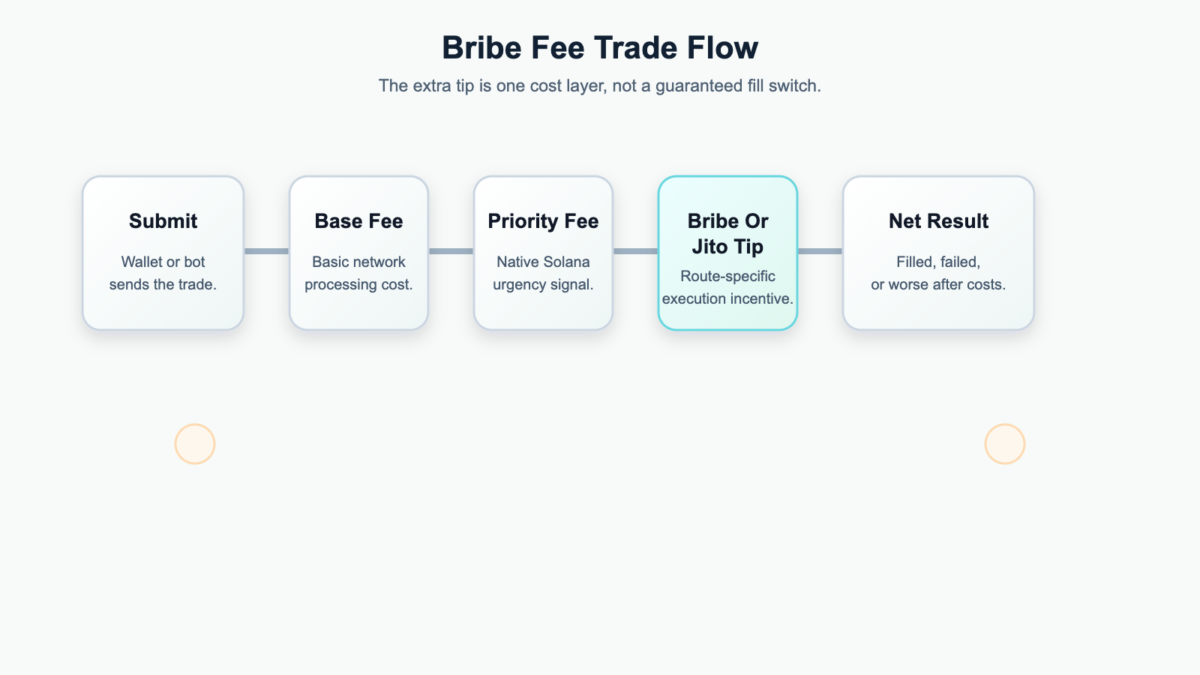
Solana lists the base transaction fee as 5,000 lamports per signature and separates it from optional prioritization fees. The base fee pays for processing the transaction. A priority fee is a native signal that can make the current leader more likely to schedule the transaction ahead of competing work.
A bot’s bribe field can work differently. Depending on the tool, route, and settings, it may become a validator incentive, a Jito tip, a private-route payment, or a product-specific setting wrapped in simpler language. That is why a BullX bribe fee, Axiom bribe fee, Photon setting, or GMGN route can feel similar on screen while using different execution plumbing. The broad flow usually looks like this:
You see this most in fast meme-coin launches and crowded routes, the part of crypto people call the crypto trenches. Everyone wants the same early fill or the same exit door, and the network has to order competing transactions.
Avoid universal bribe amounts. The right setting can change by trade size, route, token liquidity, urgency, MEV mode, and the tool’s own submission path. A setting that makes sense for a high-value snipe can be absurd for a tiny low-urgency swap.
A bribe fee, priority fee, and Jito tip are related because they all try to improve execution. They are not the same lever, and mixing them up is how users overpay.
Priority fee is Solana’s native scheduling signal. A Jito tip is tied to Jito-style bundle or route incentives. A bribe fee is the user-interface label that may map to one of those incentives, or to another tool-specific route. The label is convenient. The mechanics behind it can differ. Use the table to keep the settings separate:
| Fee Or Setting | What It Actually Changes |
|---|---|
| Base fee | Pays the basic network cost for a processed Solana transaction. |
| Priority fee | Signals extra urgency through Solana’s native prioritization mechanism. |
| Bribe fee | Adds an execution incentive that may affect routing, ordering, or inclusion. |
| Jito tip | Pays into a Jito-style bundle or routing path when that path is used. |
| Slippage | Sets how much worse the execution price may become before the trade fails. |
| Platform fee | Pays the bot, terminal, or product used to route the trade. |
| DEX or pool fee | Pays the trading venue or pool used for the swap. |
Moving every slider together is sloppy. Raising slippage allows a worse price. Raising a priority fee changes scheduling pressure. Raising a bribe fee may improve a specific route. Paying a platform fee gets you access to the interface or routing product. These settings can interact, but they do different jobs.
The clean habit is to change one reason at a time. Ask whether the failed trade was caused by network competition, route choice, token rules, liquidity, or your price limits. Then adjust the setting that actually touches that problem.
A bribe fee can help when timing has real economic value. It wastes money when the trade is not urgent, the route is wrong, or the extra cost is bigger than the possible edge. The strongest cases are crowded execution windows: hot launches, snipes, volatile exits, liquidations, or moments when many wallets hit the same pool at once.
But the same fee becomes dead weight when the market is calm. It also hurts when trade size is small. Paying extra SOL on a tiny buy can erase the gain before the chart has time to congratulate you.
| May Help | May Waste Money |
|---|---|
| Crowded launches where many trades compete. | Calm swaps with no real urgency. |
| Large trades where timing changes the net result. | Tiny trades where fees eat the position. |
| Urgent exits from fast-moving pools. | Low-liquidity tokens with no real exit depth. |
| Routes using MEV-aware or bundle paths. | Routes where the bribe setting does not apply. |
| Liquidation or arbitrage-style timing pressure. | Blindly copied presets from a tutorial. |
Panic sells deserve extra care. When jeets crowd the exit, paying more can sometimes help a transaction compete. It can also make you pay up for a terrible fill while the pool is already thinning.
Use relative math, not magic numbers. If the expected edge is small, the bribe fee, priority fee, platform fee, and sell-side repeat can overwhelm it. If the trade is large and time-sensitive, the same extra cost may be a reasonable insurance premium against missing the route. Before raising a bribe fee, compare the added cost with position size, expected price movement, liquidity depth, and failure rate.
Small bribe fee trades can lose money because the wallet balance sees every cost, not just the displayed PnL. A trade can look green on a terminal and still leave you with less SOL after the whole fee stack clears.
This happens because some costs are fixed or semi-fixed in SOL. They do not shrink just because your position is tiny. A larger trader may barely notice the same cost. A small account feels it in the ribs. The fee stack can include more than the visible bribe field:
| Cost | Why It Matters |
|---|---|
| Platform fee | The bot or terminal may charge for routing the trade. |
| Pool or launchpad fee | The venue can take a cut before your wallet result appears. |
| Base transaction fee | Processed transactions still have network cost. |
| Priority fee | Urgency adds another adjustable SOL cost. |
| Bribe or Jito tip | The extra execution incentive may be paid on top. |
| Slippage and price impact | The fill price can move against you. |
| Failed attempts | A processed failure can still leave costs behind. |
| Token account costs | Some Solana flows create or touch token accounts. |
Do not invent current platform rates when checking this. Tool fees, launchpad fees, and route settings change. Look at the transaction view, the product’s fee screen, and your wallet balance before and after the trade. Many small traders become a bagholder in miniature here, stuck with a worse result than the green percentage suggested.
The sell side needs the same accounting. Buying a token with a bribe fee is only half the story. If you need another bribe fee, another priority fee, another platform fee, and wider slippage to sell, the breakeven price moves farther away. So do not stop at “Was the trade up?” Ask whether the round trip was up after every fee, failed attempt, and price-impact cost.
Bribe fees and Jito tips can relate to MEV protection, but they do not create guaranteed safety. They may change how a transaction is routed or ordered, which can reduce some exposure in specific paths.
The usual MEV worries are easy to recognize:
MEV is the value extracted from ordering, including front-running and sandwich attacks. In a sandwich, a bot sees a trade, buys before it, lets the user’s trade move the price, then sells after it. The user gets a worse fill. The bot pockets the spread.
Protected routes, bundle submission, or MEV-only modes try to reduce that exposure. They may keep a transaction out of some public paths, bundle transactions together, or add incentives for a cleaner route. That can be useful during crowded trades. But protection has limits:
The warning is blunt: protection is not a profit shield. If the token is risky, the pool is shallow, or your slippage allows a brutal fill, MEV protection only handles part of the problem.
Advice about bribe fees gets dangerous when it sounds universal. A higher bribe may help a protected route land, but it may also raise the cost of a trade that should have been skipped. Sometimes the cheapest failed trade is the one you never send.
A bribe fee cannot guarantee a fill or exit because execution depends on more than ordering. Liquidity, token rules, routing, slippage, and other traders can all break the outcome after you pay extra.
The most painful version is the failed sell. A user raises the bribe fee, widens slippage, and still cannot exit. That does not always mean the bribe was ignored. It may mean the trade route had nothing usable to execute against. Common causes include:
The exit liquidity problem is central here. If everyone wants out and few buyers remain, paying more for execution may only help you compete for a smaller exit. It does not create new buyers.
Malicious token mechanics are worse. A hard rug can make fee settings almost irrelevant because the problem is not speed. The problem is that the token, pool, or contract behavior is hostile. Before increasing both bribe and slippage, slow down for one check:
Raising bribe and slippage together is the danger move. One makes the trade compete harder. The other lets the final price get worse. Used carelessly, they can turn a bad exit into a faster bad exit.
You can inspect a bribe fee after a trade by checking the transaction details and comparing your wallet balance before and after. The tool may not label every cost cleanly, so look for categories, not one perfect line. A bribe may appear as a tip, transfer, bundle-related payment, or terminal-specific execution setting.
Start with the transaction hash in Solscan or the terminal’s own transaction view. Then trace what happened to SOL, token balances, transfers, and swap instructions. Do the same for failed attempts, because one clean final fill can hide earlier processed transactions. The goal is to separate network cost, route cost, and trading result. Check these items:
Do not expect every interface to use the same label. One terminal may call something a bribe. Another may call it a Jito tip, MEV fee, priority route, or execution setting. Wallet movements tell you more than the label, especially when the same trade path includes platform fees and pool fees.
The cleanest habit is post-trade accounting. If a trade looked profitable but your SOL balance fell, list every fee and failed attempt. Then compare that total with the position size and the eventual sell cost. That turns vague suspicion into a specific cost stack you can reduce next time.
A bribe fee is usually a transaction execution incentive. Use that meaning when the term appears inside a Solana terminal, MEV route, or meme-coin trading tool. The user is paying extra to improve routing, ordering, or inclusion, not voting on protocol rewards.
A DeFi governance bribe is different. It is usually a reward paid to token voters, veToken holders, or governance participants to influence where rewards, liquidity, or emissions go. Those meanings overlap only because both use the word “bribe.” The clean split looks like this:
| Meaning | Main Use |
|---|---|
| Bribe fee | Extra payment for transaction execution, routing, or ordering. |
| Governance bribe | Reward used to influence votes, emissions, or liquidity direction. |
This split keeps the problem in the right lane. A Solana bribe fee question is usually about SOL costs, Jito-style tips, MEV protection, and failed fills. A governance bribe question is about incentives, voting power, and protocol rewards.
If you saw the term in a trading terminal, focus on execution. Check whether the route uses a bribe field, a Jito tip, a priority fee, or some bundled setting with a friendlier name. If you saw it in a veToken or liquidity-emissions discussion, you are probably dealing with governance incentives instead.
The risk changes with the meaning. With a trading bribe fee, the risk is overpaying for a transaction that still lands badly or fails. With a governance bribe, the risk is following incentives that may move emissions, liquidity, or voting power in ways that do not match your own position.
Start with a bribe fee setting by checking whether the trade actually needs faster or cleaner execution. Do not start with the highest preset just because a tutorial made it look normal.
There is no evergreen best bribe fee. Good settings depend on trade size, liquidity, volatility, route, MEV mode, failure rate, and the tool’s own submission path. The right number for a launch snipe can be silly for a quiet swap. Use this checklist before raising it:
Slow-drain risks deserve the same restraint. A soft rug can fade liquidity, attention, and support over time. Raising the bribe fee does not reverse that decay. It just spends more to interact with it.
If you are testing a new terminal, start small enough that one failed route will not matter. Then inspect the transaction, not just the displayed PnL. Use a bribe fee only when speed or routing is worth paying for. Keep slippage honest. Avoid copying presets blindly. And never let an execution fee convince you a bad trade became good.
No. A priority fee is Solana’s native urgency signal, while a bribe fee is a trading-interface label that may map to a Jito tip, validator incentive, or tool-specific route. They can both affect execution, but they are not identical.
No, you do not need a bribe fee for every Solana trade. It is most relevant when execution is crowded, urgent, or routed through a path where the incentive applies. Calm swaps may not need it.
Yes, some routes may still work with the bribe fee set to zero. The tradeoff is that speed, bundle routing, or MEV-aware execution may change depending on the tool and market conditions.
A bribe fee can help in some protected or private routes, but it does not stop every sandwich attack. It cannot fix wide slippage, thin liquidity, malicious token rules, or a route that never uses the protection path.
You can pay a bribe fee and still fail to sell if liquidity vanishes, the route fails, token rules block the transfer, or your slippage limits no longer match the market. The fee can improve execution competition, not create an exit.
No. A DeFi bribe usually pays governance voters or veToken holders to influence rewards or liquidity direction. A bribe fee in Solana trading usually refers to an execution incentive for transaction routing or ordering.