Physical Address
304 North Cardinal St.
Dorchester Center, MA 02124
Physical Address
304 North Cardinal St.
Dorchester Center, MA 02124


Understand a canonical bridge before you move funds across chains.
A canonical bridge is the official or chain-recognized route for moving assets or messages between blockchains, usually tied to the destination chain’s standard token representation and settlement model.
That label helps. It still does not make the route instant, cheap, or immune to weird wallet moments. A canonical bridge can be the right path for token support and settlement clarity. It can also bring wait times, approval risk, claim steps, and token-version checks before you sign.
A canonical bridge in crypto is the route a chain, rollup, or token system recognizes for moving assets or messages across chains. “Canonical” usually means official, native, preferred, or standard for that setup.
The word can sound more absolute than it is. One chain may call its route a native bridge. Another may call it an official bridge, token gateway, standard bridge, or canonical token bridge. The shared idea is that this route defines the main token mapping between the source chain and destination chain.
A simple example helps. If you move ETH from Ethereum to an L2 through that L2’s recognized bridge, the bridge may lock ETH on Ethereum and create the expected ETH representation on the L2. Apps on that L2 are more likely to understand that version than a random wrapped token from a side route.
The label usually points to three practical details:
That does not mean every canonical bridge works the same way. The details depend on the chain design, token standard, bridge contracts, and whether the route handles native assets, ERC-20 tokens, or messages.
Ask what this route controls. If it controls the standard token version, final withdrawal path, or official chain message route, it deserves extra attention before you compare it with faster options.
A canonical bridge affects funds before the transfer starts. It can decide which token version lands, which apps support it, and how you get back to the source chain. The bridge label can affect real money, not just protocol vocabulary.
Token contracts come first. Two assets can share the same ticker while using different contracts, wrappers, or issuer paths. Your wallet may show “USDC” or “ETH,” but lending markets, DEX pools, exchanges, and portfolio tools may care about the exact contract address.
Before choosing a route, check what changes for your funds:
The last point is where active users feel the pain. If a bridge exit takes days, your funds may miss a trade, repayment, farm, or rotation window. A slower route is not just a time estimate. It can change what you can do next.
Support can break here, too. If an exchange, dapp, or wallet expects the canonical version, a different bridged version may look correct until you try to deposit, swap, or borrow against it.
“Official” is still a useful signal. It can point to the route closest to the chain’s accounting model. But it cannot do the whole risk check. A good bridge choice compares settlement clarity, token support, timing, and practical exit options.
A canonical bridge usually moves assets by recording an action on one chain, sending a verified message, then creating the matching result on another chain. The asset may be locked, burned, minted, released, or represented, depending on the design.
Most users picture a token traveling through a pipe. Tidy image. Mostly wrong. Blockchains do not pass tokens around like shipping boxes. They update ledgers, and a bridge coordinates those updates across two separate ledgers.
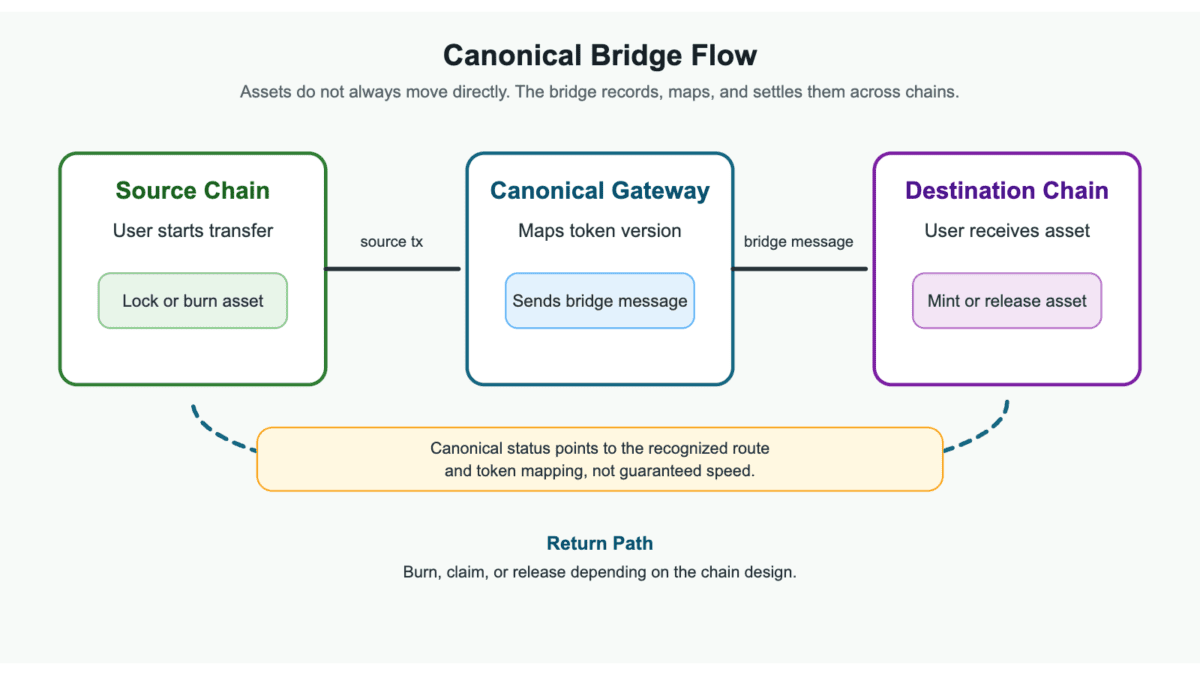
The flow often looks like this:
For ERC-20 tokens, the route may use gateways or token mappings. The bridge needs to know which source token corresponds to which destination token. That mapping is where canonical status matters: it tells wallets and apps which version is the standard one.
ETH can be simpler in some bridge flows because it may not need an ERC-20 approval. ERC-20 tokens often require an allowance before the bridge can move them. That approval is not just a button. It gives a contract permission to spend a specific token from your wallet.
Two checks matter after the asset lands:
Message passing is the quiet middle layer. The bridge has to tell the destination chain that the source-chain action happened. Some systems rely on rollup messaging. Others use gateway contracts, external verification, or liquidity layers.
The return path may differ from the deposit path. A deposit can feel quick, while a withdrawal follows a slower settlement or claim process. That asymmetry is normal on some L2s, and it is one reason the “official bridge” can surprise users.
A canonical bridge, fast bridge, aggregator, and centralized exchange route can all move value across chains. Each one changes the tradeoff. The best route depends on asset support, urgency, custody, KYC, fees, and the token version you need.
A bridge app may flatten these routes into one clean quote. The interface can hide the trust model. A route that looks faster may be using liquidity providers, solvers, swaps, or exchange custody instead of the chain’s direct bridge path.
| Route | What Changes For The User |
|---|---|
| Canonical Bridge | Usually follows the recognized chain route and standard token mapping, but may be slower or require a claim step. |
| Fast Bridge | Often fronts liquidity for speed, so timing improves while liquidity and solver risk may increase. |
| Bridge Aggregator | Compares routes in one interface, but the selected route still has its own contracts, fees, support limits, and failure path. |
| CEX Route | Can be practical when deposits and withdrawals are supported, but it adds custody, KYC, account limits, and platform policy risk. |
This table is not a ranking. A canonical bridge can be best for a large move where token version and settlement path matter. A fast bridge can be better for a small urgent transfer when the route is clear and liquidity is deep. An aggregator can save work, but only if it shows enough detail to evaluate the route.
Fees also show up differently by route. A canonical bridge may expose source gas, destination gas, withdrawal gas, and claim costs. A fast bridge may include a spread or liquidity fee. An exchange may hide part of the cost inside withdrawal fees, minimums, or timing.
The output matters more than the brand name. Confirm the destination chain, token contract, amount received, route type, timing, and refund or support path. If those details are fuzzy, reduce the size or wait.
Some canonical bridge withdrawals take days because the route follows the settlement rules of the source and destination chains. On optimistic rollups, that can include a challenge period before funds are final or claimable on the base chain.
The OP Stack Standard Bridge is the clean example. Optimism Docs list Ethereum-to-OP Mainnet Standard Bridge transfers at 1-3 minutes and OP Mainnet-to-Ethereum withdrawals at 7 days because of the challenge period. That delay is tied to settlement design, not a random support hold.
The experience can feel broken even when the route is working. Your L2 transaction may confirm, the bridge page may show progress, and the funds may still not be usable on Ethereum until the withdrawal window and final claim step are complete.
That creates a timing problem:
Not every canonical bridge has the same delay. Some deposits are faster than withdrawals. Some routes settle through different proof systems. Some chains have their own timing, pause controls, or interface rules.
For traders, the cost is not only gas. A long withdrawal can block crypto rotation when capital needs to move between chains, sectors, or risk levels. Seven days can be a strategy change, not a coffee break.
Plan exits before capital becomes urgent. If timing matters, compare the canonical route with a fast bridge, aggregator, or exchange route. Then decide whether the added speed is worth the added trust and liquidity assumptions.
Canonical bridge token versions are usually the assets a chain or token system recognizes as standard. Wrapped assets are representations created through another route or issuer. The ticker may look similar, but practical support can differ sharply.
This is where users get caught. A wallet may show the same asset name, while a DEX, lending market, or exchange deposit page rejects one version and accepts another. Same ticker, different contract. Crypto loves making simple words expensive.
Stablecoins make the problem easy to see. A destination chain may have native USDC, bridged USDC, USDC.e-style versions, or third-party wrapped stablecoins. Each can have different liquidity, issuer support, redemption path, and app support.
| Token Version | What To Check |
|---|---|
| Canonical Bridged Asset | Whether the chain, wallet, dapps, and exchanges use it as the standard version. |
| Native Issuance | Whether the token issuer directly supports minting and redemption on that chain. |
| Third-Party Wrapped Asset | Who controls the wrapper, where backing sits, and whether liquidity is deep enough. |
| Long-Tail Bridged Token | Whether there is real destination demand, not just a token contract that exists. |
Thin liquidity can turn the wrong token version into exit liquidity risk. You may receive an asset that arrived on-chain but trades badly, lacks lending support, or cannot be deposited where you planned.
Exchange support is another trap. A centralized exchange may support USDC on one network but reject a bridged version on another. Sending the wrong contract to an exchange deposit address can create a support case with poor odds and worse vibes.
Before bridging stablecoins or long-tail tokens, check the destination token contract and your planned destination app or venue. If a dapp, exchange, or wallet expects one version, do not assume a different bridge output is close enough.
With a canonical bridge, the risks are practical: the contract you approve, the URL you use, the token version you receive, the gas you need, and the claim step you may owe later. Canonical status does not remove those checks.
Bridge contract risk still exists. Bugs, upgrade controls, pause controls, or governance choices can affect transfers. A route can be recognized and still carry design risk.
Fake route risk is simpler and just as costly. Search ads, cloned frontends, fake support accounts, and copied bridge pages target users who are already anxious about moving funds.
Run these checks before signing:
Wallet-side mistakes deserve special attention. Approval amount, connected account, destination network, and claim readiness are wallet checks before they are bridge checks.
Stuck transfers are the panic layer. A bridge may be waiting on finality, a relayer, liquidity, a proof, or a manual claim. Before resending, check the source transaction, bridge status, destination explorer, and support page from the real route.
Use a small test when the amount matters. It costs extra gas. No, that is not fun. But a test transfer is often cheaper than discovering the wrong token version with your full stack.
Before you use a canonical bridge, confirm the route details while your money is still under your control. You do not need to become a bridge engineer. You need to avoid preventable mistakes before a signature makes them real.
Work through the checks in order:
Destination gas is easy to underestimate. A bridge can deliver the asset but leave you unable to claim, swap, repay, or move it because you lack the chain’s gas token. Tiny balances can also turn into dust in crypto after tests, claims, and leftover gas.
Do not skip the claim check. Some routes finish automatically. Others require you to return after a waiting period and submit another transaction. If the bridge page says prove, finalize, or claim, that step belongs to the transfer.
For larger moves, compare routes before you bridge. The canonical path may be the cleanest token route. A fast bridge may fit timing better. An exchange may be convenient if both networks are supported. Pick the route that matches the asset, size, urgency, and support path.
Concepts around a canonical bridge describe which route is recognized, how fast value appears, and what token version lands. Keeping those labels separate prevents a lot of wrong assumptions.
The useful split is route, speed, and asset version:
These terms are route clues, not status badges. Ask what each label changes for token support, custody, timing, fees, and the return path.
No, a canonical bridge is not always the safest bridge. The term means the route is recognized or standard for a chain, asset, or message path. It does not prove the contracts are bug-free, the frontend is real, or the route is best for your transfer.
A canonical bridge can reduce token-version confusion because it often maps to the standard destination asset. But users still need to check approvals, URLs, gas, claim steps, and chain-specific risks.
Canonical bridge and native bridge often overlap, but they are not perfect synonyms. A native bridge usually means the chain’s own route. A canonical bridge means the standard or recognized route for that chain or asset.
Some projects use native, official, standard, and canonical in slightly different ways. Check what the bridge controls: token mapping, message path, withdrawal route, or a specific app interface.
A canonical bridge withdrawal can take a long time because the route may follow the chain’s settlement or challenge process. On some optimistic rollups, withdrawals back to Ethereum wait through a dispute window before finalization.
That delay does not always mean funds are lost. Check whether the route shows pending, prove, finalize, or claim. If the timer has ended and no claim path appears, then move into troubleshooting.
A canonical bridge or wallet may say no route is available when the token, chain pair, liquidity, contract mapping, gas setup, or bridge interface is unsupported. It can also happen during downtime. Sometimes the wallet cannot find the exact token version.
Do not assume a route exists just because both tokens exist. Check the token contract, destination chain, supported assets list, and whether another official interface handles that route.
If a canonical bridge transaction is stuck, first check the source transaction hash. Then check the bridge status page, destination explorer, expected claim step, and any route-specific delay.
Do not resend blindly. A second transfer can create a new problem while the first one is still processing. Use only official support links, and never share seed phrases, private keys, or remote wallet access.
A canonical bridge should usually give the recognized token version for that route, but token-version confusion can still happen. The risk rises when a wallet, aggregator, dapp, or exchange expects a different contract.
Check the destination token contract before moving size. For stablecoins and wrapped assets, also check liquidity, issuer support, lending-market support, and exchange deposit rules.
Start by verifying the canonical bridge route, not by trusting the label. The word canonical tells you the route has recognized status. It does not finish the risk check for you.
The first move is boring and useful: identify the exact route you are about to use. A browser tab, wallet suggestion, aggregator quote, or social link is not enough by itself.
Then match the route to the job. A stablecoin move into a supported app has different needs from an urgent exit, a treasury transfer, or a long-tail token bridge where liquidity may vanish after the token lands.
Use this sequence before moving meaningful funds:
If the canonical route is slow, do not jump straight to the fastest button. Compare what the faster route adds: liquidity provider risk, solver risk, custody, KYC, spreads, or a different wrapped token.
If the token version is the main concern, favor clarity over speed. If timing is the main concern, compare the cost of waiting with the risk added by the faster route.
If neither route looks clear, wait. In bridge land, “I do not understand what lands” is a complete reason to stop before signing.
The cleanest bridge choice is boring in the right ways. You know what leaves, what lands, when it can be used, and what you must do if it does not land on time.