Physical Address
304 North Cardinal St.
Dorchester Center, MA 02124
Physical Address
304 North Cardinal St.
Dorchester Center, MA 02124


A practical wallet-safety guide to dusting attacks and spam tokens.
A dusting attack is when someone sends tiny amounts of crypto to wallet addresses so they can watch later movement, link addresses, or lure the wallet owner into a scam.
That does not mean your private key or seed phrase leaked. The danger usually starts after the transfer appears, when a user clicks a memo link, approves an unknown token, sells a fake asset, copies a poisoned address, or sweeps suspicious dust into a larger transaction.
A dusting attack in crypto sends a tiny amount of value to one or more wallet addresses so the sender can watch what happens next. The dust is the tiny amount. The attack is the attempt to turn that tiny transfer into tracking data, phishing bait, or a messy wallet-history trap.
Ordinary crypto dust can be harmless. It may be a leftover exchange balance, a tiny Bitcoin output, or a small amount left after fees. A dusting attack is different because it is unsolicited and meant to change what you do next.
The examples vary by chain:
The common thread is bait plus observation. The sender wants the wallet owner to spend, click, approve, claim, copy, or reveal more than they meant to reveal.
Chainlink explains dusting as a way to track later wallet movement and connect addresses. For a worried user, the plain answer is simpler: the tiny transfer is not magic access. It becomes dangerous when it changes your behavior.
After a dusting attack, slow down and avoid touching the suspicious asset. Receiving dust alone does not expose your seed phrase, but rushed cleanup can turn a small nuisance into a real wallet problem.
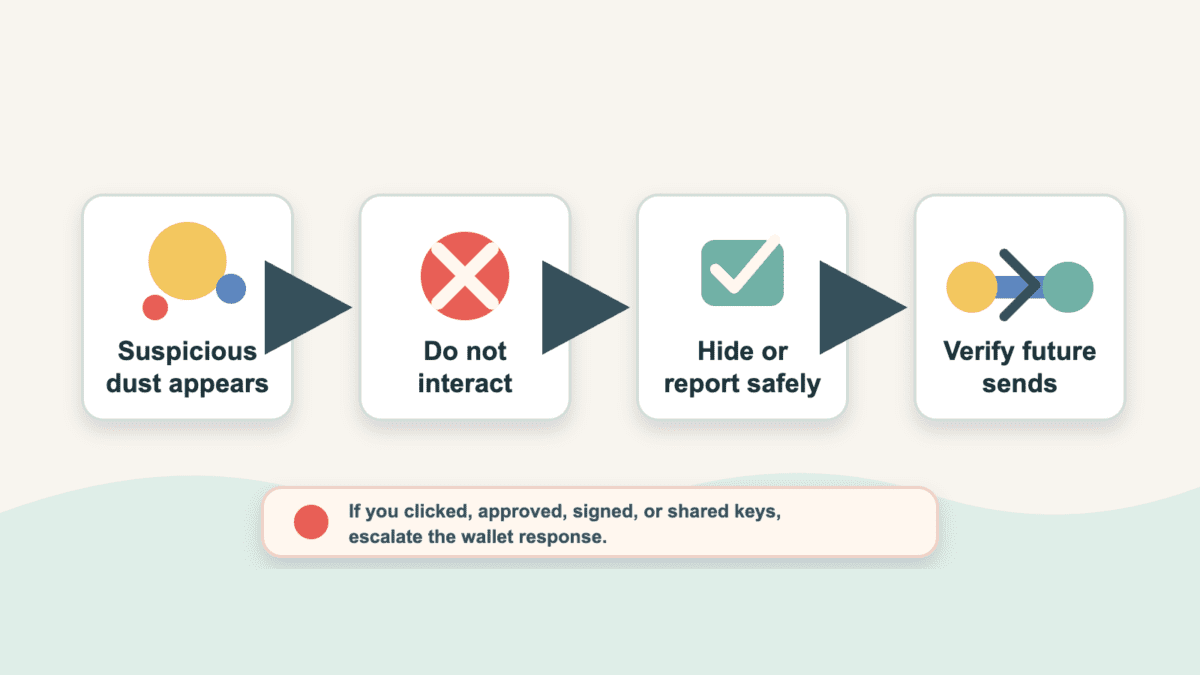
_The safest first response to suspicious dust is usually restraint, not cleanup theater._
Start with the boring answer. Boring is good here. Do not click links in token names, NFT descriptions, memo fields, transaction comments, explorer notes, or social DMs. Do not connect the wallet to a random site just to “remove” the item.
Use this response path before taking action:
The trap often appears after the first public question. Someone posts “is my wallet hacked?” and suddenly three strangers offer private help. That is not customer support. That is a second attack wearing a lanyard.
If you clicked a link, signed an approval, typed a seed phrase, or sent funds to a copied address, the problem has moved beyond a simple dust attack. Review approvals, move valuable assets only from a clean device and wallet flow, and use official wallet guidance.
If nothing was clicked or signed, the usual response is restraint. Hide the item, label it, and keep using clean address habits.
A dusting attack on Bitcoin-style chains works through UTXOs, which are individual chunks of spendable value. Your wallet may show one balance, but under the surface that balance can be built from many separate inputs.
If an attacker sends a tiny UTXO to your address, that dust may later get spent with your real funds. When several inputs are spent together, outside observers may infer that the inputs belong to the same wallet owner.
UTXO dust becomes useful to an attacker when it gets co-spent with other inputs. That does not prove identity by itself, but it can weaken address separation and make wallet activity easier to cluster.
The useful split is what you see versus what can leak:
| What the User Sees | What Can Leak |
|---|---|
| A tiny BTC, LTC, or DOGE input | The input may later link to larger wallet funds |
| One wallet balance in the app | The balance may contain many separate UTXOs |
| A normal send transaction | The send may combine suspicious dust with clean inputs |
| A cleanup or consolidation attempt | The cleanup may create more address-clustering data |
The table does not mean every tiny UTXO is malicious. It means a wallet action can change the risk. The dust sitting there is one thing. The dust joining a larger transaction is another.
Coin control lets advanced users choose which UTXOs to spend. In a dusting attack, that can help isolate suspicious dust from real funds.
But coin control is not a magic privacy button. Used badly, it can make a transaction expensive, confusing, or more revealing. If your wallet has a do-not-spend, freeze, or label feature, learn it before you need it.
For beginners, the safer habit is narrow: do not consolidate everything just because the wallet looks messy. If you use Bitcoin for long-term storage, keep public receiving habits clean and avoid sweeping suspicious inputs into a main balance without understanding the tradeoff.
A dusting attack on account-based chains often looks less like a Bitcoin UTXO and more like wallet spam. Ethereum, Solana, TRON, XRP, Stellar, and similar flows can show unknown tokens, NFTs, tiny stablecoin transfers, memos, or fake high-value assets.
The key difference is that these chains usually do not spend UTXOs the same way Bitcoin does. The risk is often phishing, approval abuse, malicious smart-contract interaction, a memo link, or address-history manipulation.
Spam tokens are random assets sent to make you interact. The token may display a huge value, a support message, a reward name, or a claim site. The value is often bait.
Do not try to sell an unknown spam token just because the app shows a tempting number. A fake token can point you to a malicious site, request a token approval, or lead you through a failed-swap scam.
Watch for these signs:
For account-chain scam overlap, MetaMask Support covers failed transaction scams where a tempting asset can push users toward malicious instructions. That overlap is why “free money” tokens deserve suspicion first and curiosity second.
Memo-heavy transfers can use text fields as bait. XRP, Stellar, and some stablecoin flows can show notes that look like refund instructions, customer support, or claim messages.
NFT spam can do the same thing with titles, descriptions, and images. The safest response is not to burn or transfer spam casually. If burning requires an interaction with an unknown contract, the cleanup may be riskier than the clutter.
Use the wallet’s built-in hide or report flow when available. If the wallet does not offer one, ignoring the item is often better than improvising with a random cleanup tool.
A dusting attack is often used as a broad label for several wallet problems. That is understandable. In the wallet app, they all look like “something random appeared in my wallet.” The safer response depends on what the sender wants you to do next.
Address poisoning is the big confusion point. In address poisoning, an attacker places a lookalike address in your transaction history and hopes you copy it later. The dust or zero-value transfer is the delivery method, not the whole scam.
| Wallet Problem | Safer Response |
|---|---|
| Dusting attack | Leave suspicious dust alone or isolate it with trusted wallet tools |
| Address poisoning | Verify the full destination address from the receive flow |
| Spam token | Hide or report it and avoid approvals, swaps, bridges, or links |
| Airdrop scam token | Do not claim, sell, or connect a wallet to unknown reward pages |
| Failed transaction scam | Stop after the failed action and ignore attached instructions |
| Ordinary leftover dust | Handle it like a small balance, not a panic event |
Scam tokens can also appear around risky projects, rugs, and exit traps. A fake reward may pull users toward late-entry behavior, where new demand funds someone else’s exit. Other spam is not about tracking at all. It is a wallet-drainer route or a shove toward a bad trade.
Do not memorize every scam name. Ask what action the transfer wants from you. If it wants a click, approval, copied address, seed phrase, or support DM, assume the risk sits in that next step.
A dusting attack cannot steal crypto by arriving in your wallet. The sender does not get your seed phrase, private key, or signing control from a tiny incoming transfer.
Loss usually comes from a follow-on action. The wallet owner clicks a fake claim link, signs a bad approval, copies a poisoned address, moves suspicious Bitcoin dust with real funds, or shares private recovery details with a fake support account.
The risky actions are specific:
Hardware wallets help protect private keys during signing, but they do not stop public addresses from receiving dust. A hardware wallet can still display a spam token, memo, or poisoned history entry.
That means the hardware-wallet question is mostly about discipline. Verify addresses on-device when possible. Read transaction prompts. Do not approve random contracts just because the keys are stored offline. A good lock still needs careful use.
Reducing dusting attack risk starts with cleaner wallet habits. You cannot stop every public address from receiving random transfers, but you can reduce what attackers learn and avoid the actions they want.
Self-custody and exchange accounts need different handling. In self-custody, you control addresses, keys, wallet features, and approvals. On an exchange, the platform controls the account ledger, supported assets, and internal dust handling.
Use these habits as a practical baseline:
| Habit | Why It Helps |
|---|---|
| Use fresh receive addresses where supported | Reduces address reuse and linking |
| Label wallets by purpose | Separates trading, testing, and storage activity |
| Verify the full address before sending | Reduces address-poisoning mistakes |
| Hide or report spam through wallet tools | Lowers visual clutter without risky interaction |
| Review token approvals | Finds old permissions that could become dangerous |
| Use coin control carefully | Helps isolate suspicious UTXO dust |
| Keep long-term storage separate | Limits damage from dApp and airdrop mistakes |
Wallet choice can shape those habits. Features like coin control, spam hiding, address labels, approval warnings, and clear receive screens make safer behavior easier. CryptoProcent’s wallets category is useful when wallet features, not yield promises, are the actual question.
For exchange accounts, use official support channels and account tools. Do not answer DMs that claim to be exchange staff. Do not invent tax treatment for random dust. And do not move funds only because a stranger says your account is compromised.
A dusting attack creates more noise for traders because active wallets already leave many links. If the same address touches exchanges, DEXs, bridges, airdrops, Telegram tips, long-term storage, and public screenshots, there is more context to connect.
High-churn wallet behavior is common in the crypto trenches, where users test tokens, chase launches, bridge funds, and reuse hot wallets. That is exactly where random spam, fake airdrops, and address-history tricks can hide in plain sight.
Use tighter trading-wallet hygiene:
Tax software can make dust feel bigger than it is. A random token may clutter imports, create unmatched records, or show a fake price. That is a recordkeeping problem first, not proof of income or a wallet hack.
Public wallet privacy changes the stakes. If a reused address connects to your identity, job, social account, or project role, dusting data can make a doxxed crypto trail easier to map. The fix is cleaner separation, not paranoia.
The most common dusting attack mistakes happen when users try to clean the wallet too fast. A tiny transfer feels wrong, so they click the nearest solution. That is the moment attackers are trying to buy with a few cents of dust.
Avoid these mistakes first:
That last mistake sounds harmless, but panic is expensive. It can lead to bad migrations, fake support chats, or rushed transactions that create the real loss.
The FBI said complaints involving cryptocurrency reached 181,565 in its 2025 Internet Crime Report. That is enough reason to read unsolicited wallet lures as a security prompt, not free money.
A related mistake is treating every spam token like a normal market asset. Some spam tries to make you someone else’s soft-rug exit path. Some tries to steal approvals. Some is just noise. None of it requires a heroic cleanup mission.
The cleanest rule is simple: if the asset arrived without request and asks you to act, do less. Verify more. Let the wallet be ugly for a bit.
Several nearby terms help explain why a dusting attack can look confusing. They separate tiny balances, scam paths, privacy leaks, and wallet behavior without forcing every wallet problem into one label.
Crypto dust is the broader tiny-balance concept. Some dust is harmless leftover value. A dusting attack is the hostile version that uses tiny value as a marker or lure.
Doxxed helps explain the privacy side. Dusting does not reveal a legal name by itself, but reused addresses, public screenshots, and social handles can make identity links easier.
Exit liquidity explains the market side of fake rewards and spam tokens. If a random asset pushes users into buying, claiming, or adding liquidity, ask who benefits from the action.
Hard rug and soft rug explain scam aftermath. They are not dusting attacks, but they help explain why fake tokens, wallet spam, and urgency can push users into someone else’s exit.
Living in the trenches explains why active traders see more wallet noise. More new tokens, bridges, and dApps create more chances for spam to blend into normal activity.
A dusting attack cannot steal your crypto just by sending a tiny transfer. The risk starts when you click a link, approve a contract, sign a bad transaction, share a seed phrase, or send funds to a poisoned address.
After a dusting attack, leave the suspicious asset alone and avoid links, claims, approvals, swaps, burns, and support DMs. Then hide, report, label, or isolate it only through trusted wallet features.
A dusting attack is not the same as address poisoning, but they can overlap. Dusting focuses on tracking or luring behavior, while address poisoning tries to plant a lookalike address in your history.
You usually should not burn, sell, or send away dust tokens after a dusting attack unless a trusted wallet flow makes the action clearly safe. Interacting with unknown tokens can be riskier than ignoring them.
A dusting attack affects Bitcoin and Ethereum differently. Bitcoin-style UTXO dust can create co-spending privacy risk, while Ethereum-style spam usually creates phishing, approval, or fake-token risk.
Hardware wallets do not stop dusting attacks because public addresses can still receive unsolicited transfers. They help protect keys, but users must still avoid bad approvals, links, and address-copy mistakes.
Start after a dusting attack by doing less, not more. The wallet may look messy, but the mess is safer than a rushed approval, suspicious burn, or copied address from a poisoned history line.
First, separate what happened from what you did next. Receiving a tiny transfer is one event. Clicking a claim link, signing an approval, or moving dust with real funds is a different risk level.
Use this order:
Then review what changed. If you only received dust, keep clean habits and move on. If you clicked, approved, signed, imported keys, or shared recovery details, escalate the response because the problem is no longer just dust.
For Bitcoin-style wallets, that may mean checking whether suspicious UTXOs were spent with larger funds. For account-based wallets, it may mean reviewing approvals and avoiding any site named in the token, memo, NFT, or explorer note.
A dusting attack is meant to make a tiny transfer feel urgent. Refusing that urgency is the first useful defense.