Physical Address
304 North Cardinal St.
Dorchester Center, MA 02124
Physical Address
304 North Cardinal St.
Dorchester Center, MA 02124


Finalized block meaning, risks, and user checks.
A finalized block is a crypto block accepted as settled by the network, so normal chain history should not change.
You will usually see this label when a wallet, explorer, bridge, exchange, or app wants to show more than “your transaction appeared somewhere.” Finality is about how hard it would be for the chain to rewrite that block, not whether the trade was wise, the bridge is liquid, or the token is safe.
A finalized block in crypto is a block the network treats as settled under its normal consensus rules. In plain English, the chain has moved past “we probably agree” and into “rewriting this should be extremely unlikely or economically irrational.”
That distinction is useful because blockchains can briefly disagree about the newest valid history. A short reorg can replace a recent block with another version. Finality is the point where that ordinary uncertainty has mostly passed.
That is why the label sits between technical status and user judgment. If your wallet says a transfer is included, the transaction has landed in the current chain view. If an explorer says the block is finalized, the chain is saying that block has passed its strongest normal settlement check.
That still leaves room for platform delays. An exchange can wait on its own deposit policy. A bridge can wait on proofs, relayers, or destination execution. Finalized block status answers the chain-history question first.
You may see a finalized block label in several places:
latest, safe, or finalized data.The exact guarantee depends on the chain. On one network, finality may mean enough confirmations have piled up. On another, validators have voted around a checkpoint and would lose money for trying to rewrite it. On an L2, the label may depend on the sequencer first, then the L1 later.
So a finalized block has crossed the network’s strongest normal settlement threshold. The newest block can still be too fresh for that.
A finalized block matters when you are about to act on a transaction. If a transfer is only pending or newly included, a wallet may show progress, but an exchange, bridge, or risk-sensitive app may still wait.
That wait is not always a bug. It is often the platform protecting itself from chain reorgs, bridge timing, suspicious deposits, or internal risk checks. Crypto loves instant labels. Settlement does not always share the enthusiasm.
Common places where transaction finality affects users include:
Say you send funds to an exchange. The transaction may appear in a block within seconds or minutes. The exchange might still wait for a stronger state before crediting your account, especially if the asset, chain, or deposit size increases its risk.
The same logic applies to bridges. A source-chain transaction can look included, while the bridge still waits for finality, proof submission, relayer action, or destination execution. Your screen may say “complete” for one step, while the whole route is still moving through its machinery.
Use finalized status as the stronger signal when one of these is true:
For small actions, a normal confirmation may be enough. For large transfers, bridge routes, liquidation-sensitive positions, or anything you cannot easily undo, a finalized block gives a cleaner signal.
A finalized block, a confirmed transaction, and a safe block are related confidence labels. They are not interchangeable names for the same thing.
The useful way to read them is as a ladder. Each step gives you more confidence that the transaction will stay in the chain history, though the names and thresholds can change by network, explorer, wallet, or RPC provider.
| Status Label | What It Means For The User |
|---|---|
| Broadcast | Your wallet sent the transaction, but it is not settled anywhere yet. |
| Pending | The transaction is waiting to be picked up or replaced. |
| Included Or Latest | The transaction appears in the current chain view, but recent history can still shift. |
| Confirmed | One or more later blocks make the transaction harder to replace. |
| Safe | The block is unlikely to reorg under normal conditions, but it may not be the strongest state. |
| Finalized | The chain treats the block as settled under its highest normal finality rule. |
This table is a map, not a universal policy. Some wallets only show pending and confirmed. Some RPC tools expose latest, safe, and finalized. Some exchanges use their own confirmation count instead of a visible finality label.
That split is plain-language shorthand. Chainlink’s CRE docs group blockchain reads into three confidence levels: latest, safe, and finalized, which is a useful reminder that tools may expose confidence as a setting, not a moral certificate.
That is why “confirmed” can be slippery. On Bitcoin-style chains, people often talk about confirmation depth. On Ethereum-style proof-of-stake chains, finalized has a more specific consensus meaning. On L2s, a sequencer-confirmed transaction may feel fast, while stronger L1-backed finality arrives later.
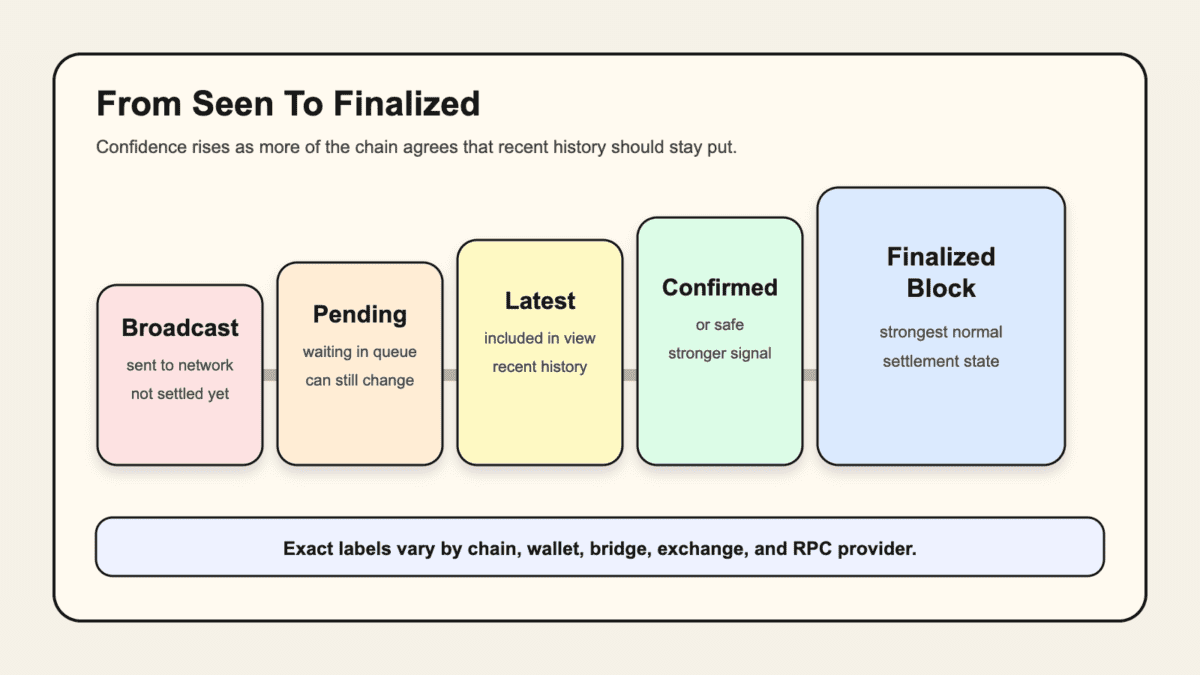
_A simplified confidence ladder for status labels. Real wallets, bridges, and RPC providers may use different thresholds._
A finalized block means different things across chains because chains use different consensus designs. The core question stays the same: how hard is it to change the accepted history after this point?
The broad models look like this:
Those models are not just branding choices. They decide whether finality comes from work piled on top of a block, validator votes, penalties, committees, or a separate settlement chain.
BFT-style finality can feel cleaner, but it still carries tradeoffs. Validator design, client diversity, network liveness, and governance assumptions all shape the real guarantee.
Block finality is not the same as block time. A chain can create blocks quickly and still need extra steps before the strongest settlement state. Fast blocks help user experience. Finalized blocks answer a narrower question: is this history settled enough to rely on?
That is the trap in many chain comparisons. “Final in seconds” may be true under one definition and incomplete under another. Always ask what became final, who finalized it, and what assumptions were needed.
An L2 finalized block can be confusing because an L2 can show fast progress before the transaction has the strongest settlement from the L1. The user sees movement, but several layers may still be doing their work.
Many rollups have a sequencer that orders transactions quickly. That can give users a fast, smooth experience. But the sequencer’s view is not always the same as fully published, proven, or finalized state on Ethereum or another settlement chain.
Here is the simple version:
| L2 Label | Plain Meaning |
|---|---|
| Sequencer Confirmed | The L2 has ordered the transaction quickly. |
| Unsafe | The transaction appears on the L2, but stronger backing is not complete. |
| Safe | The state is harder to rewrite, often because more data or L1 support exists. |
| Soft Finality | The app or chain treats it as done for normal use, with caveats. |
| Hard Finality | The stronger settlement path has completed. |
| L1 Finalized | The settlement layer has finalized the relevant state. |
OP Stack chains, Linea, and Blast use different language around transaction stages, but the user problem is similar. A bridge transfer can be sequencer-confirmed on the L2, published later, then depend on proof or settlement steps before the destination side is finished.
For a bridge transfer, split the route into pieces:
Imagine moving funds from an L2 to another chain. Your L2 wallet may show the transaction as included. The bridge may show a separate waiting step. The destination chain may show nothing yet.
None of those screens are necessarily lying. They are showing different parts of the route.
The practical takeaway is simple. For casual app activity, an L2’s fast status may be enough. For bridges, large transfers, or accounting, check whether the status is merely sequencer-level, soft-final, or backed by the final settlement layer.
Checking whether a block is finalized should be read-only. You can inspect status with a transaction hash, block explorer, wallet history, official bridge status page, or app status label without signing anything.
Start with the transaction hash. Paste it into a trusted explorer for the chain you used. Look for labels such as finalized, confirmed, safe, included, pending, or the number of confirmations. If the explorer has a block page, check the block status too.
Use a short safety workflow:
Basic wallet checks should help you read transaction history safely, not push you into a wallet connection. A status lookup does not need permission to move funds.
If an explorer looks stuck, do not assume finality is broken. The explorer may be lagging, the RPC provider may be slow, the chain may be producing blocks without finalizing, or the platform you use may be waiting on its own risk system. During delays, avoid sending the same transaction again unless you understand nonce replacement, fee rules, and the chain’s transaction model.
A finalized block guarantees less than many users assume. It settles chain history under the network’s normal rules. It does not bless the trade, the counterparty, the token, the bridge route, or the app.
This is where finality can create false comfort. A bad transaction can be permanently included. That makes it settled, not smart.
Finality works more like a receipt than a quality stamp. The network can confirm that an action happened, even when that action approved a risky contract, entered a thin market, or started a bridge route that still has more steps ahead.
After the block settles, the remaining problems move elsewhere. They may sit in venue policy, liquidity, contract design, project behavior, or the next chain in the route.
A finalized block does not guarantee:
For thin tokens, finality can simply confirm that your buy happened. It does not solve exit liquidity risk if later buyers never show up or order books are shallow.
Other risks sit outside block finality too:
So use finalized blocks as settlement evidence. Do not use them as investment research, scam screening, or bridge-completion proof by themselves.
Finalized block claims need careful reading because crypto marketing often compresses several states into one shiny speed claim. “Final in seconds” sounds simple. The details decide whether that phrase helps you or just starts another chain argument.
When a chain, app, or investor thread talks about fast finality, ask what is actually final. Is it a transaction ordered by a sequencer? A block accepted by validators? A state root published to an L1? A bridge message ready to execute? Those are not the same promise.
Use this checklist before trusting the claim:
Finality speed can support a conviction play only when it fits a wider thesis. You still need liquidity, uptime, decentralization, developer activity, app demand, custody paths, and sane risk limits.
Also watch the difference between finality and user access. A chain may finalize quickly while an exchange delays deposits. An L2 may feel instant while withdrawals take longer. A bridge may complete the source side before the destination side is useful. Trust specific status labels, official route information, and your own risk threshold more than speed slogans.
A finalized block in crypto is a block the network treats as settled under its normal consensus rules. It is stronger than a pending transaction, a latest block, or a basic confirmation. The exact guarantee depends on the chain. On some chains, finality builds through more confirmations. On others, validators vote and face penalties for trying to rewrite finalized history.
No. A confirmed transaction has been included in a block and supported by later chain activity, but that does not always mean it has reached the strongest finality state. A finalized block is usually a higher-confidence status. The confusion comes from wallets and exchanges using different labels. One platform may say confirmed, while another waits for finalized before crediting funds.
A finalized block is designed not to reverse under normal conditions. Reversal would usually require an extreme failure, a very costly attack, or a social-layer intervention on chains with strong finality rules. That is why finality is the strongest normal settlement signal for users. But “finalized” is still chain-specific. It reduces routine reorg risk. It does not make every possible disaster impossible.
Ethereum can include a transaction before the chain reaches finality around the relevant block. Inclusion happens first. Finality requires validator agreement around checkpoints and enough time for that process to complete. That is why an Ethereum transaction can look confirmed while a cautious exchange, bridge, or app still waits for finalized status before relying on it for higher-value actions.
An L2 finalized block can depend on Ethereum when the L2 uses Ethereum as its settlement layer. The L2 may order transactions quickly through a sequencer, then publish data, proofs, or state commitments to Ethereum. A wallet or app may show the L2 step as done before the strongest Ethereum-backed settlement is complete. For bridges, that difference can affect waiting time.
Faster finality can improve user experience, trading workflows, and some app designs. It does not automatically make the asset safer to buy. A finalized block says the chain history is harder to rewrite. It does not prove the token has demand, the bridge is liquid, the app is secure, or the team is trustworthy. Finality is infrastructure evidence, not a buy signal.
Start with the transaction hash, not a support link. Paste it into a trusted block explorer for the correct chain and read the status label. If the transfer involves an exchange or bridge, compare the on-chain status with the platform’s own deposit, withdrawal, or route page.
For larger transfers, wait for stronger settlement than you would for a tiny test. A finalized block is especially useful when value is high, when a bridge is involved, or when a downstream app will act on the result.
If the labels disagree, slow down and separate the jobs. The explorer tells you what the chain sees. The exchange page tells you when the venue will credit funds. The bridge page tells you whether the cross-chain route has finished every step.
A finalized block should raise your confidence in chain history. Your next move still depends on size, timing, route risk, and how hard the action would be to unwind.
Use these habits before you move on:
The main point is not to memorize every consensus model. It is to know which label you are looking at, what it can still miss, and when waiting is cheaper than fixing a rushed mistake.
Keep the hash, chain name, and platform status together if you need support later. That gives you a clean record without clicking random help links, signing a “verification” message, or sending another transaction just because one screen is slow.