Physical Address
304 North Cardinal St.
Dorchester Center, MA 02124
Physical Address
304 North Cardinal St.
Dorchester Center, MA 02124

House money in crypto without the fake-profit trap.
House money in crypto is profit or a remaining position you treat as lower-risk after recovering your original stake.
The phrase can make profit-taking feel calmer because you have pulled back the money you first put at risk. But it can also make real money feel fake. That is where a clean exit plan turns into chart therapy with extra steps.
Here, house money means trading profits and the house-money mindset, not buying a physical house with crypto.
House money in crypto usually means the part of a winning position left after the trader has recovered the original stake. Crypto traders also use it for realized profit they feel comfortable redeploying because the starting capital is already back in their hands.
The second use is where the phrase gets slippery. The money did not come from an actual house. It came from a trade. Someone bought, someone sold, and the trader owns the result. Calling it house money may reduce stress, but it does not remove ownership.
In practice, the phrase usually points to three related ideas:
Suppose you buy $100 of a token and it rises to $350. If you sell $100, your original stake is back. The remaining $250 position is often called a runner.
That is the useful version. If the runner goes higher, you still benefit. If it crashes, you have protected the starting stake before taxes and fees.
The dangerous version starts when the trader treats the remaining $250 as disposable. That runner could still become rent money, tax money, or a better long-term holding. Crypto does not care that the profit came quickly. Fast money can disappear at the same speed, usually with worse screenshots.
> The money still belongs to the trader after the label changes.
So the plain meaning is simple: house money is a mental label for profit after one risk has been reduced. It is not a safety guarantee.
House money works only after a real action changes the trade. A portfolio app showing an unrealized gain does not count. Until you sell, swap, withdraw, or otherwise lock in part of the value, the market can take back the whole move.
This distinction is easy to miss in crypto because prices update every second. A token can be up 4x on screen, but the gain may depend on thin liquidity, wide spreads, gas costs, or whether a buyer is actually there. Paper gains feel good. Realized gains change your risk.
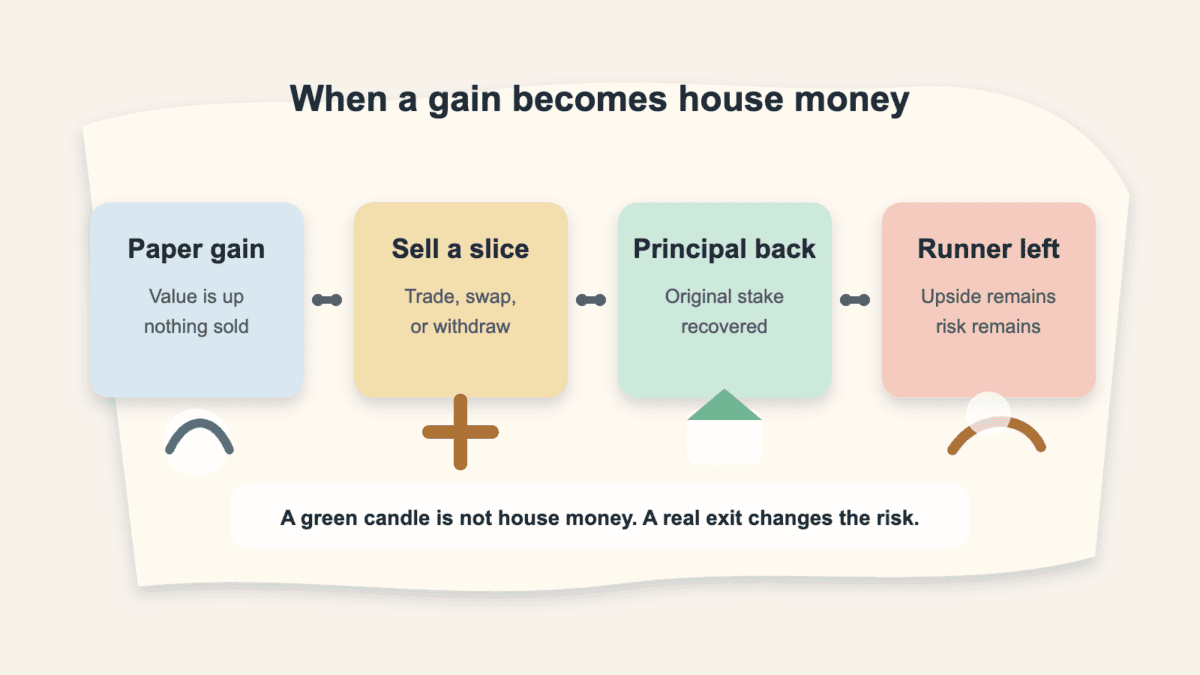
Use these four states to keep the language honest:
| Money State | What It Means |
|---|---|
| Paper Gain | The position is up, but nothing has been sold yet. |
| Recovered Cost Basis | You sold enough to get your original stake back. |
| Realized Profit | You sold gain into fiat, stablecoins, or another asset. |
| Remaining Runner | You still hold part of the position for possible upside. |
Each state creates a different problem. A paper gain needs an exit plan. A recovered cost basis needs clean records. Realized profit needs a place to sit. A remaining runner needs a sell rule, because “let it ride” is not a plan by itself.
After you sell, the risk moves to the next choice. Fiat can reduce crypto exposure, but it may require an exchange withdrawal and bank access. Stablecoins keep funds inside crypto, but they add issuer, chain, wallet, and exchange risks.
Leaving the runner in the same token keeps upside open. It also keeps you exposed to the same drawdown that made you think about selling. A useful house-money move is usually boring: sell a defined slice, record the transaction, decide where the proceeds go, and write down what would make you sell more.
The house money effect changes crypto trader behavior by making fresh profit feel less personal than the cash first deposited. After a good trade, the next risk can feel easier than it really is.
The house-money effect is a behavioral bias where people take more risk after prior gains. In crypto, the bias gets extra fuel from fast price moves, screenshots, group chats, and bull-market feedback loops.
Crypto gives the bias plenty of room. In its 2025 consumer research, the FCA found that 62% of UK cryptoasset users said their holdings had increased in value from initial purchase to August 2025.
The danger shows up when a trader turns a real win into a looser second trade. A recovered stake can reduce one kind of downside. It cannot make the next entry smarter, more liquid, or easier to exit.
Watch for the bias when a winning trade changes the next decision:
Mental accounting is the core problem. A trader may protect the first $500 with care, then risk $500 of profit on a smaller, thinner token because it feels like a bonus round. The account balance draws no magic line between “my money” and “profit money.” The market sees no line either.
Low-liquidity tokens make the effect sharper. A position can look profitable on a chart while the real exit would move price against the seller. A trader who thinks they are playing with house money may hold too long, then discover that the gain was easy to mark and hard to realize.
The bias is not always dramatic. It can show up as buying a larger dip than planned, adding borrowed exposure after a win, or rolling gains into whatever coin the timeline is yelling about. The phrase needs a guardrail: house money can describe a reduced-risk position, but it should not become permission to ignore sizing, liquidity, or the reason the trade existed.
Playing with house money can help in crypto when it turns a vague profit wish into a clear partial-exit rule. The useful version starts before the pump, not after the chart has already gone vertical.
A trader might decide to sell one-third after a double, recover principal after a 3x, or leave a small runner only if the original thesis remains intact. That runner can be a real conviction play when it still has a reason to exist beyond “number went up.”
Healthy house-money thinking usually has a few traits:
This approach can reduce panic. If a trader has already recovered principal, they may be less tempted to smash every sell button during normal volatility. That calm has value, especially in assets where 20 percent moves can arrive before lunch.
But calm is not the same as carelessness. A house-money runner still needs limits. If the remaining position has become too large for the trader’s portfolio, or if the original reason for buying has broken, recovered principal does not remove the need for a new decision.
House money thinking hurts crypto investors when profit starts feeling like fake money. That is when a sensible partial exit becomes a license to chase worse trades, ignore costs, and mistake luck for skill.
The common trap is a round trip. A trader buys early, watches the token run, refuses to sell because it is “only house money,” then rides the position back toward the entry. If the trade keeps falling and the trader still cannot exit, they may become a bagholder with a better origin story.
> If you have not sold, it is not house money yet.
The next trap is redeployment. After one win, a trader may roll profits into a lower-quality token, a perp position with borrowed exposure, or a meme coin with weak liquidity. The original trade may have been decent. The follow-up trade may be pure adrenaline with a ticker.
Before rolling profits forward, ask what changed:
Taxes and execution costs can make the label even messier. Selling may create a taxable event depending on where the user lives. Swaps can include spreads, gas, platform fees, and slippage. A trader who ignores those frictions may overestimate how much house money they really have.
Exit quality can change the whole outcome. If the remaining runner depends on late buyers arriving after earlier holders have already sold, the trader may be standing near exit liquidity rather than sitting on a clean win. None of this means every runner is foolish. It means the label should get stricter after profit, not looser.
House money changes by crypto asset and situation because not every position carries the same risk. A Bitcoin allocation, a meme-coin flip, a perp trade, and a staking position each need their own house-money rule.
Core holdings like Bitcoin or Ethereum often sit inside a broader allocation plan. Selling enough to recover principal may reduce stress, but it can also shrink long-term exposure the trader actually wanted. With major assets, the question is often allocation, not just profit-taking.
Here is a simple way to separate the situations:
| Situation | House-Money Check |
|---|---|
| Bitcoin Or Ethereum Core Holding | Does selling fit the portfolio plan, or just a short-term fear? |
| Speculative Altcoin Runner | Is liquidity deep enough to exit without crushing the price? |
| Meme-Coin Trade | Has principal been recovered before hype and volume fade? |
| Perp Trade | Could funding, fees, or liquidation erase the gain quickly? |
| Staking Or Yield Position | Do token price, lockups, custody, and rewards still justify the risk? |
| Stablecoin Parking | Are issuer, exchange, chain, and wallet risks understood? |
Speculative alts and meme coins are different. In the meme-coin trenches, speed, liquidity, insider supply, and social momentum can change the trade in minutes. Recovering principal early can protect a trader from turning a lucky entry into a full round trip.
The same label can hide very different exposures. A spot runner can fall to zero, but it cannot liquidate the rest of the account unless the trader adds borrowed exposure. A perp position can turn “house money” into a margin-call problem quickly. Yield positions add another layer because distributions may recover principal while the underlying token keeps dropping.
Airdrops, farming, and stablecoin parking need the same honesty. Tokens received for little direct cost still have market value once claimable. Funds parked in stablecoins may sit on an exchange, in self-custody, on a chain with bridge risk, or in a stablecoin with depeg risk.
A practical house money checklist starts with one blunt question: have you actually sold enough to change the risk? If the answer is no, you have a gain on screen, not recovered capital.
After that, the checklist should cover the boring details that traders often skip during a win. Boring details are where profits stop being a vibe and start becoming money you can use.
Before you call a crypto position house money, check these points:
Custody deserves its own line. If profits move off an exchange, the trader needs a wallet setup they understand. If profits stay on an exchange, they accept platform and account-access risk. A basic review of crypto wallets can help frame that choice without turning the article into a hardware-wallet lecture.
The checklist should also include taxes and records. This is not tax advice, and rules vary by jurisdiction. Still, a trader should record sale dates, amounts, fees, and proceeds. The difference between “I took profits” and “I know what I sold” becomes obvious when reporting season arrives.
Finally, decide whether the runner still deserves capital. If the only argument is that it came from profit, the argument is weak. If the trade still has liquidity, size control, and a clear reason to exist, house money can be a useful label.
No. House money in crypto is not risk free, even after you recover your original stake. The remaining position can still fall, lose liquidity, get trapped in a risky venue, or create tax and custody work.
Recovering principal can reduce regret and protect the starting stake. It does not make the remaining coins fake, free, or immune to bad decisions.
Not exactly. House money is usually profit or a remaining position that a trader mentally separates after recovering principal. Crypto profit is broader, and it can be realized or unrealized.
If the gain exists only on screen, it is still a paper gain. It becomes realized profit only after a sale, swap, or withdrawal locks in value.
Taking out your initial investment in crypto can be sensible when the position has grown enough and the sale fits your plan. It can reduce downside to your starting capital and make a remaining runner easier to hold.
But it is not always the right move. Long-term holdings, taxes, fees, and portfolio goals can change the answer.
House money can apply to Bitcoin, Ethereum, altcoins, meme coins, yield positions, and airdrops. The risk is different in each case, so the same rule should not be copied blindly.
With Bitcoin or Ethereum, selling may be about allocation. With small alts or meme coins, recovering principal may protect against a fast liquidity fade.
The house money effect in trading is the tendency to take more risk after prior gains. Traders may feel that profits are less painful to lose than their original capital.
In crypto, that can lead to larger entries, looser stops, more borrowed exposure, or rolling gains into thinner tokens. A written sell plan helps keep the bias visible.
House money after selling crypto can sit in fiat, stablecoins, another crypto asset, or a wallet, depending on the trader’s goals and risk tolerance. Each option has tradeoffs.
Fiat can reduce crypto exposure. Stablecoins can keep funds ready for another trade. Wallet custody adds control, but it also adds responsibility.
Start with a written rule before the next trade gets noisy. House money works best when it is a profit-taking plan, not a phrase invented after a token has already pumped.
Set the rule in plain numbers. Decide what counts as principal recovery, what counts as realized profit, and how large the remaining runner can become before you trim again.
Then decide where the recovered money goes. Fiat may lower crypto exposure. Stablecoins may keep funds ready for another trade. A wallet may give more control, but only if you can manage keys, networks, and backup steps without guessing.
Also set a failure condition. If liquidity thins, the thesis breaks, or the runner grows past the planned size, the house-money label should not block another sale. Profit-taking is still a decision, not a souvenir.
These next actions keep the idea useful:
Then respect the result. If the runner fits your plan, let it run with open eyes. If it only exists because the word “house” makes a trade sound cheaper, cash it out and rethink the position.