Physical Address
304 North Cardinal St.
Dorchester Center, MA 02124
Physical Address
304 North Cardinal St.
Dorchester Center, MA 02124


Understand leverage loop risk before adding debt.
A leverage loop is a DeFi borrowing cycle that redeposits borrowed funds to increase crypto exposure or yield while adding liquidation risk.
The loop can look clever because each round makes the collateral column bigger. But the debt column grows too, and the safety buffer usually gets thinner.
That is why Aave looping and similar DeFi strategies need more than an APY glance. After a few rounds, yield can start looking less like income and more like a liquidation appointment with better branding.
A leverage loop in crypto is a repeated DeFi lending pattern: deposit collateral, borrow against it, redeploy the borrowed asset, then deposit again. The goal is usually more exposure, more yield, or both.
The trade-off is simple and unforgiving. Each round adds debt.
That makes a leverage loop different from normal staking. Staking uses an asset to earn network or protocol rewards. A loop uses borrowing to make the position larger. It also differs from a one-click exchange margin trade because lending-market rules control the risk: collateral value, loan-to-value, liquidation threshold, and health factor.
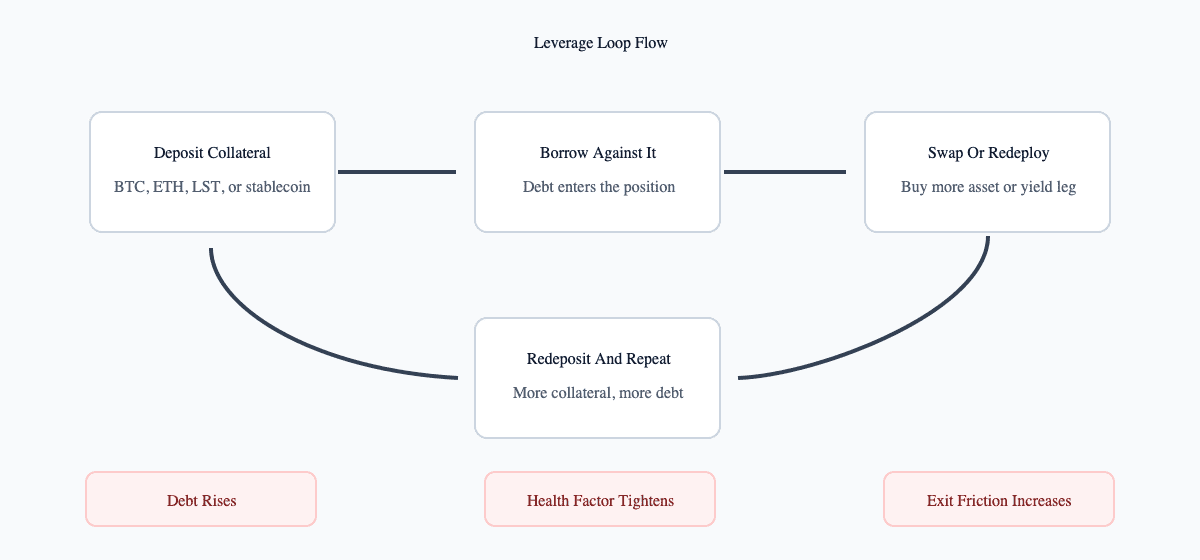
The basic loop has four moves:
The result can be a larger long position. It can also be a yield-spread trade, such as borrowing one stablecoin and supplying another higher-yielding asset. In ETH markets, it may mean depositing an LST, borrowing WETH, buying more of the LST, and repeating.
None of that makes it an infinite money glitch. The loop creates a larger position by stacking debt on top of collateral. If collateral drops, debt rises in value, the yield spread flips, or the exit gets crowded, the protocol does not care how elegant the spreadsheet looked.
The cleaner term is recursive borrowing in crypto. Recursive is the key word: one borrow creates the next collateral deposit, and that deposit supports the next borrow.
A crypto leverage loop works by turning one collateral deposit into several linked borrowing rounds. The position becomes bigger because borrowed value is recycled back into the same trade. It also becomes more fragile because the account has less room before liquidation.
The dashboard usually changes after every round. Collateral value rises because more assets are supplied. Debt rises because more assets are borrowed. The health factor, LTV, or risk score usually tightens because the account has taken on more liabilities relative to its buffer.
Here is the clean version of what changes:
| Loop Step | What Changes |
|---|---|
| Deposit collateral | The protocol recognizes an asset that can back borrowing. |
| Borrow against it | Debt appears, and the account now has a liquidation line. |
| Swap or redeploy | The borrowed asset becomes more exposure, yield collateral, or a different leg. |
| Redeposit and repeat | Collateral and debt both grow while the safety margin shrinks. |
Fees and slippage matter at each turn. If you swap borrowed stablecoins into ETH, you pay trading costs. If you redeposit through a busy chain, gas can eat part of the expected spread. If the loop uses several protocols, smart contract risk now spreads across several places, not one.
Recursive borrowing in crypto also gets riskier by the round. A position that looks calm at two loops may become touchy at five. One more loop can change the position from “wide buffer” to “please keep the market polite.” Markets are famously bad at that job.
The dashboard can hide that shift because the position still looks like one account. Under the surface, it may contain several implied rounds of the same trade.
Traders use a leverage loop because it can turn one asset base into a larger position, a yield-spread trade, or a reward-farming setup. Those motives create different trades. Mixing them together is how people talk themselves into risk they did not mean to buy.
The main motives usually fall into a few buckets:
The failure point changes with the motive:
Sort that out before the wallet becomes a personal credit desk. The mistake is reading every loop through the same APY number. A directional BTC loop lives or dies by BTC price and stablecoin debt. A leveraged staking loop lives or dies by staking yield, borrow costs, LST liquidity, and the relationship between the collateral token and ETH. A stablecoin loop may care less about candles and more about rates, peg confidence, issuer risk, and reward schedules.
So “why am I looping?” has to come before “how many times?” If the motive is long exposure, the user needs a loss boundary. If the motive is yield spread, the user needs net math. If the motive is rewards, the user needs to know whether those rewards are liquid, vested, delayed, or speculative. A loop without a clear motive is just borrowed complexity.
A leverage loop can lose money when collateral value, debt value, rates, liquidity, or protocol rules move against the position. Liquidation is the obvious failure. It is not the only one.
The core liquidation path is simple. Collateral no longer covers the borrowed value with enough buffer, so the protocol can sell or seize collateral to repay debt. On platforms that show a health factor, a lower number means less room. Once the account crosses the protocol’s danger line, liquidators can act.
> Warning: a leverage loop can fail even when the original idea still sounds reasonable. The protocol liquidates the account state, not the story behind it.
Rate changes are one quiet killer. A stablecoin loop may look profitable when the supply APY is higher than the borrow APR. If borrow demand rises or rewards fall, positive carry can become negative carry. The trade then bleeds while still looking stable on the asset-price chart.
Correlated assets can break too. ETH and wstETH may usually move together. Stablecoins may usually trade near a dollar. But “usually” is not collateral. Depegs, redemption stress, oracle pricing, thin liquidity, and protocol parameter changes can all push a loop toward liquidation. In a May 2026 Aave V3 Core snapshot, Galaxy Research found e-mode borrowers had a debt-weighted health factor near 1.05. That leaves little room for correlated-collateral loops when rates, oracles, or peg relationships move.
The less dramatic losses still count:
Stable-looking versions of the trade may simply move the risk from price volatility to rates, peg quality, issuer risk, liquidity, and protocol controls. That is a quieter room, not a safer house.
Unwinds also deserve more attention than entry screens. Opening a loop can be one clean transaction. Closing it may require repaying debt, swapping assets, withdrawing collateral, and repeating those steps while everyone else is trying to do the same thing. If liquidity is thin, the exit price can be worse than the dashboard estimate. Liquidation penalties add another hit because a forced sale is not a tidy rebalance.
Leverage loop examples are useful only if they show what debt is being added and what can break. They are not recommendations. Use them as map pins, not invitations.
Start with the risk map:
| Loop Type | Main Risk To Check |
|---|---|
| BTC directional loop | Collateral drop against stablecoin debt. |
| ETH or LST loop | LST depeg, borrow-rate change, or oracle stress. |
| Stablecoin loop | Borrow APR, peg quality, and reward durability. |
| Pendle PT or yield-token loop | Maturity, liquidity, and pricing risk. |
| Automated loop | Hidden leverage and unwind assumptions. |
Read the examples in plain terms:
Other versions move the weak point into quieter places:
If an example cannot answer “what do I owe, what backs it, and how do I leave,” it is not ready for real money.
Compare examples by the first thing that can break, not the advertised APY. For BTC loops, that may be price. For LST loops, it may be peg, liquidity, or oracle stress. For stablecoin loops, it may be rates or redemption confidence. For automated loops, it may be the user’s belief that fewer clicks mean less risk.
Margin trading, staking, crypto-backed borrowing, and leverage loops can all carry risk. The mechanics and failure points differ.
Margin trading usually gives a trader a direct leverage setting on an exchange or derivatives venue. Perpetual futures can show liquidation, funding, and position size in one trading interface. A DeFi leverage loop uses lending-market collateral and debt. The risk lives in collateral rules, borrow rates, oracle pricing, liquidity, and the number of recursive rounds.
Compare the main differences:
| Compared With | What Changes |
|---|---|
| Margin or perps | Leverage comes from a trading venue instead of recursive lending. |
| Normal staking | Staking earns rewards without automatically adding borrow debt. |
| Liquid staking | The token may stay liquid, but a loop adds collateral and debt rules. |
| Collateralized borrowing | A plain loan may stop at one borrow instead of repeating. |
| Fixed-yield products | Yield may look defined, while loop debt can still move. |
Normal staking is cleaner. A user locks or delegates an asset to earn rewards. There may be slashing, lockup, liquidity, or protocol risk, but staking alone does not automatically create a debt leg. A loop that uses staking tokens adds borrowing on top.
A plain crypto-backed loan can also be dangerous, but it is not always a loop. Borrowing once against BTC to access stablecoins is collateralized borrowing. Borrowing, buying more collateral, and borrowing again is the loop. A conviction play still needs a loss boundary, and a loop turns that boundary into a lending-market calculation. With perps, watch margin and funding. With staking, watch validator or token risk. With a leverage loop, watch collateral, debt, rates, health factor, liquidity, and the exit route.
Evaluate a leverage loop by checking the debt path before the yield path. If the downside cannot be described in plain English, the strategy is too complex for the position size.
Start with the dashboard terms. Find the health factor, LTV, liquidation threshold, liquidation penalty, borrow APR, supply APY, and incentive rewards. Then ask what changes if collateral falls, debt rises, rewards end, or the borrow rate doubles.
The checklist should be boring enough to save you money:
Do not rely on one safe-looking LTV number from a thread. Protocol parameters change, assets differ, and e-mode or correlated-asset settings can create tighter assumptions. Safer loops usually look less exciting because the buffer is larger. That is the rent you pay for not being liquidated by a normal market wobble.
Two final checks sit outside the calculator:
Rate history deserves its own look. A borrow APR that is cheap today may not stay cheap after utilization rises. A supply APY that looks rich may be temporary incentives, points, or a short-lived market imbalance. If the loop only works under one friendly rate snapshot, it is not a strategy. It is a screenshot with debt attached.
Alerts are part of the position too. A user should know which app, wallet, or monitor will warn them when health factor drops, collateral depegs, borrow APR jumps, or liquidity disappears. Without alerts, the loop becomes a part-time job that sends no calendar invite.
Leverage loops are a poor fit for users who cannot monitor positions, explain liquidation, or handle a forced exit without panic. They are also a poor fit for anyone attracted mainly by a headline APY.
Beginners should avoid loops until borrowing dashboards feel boring. That means understanding collateral factors, debt assets, liquidation thresholds, interest rates, and repayment. If those terms still blur together, the loop will not teach gently.
Several groups should be extra cautious:
Full-wallet sizing makes the problem worse. Going full port into a loop means the same market move can hit collateral, debt, and emotional control at once. That is not a strategy. It is a stress test with a wallet attached.
A leverage loop can be a useful advanced tool, but it is not a beginner shortcut. The users best suited to it already know what they will do when the trade stops working.
There is also a temperament test. If a user cannot sleep while a borrow position is open, adding more recursive debt will not improve that.
No. A leverage loop uses DeFi lending markets, collateral deposits, borrowing, and redepositing to create larger exposure. Margin trading usually uses an exchange or derivatives venue with a direct leverage setting.
The user monitors different risks too. Margin traders watch margin, funding, and liquidation price. Loop users watch collateral value, debt value, borrow APR, health factor, oracle pricing, liquidity, and unwind routes.
Yes. Correlation can reduce one type of price risk, but it does not remove liquidation risk. A depeg, oracle change, borrow-rate move, liquidity problem, or protocol parameter change can still push the loop into stress.
This is why ETH-linked and stablecoin-linked loops still need buffers. The assets may usually move together, but liquidation only needs the relationship to break at the wrong time.
A leverage loop can produce income if the yield or rewards exceed borrowing costs and execution costs. But it is not passive in the normal sense. It needs monitoring, alerts, rate checks, and a clear exit plan.
The word income can also hide exposure. A staking loop, for example, may boost staking-linked rewards while also increasing ETH-linked risk and debt sensitivity.
Rising borrow rates can reduce or erase the spread that made the leverage loop attractive. If the debt side grows faster than the collateral side earns, the position can lose money even without a major price move.
Then the user has to decide whether to repay, unwind, add collateral, or accept negative carry. Waiting can make sense only if the buffer and the thesis still hold.
Stablecoin looping may have lower price volatility than a BTC or ETH loop, but it is not automatically safe. Borrow rates can rise, supply yields can fall, stablecoins can depeg, and exits can get crowded.
It is usually a rates, peg, issuer, and liquidity trade. That can be calmer than directional crypto leverage, but calm is not the same as protected.
No. Automated tools can bundle transactions, reduce manual steps, or help manage a position. They cannot remove collateral risk, debt risk, oracle risk, rate changes, or liquidation rules.
Automation can make entry cleaner and monitoring easier. It can also make a complex position feel too simple. The debt remains real either way.
Start with the protocol’s liquidation terms, not the yield number. If you cannot explain how the position gets liquidated, you are not evaluating the loop. You are admiring the dashboard.
Then work through the trade with no money or a tiny simulated size. The goal is to learn how the health factor, LTV, borrow APR, and collateral value respond. Do not increase size because the first screen looks clean.
For an Aave-style loop, that means watching what happens after each borrow, swap, and redeposit. The useful lesson is not whether the first round works. It is how quickly the buffer tightens when the same move repeats.
Use a short action list before any real position:
After that, write down the exit in plain English. Which asset gets sold or swapped first? Which debt gets repaid? What happens if gas is high, liquidity is thin, or the collateral token trades below its usual relationship? If the answer depends on calm markets, build a bigger buffer or skip the trade.
The same rule applies to automated tools. Fewer clicks can reduce setup mistakes, but they do not make liquidation math kinder. A one-transaction entry still needs a manual backup plan if the tool, chain, or market is stressed.
Skip the loop if the downside only makes sense after three explanations and a calculator. Crypto already offers enough ways to be wrong. You do not need to borrow extra ones.