Physical Address
304 North Cardinal St.
Dorchester Center, MA 02124
Physical Address
304 North Cardinal St.
Dorchester Center, MA 02124


Understand LRTs before chasing restaking yield.
A liquid restaking token (LRT) is a transferable crypto token that represents a restaked position while the underlying asset earns possible restaking rewards.
That sounds tidy until you inspect the stack. An LRT can sit above ETH, a liquid staking token, a restaking protocol, an operator, an AVS, a bridge, and a DeFi lending market. One token can hide a surprising amount of plumbing.
Start with the useful question: what do you actually hold, what backs it, and how can you get out? Keep the focus on the token in your wallet, not the yield button trying to look harmless.
A liquid restaking token (LRT) is the token a user receives after a supported asset enters a liquid restaking route. The asset may start as ETH, an LST, or another eligible staking asset, depending on the protocol and chain.
The LRT is meant to stay movable while the underlying position is restaked. You may be able to hold it, trade it, use it in DeFi, or redeem it through the protocol. That flexibility is the point.
But the LRT is still a claim or wrapper around a route. The underlying asset remains tied to staking and restaking rules. The token in your wallet is easier to move than the position itself, but it does not make those dependencies disappear.
That is where many users get tripped up. An LRT can look like an ordinary token on a dashboard, yet it may depend on restaking contracts, an LRT issuer, operator performance, AVS reward rules, withdrawal timing, market liquidity, and the chain where the token sits.
The clean definition is this: an LRT packages restaking exposure into a transferable token. The messy part is checking whether that package is transparent, liquid enough, and worth the extra risk.
You might meet an LRT in several places: a protocol mint page, a DEX pool, a lending market, a vault, a wallet, or an exchange token list. The label does not tell the whole story. You still need to know whether you minted it, bought it from someone else, received a wrapped version, or hold a claim routed through another chain.
Your entry point changes the checklist. If you minted the LRT directly, protocol redemption and reward accounting matter first. If you bought it on a market, entry price, discount, and pool depth matter too. If you use it in DeFi, collateral rules and liquidation risk move to the front.
Start by reading the token as a claim with a route behind it. Tickers come later.
A liquid restaking token (LRT) works by turning a restaked position into a token you can move. The route usually starts with ETH or an LST, passes through an LRT protocol, and then connects to a restaking layer.
EigenLayer is the common reference model for Ethereum restaking. Its overview maps the core roles as restakers, operators, AVSs, rewards, and slashing exposure. An LRT protocol can wrap that model and give the user a tokenized claim.
Here is the simple flow. You deposit an eligible asset into an LRT protocol. The protocol routes that asset into restaking exposure. Operators perform work for AVSs. Rewards may flow back under protocol rules. The LRT appears in your wallet as the movable representation of that position.
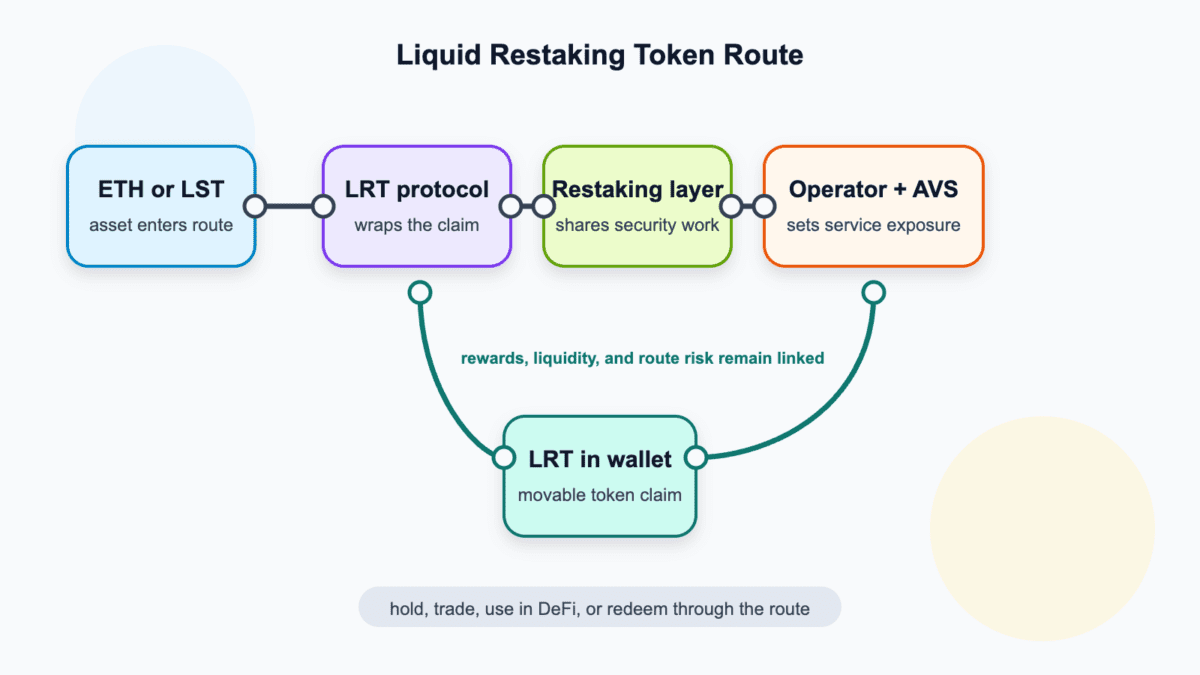
The reward accounting can vary. Some LRTs may reflect rewards through an exchange rate. Some may involve a wrapped version. Some may rely on claims, points, or later distributions. The token ticker alone does not tell you enough.
Redemption is another separate step. You may exit by selling the LRT on a market, redeeming through the protocol, waiting through a withdrawal queue, or unwinding a DeFi position. Those paths can produce very different results under stress.
So an LRT is best understood as a route token. The route is doing the work. The token is what makes that route portable.
A liquid restaking token (LRT) is not the same as a liquid staking token, or LST. An LST represents staked assets. An LRT adds restaking exposure on top of that staking layer.
Keep that split clear before any yield comparison. An LST usually depends on staking, validator performance, issuer rules, redemption, and market liquidity. An LRT can add a restaking protocol, operators, AVSs, slashing logic, reward programs, bridge routes, and LRT-specific liquidity.
Use the table to keep the two claims separate.
| Question | LST vs LRT Answer |
|---|---|
| What does the token represent? | An LST represents staked assets. An LRT represents a restaked route or packaged restaking claim. |
| Where can rewards come from? | An LST mainly tracks staking rewards. An LRT may include staking rewards, AVS rewards, incentives, points, or DeFi rewards. |
| What extra risk appears? | An LRT can add operator, AVS, slashing, route, bridge, and collateral risk beyond the LST layer. |
| How does the user exit? | Both may trade on markets or redeem through a protocol, but LRT exits can involve more route-specific queues and liquidity gaps. |
| How does DeFi use change? | LSTs often serve as staking collateral. LRTs can serve as restaking collateral, which can make loops and oracle assumptions more fragile. |
The shortcut is useful: LST means staked and liquid. LRT means restaked and liquid. Both acronyms promise movement. The LRT stack is heavier.
If you already own an LST, restaking it through an LRT route does not reset the original risk. It adds another layer. That layer may be worth it for some users, but it should be priced as extra exposure, not free yield.
Liquid restaking token (LRT) yield can come from several places. That is why a single APY number can be less useful than it looks. The display may combine durable rewards, temporary campaigns, and borrowed exposure.
Base staking rewards are the cleanest part. They come from the underlying staked asset. Restaking rewards are different. They may come from AVSs that pay for additional security or verification work. Then come incentives, points, pool fees, lending rewards, and other campaign-style payouts.
Those sources should not be blended in your head.
| Yield Source | What To Verify |
|---|---|
| Base staking rewards | Whether the LRT route clearly separates normal staking rewards from extra restaking rewards. |
| AVS rewards | Which service pays them, in which asset, and under which eligibility rules. |
| Protocol incentives | Whether rewards are active, vested, claimable, or only expected later. |
| Points | Whether points have stated value, or only signal possible future eligibility. |
| Liquidity-pool fees | Whether fees compensate for depeg, pool imbalance, and smart contract risk. |
| Lending incentives | Whether rewards depend on borrowing demand or a temporary market program. |
| Borrowed loops | Whether extra yield comes from taking repeated collateral and liquidation risk. |
That is why LRTs often resemble farming rewards more than plain staking. Incentives can be real, but they can also fade when attention, token budgets, or points campaigns cool.
Before trusting a headline yield, ask who pays it. Then ask what happens if that payer stops. If the answer is unclear, the APY is doing more marketing than math.
A liquid restaking token (LRT) can fail at several layers. The base asset can move, a contract can break, an operator can fail, an AVS can create slashing exposure, or the LRT market can lose liquidity.
That does not mean every LRT is fragile. It means the risk is stacked. A calm token chart can hide a route that depends on contracts, governance, bridges, queues, or DeFi collateral settings.
Map each failure point before you size an LRT position.
| Failure Point | User Check |
|---|---|
| Smart contracts | Look for audits, bug bounties, upgrade controls, and public incident handling. |
| LRT protocol rules | Check minting, wrapping, rewards, redemption, fees, and governance powers. |
| Operator performance | Check who performs the work and whether risk is spread across operators. |
| AVS slashing | Understand which services can impose penalties and what behavior triggers them. |
| Withdrawal queues | Check whether redemption can slow when many users leave at once. |
| Secondary-market liquidity | Compare pool depth and slippage before assuming you can sell quickly. |
| Bridge route | Check whether the LRT on your chain depends on a bridge, messenger, or wrapped asset. |
| Oracle assumptions | Check how a lending market prices the LRT during stress. |
| Wallet approvals | Remove old permissions and avoid fake front ends that imitate real protocols. |
> Multichain LRT routes add convenience, but they can also add bridge and chain-location risk. The token may look the same in your wallet, while the exit path underneath is very different.
The worst mistakes usually come from compressing all of this into “smart contract risk.” That phrase is too small. A user borrowing against an LRT cares about oracle pricing, collateral settings, liquidity, and forced selling. A user bridging an LRT cares about bridge trust and destination-chain redemption.
Small spot exposure and a large borrowed loop are not the same risk. Same ticker, different headache.
A liquid restaking token (LRT) can trade away from the value users expect. That gap is often called a depeg, even when the token is not meant to be a strict stablecoin-style peg.
Market price and redemption value are related, but they are not identical. If users need to sell faster than the protocol can redeem, the market may clear at a discount. If the route faces stress, buyers may demand an even larger discount.
That is when exit liquidity becomes concrete, not just trading slang. If the LRT can only be sold into a thin pool during stress, the visible token balance may overstate what you can actually recover right now.
There are several exit paths, and each behaves differently. A market sale can be fast but discounted. Protocol redemption may be cleaner but slower. A withdrawal queue can stretch when many users leave. A bridge exit can add chain-route risk. A lending unwind can force sales at the worst time.
Imagine an LRT used in a lending loop. The token slips below its expected backing value, liquidity thins, and the oracle catches part of the move. The user’s health factor drops. A position that looked like a yield strategy turns into a race between adding collateral, repaying debt, or getting liquidated.
That is why “liquid” needs a sober translation. It means transferable. It does not mean instant full-value exit in every market.
Using a liquid restaking token (LRT) as collateral changes the risk from holding to managing. A spot holder can wait through volatility. A borrower may not get that luxury if collateral value falls.
Lending markets usually track a position through a health factor or a similar safety measure. That measure depends on the LRT price, oracle method, collateral factor, borrowed asset, interest, and liquidation threshold. If the LRT falls far enough, the market can liquidate the position.
The danger grows when users loop the same exposure. A loop might deposit an LRT, borrow ETH or a stablecoin, buy or mint more LRT, and deposit again. That can raise yield on a dashboard, but it also makes the position more sensitive to discounts, oracle changes, and thin exits.
The usual stress path is not complicated:
Some LRT collateral markets are managed carefully. Even then, collateral use should be sized like a risk trade, not a savings account. The more route dependencies sit under the token, the less room a borrowed position has for surprise.
If you cannot explain the exit path without squinting at five tabs, keep the position simple.
Liquid restaking token (LRT) examples make the category easier to recognize, but they should not become a stale ranking list. Tickers change, incentives shift, and protocol routes can differ across chains.
Common examples users may see include eETH, weETH, rsETH, ezETH, and pufETH. These are examples to verify, not endorsements. The important task is identifying what each token represents and how the route works.
As a scale check, DefiLlama tracked about $4.16 billion in total value locked across its Liquid Restaking category on June 20, 2026. That makes liquid restaking a real DeFi sector, not a few isolated tickers.
The table separates common labels.
| Token Or Label | What To Verify |
|---|---|
| eETH or weETH | Whether you hold a native or wrapped form, and how rewards and redemption work. |
| rsETH | Which chain the token sits on, what backs it, and what bridge or redemption route applies. |
| ezETH | How the protocol accounts for rewards, redemptions, and any route-specific limits. |
| pufETH | Which asset backs the claim and what withdrawal or market path is available. |
| Governance token | Whether it is protocol price exposure, not the LRT claim itself. |
| Points or vault share | Whether it is a rewards program or vault receipt, not the base LRT. |
The governance-token confusion is common. Buying ETHFI, REZ, or another project token is not the same as holding the restaked asset receipt. One is market exposure to a protocol token. The other is a claim tied to a restaking route.
Narratives can also move faster than fundamentals. A restaking ticker can catch a wave of attention, then cool when market rotation moves elsewhere. That price action does not prove the LRT route is safer or worse. It proves crypto can turn plumbing into a trade.
Before using a liquid restaking token (LRT), follow the route from wallet to redemption. If you cannot trace the route, you are probably buying the dashboard story, not the position.
Start with the asset. Is the route based on ETH, an LST, a wrapped LRT, a bridge token, or a vault share? Then check the chain. The same ticker on another chain may depend on a bridge or messenger before it can reconnect with the base route.
Then check what your wallet can sign. Wallet connection, token approvals, contract permissions, and fake URLs create user-level risk even when the protocol is legitimate. Clean wallet approvals matter because a bad permission can outlive the trade.
Use this checklist before you buy, mint, bridge, lend, farm, or loop:
You do not need to become a protocol auditor before using one. You do need to avoid lazy LRT diligence, where a higher number on a card gets mistaken for a better route.
When in doubt, simplify. Holding a small spot position is easier to unwind than a bridged, borrowed, farmed, and looped LRT stack that needs perfect timing.
Start by naming the exposure behind a liquid restaking token (LRT), then check the exit. The yield comes later. If the exit is unclear, the reward number is not ready for prime time.
A beginner-friendly path is slower, but cleaner. Identify the token, understand the backing route, and compare holding the LRT with simpler options such as an LST or ordinary staking exposure.
Do one route at a time. Buying an LRT, bridging it, lending it, farming it, and looping it are separate actions. Combining them before you understand the first route makes every later problem harder to unwind.
Use these next actions:
This is not legal or tax advice. It is just good record hygiene. Crypto already gives users enough mystery boxes.
The best first move is boring: understand the token before adding complexity. If an LRT only makes sense after five reward screens and a points rumor, it is not beginner-simple.
After that, size the position around what you can explain. A route that depends on a bridge, a thin pool, and a lending market deserves less room for error than a simple spot holding.
No. An LST represents a staked asset, while a liquid restaking token (LRT) represents a restaked route or packaged restaking claim. The LRT may include the LST layer underneath, plus restaking protocol, operator, AVS, and redemption risk.
That extra layer is the key difference. An LST is already a wrapper around staking exposure. An LRT can be a wrapper around the wrapper, plus restaking rules and possible DeFi use. Similar acronym, heavier stack.
Yes. A liquid restaking token (LRT) can trade below the value users expect if liquidity thins, redemption slows, confidence drops, bridge risk appears, or collateral positions unwind. Market price and redemption value can separate during stress.
The discount may close if arbitrage and redemption work smoothly. It can also linger if buyers doubt the route, exits are slow, or forced sellers keep hitting the market. “Liquid” does not guarantee par exit.
Yes, if you use a liquid restaking token (LRT) as collateral or inside a borrowed loop. Liquidation can happen when the LRT price, oracle value, collateral factor, or borrowed position moves against you.
Spot holders can usually wait. Borrowers may need to add collateral, repay debt, or accept a liquidation if the health factor falls. The same LRT can feel calm in a wallet and dangerous inside a loop.
No. A liquid restaking token (LRT) may receive staking rewards, AVS rewards, incentives, points, pool fees, or lending rewards, but none of those should be read as guaranteed. Check who pays the reward and when it can change.
Some rewards are tied to protocol activity. Others are temporary campaigns or points programs. If the yield disappears when incentives end, it was not the same kind of return as base staking rewards.
No. A governance token gives price exposure to a protocol or project. A liquid restaking token is the tokenized claim tied to a restaking route. The tickers may appear near each other, but the claims are different.
This mistake is easy on exchanges because project tokens and LRTs can share the same story. Buying a protocol token may track sentiment, fees, governance, or future expectations. It does not give you the restaked asset claim.
Check the token contract, chain, backing asset, redemption route, withdrawal queue, bridge dependency, operator exposure, AVS exposure, audits, fee path, reward source, liquidity depth, collateral settings, and wallet approvals. If the route is unclear, reduce the position or skip it.
The strongest quick check is the exit path. If you know how to leave, what it may cost, and what can delay it, the rest of the risk review becomes easier. If you only know the yield number, you do not know enough.