Physical Address
304 North Cardinal St.
Dorchester Center, MA 02124
Physical Address
304 North Cardinal St.
Dorchester Center, MA 02124


Understand liquidator bots before collateral gets tested.
A liquidator bot is an automated crypto program that watches unsafe DeFi loans and submits liquidation transactions for a reward. It acts when a protocol says a borrower’s collateral no longer covers the position well enough.
On a screen, that sounds tidy. In a wallet, it can feel brutal. Once a lending protocol marks a position as liquidatable, a bot can move faster than your dashboard refresh habit. The bot is not a support agent. It is software following protocol rules.
Good or bad is too blunt. The real issue is what liquidator bots can do, why protocols pay them, and how borrowers can avoid giving one a clean shot at their collateral.
A liquidator bot in crypto is software that finds DeFi positions eligible for liquidation and submits the transaction that closes or reduces risky debt. It is often called a keeper bot because it performs a maintenance job the protocol wants done quickly.
The main setting is DeFi lending. A user deposits collateral, borrows against it, and must keep the position inside the protocol’s risk limit. If the collateral falls, debt grows, or the allowed ratio changes, the position can become liquidatable.
That is where the liquidator bot enters. It monitors protocol data, price feeds, account health, and pending transaction conditions. When it sees a valid opportunity, it sends a transaction to repay debt, absorb the position, or trigger the protocol’s liquidation function.
A simple example helps. Suppose a user borrows stablecoins against ETH. If ETH drops far enough, the lending market may allow someone else to repay part of that debt and receive discounted ETH collateral. A liquidator bot tries to be that someone else before rival bots get there.
The phrase can confuse traders too. A liquidation-map trading bot reads clusters of forced liquidations in perpetual futures markets and may use that data for entries or exits. That is different from a DeFi liquidator bot. One executes a protocol liquidation. The other reads market data and trades around it.
So keep the short answer clean: a liquidator bot is automated risk enforcement for DeFi lending. It helps the protocol, rewards the operator, and can be painful for the borrower.
A liquidator bot works by watching collateralized positions until a protocol says one can be liquidated. The bot then sends the required transaction, usually competing with other bots for the same reward.
The setup starts before the bot arrives. A borrower deposits collateral, opens debt, and gets a safety metric. On Aave, that metric is a health factor, and liquidation can occur when it falls below 1. Other protocols may use collateral factors, liquidation thresholds, vault ratios, auctions, absorb mechanics, or liability transfers.
The exact names change, but the workflow is recognizable:
| Stage | What It Means |
|---|---|
| Collateral is posted | The borrower deposits crypto that backs the loan. |
| Debt opens | The protocol lets the borrower take assets against that collateral. |
| Risk moves | Price, interest, or collateral quality changes the safety ratio. |
| Threshold breaks | The position becomes eligible under protocol rules. |
| Bot sends transaction | The liquidator bot calls the liquidation function. |
| Debt is reduced | The bot repays, absorbs, or helps close risky debt. |
| Incentive is paid | The bot receives a reward or discounted collateral. |
That is the beginner model. Real protocol designs get messier. Aave-style markets often make health factor the visible user metric. Compound-style systems may use absorb mechanics. Maker-style designs historically used keeper auctions. Perps venues may transfer liabilities or close positions under different margin rules.
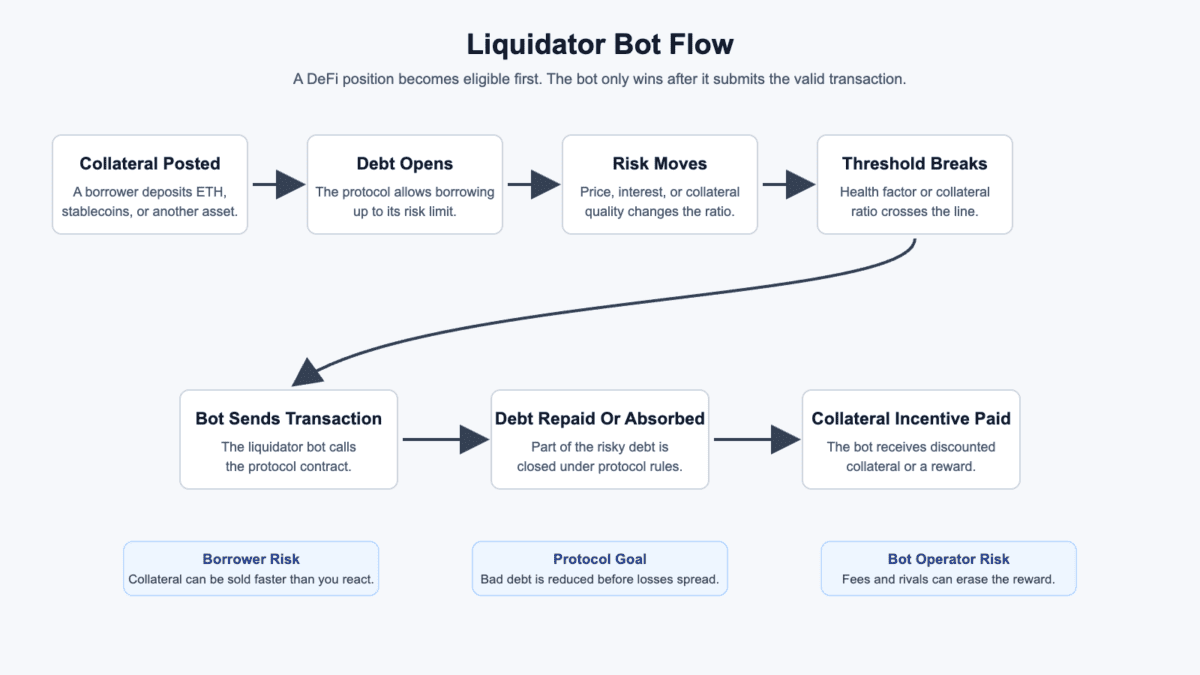
Then the bot still has to land the transaction. It may need a funded wallet, flash-loan route, private transaction path, fast RPC connection, and a swap route for seized collateral. If another bot wins first, the losing bot can pay costs and get nothing. The code does the watching. The market does not promise a polite queue.
A liquidator bot can reduce, sell, seize, or transfer part of your collateral position, depending on the protocol. It does not always take everything, but it can still leave the account badly damaged.
Borrowers often describe liquidation as “the bot took my collateral.” That can feel true while still missing the mechanics. Most protocols define a specific close factor, penalty, bonus, auction, or absorb process. The bot follows those rules because the smart contract allows it.
What happens next depends on the position:
| What Changes | What It Means For You |
|---|---|
| Debt is repaid or absorbed | The risky part of the loan is reduced under protocol rules. |
| Collateral is transferred or sold | The liquidator receives collateral, often at an incentive price. |
| The position may remain open | Some liquidations only close part of the debt. |
| The position may be closed | A severe move or protocol design can leave little collateral. |
| Slippage can affect outcomes | Thin collateral can make the exit worse. |
| Records still matter | The event may create accounting and tax follow-up. |
Partial liquidation is common in many lending markets because protocols want to restore safety without over-closing more than the rules require. But partial does not mean gentle. If the collateral asset is falling fast, a partial close can be followed by another liquidation if the account stays unsafe.
Full liquidation can happen when the position is too far gone, the protocol uses a full-close design, or the remaining collateral cannot support the debt. Some systems may also leave leftover debt or socialized losses if markets gap hard and collateral cannot cover the account. That is the ugly corner DeFi tries to avoid.
Slippage adds another layer. A liquidator may need to sell collateral after receiving it. If the asset is thin, depegging, or moving hard, the bot’s expected reward can shrink. For the borrower, thin exits can make the final result worse than the dashboard warning implied.
In a study of Aave V3 liquidation risk, a Bank of Canada staff paper estimated that borrower losses, including liquidation penalties and missed recoveries, can reach about 10% to 30% of liquidated value in its sample.
The takeaway is simple. A liquidator bot may not liquidate your whole position every time, but partial liquidation can still hurt. The actual outcome comes from protocol rules, market liquidity, and how far past the line the position already is.
A liquidator bot exists because DeFi protocols need risky debt cleaned up fast. Waiting for a human team to notice every weak loan would make lending markets slower, more centralized, and more exposed to bad debt.
The protocol is not trying to make borrowers suffer. It is trying to keep the market solvent. If collateral no longer covers debt, the loss can spill into lenders, reserves, or other users. Liquidator bots are paid because fast action reduces that risk.
The incentives are different for each side:
That incentive mix is why liquidations feel harsh. Once the position becomes eligible, the bot is rewarded for speed. It is not rewarded for checking whether you planned to add collateral after coffee.
Good protocol design makes those rules visible before you borrow. The safer interface shows your risk metric, liquidation threshold, collateral mix, borrow cost, and what can happen during volatility. A vague warning label is not enough when the penalty can arrive in one block.
The moral tension is real. Liquidator bots help DeFi work without a central collections desk. They also turn weak risk management into immediate loss. Both things can be true, which is inconvenient and very on-brand for DeFi.
You reduce liquidator bot risk by keeping a wider collateral buffer, using alerts, avoiding hidden borrowed exposure, and knowing exactly how your protocol handles liquidation. The goal is to act before the bot is allowed to act.
Start with margin for error. A position close to the liquidation line is not “efficient” if normal volatility can push it over while you sleep. The right buffer depends on the collateral asset, borrow asset, liquidity, oracle design, and how quickly you can add collateral or repay debt.
Use this checklist before opening or maintaining a DeFi loan:
Looping deserves special attention. A user may deposit collateral, borrow against it, buy more collateral, and repeat the process to amplify yield. That can make a crypto farming route look productive while hiding how quickly borrowed exposure has stacked up.
Correlated assets can mislead too. Borrowing stablecoins against ETH is one risk shape. Borrowing against a liquid staking token adds smart contract, validator, and depeg risk. Borrowing one volatile asset against another can create a position that breaks from either side.
Alerts help only when you can act. If your collateral is on one chain, repay funds are on another, the bridge is congested, and gas is spiking, an alert becomes a very small fire alarm in a very large kitchen.
Wallet setup is a separate layer. Strong wallet setup protects keys, approvals, and recovery. It does not stop a valid liquidation once collateral is inside a protocol. That distinction saves a lot of false comfort.
Decide your rescue path before borrowing. Know whether you would repay, add collateral, close the loan, or reduce a loop. If your first plan starts after a liquidation alert, the liquidator bot may already be halfway through the door.
A liquidator bot operator earns money when the liquidation reward beats every cost required to win and settle the transaction. That sounds simple until rivals, failed transactions, gas, slippage, and records show up.
The reward may come as a liquidation bonus, discounted collateral, auction spread, or protocol-specific incentive. Some designs require the operator to bring capital. Others can use flash loans or capital-light flows. Some perps systems require funded accounts and risk controls because the operator may inherit position exposure.
Here is the operator reality check:
| Requirement | What Can Go Wrong |
|---|---|
| Fast monitoring | Stale data makes the bot chase dead opportunities. |
| Accurate simulation | A profitable-looking liquidation can fail on execution. |
| Capital or flash loans | Funding costs and route failures can erase the reward. |
| Private submission | Public transactions can be copied, delayed, or beaten. |
| Collateral exit plan | Discounted collateral can still be hard to sell. |
| Clean records | Many wallets and routes can create tax and banking questions. |
This is why a working script is not the same as a profitable operation. The bot must index borrowers, watch price feeds, estimate collateral value, simulate swaps, price gas or priority fees, protect private keys, and handle failed transactions without burning through the operator’s wallet.
Liquidator bot competition can become pure crypto PVP. Several bots may see the same position at once. One wins the reward. Others may lose time, fees, or opportunity. The market is not handing out participation trophies, which is rude but efficient.
Flash loans do not make every bot capital-free. They can help when the debt repayment and collateral sale can complete in one transaction. They can also fail if liquidity is thin, routing changes, or the protocol requires funded collateral ahead of time.
Smart contract risk sits under all of it. A bad liquidation contract, wrong parameter, unsafe approval, or confused oracle assumption can turn a bot into a very fast mistake machine. Automation raises the ceiling on speed and the floor on preparation.
So yes, anyone can study liquidator bot logic. Running one well is different. The code may automate the work, but it does not automate judgment.
A liquidator bot closes eligible DeFi positions. A liquidation map trading bot reads forced-liquidation data and may trade around likely pressure zones. They both use the word liquidation, but they do different jobs.
Liquidation maps are usually tied to margin trading. They estimate where clusters of forced closes may happen if price moves. Traders may watch those clusters as possible support, resistance, stop-hunt zones, or volatility magnets. A bot can use that data as one signal among many.
The distinction is easier in a table:
| Tool | What It Does |
|---|---|
| DeFi liquidator bot | Sends protocol transactions that repay or absorb risky debt. |
| Liquidation map | Shows estimated zones where leveraged traders may be forced out. |
| Trading bot using maps | Buys, sells, or alerts based on liquidation-cluster data. |
| Keeper bot | Performs automated protocol maintenance tasks, which may include liquidation. |
If you came here from trading content, the difference matters. A liquidation-map bot might help a trader read market pressure, similar to how some users look for bottom signals after forced positions get flushed. It does not liquidate DeFi borrowers.
The overlap is pressure. In both cases, liquidation means a forced process caused by risk limits. The action is different. DeFi liquidator bots interact with smart contracts. Trading bots react to data about positions that may get forced out.
That line keeps the concept useful. A borrower needs collateral-risk controls. A perps trader needs signal discipline and risk sizing. Mixing those two can leave both groups with the wrong tool.
Liquidator bots are good for protocol solvency and bad for careless borrowing. They are not heroes, villains, or customer service. They are incentives made executable.
For lending markets, liquidator bots can reduce bad debt before losses spread. For lenders, that is valuable. For borrowers, it can feel brutal because the bot does not negotiate, wait, or weigh intent. The account is either eligible or it is not.
The balanced view looks like this:
The legal side is not a neat slogan. Liquidator bots usually interact with public protocol rules, but legality can depend on jurisdiction, conduct, tax reporting, source of funds, and whether the operator manipulates markets or abuses private information.
Design quality matters. A protocol with clear thresholds, reliable price feeds, sensible incentives, and visible user warnings gives borrowers a fairer chance to manage risk. A protocol with vague metrics and thin collateral support leaves users guessing until the bot explains the rules with their wallet balance.
So are liquidator bots good or bad? They are necessary in many DeFi markets, but they expose bad assumptions quickly. If a position only works when nobody checks the collateral math, the liquidator bot is not the main problem.
Liquidator bot concepts are easier once nearby terms are separated. These terms often appear in the same DeFi conversations, but they are not interchangeable.
Start with the keeper bot. A keeper bot performs protocol maintenance, and liquidation can be one keeper task. Keepers can also update prices, trigger auctions, or maintain vault actions.
Health factor, liquidation threshold, and liquidation bonus sit closer to the borrower. Health factor is a safety metric in some lending markets. Liquidation threshold is the point where the position can be liquidated. Liquidation bonus is the incentive paid to the liquidator.
Oracle, MEV, and flash loan describe the machinery around the bot. An oracle values collateral and debt. MEV is the competition around transaction ordering. A flash loan can fund a liquidation inside one transaction, but only when the route and protocol support it.
A liquidation map is a trading-data tool, not a DeFi liquidation function. It belongs closer to market-structure analysis than protocol debt management.
Trading-side terms need care too. Bottom signals may include liquidation clusters as one clue after forced positions unwind, but they do not explain whether a DeFi loan is safe. Exit liquidity is different again, though forced collateral sales can make the idea clearer because weak markets often punish the side that needs to sell right now.
A liquidator bot in crypto is automated software that watches DeFi positions and submits liquidation transactions when a protocol allows them. It usually earns a reward, discounted collateral, or another incentive for reducing risky debt.
A liquidator bot can act very quickly once your position becomes eligible for liquidation. It cannot bypass the protocol rules, but if those rules allow liquidation and the bot wins the transaction race, the collateral change can feel instant.
A liquidator bot does not always liquidate your whole position. Many protocols allow partial liquidation first, but severe market moves, protocol design, or repeated liquidations can leave very little collateral behind.
Anyone can study or deploy liquidator bot code, but running one profitably is much harder. You need protocol knowledge, safe contracts, fast infrastructure, capital or flash-loan access, simulations, private-key security, and clean records.
A liquidator bot is not the same as a normal trading bot. A DeFi liquidator bot executes protocol liquidation transactions, while a trading bot buys or sells based on market signals, including liquidation maps or other data.
Liquidator bots are generally protocol interactions, but the legal answer depends on where the operator is, how the bot behaves, and how profits are reported. Market manipulation, stolen keys, or poor records can create separate problems.