Physical Address
304 North Cardinal St.
Dorchester Center, MA 02124
Physical Address
304 North Cardinal St.
Dorchester Center, MA 02124


Plain-English guide to stuck chains, finality stalls, and user risk.
A liveness failure happens when crypto infrastructure stops confirming transactions, blocks, or finality on the timeline users normally expect.
That can show up as an L1 finality stall, an L2 sequencer pause, a bridge waiting for proof, or an exchange refusing to credit deposits. “Stuck” does not always mean “stolen,” but it can still cost real money.
A liveness failure in crypto is a progress failure. The system may still know the valid rules, but transactions, blocks, finality, proofs, or credits are not moving forward at the pace users need.
“Eventually” does a lot of work here. Many blockchains are designed to keep making progress if enough honest participants stay online and messages move through the network. A short delay is normal. A liveness failure starts when the delay breaks the expected path for users, apps, validators, or settlement.
Here is the clean split:
| Failure Type | What It Means For Users |
|---|---|
| Liveness failure | The system gets stuck, slows down, or cannot confirm progress. |
| Safety failure | The system accepts conflicting, invalid, or wrong history. |
A safe system can still be painfully non-live. A bridge may refuse to release funds because it is waiting for stronger finality. A chain may protect history while new finality stalls. Annoying, yes. But delay can be better than confidently accepting the wrong state.
Expected progress can mean several things, depending on the layer:
The reverse is uglier. A system can keep moving while carrying unsafe assumptions, bad ordering, or conflicting history. So liveness failure is not just a fancy synonym for “the app is down.” It is a warning that progress has stopped somewhere in the trust path.
Liveness failure affects crypto users because timing is part of the trade. A delayed confirmation can block a deposit, miss a trade, trap bridge liquidity, or leave a margin position exposed while the market moves elsewhere.
Picture a trader sending funds to an exchange during a volatile move. The transaction appears on a wallet screen, but finality stalls or the exchange waits for more confidence before crediting the account. The trader cannot sell, hedge, or add collateral. The chain may be acting cautiously, but the position does not care.
The same timing problem hits bridge users, stakers, and DeFi users in different ways. A bridge credit can arrive after a quote changes. A collateral transfer can land after liquidation. A staking queue can move slower than expected while the market reprices the asset.
The user-visible symptoms usually look like this:
Bad exits often start here. When users panic-sell because a chain, bridge, or app looks frozen, they can become exit liquidity for calmer traders with better information.
The lesson is not “ignore outages.” It is to slow the first reaction. Find out whether the problem is block production, finality, a bridge, an app, an RPC, or an exchange policy before you assume the whole network failed. The narrower the failure, the better your next move can be.
Liveness failure is about whether the system can keep moving. Safety failure is about whether it can avoid accepting a bad result.
That distinction shapes the response. A liveness failure may justify waiting, pausing transfers, and checking status sources. A safety failure may call for stronger action because chain history, settlement, or custody assumptions could be wrong. This is why a status page that says “finality delayed” deserves a different reaction from one warning about invalid state or disputed history.
Ethereum’s proof-of-stake FAQ frames liveness and safety as separate risks, including how stake can affect progress, block contents, or history. Ethereum is only one design, but it gives a useful reference point: progress and correctness are separate questions. A chain can be slow because it is refusing to finalize too cheaply, and that caution can be part of the safety design.
| Question | What You Are Testing |
|---|---|
| Is the chain still live? | Can transactions, blocks, finality, or confirmations keep advancing? |
| Is the chain still safe? | Is the accepted history valid, consistent, and hard to contradict? |
Finality sits between these ideas. Finality is the point where a chain treats history as settled under its rules. A finality stall can be a liveness problem because the network keeps failing to reach that stronger state. A finality failure can become a safety problem if conflicting history gets accepted as settled.
So “stuck” is not the same as “wrong.” A stalled chain can still protect users from worse outcomes. The price is delay, uncertainty, and often a very grumpy timeline. For users, the key is to ask which promise failed: progress, correctness, or both.
A liveness failure can come from missing participants, broken communication, software bugs, clogged dependencies, or conservative rules that refuse to move without enough confidence. It is not automatically an attack.
Keep that split clear. A project can have technical liveness trouble without being a scam, and a scam can keep its website moving while user funds are gone. If the pattern looks more like abandonment, misleading updates, and fading support, compare it with soft rug signals instead of calling every stall a consensus failure.
Validator or node outages can cause liveness failure when too many required participants stop proposing, voting, attesting, relaying, or serving data. In proof-of-stake systems, validator liveness is often part of the chain’s ability to finalize.
Users may see blocks slow down, finality stop advancing, or transactions wait even though fees look normal. A small number of offline nodes may be routine. A larger outage can cross the line into a network-wide progress problem.
Stake concentration can make this harder to read. If a few operators control too much of the active set, their downtime can affect more than their own rewards. That does not make every large operator dangerous. It does make distribution, redundancy, and recovery plans worth checking.
Network partitions happen when parts of a network cannot hear each other reliably. Validators, nodes, relays, or clients may see different views of recent activity, even if each machine is working.
Many consensus designs prefer caution when messages are delayed. They may slow, halt, or refuse to finalize instead of pretending agreement exists. That feels broken from a wallet screen, but it can be the chain avoiding a more expensive mistake.
Timing assumptions are the hidden part. A chain that wants very fast finality needs the network to spread messages quickly enough. Geography, data centers, latency, and validator distribution all affect that promise.
Client bugs can create liveness failure when a major implementation cannot process blocks, attestations, state transitions, or network messages correctly. A chain may depend on several client teams, but a dominant client bug can still drag too much of the network into trouble.
Dependencies can also stall progress. A relay, builder, node provider, indexer, or data pipeline may fail before the core chain itself fails. Users often meet those failures through apps, not through protocol logs.
Client diversity helps because one bug should not take down too much of the active network. It is not a magic shield. It is closer to having multiple exits in a crowded venue, which crypto could use more often.
Sequencer, bridge, and app-layer bottlenecks create liveness problems above the base chain. An L2 can stop including transactions while the L1 still produces blocks. A bridge can wait for proof or relayer action while both source and destination chains keep running.
Apps add their own liveness risk too. A protocol may pause a market, an oracle may delay updates, or a withdrawal queue may move slowly under stress. Users experience all of this as “crypto is stuck,” even when only one layer is stuck.
Extreme fee pressure can look similar. If the network still accepts transactions but fees are absurd, small users may be priced out of progress. That is not always a formal liveness failure, but it is still a user-level failure to get things done.
Liveness failure looks different depending on which layer is stuck. A base chain finality stall, an L2 sequencer pause, a bridge delay, and a wallet RPC outage can all feel the same to users: nothing is moving.
The layer model helps you avoid bad guesses. If one explorer shows blocks and a wallet still says pending, the chain may be live while your access path is not. If the L1 finalizes normally but an L2 sequencer stops, the base chain can be fine while the app layer is not.
| Layer Or Service | What The User Sees |
|---|---|
| L1 consensus | Blocks slow down, finality stalls, or confirmations feel unreliable. |
| L2 sequencer | Transactions do not get included, even while the L1 keeps moving. |
| Bridge verification | Source action appears done, but destination credit waits. |
| RPC or wallet access | The wallet looks broken while other explorers still show progress. |
| Exchange policy | A deposit exists on-chain but the balance stays pending. |
Data availability needs its own lane. Publishing data can help users and verifiers inspect what happened, but it does not always mean a bridge, rollup, or exchange can safely credit the next step. Finality, authentication, and app policy still matter.
The stack is easier to read in a diagram than in a panic thread:
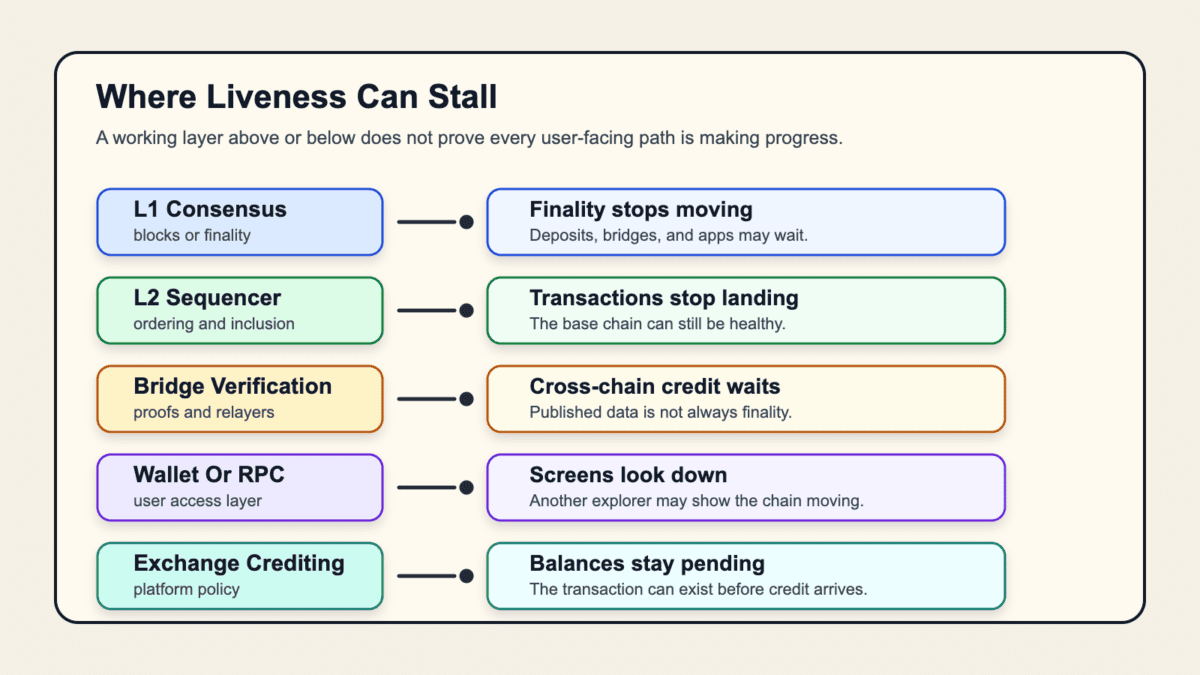
This is why wallet access can mislead users during an outage. A wallet is often the interface, not the source of truth. Check another explorer, another RPC, and the relevant bridge or exchange status before acting.
A liveness failure usually does not mean funds are lost. It means the path for progress has stalled, so transfers, finality, withdrawals, bridge messages, or exchange credits may be delayed.
That answer still needs caveats. Delay can be expensive. A margin position can liquidate while a transfer waits. A bridge route can expose users to changing liquidity, stale quotes, or unclear refund paths. An app with custody or admin controls can add risks that sit outside the chain’s liveness.
Do not send more funds into a broken path just because the first transaction is stuck. That is how one annoying delay becomes a larger problem with a worse support ticket.
The clean distinction is theft versus delay. A hard rug involves direct asset draining, malicious contract behavior, or a sudden destructive exit. A liveness failure is usually a progress failure. Chaotic incidents can blur the two, but the labels should stay separate.
Common loss paths during a stall are usually indirect:
The safest wording is “not automatically lost.” Funds may still be recoverable once the affected layer resumes, but outcomes depend on the app, bridge, exchange, liquidation rules, and market conditions around the stall.
You can evaluate liveness failure risk by checking how a chain, L2, bridge, or app keeps progress going under stress. You are not trying to predict every outage. You are trying to avoid depending on a path you do not understand.
Start with the boring reliability signals. Boring is good here. Fast confirmations and sleek dashboards mean less if the system has weak redundancy, thin operator diversity, unclear recovery steps, or a single sequencer with vague escape routes.
Useful pre-use checks include:
Avoid universal rules. One-third-style liveness claims may apply in many BFT-style proof-of-stake discussions, but each network defines failure thresholds and recovery paths differently. Bitcoin-style systems, Ethereum-style proof-of-stake, Tendermint-style chains, optimistic rollups, and centralized sequencer designs do not fail in identical ways.
Ask the boring questions before the urgent transfer. If progress stops, who can restart it? What can users still do? How long can you afford to wait? If the answer is vague, keep transfer size small or choose a path with clearer failure handling.
During a suspected liveness failure, pause first. The worst move is often sending another high-value transaction into the same stalled route before you know which layer is failing.
Separate evidence from noise. A viral post can be early, wrong, or both. A single wallet screen can be stale. A single explorer can lag. You want several signals that point to the same layer.
Use this checklist before acting:
If your transaction is already pending, do not assume speeding it up fixes every case. Fee bumps help some mempool delays. They do not fix a bridge verification stall, exchange crediting pause, finality problem, or sequencer outage.
If explorers disagree, look for the narrower failure. One RPC may lag while the chain moves. One bridge route may pause while another route works. One exchange may delay credits because its policy is stricter than the chain’s visible status.
For urgent funds, think in layers. A different route may avoid the broken service, but it can also add bridge, liquidity, and asset-version risk. Small test transfers still earn their keep. Crypto makes impatience expensive in impressively creative ways.
Related liveness failure concepts help you read outage posts without blending every risk into one blob. The terms overlap, but each one points to a different failure mode.
Keep these distinctions close:
These terms point to different user actions. A reorg risk may make you wait for stronger settlement. Congestion may make you adjust fees or delay a small transfer. A sequencer pause may make you check whether forced exits or alternative routes exist.
The better you name the failure, the less likely you are to overreact. A stalled chain, a broken wallet endpoint, a bridge wait, and a scam are different problems. They deserve different moves.
Liveness failure can look like a blockchain outage, but the term is more specific. It means progress has stalled somewhere in block production, finality, sequencing, confirmation, or a related service path.
An outage can also come from wallets, RPC endpoints, explorers, bridges, or exchanges. The user experience may be similar, but the cause and response can differ.
Yes. A liveness failure can happen without a hack. Bugs, offline validators, network partitions, delayed messages, failed relays, sequencer downtime, bridge bottlenecks, or conservative safety rules can all stall progress.
An attack is one possible cause, not the default explanation. Check evidence before turning every delay into a crime scene.
Liveness failure is not always worse than a reorg. A liveness failure means progress stalls, while a reorg means recent accepted history changes.
For users, the bigger risk depends on context. A stall can trap funds during a volatile market. A deep reorg can reverse assumptions that apps, exchanges, or bridges already relied on.
Liveness failure is the broader progress problem. Finality failure is a more specific issue where the chain cannot reach or preserve its strongest settlement state.
A chain might still produce blocks while finality stalls. That can be confusing because activity continues, but the stronger “settled” signal does not arrive.
Yes. An L2 can have a liveness failure even if Ethereum is still working. The L2 sequencer, prover, bridge, RPC layer, or app-specific withdrawal path can stall independently.
That is why L2 users should check both layers. Ethereum block production alone does not prove every L2 transaction, bridge message, or withdrawal path is live.
No. One-third offline stake does not always cause liveness failure across every chain. The threshold depends on the consensus design, validator set, timing assumptions, and recovery rules.
Many BFT-style proof-of-stake discussions use one-third-style liveness language, but it should not be treated as a universal law for every crypto network.
Start during a liveness failure by narrowing the problem before you move more funds. That reduces avoidable mistakes while the affected chain, L2, bridge, app, or exchange catches up.
Before doing anything dramatic, write down what you actually know. A transaction hash, bridge route, destination address, and timestamp are more useful than a half-remembered wallet warning. Support teams and status channels work better when the details are boring and exact.
Separate urgent from merely irritating. A delayed small transfer may only need time. A delayed collateral move, bridge withdrawal, or exchange deposit during a fast market may need a backup plan, smaller test route, or manual support ticket.
Use these actions in order:
If the funds are already in motion, patience may be the least exciting correct move. Liveness failures are about progress getting stuck. Your job is not to become the next test case for the stuck path.
When the affected service resumes, do not rush the largest follow-up transaction first. Test with a small move, confirm the expected crediting path, then decide whether the original route is worth using again.
If the same layer keeps failing, change your default route before the next urgent transfer. Reliability is not a vibe check. It is the boring habit of choosing paths that still work when the timeline is ugly.