Physical Address
304 North Cardinal St.
Dorchester Center, MA 02124
Physical Address
304 North Cardinal St.
Dorchester Center, MA 02124


MEV-Boost, without stale staking-reward hype.
MEV-Boost is open-source Ethereum validator middleware that lets validators request pre-built blocks from specialized builders through relays, then propose the most valuable valid block they receive.
That makes it easy to misread. MEV-Boost is not a token, bot, wallet feature, exchange product, or retail MEV protection toggle. It sits in Ethereum’s proof-of-stake block-production flow, where it can affect staking economics, relay trust, and how transaction ordering value moves through the network.
> MEV-Boost shows up in three places:
MEV-Boost in Ethereum is a sidecar program that connects a validator’s consensus client to an outside market of block builders. The validator still proposes the block. MEV-Boost just helps it ask specialized builders for candidate blocks first.
The name often gets mistaken for a yield product. That is the wrong lane. MEV-Boost is infrastructure used by validators in proof-of-stake Ethereum, not a staking pool, wallet app, exchange feature, or coin you buy.
> Rule out the wrong meanings first:
MEV-Boost gives validators access to a competitive block-building market. In plain English, it lets a validator outsource the hard work of finding a valuable block to builders competing to supply it.
The validator does not see every detail immediately. Builders send bids through relays. Relays check that a bid is valid and hold back the full block contents until the validator signs the winning header. That design stops a validator from copying a builder’s block while still letting the validator compare bids.
> For a beginner, the clean split is this:
So MEV-Boost is market plumbing for validators. It routes block bids between builders and proposers. It does not make MEV harmless, and it does not protect a retail swap by itself. It changes who builds blocks and how validators can access the value inside them.
MEV-Boost exists because block building became too specialized for ordinary validators to handle well on their own. A validator can build a normal local block, but searchers and builders may find more valuable transaction orderings during busy DeFi activity.
That value can come from arbitrage, liquidations, backruns, and other ordering strategies. Some of it can improve market efficiency. Some of it can hurt users. Ethereum still needs blocks, and those blocks can contain valuable ordering choices.
> The pressure shows up in two ways:
Without a builder market, validators face a hard choice. They can build simple blocks and leave value on the table, or they can try to become trading infrastructure themselves. That second path favors larger, better-connected operators.
MEV-Boost tries to solve a narrower problem:
That is the promise. A solo validator can access bids from specialized builders instead of competing directly with them. In theory, that makes validator rewards less dependent on running a private MEV shop.
But the tradeoff is not small. MEV-Boost moves trust and performance questions toward relays and builders. A validator now cares which relays it uses, how fast they respond, what policies they follow, and whether the builder market is competitive.
> MEV-Boost lowers one specialization problem and creates a relay-market problem. That is the bargain.
It also does not remove harmful MEV. A sandwich attack can still be harmful to the trader who receives a worse fill. MEV-Boost may route the block that contains that transaction, but the harm comes from ordering and execution, not from the middleware name on the validator’s machine.
The takeaway is narrow: MEV-Boost helps distribute block-building competition to validators, but it does not make transaction ordering clean, fair, or boring. Crypto remains crypto. The wiring just got more specialized.
MEV-Boost works by adding a builder-relay-proposer path to Ethereum block production. When a validator is selected to propose a block, it can ask MEV-Boost for the best valid builder bid instead of only building a local block.
The actor list is easier than the protocol alphabet soup. Each participant wants something different, and each adds a different risk.
| Actor | Role In MEV-Boost |
|---|---|
| User Or Searcher | Sends transactions or bundles that may create ordering value. |
| Builder | Assembles candidate blocks and bids for validator attention. |
| Relay | Checks builder bids and hides full payload details until signing. |
| MEV-Boost | Lets the validator request and compare valid block headers. |
| Validator Proposer | Signs the winning header and proposes the revealed block. |
The table leaves out plenty of implementation detail, but it captures the useful flow. Users and searchers create transaction flow. Builders package that flow into candidate blocks. Relays sit between builders and validators, checking bids and controlling what gets revealed.
Then MEV-Boost asks relays for headers. A header is a compact commitment to a block, not the full block body. The validator compares valid bids, signs the winning header, receives the full payload, and proposes the block to Ethereum.
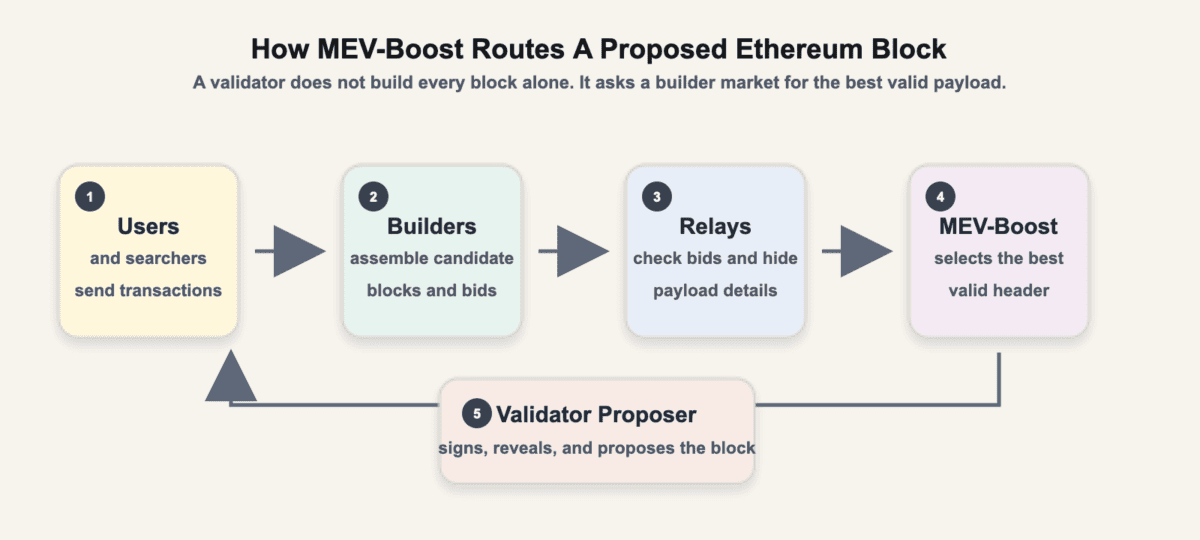
_MEV-Boost adds a builder and relay path before the validator proposes the block._
This flow exists because builders need protection too. If a builder sent the full block to every proposer before a signature, a dishonest proposer could copy the block and keep the value. The relay helps prevent that by revealing the payload only after the validator commits.
The validator still has duties. It must run the normal validator stack, propose on time, and avoid missed slots. MEV-Boost does not replace the consensus client or execution client. It sits beside them and handles builder-bid communication.
> Two timing details do most of the work:
Fallback matters too. If remote relays fail, time out, or return bids below a configured threshold, a validator may build locally depending on setup. That fallback is important because a missed block can cost more than a small extra bid.
Picture a bidding desk attached to validator software. The validator asks, “Who has the best valid block for this slot?” MEV-Boost helps collect the offers. The validator still needs to sign and propose correctly before the clock moves on.
MEV-Boost, MEV, PBS, ePBS, and Commit-Boost are related terms, but they are not interchangeable. The confusion usually starts because all of them sit near Ethereum block production and transaction ordering.
Use this split when the acronyms start elbowing each other:
| Term | Plain-English Meaning |
|---|---|
| MEV | Value from ordering, including, or excluding transactions. |
| MEV-Boost | Today’s out-of-protocol sidecar for validator access to builder bids. |
| PBS | The broad idea of separating block proposers from block builders. |
| ePBS | A roadmap direction for putting more PBS logic inside Ethereum itself. |
| Commit-Boost | An emerging sidecar approach for commitments and builder-market extensions. |
MEV is the economic phenomenon. It can show up in arbitrage, liquidations, sandwiches, or other ordering strategies. It exists whether a beginner likes the name or not.
MEV-Boost is a live infrastructure tool. It helps validators interact with builders and relays today. It is one out-of-protocol form of proposer-builder separation, which means it happens through external software rather than as a fully built-in Ethereum rule.
> MEV is the value. MEV-Boost is one route for builder bids. PBS is the architecture idea.
PBS is the design idea behind that split. In PBS, one party proposes the block while another party specializes in building it. That can improve block-building competition, but it also creates hard questions about trust, censorship, timing, and who sees transaction flow first.
ePBS is the long-term research direction. The “e” stands for enshrined, which means more of the proposer-builder separation logic would move into the Ethereum protocol. The goal is to reduce reliance on trusted relays and external coordination.
> The timing split is the part worth remembering:
Commit-Boost belongs in the future-context layer. Some operators discuss it as a sidecar path that can work around or beyond parts of the current MEV-Boost setup. For most users, it is context, not a reason to skip the basic MEV-Boost definition.
Timing is the useful divider. MEV-Boost is current infrastructure. ePBS is a possible protocol direction. Commit-Boost is an adjacent operator tool. MEV is the value that made the whole architecture worth arguing about in the first place.
MEV-Boost can help ETH stakers receive execution-layer value when their validator is selected to propose a block. That value comes through builder bids, not through a smooth daily bonus.
Rewards are lumpy because block proposals are lumpy. A validator may go long stretches without proposing a block, then receive a block opportunity during quiet or busy market conditions. Old posts that pitched huge reward boosts can age badly because MEV depends on activity, volatility, builder competition, and luck.
> Read MEV-Boost as possible proposer upside, not as a steady yield coupon.
The reward path can also confuse new validators. Consensus rewards and execution-layer payments may appear differently. The fee recipient address controls where execution-layer tips and builder payments can land, so a wrong or misunderstood fee recipient can make reward tracking messy.
A staking provider adds another layer. If you stake through a service, you need to know whether MEV rewards are shared, retained, smoothed, delayed, or excluded from advertised yield. A headline APY can hide those details behind one friendly number.
> Useful provider questions are blunt:
Solo stakers have a different checklist. They care about relay registration, fee recipient settings, logs, client compatibility, min-bid configuration, and local fallback. That does not mean every ETH holder needs a terminal window. It means the reward story depends on operations, not only on “MEV on or off.”
The honest staking takeaway is measured. MEV-Boost can improve proposer revenue when good bids appear. It can also add monitoring work, relay choices, and policy tradeoffs. If someone sells it as a simple yield button, ask where the relay list, fee recipient, and reward-sharing policy are hiding.
MEV-Boost risks start with relays because relays sit between builders and validators. They are useful intermediaries, but they also become performance, trust, and policy dependencies.
A relay can fail, respond slowly, return no bid, or filter what it is willing to pass along. A validator in a faraway region may care more about latency than a validator near major infrastructure hubs. Timing is not glamorous, but missed or late proposals are expensive in validator land.
> The relay is helpful because it reduces builder-proposer trust. It is risky because validators then depend on it.
Relay choice also affects censorship risk. Some relays may follow filtering policies tied to compliance, including OFAC-related concerns. Others may position themselves as neutral. The validator’s relay set can therefore affect which builder bids it sees and which policy tradeoffs it accepts.
The operational risks usually look like this:
More relays can improve bid coverage, but they do not erase trust tradeoffs. Each relay adds another external service to monitor and another policy choice to understand. Fewer relays may simplify operations but reduce bid diversity.
Builder concentration is the market-structure risk. If a few builders control much of the valuable order flow, validators may depend on a narrow set of actors even while MEV-Boost appears competitive on the surface. Private order flow can sharpen that problem because the best transaction flow may not be available to every builder.
A Relayscan builder table updated on June 20, 2026 showed Titan (titanbuilder.xyz) producing 52.07% of MEV-Boost blocks in its 24-hour view. One short window is not destiny, but a share that large explains why builder concentration matters even when the relay list looks diverse.
> That risk has two faces:
For users, that can feel closer to PVP trading than a neutral payment rail. In thin or adversarial markets, several actors compete over the same value, and the cleanest-looking transaction path may still hide a fight over ordering.
A common operator confusion is the min-bid setting. The min-bid is a threshold for accepting remote builder bids. It does not summon bigger bids, and it does not increase the odds of a jackpot block.
> If a remote bid is below the threshold, the validator may fall back to local building. That can be sensible, but it is a filter, not a reward lever.
So the risk section is not a verdict that MEV-Boost is bad. It is more precise. MEV-Boost can improve access to block-builder competition while adding relays, timing, filtering, and concentration risks that validators and staking-provider shoppers should be able to name.
MEV-Boost affects regular ETH traders indirectly. MEV can affect swaps through transaction ordering, but MEV-Boost is validator-side infrastructure, not a wallet setting that protects your trade.
For traders, the painful side of MEV usually looks like bad execution. A sandwich can push a swap against you. Arbitrage can move prices quickly. Liquidations can create sudden priority battles. Builders may package those opportunities into blocks that validators later propose.
> Running MEV-Boost is a validator action. Protecting a swap is a trader action.
That does not mean a trader should install MEV-Boost. Retail controls live somewhere else:
Thin liquidity is where small mistakes get loud. If a pool has weak depth, your own order can move price before any bot gets clever. The same warning sits behind exit liquidity: the problem may be market depth, not just the validator’s block route.
MEV-Boost also sits near DeFi because DeFi creates many of the opportunities builders compete over. Arbitrage, lending liquidations, and pool rebalancing can all create valuable ordering moments. If you are active in yield farming, the MEV market can touch your swaps, harvests, and exits through price impact and execution quality.
> That difference changes the next action:
The trader takeaway is simple. MEV-Boost helps validators access builder bids. MEV protection helps traders reduce harmful exposure. Those are neighboring topics, not the same product with different branding.
MEV-Boost is still important current infrastructure, but Ethereum researchers and operators are trying to reduce some of its trust assumptions. The long-term direction is less dependence on external relays and more protocol-level handling of proposer-builder separation.
That is where ePBS enters the discussion. Enshrined PBS would move more of the builder-proposer logic into Ethereum itself. The goal is not to pretend MEV disappears. The goal is to reduce the need for trusted relays and make block production safer at the protocol layer.
> The roadmap is not about deleting MEV. It is about reducing fragile trust points around block building.
Commit-Boost is another future-context term. It appears in operator discussions because it can support commitment workflows and builder-market extensions beyond the classic MEV-Boost setup. Some operators may test or migrate toward it, but that does not make the older term irrelevant overnight.
The useful signals to watch are practical, not hype-shaped:
For beginners, the risk is getting lost in roadmap language too early. MEV-Boost explains the builder-relay-validator market Ethereum uses today. ePBS explains what Ethereum may want to absorb later. Commit-Boost explains one path operators may explore while the protocol direction develops.
That is why “replacement” is too blunt. Each design removes a different trust problem. MEV-Boost reduces the need for every validator to become a builder. ePBS tries to reduce the need for external relays. Commit-Boost points at a more flexible sidecar layer for commitments.
> Those are different jobs, not one neat upgrade button.
The direction is clear enough: Ethereum wants competitive block building without leaning forever on trusted relays. The timing and final design are harder. Until that changes at protocol level, MEV-Boost remains one of the best ways to understand how builder bids reach validators now.
Start with your role, because MEV-Boost does not ask every user to do the same thing. An ETH holder, solo validator, staking-provider shopper, and DeFi trader should not all walk away with the same checklist.
If you only hold ETH, focus on staking exposure. Ask whether your staking route shares MEV rewards, discloses relay policies, and explains reward accounting. You do not need to run MEV-Boost to care about those answers.
> Your next step depends on whether you hold, stake, validate, trade, or evaluate Ethereum risk.
If you solo stake, start with official client guidance and your own setup notes. The important checks are fee recipient, relay registration, logs, relay diversity, local fallback, and min-bid behavior. Boring checks beat heroic tweaking.
If you trade onchain, look away from validator setup and toward execution controls. Wallet settings, protected routes, private RPCs, slippage, liquidity depth, and app routing are the real surface. Good wallet tools can help, but only when you know which risk they actually reduce.
> One final split keeps the advice clean:
Use this short next-step list:
The useful mindset is not panic. MEV-Boost is neither a magic yield pipe nor a villain wearing a relay badge. It is a live part of Ethereum block production, with real benefits and real tradeoffs. Once you can name the actors, the debate gets much less foggy.
No. MEV-Boost is not a token, coin, staking pool, wallet feature, or exchange product. It is open-source middleware used by Ethereum validators to request block bids from builders through relays.
No. MEV is the value created by transaction ordering, inclusion, or exclusion. MEV-Boost is one validator-side system that helps Ethereum proposers access builder bids connected to that value.
MEV-Boost can increase proposer revenue when a validator receives a valuable builder bid, but the rewards are lumpy and market-dependent. It should not be read as a guaranteed staking-yield booster.
MEV-Boost can contribute to missed or weaker proposals if relays fail, respond too slowly, or return unusable bids. Good validator setups usually account for timeout behavior and local block fallback.
A MEV-Boost relay is an intermediary between block builders and validator proposers. It checks builder bids, hides full payload contents until signing, and helps both sides reduce trust problems.
Not immediately. MEV-Boost remains important current infrastructure, while ePBS is a protocol-level research direction and Commit-Boost is an adjacent sidecar path operators may explore.