Physical Address
304 North Cardinal St.
Dorchester Center, MA 02124
Physical Address
304 North Cardinal St.
Dorchester Center, MA 02124


A plain guide to order flow auctions, solvers, MEV, and safer swap checks.
An order flow auction routes a user’s order, transaction, or intent into a competitive auction where specialized bidders fight to execute it, route it, backrun it, or settle it for a better outcome.
In crypto, that order can be a swap, a signed intent, or a transaction path from a wallet or dApp. The auction may help reduce MEV leakage, improve a route, or return a rebate, but it is not a force field against every bot with caffeine and server bills.
The useful questions are simple. Who sees the order? Who bids for it? How is the winner chosen? And what can still go wrong before settlement?
An order flow auction in crypto is a market structure for routing a user’s trade through competition. Instead of sending a swap straight into a public venue, the wallet, app, or protocol lets approved bidders compete to fill, route, backrun, or settle the order.
OFA is the common acronym. You will see it around private RPCs, intents, solver systems, MEV protection tools, and DEX routes that promise price improvement or rebates.
The core idea is not complicated. A user creates valuable order flow. Someone else may earn value from executing around that order. An OFA makes that competition explicit, so more of the value can return to the user or show up as a cleaner fill.
That sounds tidy. The fine print is where most of the work lives.
An order flow auction is different from order-flow charts, volume profile, or an “unfinished auction” setup from day-trading content. The word auction also does not make a route safer by itself.
That distinction matters at the signing screen. A wallet may show one swap quote, but the route behind it can decide whether the order is broadcast publicly, shared with a permissioned solver set, or sent through a private path. The user sees a button. The OFA design decides who gets the first look at the trade.
For a beginner, picture this: your order enters a controlled bidding process before final execution. The auction can improve the route, but the design decides who gets to bid, what they can see, and what happens if no good fill appears.
An order flow auction works by turning a user’s intended trade into something specialized bidders can compete over. Those bidders may be solvers, searchers, fillers, market makers, builders, or other execution actors depending on the system.
The names vary. The path usually follows the same shape.
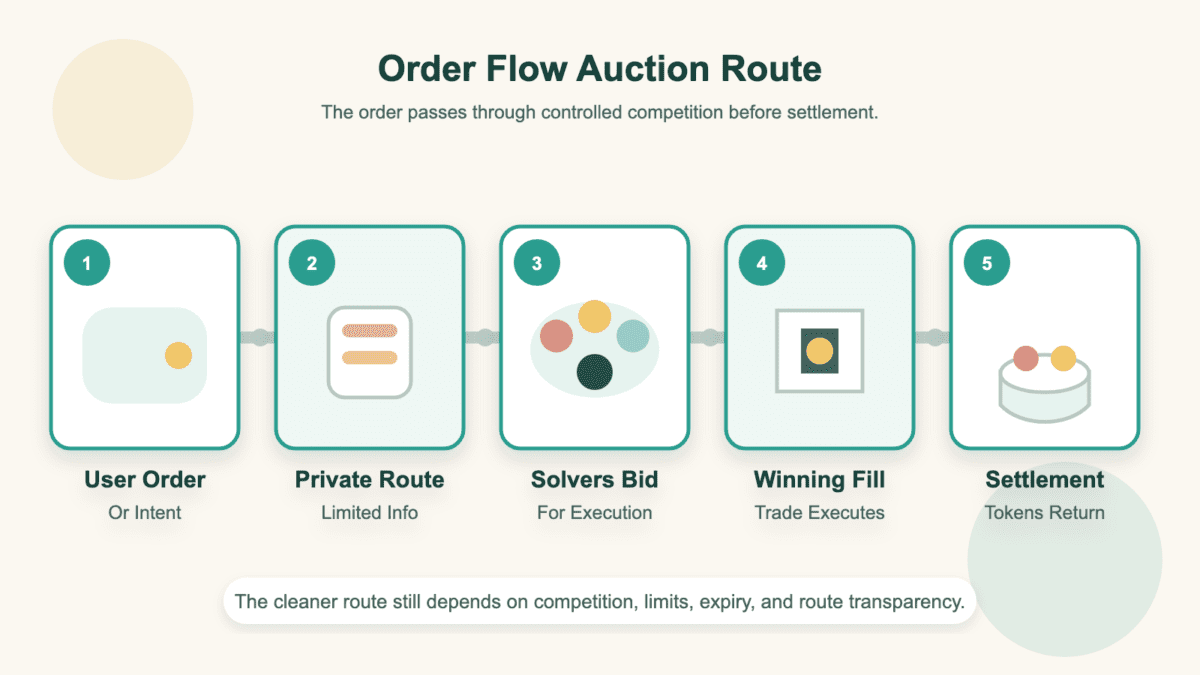
Here is the simple sequence:
For a small ETH-to-USDC swap, the user may only notice that the wallet offers a protected route. Behind the screen, bidders compete to fill the swap or attach a profitable backrun that does not harm the user. If the design works, the user gets at least the quoted output and may receive some improvement.
A large stablecoin swap can be more interesting. A direct AMM swap may push the price against the user. An OFA can let solvers search across pools, market makers, and routing paths to beat a simple public route. That competition is the point.
The actor map helps because OFA language gets crowded fast:
| Actor | What They Usually Do |
|---|---|
| User | Signs an order, transaction, or intent. |
| Wallet Or dApp | Originates or routes the order flow. |
| Auctioneer | Controls how order details reach bidders. |
| Solver Or Filler | Competes to satisfy the user’s order. |
| Searcher | Looks for MEV, backruns, or execution value. |
| Builder Or Validator | Helps determine block inclusion and ordering. |
| Settlement Contract | Finalizes the trade or returns assets. |
That table is a map, not a universal law. Some systems merge roles. Some restrict who can bid. Some run auctions per order, while others batch many orders together.
So the first check is whether real competition exists inside the OFA, not whether the label appears in the interface.
Order flow auction and payment for order flow share one theme: user orders are valuable. After that, the crypto and TradFi versions split fast.
In stock-market discussions, payment for order flow usually means a broker routes retail orders to a wholesaler or market maker that pays for that flow. Order-by-order auction proposals try to make retail execution more competitive by exposing individual orders to more competition.
Crypto OFAs sit in a different setting. They often involve wallets, DEX apps, private mempools, solvers, builders, validators, and on-chain settlement. Users usually sign with a wallet rather than place an order through a regulated stock broker.
| Term | Plain-English Difference |
|---|---|
| Crypto order flow auction | A wallet, app, or protocol routes crypto orders or intents into bidder competition before on-chain settlement. |
| Payment for order flow | A broker-routing model where retail stock or options orders may be sent to firms that pay for that order flow. |
| Order-by-order auction | A TradFi market-structure idea for auctioning individual retail orders before execution. |
| Order-flow trading | A trading-analysis style that studies buying and selling pressure, not a crypto routing auction. |
The overlap can confuse users because both worlds talk about order flow, routing, competition, and best execution. But custody, settlement, regulation, and transparency differ.
Crypto users do not need to import the whole TradFi debate into every OFA route. The narrower comparison matters more: does the crypto design make bidders compete in a way that improves the user’s actual fill after fees, slippage, timing, and trust costs?
That answer depends on the system, not the acronym.
An order flow auction changes MEV exposure because a public crypto transaction can reveal value before it settles. If the transaction sits in a public mempool, bots may see it, copy it, front-run it, backrun it, or sandwich it.
A sandwich attack is the beginner-friendly nightmare. A bot sees a user’s swap, buys before it, lets the user’s swap push the price up, then sells after it. The user gets a worse price. The bot eats the spread. Very polite, in the way a toll booth in a dark alley is polite.
This is one reason DeFi can feel like PVP trading. The trade is not only between user and market. It can also become a contest with bots, searchers, and other actors watching the same path.
An OFA can change that contest in several ways:
Backruns are not always harmful to the user. A backrun may capture value after the user’s order without worsening the user’s minimum output. Some OFA designs let searchers bid for that backrun opportunity, then return part of the value as a rebate or price improvement.
That is the clean version. Reality is messier.
> An order flow auction can reduce some MEV exposure, but it cannot make a bad trade good. Wide slippage, thin liquidity, stale quotes, and opaque routing can still hurt the user.
The honest MEV claim is limited. OFAs can move certain trades from public chaos into controlled competition. They may improve execution when bidders compete seriously and the route enforces the user’s limits.
They do not remove the need for minimum received, size discipline, and liquidity checks. A protected route with a loose slippage setting can still give a trader an ugly fill.
An order flow auction does not guarantee the best possible price. It only creates a process where bidders compete under specific rules, and those rules can be strong, weak, open, closed, transparent, or painfully vague.
The main risk is a trust shift. The user may avoid one public mempool problem, then depend on an auctioneer, bidder list, solver set, private route, builder market, or settlement contract instead.
A 2025 arXiv paper modeled order flow auctions under proposer-builder separation as two sequential auctions: first the order flow auction, then the block-building auction. It found that builder advantages can add centralization pressure in the builder space. You do not need the math to understand the warning. If a few actors see more flow, win more auctions, or gain better execution paths, competition can narrow.
An OFA also does not guarantee:
Last-look risk can also appear. In some designs, a bidder may see enough information to decide whether to fill, delay, or skip. In other designs, a permissioned solver set may protect users from spam but reduce competition.
Thin markets are the awkward part. If the token has weak liquidity, the auction may not find a good route at all. Someone can still become exit liquidity when the market has too few real buyers and too much toxic flow.
The useful checks are outcomes and rules. Ask who can bid, what information they receive, how winners are chosen, what happens on failure, and whether the user’s minimum output is enforced.
Order flow auction is a family name, not one product feature. Two OFAs can both route orders through competition while giving users very different speed, privacy, rebate, and trust tradeoffs.
The most common designs are easier to compare by user-facing effect:
| Design Type | What Changes For The User |
|---|---|
| RFQ-style auction | Market makers or solvers quote for a specific order, often with fast fills and known counterparties. |
| Dutch-auction filler model | Fillers compete as price terms change over time, often around intent-based routes. |
| Batch auction | Many orders are grouped, then matched or settled together to reduce ordering games. |
| Fair combinatorial auction | Solvers can compete across combinations of orders, which may improve matching but adds complexity. |
| Private RPC rebate model | A private route hides transactions from public mempools and may return backrun value. |
| Cross-chain intent auction | Bidders compete to move value across chains, adding bridge, message, and fill risk. |
| Builder-integrated auction | Order flow connects closer to block building, where inclusion and centralization questions get sharper. |
An RFQ-style route can feel closest to asking dealers for quotes. It may be fast and clean, but competition depends on the quality and number of quote providers.
A Dutch-auction filler model can let bidders step in when terms make sense. That can support intents and cross-chain fills, but users need clear expiry and price limits.
Batch auctions reduce some ordering games by settling many orders together. They can be powerful, but a batch auction is not automatically the same as every OFA. It is one possible design inside the larger category.
Private RPC models focus on avoiding public exposure. They can help with sandwich risk, but private does not always mean best, neutral, or guaranteed.
The takeaway is simple. Ask what kind of OFA you are using, then check what that design changes for your order.
An order flow auction can help traders when the order is valuable enough for real competition and the route gives bidders enough room to improve execution. Bigger swaps, fragmented liquidity, and MEV-sensitive routes are the clearest cases.
That does not mean every large trade should go through any OFA-looking button. The mechanism helps when it adds competition that a direct route would not create.
Good-fit situations often include:
For example, a user swapping a meaningful amount of ETH may benefit if solvers compete across AMMs, private liquidity, and backrun opportunities. The user does not need to understand every bidder’s inventory. They do need the final minimum received to make sense.
OFA routes can also help when the alternative is blind public execution. A protected route with clear limits may be better than broadcasting a juicy trade into a mempool where every searcher sees dinner.
They can also help users who care more about the final fill than raw speed. A direct route may be instant, but instant is not always kind when liquidity is split across pools.
The tradeoff is patience. Some OFA routes need time for bids, fillers, or settlement paths. If the quoted expiry is short and the market is moving quickly, the route may fail rather than fill badly.
The strongest use case is competition with enforceable user limits. Without those limits, the auction label is mostly decoration.
An order flow auction can hurt traders when delay, opacity, weak liquidity, or poor settings matter more than auction competition. Protection from one execution problem can introduce another.
Thin memecoin trades are a good example. A route may claim MEV protection, but the token may have shallow pools, wide spreads, concentrated holders, or fast-moving hype. The auction cannot create deep liquidity out of a group chat and a candle.
Bad-fit situations often include:
Oversizing is the quiet killer. If a trader enters a full-port trade because the route says protected, the OFA has become a comfort blanket with a hole in it.
Chain context changes the risk. Ethereum L1, EVM L2s, Solana, and app-specific systems expose and settle orders differently. A private RPC model on one chain does not map perfectly to a solver route on another.
Failure handling is the part most users skip. If the order expires, does it simply cancel, or does the wallet ask for a new signature? If the route partly fills, can the user see what happened? If a rebate is expected, is it included in the quoted output or paid later?
Those details decide whether a route feels safe or merely complicated. An auction with unclear failure rules can turn a simple swap into a support ticket.
The boring rule is the useful one. If you cannot explain what the route protects, what it exposes, and how failure works, keep size small or skip the trade.
Check an order flow auction before signing by reading the route like a risk screen, not a magic button. It should show what you receive, when it expires, and what permissions you grant.
Start with the output. Minimum received is the line that turns a promise into a boundary. If the route cannot show a clear minimum, price limit, or expiry, you are trusting vibes with wallet access.
Use this checklist before approving an OFA-backed route:
Wallet behavior deserves extra attention. A signature may authorize an intent, while a token approval may let a contract move assets. Those are not the same action. If you need a refresher on custody and approvals, start with trustworthy crypto wallets and keep trading wallets separate from long-term holdings.
Scam hygiene belongs here too. Fake MEV bots, Telegram tools, seed-phrase requests, and guaranteed-profit scripts borrow the same technical vocabulary as real execution systems. Vocabulary is cheap. Wallet permissions are not.
The cleanest OFA route should let you see the basics before signing: what you give, what you get, who routes it, what can fail, and how to stop or cancel if the order does not fill.
Related order flow auction concepts are useful only when they clarify the route. A glossary pile does not help if the user still cannot tell who sees the order or who profits from it.
MEV, or maximal extractable value, is the value that can be gained by controlling transaction ordering, inclusion, or execution around user activity. Sandwich attacks are one harmful MEV pattern, while backruns can sometimes be redirected without worsening the user’s fill.
PVP trading helps explain the adversarial side of this. Crypto execution can become a contest over who captures value around the same flow.
Solvers and fillers usually compete to satisfy a user’s order or intent. Searchers often look for MEV opportunities, including arbitrage and backruns. The labels change by system, so focus on the job each actor performs.
Private RPCs are routing tools that can hide transactions from public mempools. Intents describe what the user wants, such as “swap this for at least that,” without forcing the user to choose every execution step.
Batch auctions group orders. Dutch auctions change fill terms over time. RFQ asks bidders for quotes. Proposer-builder separation, or PBS, separates block proposal from block building, which can affect how order flow and builder power concentrate.
Exit liquidity is the related trading-risk concept to keep nearby. Even a cleaner route cannot rescue a market where the real problem is a crowd of sellers and too few buyers.
All of these ideas orbit the same point. Order flow has value, and the design decides who competes for it.
No. An order flow auction in crypto usually routes wallet, dApp, or intent-based orders into bidder competition before on-chain settlement. Payment for order flow is a TradFi broker-routing model tied to retail stock or options execution.
They share a concern about who profits from user orders. The custody, venues, settlement, and rules are different.
An order flow auction can reduce sandwich risk when it keeps the order away from a public mempool and enforces the user’s minimum output. It cannot guarantee protection in every route or market.
Thin liquidity, weak settings, opaque auction rules, and bad token markets can still hurt the user.
No. A batch auction can be one type of order flow auction design, but OFA is broader. Some OFAs work order by order, some use RFQ-style bidding, and some use intent or private RPC models.
The difference is useful because batching changes ordering and matching, while OFA describes the broader competition for user order flow.
That depends on the design. The wallet, originator, auctioneer, solvers, searchers, fillers, builders, or settlement contracts may see different parts of the order.
Better systems limit information sharing and explain who can bid. Weak systems hide those details behind vague “protected route” language.
Solvers usually compete to satisfy the user’s stated intent or route, such as filling a swap at a better price. Searchers often look for MEV opportunities around ordering, arbitrage, or backruns.
Some systems blur the labels. The useful question is what each actor can see, bid on, execute, and earn.
Beginners can use an order flow auction route when it is built into a reputable wallet or dApp and shows clear limits before signing. It should not require seed phrases, custody shortcuts, or blind approvals.
Start small, check minimum received, read the expiry, and understand whether the route protects the trade from public exposure or simply changes who gets to handle the order.


