Physical Address
304 North Cardinal St.
Dorchester Center, MA 02124
Physical Address
304 North Cardinal St.
Dorchester Center, MA 02124


Private RPC explained without the false privacy glow.
Private RPC is a wallet or app connection to a blockchain node through a restricted, custom, or MEV-protected endpoint instead of a shared public RPC URL.
It can improve reliability, reduce public mempool exposure, or give transactions a different route. It does not make your wallet anonymous, guarantee faster fills, or clean up a bad trade.
Private RPC in crypto means a wallet, app, bot, or backend uses a non-public endpoint to talk to a blockchain node. The word “private” usually describes access to the endpoint, the transaction route, or both.
That creates three meanings users often mix together:
A private RPC endpoint is still an RPC endpoint. RPC stands for remote procedure call, and in crypto it usually means JSON-RPC requests such as checking a balance, estimating gas, reading contract data, or submitting a signed transaction.
The privacy claim depends on what the endpoint does. If it only gives you a custom URL, it may improve reliability without changing transaction visibility. If it routes transactions through a private mempool or relay, it may reduce exposure before inclusion.
So a private RPC is not the same as a private transaction. The final transaction still lands on a public chain if the network is public. Anyone can inspect the included transaction, wallet address, token movement, gas paid, and contract call after settlement.
The clean split is this:
Most confusion starts when provider pages use one label for all three. A wallet user hears “private” and thinks anonymity. A DeFi trader hears it and thinks sandwich protection. A builder hears it and thinks rate limits or infrastructure isolation.
All three can be valid in the right context. They are not interchangeable.
Private RPC connects a wallet or app to a blockchain by changing the endpoint that receives its requests. The wallet still signs locally, but the RPC route decides where read calls and transaction submissions go next.
Wallets use RPCs for almost every visible action. They check balances, show token data, estimate fees, read contract state, simulate transactions, and broadcast signed transactions. A private RPC can answer some requests from a provider node and route others through a protected path.
| Step | What Happens |
|---|---|
| Wallet Or App Creates A Request | The wallet asks for chain data, fee estimates, contract reads, or transaction submission. |
| Private RPC Endpoint Receives It | The endpoint checks access, rate limits, API keys, and supported methods. |
| Node Or Provider Handles Reads | Balance checks, contract calls, and simulations come from the connected node layer. |
| Transaction Route Is Chosen | Signed transactions may go to a public mempool, private relay, or provider-specific path. |
| Chain Includes The Transaction | The final result becomes visible according to the chain’s normal rules. |
The read/write split is the part many users miss. A private RPC can make balance checks faster or more stable while doing little for transaction privacy. Another endpoint may focus on MEV routing while still relying on ordinary node infrastructure for reads.
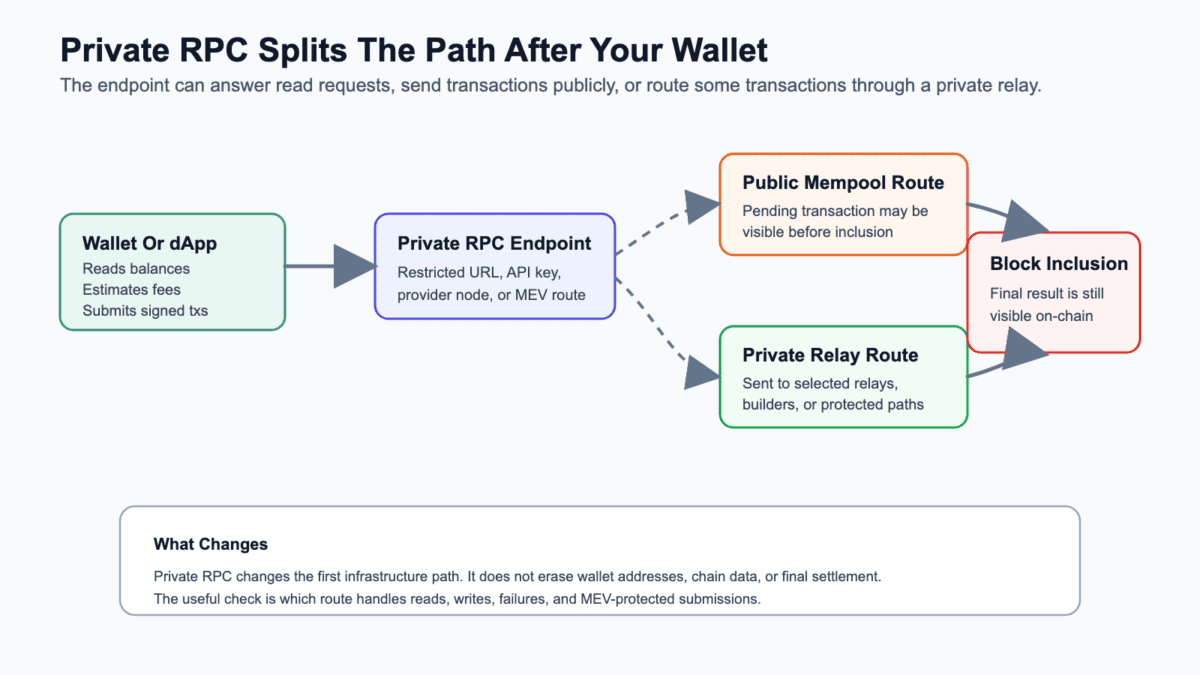
_A private RPC changes the first infrastructure path. The final onchain result is still public on public networks._
For everyday users, this shows up in wallet settings, custom network menus, swap protection toggles, and app-specific RPC defaults. For builders, it shows up as API keys, method support, archive access, trace calls, and higher request limits.
Do not stop at “is this private?” Ask what the endpoint handles. Reads, writes, simulations, private submissions, and failures can follow different rules.
Private RPC differs from public RPC and dedicated nodes by access, control, cost, and trust. The label does not automatically mean exclusive infrastructure or MEV protection.
A public RPC is a shared endpoint anyone can use. It is convenient, but it often comes with rate limits, congestion, inconsistent performance, and little user-specific support. That may be fine for basic wallet activity. It is usually weak for bots, high-volume apps, or serious trading setups.
| Option | Best Understood As |
|---|---|
| Public RPC | A shared endpoint for general access, usually with strict limits and variable reliability. |
| Private RPC Endpoint | A restricted URL from a provider, wallet, app, or infrastructure service. |
| Dedicated Provider Node | Provider-managed infrastructure reserved for one customer or workload. |
| Self-Hosted Node | Your own node, with more control and more maintenance. |
A private RPC endpoint sits in the middle. It may have an API key, allowlist, paid tier, lower congestion, better uptime, or special routing. But it can still be shared behind the scenes. Private access does not always mean a dedicated machine.
A dedicated node gives more predictable capacity and control. It may help builders, trading desks, indexers, or apps that need steady performance. But it costs more, requires operational attention, and still depends on the provider unless you run it yourself.
Self-hosting gives the strongest control over reads. You do not need to ask a provider what your node can query. But self-hosting does not automatically give MEV protection, private routing, perfect uptime, or low-latency access to every validator or leader.
The tradeoffs usually land in five buckets:
So “public vs private RPC” is not a moral ranking. It is an infrastructure choice. Pick the option that matches the actual problem, not the word that sounds safer.
Private RPC can help protect a transaction from MEV when it changes who can see the pending transaction before inclusion. It helps most when public pre-trade visibility is the problem.
On Ethereum-style public mempool routes, a signed transaction may be visible before it lands in a block. Searchers can simulate it, estimate the price impact, and try to place transactions before or after it. That is where front-running and sandwich attacks enter the chat, usually without asking politely.
A MEV protection RPC tries to reduce that exposure by sending the transaction through a private route. Flashbots Protect is one Ethereum example built around private transaction routing for front-running and sandwich protection.
In the default configuration described by Flashbots’ Settings Guide, 90% of MEV refunds go to tx.origin, with the remaining 10% going to the validator. That detail is a reminder that private routing can involve economic settings as well as visibility settings.
Other examples include MEV Blocker, Infura MEV protection, and chain-specific private mempool designs such as Polygon Private Mempool. They are examples, not rankings. The implementation details decide how much protection the user actually gets.
The basic flow looks like this:
This can reduce exposure to public searchers. That is especially useful when the trade is large enough to attract attention, the pool is thin, or the slippage setting gives attackers room.
But private RPC cannot promise a better outcome every time. The route may fail, be slower than expected, have limited builder coverage, or fall back in ways that are hard to spot. Protection also does not fix bad slippage, a stale quote, a toxic token, or weak liquidity.
MEV belongs in a market-structure bucket as much as a security bucket. In PVP trading environments, the risk comes from other actors reacting to your order flow. Private routing narrows the audience, but it does not remove the game.
Use this check: private RPC helps when it prevents the wrong people from seeing a pending transaction too early. It helps less when the trade was already poorly built.
Private RPC does not hide your wallet address, your final onchain transaction, or the fact that you interacted with a public blockchain. It only changes part of the route between your wallet and the chain.
After inclusion, public-chain activity is still visible. That includes sender address, recipient or contract address, token transfers, gas, calldata where applicable, timing, and links to other transactions from the same address.
The provider may also see offchain metadata. Depending on the service and setup, that can include IP address, API key, user agent, request timing, queried addresses, transaction simulations, and which dApps you interact with.
That creates two separate privacy surfaces:
A private RPC can reduce shared-endpoint exposure, but it can also concentrate information with one provider. If every wallet read, simulation, and transaction goes through the same service, that service may have a cleaner map of your behavior than a random public endpoint would.
There is also address-linking risk. If you reuse one wallet across DeFi, NFTs, exchange withdrawals, social profiles, and public ENS-style identity, private RPC does not unlink that history. A private endpoint cannot unring an onchain bell.
The doxxed in crypto idea is broader than founder identity here. Wallet identity can be linked through public behavior, app logs, exchange records, leaked screenshots, or repeated patterns. RPC privacy is only one piece of that puzzle.
> Private RPC is not a mixer, privacy coin, VPN, or wallet hygiene plan. It is infrastructure routing.
For privacy-minded users, separate the jobs. Use private RPC for the specific routing benefit it offers. Use wallet compartmentalization, careful address reuse, privacy-aware apps, and operational caution for identity exposure.
Choose a private RPC by matching the endpoint to the problem you actually need solved. Better reliability, higher limits, private transaction routing, and stronger privacy claims are different products.
Start with the chain and use case. A wallet user needs safe network settings and predictable transaction behavior. A DeFi trader may care about protected submission. A builder may need archive data, trace methods, high throughput, WebSocket support, or regional routing.
Before paying or pasting a new endpoint into a wallet, check the practical details:
Watch wording around “private.” Some providers mean private access to an endpoint. Others mean dedicated infrastructure. Others mean private transaction routing. A few mix all three in one pitch because marketing departments also enjoy chaos.
The strongest provider pages make boundaries clear. They tell you what chains are supported, which methods work, how private transaction routing behaves, when fallbacks happen, and what metadata may be logged.
Weak pages lean on vague comfort. Be careful with phrases that promise stealth, guaranteed speed, total MEV prevention, or anonymous transactions without explaining the route.
For trading, test the endpoint under the exact conditions you care about. A private RPC that feels fast for balance checks may not improve a swap. A protected transaction route that works on Ethereum may not work the same way on an L2 or Solana.
For builders, test failure handling before production. Rate-limit errors, stale reads, unsupported methods, and partial outages can create strange app behavior. Better to find that with test traffic than during a launch, when everyone suddenly discovers your RPC bill has opinions.
Add or test a private RPC safely by treating the endpoint as a network setting, not a magic upgrade. Verify the chain details first, then test with a small amount before depending on it.
Most wallet flows ask for a network name, RPC URL, chain ID, currency symbol, and block explorer URL. The exact menu changes by wallet, so check the wallet’s own network screen. Blind-copying random RPC URLs from social posts is how people turn “custom setup” into “custom regret.”
Use this safety checklist before moving meaningful funds:
The chain ID check is non-negotiable. A wrong network setting can make a wallet show confusing data or route transactions somewhere you did not intend. The explorer check gives you a second place to verify what actually happened after settlement.
Also check wallet-native protections. Some wallets route swaps through built-in MEV protection or preferred RPC infrastructure. Changing to a custom RPC can add protection, remove protection, or simply change the provider with no meaningful MEV benefit.
MetaMask and similar wallets can support custom RPC entries, but “supports” does not mean “safe for every endpoint.” The endpoint still has to be reputable, chain-correct, and suitable for the action.
For DeFi, test the full path. Confirm the quote, minimum received, gas estimate, pending status, and final transaction. If the provider claims private routing, check whether your transaction appeared in the public mempool before inclusion, if your tools can show that.
Small tests are boring. That is the point. If an endpoint cannot handle a tiny action cleanly, it has not earned the right to touch size.
Private RPC behaves differently on Ethereum, L2s, and Solana because each network routes and orders transactions differently. Advice from one chain can be wrong on another.
Ethereum mainnet has the classic public mempool story. A transaction can sit where searchers observe pending flow, simulate effects, and compete around ordering. Private RPC routes can matter there because they may avoid normal public mempool exposure.
| Network Context | What Private RPC Can Change |
|---|---|
| Ethereum Mainnet | It can route supported transactions through private mempools, relays, builders, or protected RPC paths. |
| Ethereum L2s | It may change endpoint reliability, but sequencer design controls much of the ordering path. |
| Polygon Private Mempool Context | It shows how chain-specific protected routes can exist outside the broad Ethereum mainnet pattern. |
| Solana | It may improve latency or routing, but private RPC alone does not hide every trade from every bot. |
On many L2s, the sequencer is the central ordering actor. A private RPC may still help with reliability, app routing, or provider access, but the MEV story is not always the same as Ethereum mainnet. You need the chain-specific transaction path, not a recycled mainnet slogan.
Solana is different again. Traders often ask whether private RPC makes launch trading faster or more hidden. It can help with endpoint speed, reliability, and routing in some setups. It does not automatically give stealth against every validator, leader, bot, or bundle path.
The chain-specific split is especially important in the trenches, where Solana launch traders may care about milliseconds, priority fees, block engines, private relays, and bot-heavy launches. A faster endpoint can help execution. It cannot make a terrible entry good.
Start with chain support. Ask whether the provider supports the network, whether private transaction submission exists on that network, who handles ordering, and what happens if the private path cannot land the transaction.
If the provider cannot answer that clearly, do not fill in the blanks with hope. Hope has poor uptime.
Private RPC can fail by giving users false confidence, stale data, poor routing, or a new trusted middleman. The main risk is assuming the word “private” solved more than it did.
Some failures are ordinary infrastructure problems. The endpoint may rate-limit you, return stale reads, miss WebSocket events, reject certain methods, or go down during market volatility. For builders and bots, that can break flows fast.
Other failures are transaction-route problems:
MEV protection can also fail at the market layer. If a swap has thin liquidity, wide slippage, or bad route construction, private submission may only hide a weak trade until it lands badly.
A private route can still dump you into exit liquidity. Private routing does not create buyers, deepen pools, or stop insiders from selling into late demand. It only changes part of transaction visibility and routing.
Watch for these failure signs before trusting size:
Running your own node is not the universal fix. Self-hosting improves control over reads, but it adds maintenance and may not give private submission. Sometimes the better answer is a reputable provider, a wallet-native protected route, smaller trades, or avoiding the trade entirely.
Private RPC should make a specific workflow safer or more reliable. If it only makes you feel protected, that feeling is not an infrastructure feature.
Start with private RPC by naming the exact problem you want to solve. Reliability, rate limits, wallet privacy, faster routing, and MEV protection need different checks.
If you are a regular wallet user, avoid changing RPC settings just because a social post says a private endpoint is faster. If your wallet already works and you do not understand the new route, the upgrade may only add a provider you cannot evaluate.
Use this short path:
For DeFi trades, pair private RPC with normal trade hygiene. Check liquidity, price impact, minimum received, slippage, token address, approvals, and route details before signing.
For builders, test method support, latency, failover, API-key controls, and rate limits under realistic load. Also separate read infrastructure from transaction submission. The best read endpoint may not be the best private submission route.
Keep the final rule modest: private RPC is a route choice. It can reduce some exposure and improve some workflows. It cannot replace wallet hygiene, liquidity checks, or understanding who now sees your transaction first.
Private RPC in crypto is a restricted, custom, or protected endpoint that lets a wallet or app talk to a blockchain node instead of using a shared public RPC URL.
It can improve reliability, rate limits, transaction routing, or MEV protection depending on the provider. It does not automatically make transactions anonymous.
Private RPC can reduce front-running risk when it routes supported transactions away from the public mempool. That is the useful version of a MEV protection RPC.
It does not guarantee protection. The route can fail, support only some transaction types, or leave other execution risks untouched.
A private RPC is not the same as running your own node. A private endpoint usually comes from a provider, wallet, app, or managed infrastructure service.
Running your own node gives more control over reads and verification. It also adds maintenance and does not automatically provide private transaction routing.
Private RPC cannot hide your wallet address after a transaction settles on a public blockchain. The address and transaction details still become visible on-chain.
It may reduce exposure to a shared public endpoint, but the RPC provider may still see metadata such as IP address, request timing, and queried addresses.
Private RPC can be safe to use in MetaMask when the endpoint is reputable, chain-correct, and tested with small transactions first. The main risk is using a bad or wrong RPC URL.
Always verify the chain ID, explorer URL, and provider source. Also check whether changing RPC settings affects any wallet-native transaction protection.
You do not automatically need private RPC for Solana trading. It may help with latency, reliability, or certain routing setups, but it does not make every trade hidden from bots.
Solana execution depends on its own leader, priority, and routing mechanics. Test the endpoint and understand what protection it actually provides before using it for size.