Physical Address
304 North Cardinal St.
Dorchester Center, MA 02124
Physical Address
304 North Cardinal St.
Dorchester Center, MA 02124


RWAFi explained without the tokenized-asset fog.
RWAFi, short for real-world asset finance, is the use of tokenized off-chain assets inside DeFi trading, lending, yield, and collateral markets.
The term usually points to tokenized Treasuries, credit, real estate, commodities, funds, or similar assets made usable in crypto apps. It is not a single coin, not automatic ownership of a physical asset, and not guaranteed liquidity just because a token appears in a wallet.
That distinction is the whole game. A tokenized Treasury, an RWAFi vault, and an RWA-themed protocol token can sit under the same market story while exposing you to very different risks. The label sounds tidy. The structure underneath can be anything but.
RWAFi in crypto means putting tokenized real-world assets to work inside DeFi-style markets. The asset starts outside crypto. The token sits onchain. The finance layer lets users trade, borrow, lend, earn, or use that token as collateral.
The phrase is still niche. You will often see it around Plume, RWA infrastructure, and tokenized asset coverage. But the useful meaning is broader than one project. RWAFi describes the finance layer around tokenized real-world assets.
That finance layer can include several different things:
Those are not interchangeable. A tokenized Treasury position may track a claim on a fund or debt instrument. A protocol token may track network usage, fees, governance, scheduled supply releases, and market sentiment. A narrative coin may track little more than attention and timing. Crypto, naturally, found a way to make a plain finance label need a spreadsheet.
So RWAFi is best read as a category of structures, not a magic wrapper. Start with a simpler question: what exactly sits behind the token?
| RWAFi Means | RWAFi Does Not Automatically Mean |
|---|---|
| Real-world asset finance | Direct ownership of the physical asset |
| Tokenized assets used in DeFi | Guaranteed redemption |
| Onchain transfer and settlement | Deep secondary-market liquidity |
| Cash-flow or collateral products | A low-risk investment |
| Infrastructure around RWA markets | The same exposure as an RWA protocol token |
This is the first guardrail. RWAFi can make off-chain assets more usable in crypto, but it does not erase the legal, custody, and market plumbing that makes those assets work.
RWAFi works by connecting an off-chain asset to an onchain token, then letting that token interact with DeFi markets. The blockchain part is visible, but it is only one layer in the machine.
A normal RWAFi setup starts before any token contract exists. Someone must choose the asset, create a legal wrapper, appoint an issuer, arrange custody, publish reserve or valuation data, and define who can hold, transfer, redeem, or borrow against the token.
Then the crypto layer enters. A token contract represents the position or claim. Compliance controls may restrict transfers to approved wallets. Oracles or reporting feeds may update prices, yields, reserve status, or asset values. A DeFi app can then list the token in a vault, lending market, collateral market, index, or trading pool.
The flow usually looks like this:
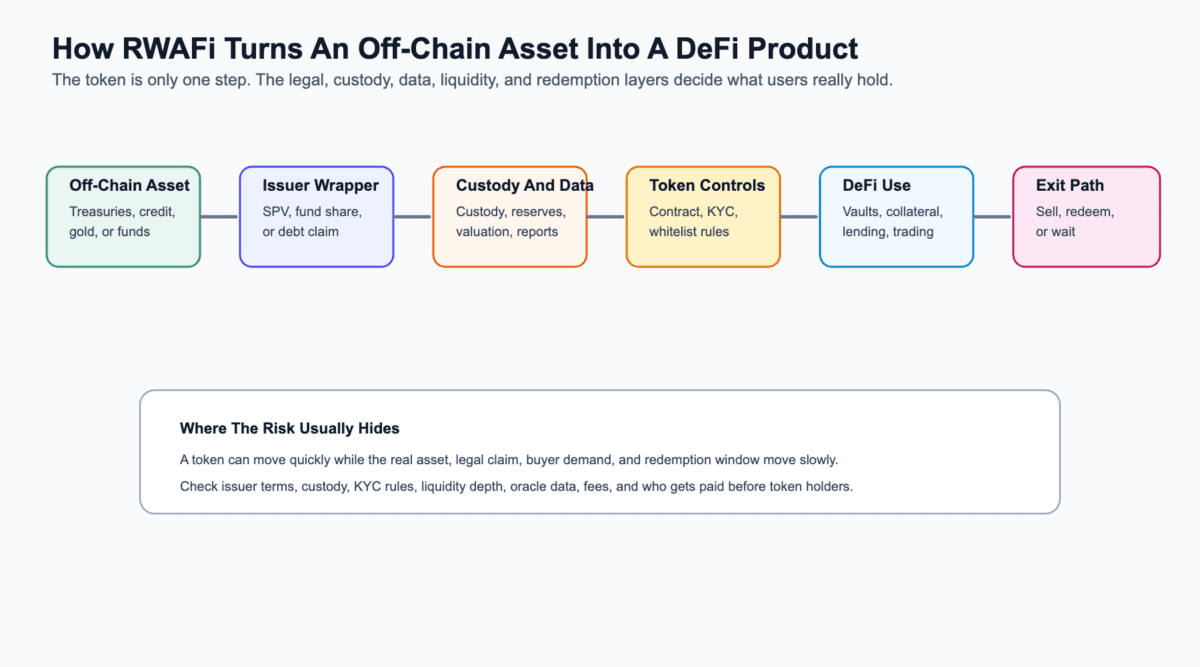
The important detail is that onchain movement can be faster than off-chain enforcement. A token can transfer in seconds while a custodian, issuer, redemption agent, or legal claim still moves through slower real-world rules.
That is why RWAFi is not just “RWA plus DeFi.” It is a stack of claims, controls, and markets. Each layer can add utility. Each layer can also break in a different way.
RWAFi and RWA are related, but they answer different questions. RWA describes the real-world asset category. RWAFi describes what happens when tokenized RWAs become usable in financial products.
An RWA can be the simpler part. A fund, Treasury bill, credit claim, real estate interest, or gold reserve gets represented as a token. The token may make transfer, settlement, tracking, or fractional access easier.
RWAFi starts when that token becomes financial infrastructure. It can be deposited in a vault, used as collateral, traded against stablecoins, bundled into an index, or routed through a yield strategy. That adds flexibility. It also adds more moving parts.
| Concept | Plain Difference |
|---|---|
| RWA Tokenization | Turns an off-chain asset or claim into an onchain token. |
| RWAFi | Uses tokenized RWAs inside lending, trading, collateral, vault, or yield markets. |
| TradFi Product | Usually sits inside broker, bank, custodian, or fund infrastructure. |
| DeFi Product | Runs through wallets, smart contracts, pools, vaults, or onchain settlement. |
| Protocol Token | Gives exposure to a network, fees, governance, scheduled supply, or market story. |
| Tokenized Asset | May give exposure to a specific asset claim, if the legal terms say so. |
The risk review changes with that shift. A tokenized asset asks, “What backs this?” RWAFi adds, “What is this token being used for, who can redeem it, what market prices it, and what happens if the app fails?”
That is the distinction to keep. Tokenization can make an asset easier to move. RWAFi can make it easier to use. Neither automatically makes it safer, more liquid, or better priced.
Many assets can appear in RWAFi, but the asset type changes the risk profile. A tokenized Treasury and a tokenized apartment do not belong in the same risk bucket.
Tokenized Treasuries and money-market funds are often the clean beginner example because the underlying assets are familiar and cash-flow logic is easier to explain. Private credit, real estate, tokenized stocks, commodities, royalties, collectibles, and niche funds can be far messier.
The useful question is not only what backs the token. It is what changes for the holder once that asset becomes part of an onchain product.
| Asset Type | What Changes For The Holder |
|---|---|
| Treasuries or money-market funds | You may get tokenized access to conservative yield, but issuer terms and redemption limits still control the position. |
| Gold or commodities | The token can move onchain, while custody, proof, fees, and delivery rights remain off-chain questions. |
| Private credit | Yield may be higher, but credit underwriting, defaults, and recovery are harder to inspect. |
| Real estate | Fractional access can improve, but legal title, rent flow, taxes, and exits may stay slow. |
| Tokenized stocks | Market access may expand, but regional rules, issuer structure, and trading hours can differ from the real share. |
| Funds and indexes | Exposure can be packaged neatly, while fees and underlying holdings need extra review. |
| Royalties or collectibles | Valuation can be subjective, and buyer demand may disappear quickly. |
This is why “asset-backed” is not enough. Backed by what, held by whom, valued how, redeemable when, and transferable to which wallets are the working questions.
If an RWAFi product cannot answer those questions in plain terms, the token wrapper is doing too much of the sales work.
What you own with RWAFi depends on the issuer terms, legal wrapper, custodian, and token design. The token alone does not prove a direct claim on the underlying asset.
Some tokens may represent a beneficial interest in a fund. Some may represent a debt claim. Some may act like a receipt. Some may only represent a vault share. Others may be governance or infrastructure tokens with no direct claim on the off-chain asset at all.
That difference matters during stress. If the issuer fails, the custodian freezes transfers, the asset valuation changes, or redemption pauses, the token interface may not tell you what legal rights you have. The legal documents do.
Common ownership patterns include:
Examples make the gap easier to see. A gold-backed token may depend on the custodian and redemption rules. A tokenized Treasury may depend on fund shares, transfer restrictions, and minimum redemptions. A real estate token may depend on an SPV, local law, rental flow, and whether anyone wants to buy the token later.
Wallet setup can also matter more than users expect. Some RWAFi assets only move between approved addresses, so ordinary wallet setup is only part of the custody question. Whitelists, KYC status, supported chains, and regional eligibility can decide whether your token is useful or stuck.
The plain check is this: read the token as a pointer to terms, not as the terms themselves.
RWAFi yield comes from the asset, the DeFi product, or both. If those sources get blended together, the advertised return can look cleaner than the risk underneath.
Real-world cash flow can include Treasury interest, private credit interest, rental income, royalty payments, commodity financing, or fund distributions. DeFi-side return can include lending spreads, vault fees, token rewards, liquidity incentives, borrowed loops, or protocol emissions.
Those are different engines. A Treasury yield has duration, issuer, fee, and redemption risk. Private credit has borrower and recovery risk. A token reward has emissions and sell-pressure risk. A borrowed loop can work until liquidity tightens, rates move, or collateral rules change.
| Yield Source | Main Failure Point |
|---|---|
| Treasury or money-market income | Rates fall, fees rise, or redemption terms bite. |
| Private credit interest | Borrowers default or recovery takes longer than expected. |
| Real estate rent | Vacancy, legal costs, taxes, or slow exits reduce payouts. |
| DeFi lending spread | Collateral values move or borrowers vanish. |
| Token rewards | Emissions dilute holders or sell pressure overwhelms demand. |
| Borrowed loops | A small move can force liquidations or expensive exits. |
If most of the return comes from token incentives, the position behaves closer to yield farming mechanics than a simple asset-backed yield product. That does not make it bad. It means the reward depends on protocol design and market demand, not only off-chain cash flow.
So do not stop at “What is the APY?” Ask what pays it, who takes fees first, how redemptions work, and what happens when incentives stop.
RWAFi tokens can mean several things, and the market often blurs them. Buying an exchange-listed RWA or RWAFi token does not automatically mean you own a Treasury, a loan, a building, or a fund share.
A tokenized asset is one possible exposure. A vault share is another. A gas or infrastructure token is different again. A governance token may depend on protocol fees, voting power, emissions, supply releases, and growth expectations. A narrative coin may only borrow the RWA story because it is the story of the month.
Plume and PLUME often appear near RWAFi discussions because exact RWAFi search results are Plume-heavy. That context can help explain the term. But a protocol token should not be assumed to give direct ownership of tokenized assets unless the issuer’s terms clearly say so.
| What You Buy | What You Are Exposed To |
|---|---|
| Tokenized asset | The issuer terms, asset value, custody, fees, and redemption path. |
| Vault share | The assets inside the vault plus strategy, smart contract, and manager risk. |
| Infrastructure token | Network usage, fees, vesting releases, governance, and market sentiment. |
| Governance token | Voting power, protocol direction, and possible value capture. |
| RWA narrative coin | Attention, liquidity, timing, and how fast the story cools. |
That last row is not a joke. A narrative-driven coin can run hard while the actual asset side stays tiny, restricted, or unrelated to holders. Price can move before proof catches up.
The fix is boring but useful. Label the exposure before you label the thesis. If you cannot explain what cash flow, rights, fees, vesting schedule, or asset claim you are buying, you are probably trading the story.
The main RWAFi risk is assuming the token gives more safety, rights, or liquidity than the structure really provides. The token can look simple while the real risk sits behind it.
Issuer risk comes first. The issuer may control disclosures, redemption terms, fees, and legal claims. Custodian risk follows. The asset can be real, yet holders still depend on someone storing it, reporting it, and honoring the claim.
Legal enforceability is another quiet risk. Jurisdiction, securities rules, transfer restrictions, KYC status, sanctions screening, and insolvency treatment can decide whether a holder can sell or redeem. A wallet balance is not a court order.
Then come crypto-native risks. Smart contracts can fail. Oracles can lag or misprice assets. Liquidity pools can be thin. Governance can change terms. Vesting releases can add sell pressure. Fees can eat yield. A dashboard can show growth while the actual exit door remains narrow.
Liquidity is the centerpiece. Tokenization can improve transferability, but it does not create buyers by magic. A token can be transferable and still hard to sell near fair value. If the main buyers are late retail users chasing the RWA story, earlier holders may be using them as exit liquidity.
Run these checks before getting impressed:
RWAFi can reduce some crypto risks by linking to real assets. It can also import finance risks that crypto users are bad at reading. Both can be true. Annoying, but useful.
Researching an RWAFi project starts with classifying the exposure. Before a thread, chart, or token page pulls you in, decide whether you are looking at a tokenized asset, a vault, a lending market, an infrastructure token, or a narrative trade.
Then follow the asset trail. Identify the issuer, the legal wrapper, the asset, the custodian, the reserve or audit process, the redemption rules, and the supported jurisdictions. If the project makes that hard, the opacity is information.
Dashboards can help, but they should not replace the documents. As of June 22, 2026, RWA.xyz listed about $32.2 billion in distributed tokenized real-world asset value. Use that market context to compare networks, asset categories, managers, and platforms. Then go back to the issuer terms and liquidity screens before risking funds.
A useful RWAFi checklist looks like this:
Do not skip the exit path. Many RWAFi products look fine at entry because the story is clean and the dashboard is tidy. The hard part is what happens when you want out, the token trades at a discount, or redemptions slow.
Good research should leave you with a sentence, not a vibe: “I am buying this claim, backed by this asset, issued by this entity, with this redemption path, on this chain, with these risks.”
RWAFi can fit a crypto portfolio only after you define the exposure. Asset-backed yield, private credit risk, commodity exposure, protocol-token beta, and narrative trading are different allocations.
For cautious users, tokenized Treasuries or money-market-style products may look closer to onchain cash management than an altcoin bet. For DeFi users, RWAFi collateral and vaults may offer new yield sources. For traders, infrastructure and RWA-themed tokens may behave like sector beta with vesting, liquidity, and sentiment risk.
That range creates the portfolio problem. A growing RWA market does not make every RWAFi product a good investment. It may mean more issuers, more wrappers, more fees, more chains, and more tokens competing for attention.
RWAFi may fit when:
RWAFi may not fit when:
The portfolio lens should stay humble. RWAFi can bring useful real-world cash flows onchain. It can also give a suit and a slide deck to ordinary crypto risk.
RWAFi in crypto is real-world asset finance, where tokenized off-chain assets are used inside DeFi markets for trading, lending, yield, collateral, or structured products.
The key point is that RWAFi describes a finance layer, not one coin. Always check whether the token represents an asset claim, a vault share, a protocol token, or only a market story.
RWAFi is not the same as RWA. RWA usually means the tokenized real-world asset category, while RWAFi means the financial products built around those tokenized assets.
A tokenized Treasury can be an RWA. A vault that uses tokenized Treasuries for lending, collateral, or yield is closer to RWAFi.
An RWAFi token only means you own the rights described in the issuer terms. It may represent a fund share, debt claim, receipt, vault share, governance token, or no direct asset claim.
Check the legal wrapper, custodian, redemption terms, KYC rules, and insolvency treatment before assuming the token equals ownership.
RWAFi yield can come from real-world cash flow, DeFi activity, or token incentives. Examples include Treasury interest, private credit interest, rent, lending spreads, vault fees, and emissions.
Those sources carry different risks. A yield backed by borrower payments can fail differently from a yield funded by token rewards.
RWAFi is not safe by default for beginners. Some products may be more transparent or asset-backed than pure meme trades, but they still carry issuer, custody, legal, liquidity, smart contract, and redemption risk.
Beginners should start with the structure, not the brand. If the ownership claim and exit path are unclear, the product is not beginner-friendly.
You may be able to buy RWA or RWAFi-themed tokens on supported venues, but that does not mean you are buying the underlying real-world asset.
Many coins in this category are protocol, governance, infrastructure, or narrative tokens. Check what the token actually controls, earns, or claims before treating it as asset exposure.
Start with the exposure type. Decide whether the product is a tokenized asset, vault, lending position, infrastructure token, governance token, or narrative coin. That one label prevents a lot of expensive confusion. Each version pays, fails, and exits differently.
Then move through the real checks. Read issuer terms, custody details, redemption rules, KYC limits, supported wallets, chain risk, liquidity depth, fees, vesting, and yield source. If that sounds dull, congratulations. You found the part that usually saves money.
The order matters. A token page or dashboard can make RWAFi look simple, but the useful work starts behind the interface. First find the legal claim. Then find the asset. Then find the exit path. After that, the chart becomes context instead of the whole argument.
Use these steps before acting:
If the project fails one of those checks, slow down instead of filling the gap with optimism. A missing redemption term, vague custodian, thin pool, or unclear token role is not a small footnote in RWAFi. It is often the risk.
RWAFi is useful when the structure is clear and the risk is priced honestly. It gets dangerous when the token wrapper makes slow, legal, off-chain claims look as frictionless as a swap button.