Physical Address
304 North Cardinal St.
Dorchester Center, MA 02124
Physical Address
304 North Cardinal St.
Dorchester Center, MA 02124


Scheduler market explained without old ATOM 2.0 fog.
A Scheduler market is a proposed crypto market for reserving future blockspace so bidders can compete for cross-chain MEV rights.
In Cosmos discussions, the phrase usually points to the Interchain Scheduler from the ATOM 2.0 proposal. It was not a calendar tool, a trading bot, or a way to schedule buys while you sleep.
The useful question is narrower: could a blockchain sell future transaction-ordering rights in a cleaner way? And could that revenue flow back to the network that coordinated the sale? That is where the Scheduler market gets interesting, and where a lot of old ATOM hype needs a cold shower.
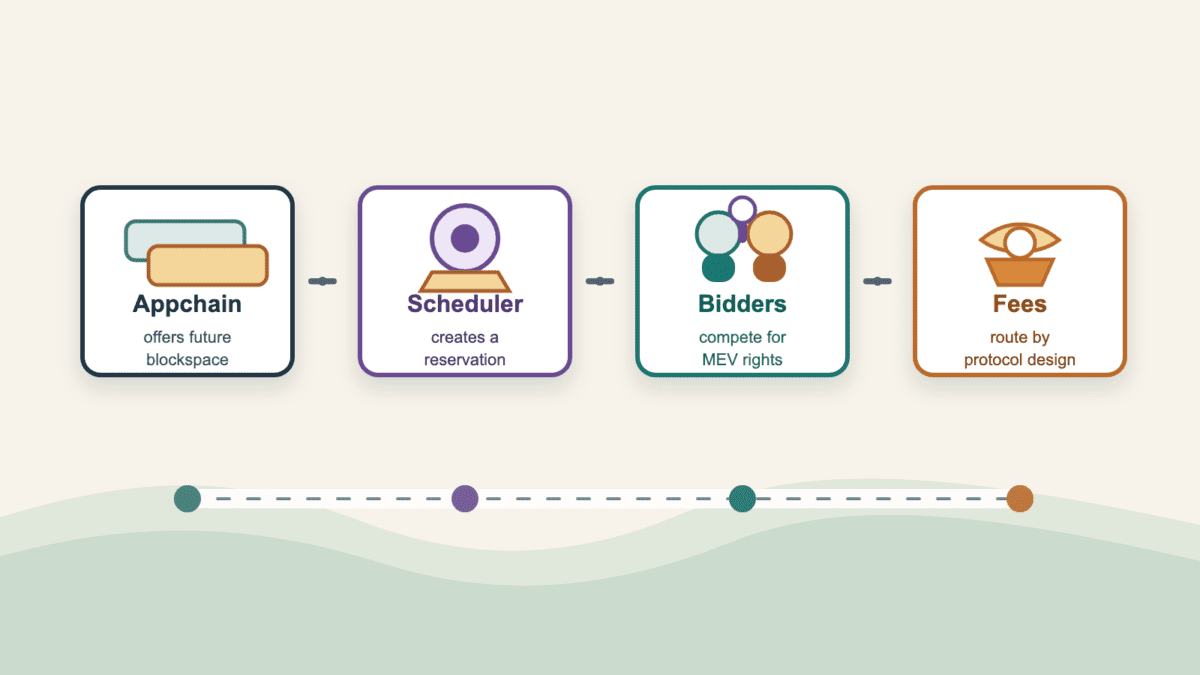
A Scheduler market in crypto is a marketplace for future blockspace rights. In the Cosmos version, it meant the proposed Interchain Scheduler. Appchains could offer future blockspace, bidders could compete for it, and the resulting revenue could be routed through the protocol design.
Blockspace is the scarce room inside a block. Transaction ordering can be valuable because the first, last, or best-positioned transaction may capture arbitrage, liquidations, or other trading advantages. That value is called MEV, short for maximal extractable value.
Here is the quick version before the jargon starts wearing a lab coat.
| Field | Plain Answer |
|---|---|
| Main term | Scheduler market |
| Cosmos name | Interchain Scheduler |
| Market item | Future blockspace and ordering rights |
| Main bidders | Searchers, arbitrageurs, and other MEV actors |
| Status | Proposed through ATOM 2.0, not launched through that proposal |
| Trader concern | Transaction ordering can affect price, slippage, and execution |
The phrase sits between two topics beginners often merge: blockchain infrastructure and token price narratives. A Scheduler market could be a real mechanism for pricing future execution rights. But the Cosmos proposal also became part of a bigger ATOM value-accrual story, so investors need to slow down.
So when someone says “Scheduler market,” ask which one they mean. If they mean Cosmos, they are probably talking about the old Interchain Scheduler proposal, not a live app you can open and use today.
Cosmos proposed a Scheduler market because appchain growth did not automatically create value for ATOM. The Cosmos model lets many chains run with their own validators, tokens, apps, and communities, while IBC helps them communicate across chains.
That design is powerful, but it creates a business-model headache for the Cosmos Hub. If another appchain succeeds, its own token, validators, and users may capture most of the benefit. ATOM holders can still care about the wider network, but caring does not pay the rent.
ATOM 2.0 tried to answer that gap by turning the Hub into more of an infrastructure-service layer. Instead of relying mainly on staking, governance, and brand gravity, the Hub would coordinate services that other chains might use. The Scheduler market was one proposed service.
The proposed answer had three moving parts:
The idea was simple: if cross-chain activity creates MEV, the Hub could help organize a market around that value. Part of the revenue could then support the Hub’s broader plans, including the Interchain Allocator.
That is the theory. The hard part was making that value reach ATOM in a real way.
Cosmos activity does not naturally become ATOM demand unless the design gives ATOM a clear role. That role could come through fees, security, liquidity, governance, collateral, or some other hard link. Without that link, appchains can be busy while ATOM still has a weak value-capture story.
That is why the Scheduler market is worth understanding even if you do not care about Cosmos governance history. It shows the exact problem many modular crypto networks face: shared technology can grow, while the token attached to the flagship chain still needs a reason to be held.
A Scheduler market was supposed to turn future blockspace into something that could be reserved, priced, and sold. Instead of leaving every valuable ordering opportunity to private deals, the protocol could create a more visible auction process.
Think of a busy DEX route across two chains. A searcher may know that buying on one chain and selling on another could earn a spread. But that trade only works if the searcher can get the right transaction ordering at the right time.
The proposed flow had four basic parts.
| Step | What Happens |
|---|---|
| Appchain offers blockspace | A chain makes some future blockspace available for reservation. |
| Scheduler creates the right | The market packages that access as a reservation or similar claim. |
| Bidders compete | Searchers bid for the right to use that future ordering opportunity. |
| Fees route back | Revenue flows according to the protocol design, rather than only through private deals. |
Some descriptions mentioned tokenized reservations, including NFT-like rights. That detail helps explain the design, but it should stay in its lane. This was about future execution access, not collectibles.
The harder part is settlement. Cross-chain trades depend on timing, liquidity, relayers, validators, and whether the promised blockspace is actually usable when the opportunity appears. A reservation is only valuable if the chain can honor it in a way bidders trust.
So a Scheduler market was not just an auction page. It would need governance, validator coordination, clear fee routing, and credible execution rules. Otherwise it becomes another nice diagram looking for a production system.
MEV is the value someone can extract by influencing transaction order, inclusion, or timing. A Scheduler market was designed around MEV because future blockspace is valuable only when transaction placement creates economic advantage.
Some MEV can be useful. Arbitrage can pull DEX prices back into line. Liquidations can keep lending markets solvent. Cross-chain routing can move prices closer together across venues.
But MEV can also hurt users. The classic example is a sandwich attack. A trader submits a large swap, a bot buys before the trade, lets the trader push the price up, then sells after. The user gets worse execution, and the bot pockets the difference. Delicious for the bot. Less charming for the person paying slippage.
| MEV Type | User Impact |
|---|---|
| Arbitrage | Can improve price alignment across venues. |
| Liquidation | Can protect lending protocols from bad debt. |
| Sandwiching | Can worsen execution for ordinary traders. |
| Private order flow | Can hide who captures value and why. |
The Scheduler market pitch was that transparent auctions could be cleaner than private validator-searcher deals. If someone is going to profit from ordering rights, the chain could price that right openly and route some proceeds back through the protocol.
That does not make all MEV harmless. It also does not make every auction fair. A market can still favor well-capitalized searchers, sophisticated infrastructure, or insiders who understand timing better than everyone else.
Here is the useful takeaway: a Scheduler market tries to expose and price MEV. It does not delete MEV. Anyone claiming otherwise is selling detergent to a grease fire.
The Scheduler market was proposed as part of ATOM 2.0, but that specific Cosmos Hub proposal did not pass. The Cosmos Hub Forum Proposal #82 page was posted on September 26, 2022, and is marked rejected.
That status is the part many older explainers blur. In late 2022, ATOM 2.0 bundled several ideas together, including the Interchain Scheduler, Interchain Allocator, liquid staking changes, governance councils, and issuance changes. The package drew attention because it tried to reshape ATOM’s role inside Cosmos.
It also drew pushback. Voters and community members debated scope, token issuance, governance design, treasury control, and whether too many changes were packed into one proposal. By November 2022, the rejection context had become central to any honest explanation of the Scheduler market.
> The Scheduler market should be read as a proposed ATOM 2.0 mechanism tied to a rejected governance package, not as proof of a launched Cosmos revenue product.
That does not mean nobody can ever build a scheduler-style market. Crypto ideas often return in smaller, cleaner, or renamed forms. But old ATOM 2.0 articles are not implementation evidence by themselves.
So if you see a claim that the Scheduler market is generating revenue, ask for the live system, contracts, governance approval, fee route, and chain-level documentation. A 2022 roadmap post is a clue. It is not a receipt.
A Scheduler market would have mattered to ATOM holders because it offered a possible revenue path for the Cosmos Hub. If the Hub coordinated a cross-chain blockspace market, fees could support treasury activity, public goods, or the Interchain Allocator concept.
The Interchain Allocator was supposed to use capital to support new Cosmos chains and collaborations. In the full ATOM 2.0 vision, Scheduler revenue and Allocator activity could reinforce each other: more chains create more cross-chain opportunities, which create more scheduler demand, which could fund more growth.
That sounds tidy. Crypto flywheels often do on paper.
The investor caveat is that fee capture is not the same as token demand. A protocol can earn revenue without supporting its token price in a direct or durable way. Holders need to know who receives the fees, what asset fees are paid in, whether ATOM is required, and whether governance can redirect the flow.
A Scheduler market also would not fix every ATOM concern by magic. These checks matter more than the pitch deck:
This is where old value-capture narratives can become exit liquidity for late believers. A proposed mechanism may be clever, but investors still need a live route from usage to token demand.
Staking APY adds another layer of confusion. A high nominal yield can still disappoint if issuance, sell pressure, or weak demand drags the token down. Service revenue could have helped the ATOM story, but only if the design turned that revenue into something holders could actually feel.
A Scheduler market is only one Cosmos-related idea, and it should not be merged with every newer tool or service in the same conversation. Shared security, routing, MEV tooling, and liquidity auctions solve different problems.
Cosmos discussions often bundle many terms into one hopeful cloud. The result is confusion: a user sees Interchain Security, Skip, Hydro, Forge, IBC, and Scheduler in the same thread, then assumes they are all versions of the same value-accrual machine.
They are not.
| Concept | What It Solves |
|---|---|
| Scheduler market | Prices future blockspace and ordering rights. |
| Interchain Security | Lets another chain use Cosmos Hub validator security. |
| Skip | Relates to routing, MEV, and transaction-flow infrastructure. |
| Hydro | Relates to liquidity allocation and auction-style coordination. |
| IBC | Lets compatible chains communicate and move assets. |
That separation still holds when the Hub itself is active. Validator activity can show a live network, but it does not prove the Scheduler market launched.
The Scheduler market is closest to MEV and blockspace pricing. Interchain Security is closer to security rental. Skip is closer to transaction flow and routing infrastructure. Hydro is closer to liquidity allocation.
The boundaries can blur because real crypto systems interact. A chain might care about security, liquidity, routing, and MEV at the same time. But a value claim should still identify the exact mechanism doing the work.
If someone says a newer Cosmos tool proves the Scheduler market thesis, slow down. It may support the same broad question around value capture, but it does not revive the rejected ATOM 2.0 Scheduler by default.
Scheduler market risks start with implementation. A proposal is not a product, and a clever market design can fail if validators, appchains, searchers, and users do not coordinate around it.
Governance risk is just as important. ATOM 2.0 showed how a large package can attract support for one module and opposition to another. If the market, treasury, issuance, and governance changes travel together, voters may reject the whole bundle.
MEV risk also stays alive inside an auction design. Transparent pricing can reduce hidden side deals, but it may also concentrate opportunities among the best-funded searchers. Ordinary users can still face sandwiching, bad routing, or worse execution if protections are weak.
Watch for these misconceptions when you see Scheduler market claims:
The investor risk is narrative drift. A rejected idea can keep circulating because it sounds technical, plausible, and bullish. That is fertile ground for bagholder risk when holders repeat an old mechanism after the underlying plan failed to ship.
Capital also moves on. Even when an infrastructure idea remains interesting, market attention can follow crypto rotation into fresher stories with clearer catalysts. That does not make the old idea worthless. It means the old idea needs fresh evidence.
Read Scheduler market claims in three pieces: mechanism, governance, and token value. If one part is missing, the thesis is incomplete.
Start by asking whether the claim describes a concept, a rejected Cosmos proposal, or a live market. Those are three different things, and mixing them creates most of the confusion around the Scheduler market.
Then check the chain context. A generic blockspace auction on another network is not automatically the Cosmos Interchain Scheduler. A Cosmos governance thread is not automatically a launched product. A token-price argument is not automatically supported by protocol revenue.
Next, separate evidence from narrative. A real Scheduler market claim should point to something concrete: approved governance, running infrastructure, fee routing, or documentation that explains who can bid and who receives the proceeds. If the claim only points back to ATOM 2.0 material, you are looking at historical context.
Use these checks before you let a Scheduler market claim shape your research:
If your thesis depends on the Scheduler market, make it prove itself. A researched conviction play needs more than a recycled ATOM 2.0 slide and a hopeful thread.
The same check helps with ATOM claims. Ask whether ATOM is required, whether fees reach holders or the treasury, and whether appchains have a clear reason to participate. If those answers are vague, the value-capture story is still vague too.
The concept still has value because blockspace, ordering rights, and MEV are live DeFi problems. But the Cosmos Scheduler market is best understood as a historical proposal that teaches a current market-structure lesson.
In Cosmos context, yes. The Scheduler market usually refers to the proposed Interchain Scheduler from the ATOM 2.0 package. Outside that context, someone might use the phrase more generally for a market that prices future blockspace or ordering rights.
Yes. The Scheduler market was one of the major ATOM 2.0 ideas, alongside the Interchain Allocator and other governance, issuance, and Hub-service proposals. It was meant to help the Cosmos Hub capture revenue from cross-chain MEV and future blockspace demand.
The specific Scheduler market from ATOM 2.0 did not launch through Proposal #82 because that proposal was rejected. A future Cosmos or non-Cosmos project could still build a scheduler-style market, but old ATOM 2.0 material should not be read as launch proof.
A Scheduler market would make money by auctioning future blockspace or ordering rights to bidders who expect to earn MEV. In the Cosmos proposal, that revenue could then be routed through the protocol design, potentially supporting Hub-related activity.
No proposal alone makes ATOM a good investment. The Scheduler market could have been one possible value-capture path, but investors still need live usage, clear fee routing, token demand, governance support, and risk controls before drawing any price conclusion.
No. Some MEV, like arbitrage, can help align prices across markets. Other MEV, like sandwiching, can hurt traders by worsening execution. The hard part is designing markets that expose useful MEV while limiting abusive extraction.