Physical Address
304 North Cardinal St.
Dorchester Center, MA 02124
Physical Address
304 North Cardinal St.
Dorchester Center, MA 02124


Secondary unlocks explained without the panic trade.
A secondary unlock is a later scheduled release of previously locked crypto tokens that may become transferable, claimable, sellable, stakeable, or usable.
The phrase is thinner than it sounds. A project, exchange page, governance post, or token dashboard may use secondary unlock for a second release tranche after an initial unlock. It is not a universal protocol feature.
That makes the term useful and annoying. The label points to a real supply event, but the chart still cares about three things: how many tokens become liquid, who receives them, and whether buyers are deep enough to absorb the pressure.
A secondary unlock in crypto is a later release of tokens that were already allocated but could not yet move freely. The tokens may belong to a team, early investors, advisors, public-sale buyers, a treasury, grant program, or user-reward pool.
The word “secondary” usually means the event happens after an initial release. It does not mean the tokens are second-class, less real, or created from nowhere.
You will usually see the label in a few places:
The important word is “may.” A secondary unlock can make tokens claimable but not instantly tradable. It can make tokens transferable but still subject to staking rules. It can also release tokens to a project wallet that later grants, sells, or deploys them.
So the phrase starts the investigation. It does not finish it. Ask what changes after the unlock. If tokens become liquid and the recipients are likely sellers, risk rises. If the tokens fund grants, market making, staking rewards, or treasury operations, the immediate sell pressure may be lower. Generic labels are not enough here. The project’s actual schedule, contract rules, wallet movements, and recipient categories decide what the event means.
A secondary unlock fits inside a token vesting schedule. Vesting is the plan that controls when allocated tokens become available over time.
The awkward part is ownership. Someone may already own an allocation, but they may not be able to transfer or sell it yet. That gap between “allocated” and “liquid” is where vesting does its work.
Here is a simple lifecycle:
| Stage | What Changes |
|---|---|
| Token Generation Event | The token launches or begins its official supply schedule. |
| Initial Unlock | The first tranche becomes available to defined recipients. |
| Lockup | Some holders own allocations but cannot freely move them. |
| Secondary Unlock | A later tranche becomes claimable, transferable, sellable, stakeable, or usable. |
| Linear Vesting | Smaller releases continue on a recurring schedule. |
The exact flow depends on the project. Some schedules start with a small public release, then a long no-release lockup. Others release public-sale tokens first while team or investor allocations wait.
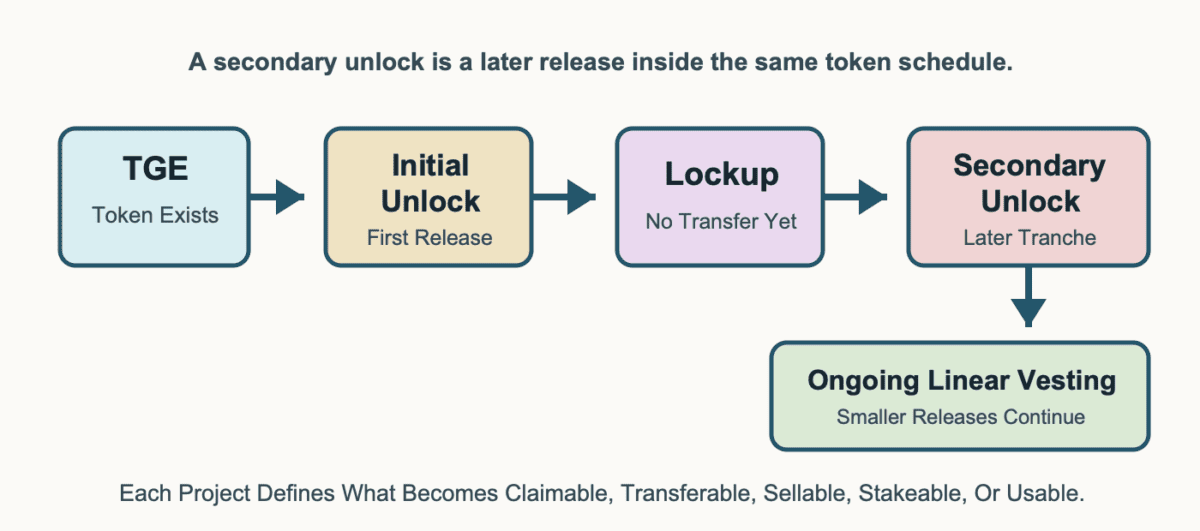
A secondary unlock can also sit after a cliff. Imagine a token launch with a small initial release, a 12-month lockup, then a second tranche for early contributors. After that, the remaining allocation may drip out monthly.
That timeline changes the risk because the same token count can mean different things. A one-time release after a long lockup can hit sentiment hard. A smaller recurring release may create steadier pressure that traders get used to seeing.
A secondary unlock is not the same as every other vesting term. It is one label for a later release, while the other terms describe timing, shape, or transferability.
This is where many holders get crossed up. A dashboard may show an “unlock,” a project may call it a “claim,” and a governance post may describe a “vesting tranche.” The market reads all of that through one lens: how much supply can move now?
Use this term map before reacting:
| Term | What It Usually Means |
|---|---|
| Initial Unlock | The first release of allocated tokens. |
| Secondary Unlock | A second or later release after the first tranche. |
| Cliff Unlock | A batch release after a period with no releases. |
| Linear Vesting | Gradual releases over time, often monthly or daily. |
| Tranche | One scheduled batch inside a larger release plan. |
| Claim | A user action that pulls unlocked tokens into a wallet. |
| Transferability | The ability to move, sell, stake, or use tokens. |
Apply the labels in order:
A secondary unlock can also be a cliff unlock. If the second tranche arrives after a long no-release period, both labels may fit.
But a secondary unlock can also be one scheduled release inside a longer linear plan. So project-specific wording wins. The label tells you where to look. The project terms and contract rules tell you what happens.
A secondary unlock can move price because it can increase tradable supply. If more tokens can sell into the same demand, the market may need a lower price to clear that supply.
That does not mean every token falls on the unlock date. It means the event creates a sell-pressure question. The answer depends on float, volume, depth, recipient behavior, and expectations.
Run these checks before assuming the chart must dump:
Start with unlock-to-float. A release equal to 1% of total supply can still be large if only a small share is already circulating. Then compare the release with daily volume and order-book depth. A token can show heavy volume but still have thin bids, which is how late buyers become exit liquidity for better-timed sellers.
Keyrock’s token-unlock research reported that 90% of unlocks in its dataset created negative price pressure. That framing is useful: supply amount counts, but seller behavior decides how supply reaches the market. Price can also move before the official unlock as traders front-run calendar risk, recipients hedge, and market makers prepare inventory.
A secondary unlock does not always cause a dump because markets price expectations before events. If everyone already feared the unlock, sellers may have crowded the same trade early.
Demand can also absorb new supply. A strong listing, active market makers, real usage, or a powerful story can pull buyers in while tokens become liquid. That does not erase dilution risk, but it can delay or soften the hit.
Several conditions can make a secondary unlock less immediately ugly:
That last point cuts both ways. Story-driven demand can absorb supply for a while. It can also vanish when the story gets stale. If the only buyer is hype, the unlock is not gone. It is waiting for attention to thin.
Think of the “nothing happened” outcome as a data point, not proof that unlocks are harmless. A secondary unlock can fail to dump on day one and still create future pressure as recipients sell slowly, hedge, or move tokens toward exchanges.
The clean takeaway is boring but useful: do not turn one date into one mechanical trade. Track supply, recipients, liquidity, and market positioning together.
The recipients during a secondary unlock are the wallets or groups assigned that tranche. Their incentives can change risk more than the raw token count.
Team tokens, private-sale tokens, advisor tokens, public-sale claims, treasury releases, grants, market-making allocations, staking incentives, and community rewards all behave differently. Calling all of them “new supply” is true but too blunt.
Use recipient type to estimate likely behavior:
| Recipient Group | Typical Risk Question |
|---|---|
| Founders Or Team | Are tokens compensation, and do recipients need liquidity? |
| Private Investors | Are early buyers deeply in profit or already hedged? |
| Advisors | Is the allocation small, disclosed, and spread out? |
| Public Sale Buyers | Are many users likely to claim and sell quickly? |
| Treasury | Will tokens fund operations or move toward exchanges? |
| Grant Fund | Are releases tied to grants, liquidity, or incentives? |
| Market Makers | Are tokens for depth, loans, or inventory management? |
| Staking Rewards | Are users likely to restake or sell rewards? |
A team unlock can create heavy pressure if many individuals want to monetize years of work. A private-investor unlock can be calmer if holders are hedged or selling through negotiated routes.
A treasury or grant release is different again. Those tokens may fund operations, builder grants, liquidity programs, or user incentives. They can still dilute holders, but the immediate seller may not be a profit-taking insider.
The cleaner setup names the recipients, leaves wallet behavior traceable, and explains what the tranche is for. Vague buckets and invisible wallets make the market guess. Markets are not famous for guessing gently.
A secondary unlock is risky when the newly available supply is large relative to liquid demand. The headline percentage is only one input.
Start with the denominator. “Five million tokens” means little until you compare it with circulating supply, average volume, and real depth. A smaller release can hurt more on a thin token than a larger release on a deep market.
Work through the risk stack in this order:
Then ask what your position needs. Holding through a known unlock can make sense if you have a clear thesis, size control, and a reason to expect demand after the event. That is closer to a conviction play than a shrug.
But “I do not want to miss a pump” is not a thesis. It is just fear with better marketing. The useful habit is to separate calendar risk from trading advice. An unlock date can tell you when supply risk rises. It cannot tell you the exact candle, low, or bounce.
Common secondary unlock red flags point to unclear supply, hidden sellers, weak liquidity, or unsafe claim paths. None proves fraud alone, but several together deserve respect.
The worst setup is not just a large release. It is a large release with vague recipients, thin markets, and a community treating screenshots as proof. That is how a tokenomics event becomes a social panic machine.
Watch for these warning signs:
Low float plus high FDV deserves special care. If most supply is locked, the live price may reflect a small slice of supply. When more tokens enter circulation, slower holders can get trapped as liquidity fades and confidence breaks.
That is how a trader becomes a bagholder without one dramatic rug pull. The chart just keeps asking for more buyers while unlocked supply keeps looking for exits. Red flags are not sell commands. They are reasons to reduce confidence, resize exposure, or wait for cleaner information.
You verify a secondary unlock date by checking official sources first, then comparing dashboards and onchain evidence. A random calendar screenshot is not enough.
Start with the project’s tokenomics page, governance forum, official announcement, vesting contract, or exchange notice. Then use unlock dashboards as helpful trackers, not as final truth. Dashboards can rely on assumptions, stale data, or simplified labels.
Use this source-quality map:
| Source | What It Can Prove |
|---|---|
| Official Tokenomics Page | The intended schedule and allocation logic. |
| Governance Proposal | Approved changes, votes, or release conditions. |
| Vesting Contract | Onchain timing and claim mechanics when public. |
| Unlock Dashboard | A useful calendar view with possible assumptions. |
| Exchange Notice | Trading, deposit, withdrawal, or claim support. |
| Recipient Wallets | Whether tokens moved after release. |
Claim portals need extra caution. Verify the domain through official channels, inspect the wallet prompt, and avoid approvals that ask for broad token permissions. If a secondary unlock requires a wallet action, handle it like any other signing risk and keep your crypto wallets separated by purpose when possible.
One more habit helps: type the official domain yourself instead of clicking a social link. Unlock windows attract fake portals because urgency makes people sloppy. The scam does not need to predict the chart. It only needs you to sign once.
If the source is estimated, say so in your notes. Estimated unlock dates can still be useful, but they should not carry the same weight as a contract, official post, or exchange notice.
Start secondary unlock research by turning the headline into a checklist. The goal is not to predict one candle. The goal is to understand what can become liquid and who controls it.
A useful workflow separates timing, transferability, and likely seller behavior. If one piece is missing, the read is still incomplete. The cleanest notes are boring: source, amount, recipient, liquidity, wallet movement, and date checked. Boring is fine. A secondary unlock is exactly the kind of event where a neat rumor can outrun the facts.
Use this workflow before reacting:
Then write down what would change your view. Keep the triggers simple:
Then size your decision around uncertainty. A secondary unlock is not always doom, and it is not free supply magic either. It is a supply event with incentives attached. If the evidence is mixed, reduce certainty before you change position size. Read the incentives before the chart forces the lesson.
Secondary unlock means a second or later scheduled release of previously locked crypto tokens. The release may make tokens claimable, transferable, sellable, stakeable, or usable, depending on the project’s rules.
A secondary unlock is part of vesting, but it is not the whole vesting schedule. Vesting describes the broader release plan, while the secondary unlock is one later tranche inside that plan.
A secondary unlock does not always lower price immediately. Price impact depends on unlock size, circulating supply, liquidity, recipient behavior, demand, and whether traders already sold before the event.
You should not sell before a secondary unlock just because the date exists. Check the tranche size, recipient type, liquidity, prior price action, and your own risk plan before making any trade.
You can check a secondary unlock schedule through official tokenomics pages, governance posts, vesting contracts, exchange notices, and reputable unlock dashboards. Use dashboards for tracking, then confirm important dates through official sources.
Secondary unlock portals are safe only when the domain, contract, and wallet prompt are verified. Fake claim portals often copy real events, so avoid social links and never sign broad approvals you do not understand.