Physical Address
304 North Cardinal St.
Dorchester Center, MA 02124
Physical Address
304 North Cardinal St.
Dorchester Center, MA 02124


A plain-English guide to session key permissions and wallet risk.
A session key is a temporary, scoped crypto wallet permission that lets an app sign approved actions without using your main key every time.
That sounds tidy, but the phrase carries two meanings. In classic cybersecurity, a session key protects one encrypted communication session. In crypto wallets, it usually means delegated signing authority for an app, game, bot, or smart account. The money question is what it can do, who enforces the limit, when access ends, and how fast you can shut it off.
A session key in crypto is a temporary signing permission for a wallet, smart account, or app session. It lets approved actions happen without forcing the main wallet key to sign every small step.
Think of a blockchain game that needs many tiny moves. If every move opens a wallet popup, the game becomes a paperwork simulator with nicer graphics. A session key can let the game sign only approved moves for a short time.
That split gives a crypto session key three jobs:
That does not make it a new master key. The main wallet, smart account, or account owner should still grant the session, define its boundaries, and revoke it when the app no longer needs access.
The last point is the real one. A session key is useful only when the limits are specific and enforceable. Crypto session keys show up near smart accounts, account abstraction, embedded wallets, GameFi apps, trading bots, and AI agents. In each case, the goal is similar: make crypto feel less like signing paperwork every twelve seconds while avoiding full wallet access.
But a session key is not magic dust. It should have a narrow blast radius. If the app can spend any token, call any contract, and run for months, the “session” part is doing a lot of unpaid branding work.
So the first question is not whether the feature sounds modern. It is whether the wallet can show the exact permission, enforce it, and turn it off without drama.
Session key meaning depends on the context. In cryptography, the term usually points to a temporary key used to protect one communication session. In crypto wallets, it points to limited signing authority for wallet actions.
That distinction prevents a common mix-up. A TLS session key helps secure data between systems. A crypto wallet session key may approve on-chain actions that can move assets or change permissions.
The risk question changes with the setting. In a browser session, the concern is usually private data moving between systems. In a wallet session, the concern is signed action: what can be called, what can be spent, and which account is exposed.
| Context | Plain Meaning |
|---|---|
| General cryptography | A temporary key protects one secure communication session. |
| Crypto wallets | A delegated key signs only approved wallet or app actions. |
| What the key does | It either encrypts communication or authorizes limited wallet activity. |
| What expires | The secure session, the delegated wallet permission, or both. |
| Main risk | A compromised key can expose data, funds, permissions, or app actions. |
The shared idea is temporary access. The job is different. A wallet-focused definition cannot stop at HTTPS or TLS. That meaning is correct in computer security, but it misses the money-facing wallet question.
So use the classic meaning as background, then focus on wallet scope. In crypto, a session key is usually about what another signer can do for your account.
That makes the term easy to misuse. If someone says “session key” without explaining scope, expiry, validation, and revocation, they have named the tool but not the safety model.
A crypto session key works by separating root authority from routine action. Your main wallet, smart account, hardware signer, or account owner approves a limited session. The app then uses that delegated key only inside the approved boundaries.
The clean version has a clear flow. First, the wallet asks for permission. Then the user checks scope, duration, contract access, token limits, gas rules, and revoke controls. After approval, the app can sign covered actions until the session expires or gets revoked.
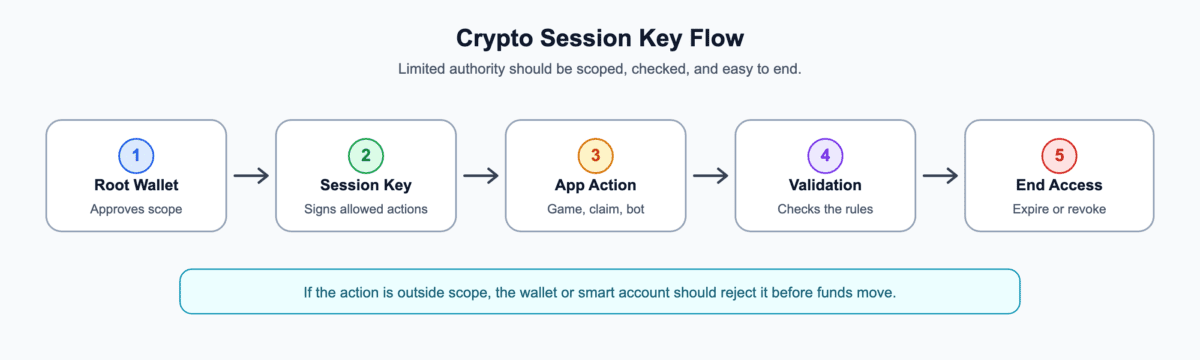
The validation step is where the promise becomes real. A smart account, wallet module, plugin, co-signer, policy engine, or app contract needs to check whether the action fits the rules.
In ERC-4337 smart-account flows, session-key and delegation patterns are still not one single universal wallet behavior. ERC-4337 covers session keys as wallet-specific implementation patterns rather than a fully standardized user path. That means two apps can both say “session key” while enforcing very different limits.
A practical flow looks like this:
If the key is compromised, the attacker should be stuck inside the same limits. If those limits are vague, the attacker gets more room. That is why the permission screen is not decoration. It is the whole point.
Session key permissions should limit time, value, destination, and action type. The more specific the permission, the easier it is to understand what can happen while the session is active.
Good session-key design starts with plain boundaries. A user should not need to read contract bytecode to learn whether a game can sign moves, a bot can spend tokens, or an agent can send stablecoins.
In real crypto wallets, the permission screen should turn abstract access into concrete limits. The user should see the app, contract, asset, cap, and expiry before approving anything. If those details are hidden, the session key may be narrow in theory and fuzzy where it counts.
Before approving a session key, check whether the permission screen explains these limits:
The phrase “limited permission” is not enough. A limit needs an enforcement point. That may be smart-account validation, a wallet module, a contract rule, a co-signer policy, or another wallet-specific system. Offchain checks can help, but they also add trust if a server is supposed to block bad actions.
The best user-facing session key makes boring facts visible. Duration, cap, allowed contract, and revoke path should appear before approval. Boring is good here. Boring is how money survives the interface.
Session keys fit where crypto apps ask users to choose between security friction and reckless convenience. Repeated signatures are safer than blind automation, but they can make normal app use miserable.
A clear example is GameFi. A player might approve a session key for one hour, only for one game contract, with no token spending. The game can sign moves without interrupting every turn, but it cannot empty the wallet.
Use cases make the trade-off easier to see:
DeFi has a different shape. A session key might support bounded reward claims, small dollar-cost averaging orders, or app-native rebalancing under a cap. That can help with repetitive work, but it should not become unattended control over a serious portfolio.
AI agents make the idea louder. An agent wallet might pay for data, run small tasks, send capped stablecoin amounts, or execute allowlisted actions. Gasless UX gets mixed into this story too, but a session key does not make blockchain costs vanish. Someone still pays through an app, relayer, paymaster, or sponsor flow.
The pattern is not “let software do anything.” It is “let software do this narrow thing for this short time.” That sentence should survive every session-key pitch.
Session key risks start when delegated access is wider than the user understands. A session key can be compromised, abused by a malicious app, or paired with old token approvals that already expose funds.
Start with wallet control. Your root wallet or smart account should remain the authority that grants and revokes access. If the wallet does not show active sessions, permissions, expiry, or revoke controls, the setup is hard to trust with meaningful funds.
Before approving a session key, run this checklist:
Security failures usually come from the unglamorous parts: access control, signature validation, and contract rules that accept more than they should. The takeaway for session keys is blunt: scoped permission only helps when the wallet or account contract actually validates the scope correctly.
The safer path begins with wallets that make signing and revocation understandable. A wallet does not need fancy branding. It needs clear prompts, readable permissions, and an exit door that is not hidden behind seven tabs.
Malicious contracts deserve special attention. A session key cannot save you from an approval that lets a bad contract move assets outside the intended session. If a project is already built to steal or trap funds, hard rug risk remains a separate problem.
Poor previews add another risk. If the wallet cannot explain what the session can sign, the user is trusting a label instead of a rule. Long-lived sessions age badly too, because a weekend test permission can become stale risk months later.
Session keys are easy to confuse with nearby wallet concepts. They all deal with access, but they control different things and fail in different ways.
The useful split is simple. A private key is root authority. A token approval gives a spender rights over tokens. A burner wallet isolates funds. A passkey may authenticate a user. A session key delegates limited signing under wallet or account rules.
| Concept | What It Controls |
|---|---|
| Private key | The root ability to authorize wallet actions. |
| Session key | A limited signer for approved actions and time windows. |
| Token approval | A spender’s permission to use specific tokens. |
| Burner wallet | A separate wallet funded with a small amount. |
| Passkey | A login or signing credential tied to a device or account. |
| API key | App or exchange access, usually outside normal wallet signing. |
The table shows why one security habit does not replace the others. A passkey can help you log in or approve with a device. It does not automatically limit on-chain spending. A burner wallet can cap loss by holding less value, but it does not prove the app is safe.
A quick failure-mode check helps:
Token approvals are especially important. A session key may be narrow, while an old token approval remains broad. If a spender already has high allowance, a new session can feel safer than the wallet really is.
Different tools. Different blast radius.
A session key makes sense when the action is low value, repetitive, app-native, short-lived, and easy to revoke. It should reduce friction without turning the wallet into unattended capital.
Good fits are usually boring. Signing game moves for one session. Claiming small rewards. Paying a capped subscription. Running a tiny DCA under a fixed amount. Letting an agent make allowlisted payments from a small wallet.
A clean test is reversibility. If the session does the wrong thing, can the damage stay small? Can you revoke access quickly? Can you see what happened afterward? If the answer is no, the convenience is getting ahead of the controls.
Stronger sessions share a few traits:
A session key does not make sense when the app asks for broad portfolio authority. Long-lived access, unknown contracts, unlimited token spending, vague AI-agent permissions, and weak previews should slow you down.
The same applies when a wallet hides enforcement. If you cannot tell who checks the rule, you cannot tell how much trust the session needs. Use session keys for narrow convenience, not open-ended control.
That line is especially important for bots and agents. Automation can make small tasks less annoying, but it also moves mistakes faster. Keep the first session small enough that a bad rule teaches a lesson instead of writing the lesson in your balance.
No. A session key should be a limited signer, while a private key is root wallet authority.
If a session key is implemented well, it can sign only approved actions for a limited time or scope. If the root private key is compromised, the attacker may control the whole wallet. That is why the distinction is not cosmetic.
Yes, a session key can expose funds if permissions are broad, buggy, malicious, or poorly enforced.
The safer version has spending caps, allowlists, short expiry, clear transaction previews, and an obvious revoke path. If the session can call unknown contracts or spend any token, that is high risk.
No. Ethereum and EVM account-abstraction content dominates search, but scoped signing patterns also appear around Solana, Starknet, and other wallet systems.
The exact implementation changes by chain and wallet. Focus on the user-facing controls: scope, expiry, caps, validation, and revocation.
A session key delegates signing authority under wallet or account rules. A token approval gives a spender permission to use specific tokens under allowance rules.
Both can create risk. They can also overlap. A narrow session key does not erase an old broad token approval, so check both before trusting the setup.
No. Session keys can help make app use smoother, but they do not remove network costs by themselves.
Gasless UX usually needs a sponsor, paymaster, relayer, or app-funded flow. Someone still pays the fee, and the payment rules can affect which actions are allowed.
Use session keys for bots or AI agents only when the scope is small, capped, allowlisted, visible, and easy to revoke.
Do not hand broad portfolio authority to software you barely understand. Start with a low-value wallet, fixed recipients, small limits, and transaction previews before scaling any automated flow.
Start with the smallest useful session. If an app offers a session key, approve only the permission needed for the action in front of you.
Then check how the session ends. Expiry is useful, but manual revocation matters too. A wallet UI that shows active sessions and lets you revoke them is much easier to trust than one that makes you hunt through vague settings.
Look for boring controls before you continue:
Then test with low value. Use a small wallet or small balance first, especially for games, bots, reward tools, and agent wallets. Revoke old sessions when you stop using an app, and review token approvals because they can expose assets after the session key expires.
If the first test works, scale slowly. Keep large holdings away from experimental sessions, and do not let a convenience feature become the default path for every wallet action. Session keys are best when they reduce a known irritation without creating a new blind spot.
Keep one habit after that: audit active permissions on a schedule. Old sessions, old approvals, and abandoned apps tend to pile up quietly. The cleanup is not glamorous, but neither is explaining why a tiny shortcut still had access months later.
The best session key feels almost dull. It says what it can do, does only that, and disappears when the job is finished. In wallet security, dull is a feature.