Physical Address
304 North Cardinal St.
Dorchester Center, MA 02124
Physical Address
304 North Cardinal St.
Dorchester Center, MA 02124


ETH boomer slang, risks, and token confusion.
An “ETH boomer in crypto” is a casual label for someone who stays loyal to Ethereum and is skeptical of newer-chain hype.
The phrase is usually a joke, insult, or self-aware identity label rather than an official investor type. On its own, it says nothing about whether ETH, Solana, BOOMER, or any related token is worth buying.
Context does the real work. Sometimes the label points to real Ethereum tradeoffs around speed, fees, layer 2 networks, and institutional acceptance. Other times, it is only a shortcut for dismissing someone who prefers Ethereum’s older, larger ecosystem.
An ETH boomer means a crypto user who still sees Ethereum as the serious base layer while newer-chain supporters see that loyalty as dated. The word “boomer” does not have to refer to actual age.
The label usually carries one of three tones. A Solana trader may use it as an insult. An Ethereum supporter may use it as a joke about staying patient with slower infrastructure. A critic may use it to describe someone who defends Ethereum even when the user experience is weak.
The ETH boomer meaning is cultural rather than technical. It points to preferences, not credentials:
Those preferences do not prove the person is right. They only explain why an Ethereum supporter can sound conservative in a market that rewards speed, novelty, and viral narratives.
ETH boomer, ETH maxi, ETH holder, and Boomer Coin are different ideas that often collide in social posts, converter pages, and token data. The distinction is useful because one is slang, one is an identity, one is simple ownership, and Boomer Coin is a separate token name.
Use this split before reacting to a post, chart, or converter result:
| Phrase | Plain Meaning |
|---|---|
| ETH Boomer | Slang for an Ethereum-loyal user seen as old-school, cautious, or too attached to ETH |
| ETH Maxi | Someone who strongly believes Ethereum is the best or dominant crypto ecosystem |
| ETH Holder | Anyone who owns ETH, with no required ideology |
| Ethereum Bull | Someone optimistic about ETH or Ethereum adoption |
| Crypto Boomer | A broader label for someone seen as old-school in crypto culture |
| Boomer Coin | A separate token name, not the slang meaning |
| BOOMER To ETH | A token conversion result showing BOOMER priced in ETH |
| Bitcoin Boomer | A similar joke aimed at Bitcoin loyalists or older-asset supporters |
An ETH boomer can also be an ETH maxi, but the terms are not identical. A maxi usually makes a stronger claim about Ethereum’s dominance. The boomer label often says more about tone, patience, and cultural preference.
The token confusion is separate. CoinGecko and Coinbase both have BOOMER-to-ETH style pages, which can make a slang phrase look like token data. Those pages are market-data or converter pages, not definitions of the ETH boomer label.
Keeping the slang separate protects beginners from a common mistake. A joke should not automatically become research into a similarly named token.
The visual below keeps the slang, identity, ownership, and token lanes separate before one phrase turns into a thesis or trade.

*ETH boomer is the cultural label. BOOMER token pages are a separate market-data lane.*
People call Ethereum boomer crypto because Ethereum is now old by crypto standards, institutionally recognizable, and built around slower infrastructure choices than some newer chains. The phrase can mean outdated, mature, conservative, or battle-tested.
Ethereum launched years before many high-speed chains that dominate today’s retail attention. Its main chain prioritizes settlement and decentralization more than cheap mass activity on the base layer, while much of the scaling work happens through layer 2 networks.
The culture clash is obvious. A user who wants one fast chain with low fees may see Ethereum as clunky. A user who values settlement guarantees, deep liquidity, and long-running developer infrastructure may see the clunkiness as the cost of a stronger base layer.
The label lands partly because Ethereum can now look familiar to institutions. The SEC order in May 2024 approved exchange rule changes to list and trade shares of ether-based exchange-traded products, which made ETH easier for traditional finance to categorize.
The tone is clear in ordinary posts. If someone says, “Only ETH boomers still think L2s fix everything,” the claim is not really about age. It is a criticism of the Ethereum scaling story and the people who defend it too quickly.
The ETH boomer crypto argument for Ethereum is that Ethereum does not need to win every speed comparison to stay important. Supporters see Ethereum as settlement, collateral, developer infrastructure, and a base for many connected app ecosystems.
The pro-Ethereum case has substance. Ethereum has deep DeFi history, broad wallet support, a large developer base, and the EVM network effect. ETH is also used for gas, staking, and collateral across many parts of the ecosystem.
Ethereum loyalists often point to strengths that are hard to rebuild quickly:
The layer 2 point is central. Ethereum’s layer 2 explainer describes L2s as networks that help scale Ethereum by processing transactions away from the base layer while remaining connected to it.
Fees are where the roadmap becomes measurable. The Ethereum Foundation’s Pectra post reports that blobs have reduced L1 fees for L2s by 10-100x since Dencun.
Recent upgrades also give Ethereum loyalists concrete examples to cite. The Ethereum Foundation’s Dencun announcement included EIP-4844, the blob-data change aimed at reducing layer 2 costs. The Ethereum Foundation’s Pectra announcement included EIP-7702, which moved account functionality closer to smart-account-style user experience.
The fair version of the argument is not that Ethereum is perfect. It is that Ethereum’s slower path may still serve users who care about liquidity, settlement, security assumptions, and long-lived infrastructure.
The ETH boomer label often sticks when Ethereum supporters dismiss real user complaints too quickly. The strongest criticism is that a secure roadmap does not erase bad experiences with fees, bridges, fragmented apps, or confusing layer 2 choices.
Newer-chain users often care less about settlement theory and more about whether a wallet action is cheap, fast, and simple. If Ethereum supporters answer every complaint with roadmap language, they can sound detached from the user experience.
The complaints usually land in a few places:
| Criticism | Practical Consequence |
|---|---|
| L1 fees can spike during busy periods | Users may avoid Ethereum if basic actions feel too expensive |
| L2 activity feels fragmented | Assets, apps, and liquidity can sit across several networks |
| Bridges add risk | Moving assets between networks introduces extra trust and operational steps |
| Solana feels simpler | One-chain UX can be easier for newer users to understand |
| Low fees reduce burn narratives | Cheap activity can weaken simple ETH value-capture stories |
| ETH can underperform narratives | Holders may become defensive when price lags attention |
| Governance moves slowly | Slow coordination can frustrate users who want rapid product changes |
| Social defensiveness turns people off | Tribal replies can hide legitimate tradeoffs |
Lower fees are good for users, but they can still change how people discuss ETH value capture. The value-capture tension is why the debate often becomes emotional.
A stronger reply names both sides. Ethereum supporters can defend settlement and L2 scaling while still admitting that fragmented UX, bridge anxiety, and slow coordination are real problems.
Read ETH boomer posts as social signals first, not evidence. The label usually tells you how someone wants the argument to feel before it tells you whether the technical claim is true.
Crypto tribal language compresses hard tradeoffs into easy teams. ETH boomer, Solana kid, BTC maxi, degen, and bagholder can all turn a useful debate into a status fight.
Use this checklist before trusting a viral claim:
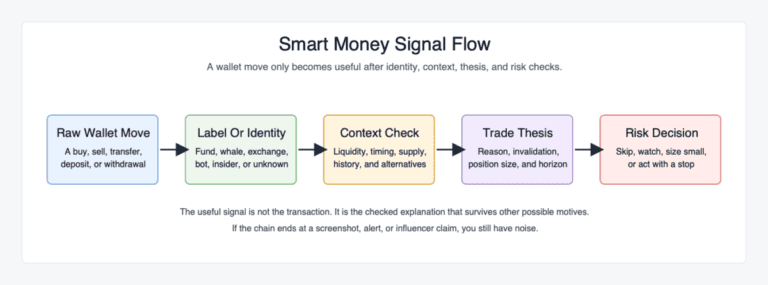
The flow below slows the reaction down before any asset claim turns into a trade idea.

*Read the label, isolate the claim, then check evidence and pressure.*
For example, “ETH boomers hate Solana because it is faster” is too vague to be useful. A better claim would compare fees, outages, decentralization tradeoffs, liquidity depth, app quality, and bridge assumptions.
Slowing down keeps the meme in its lane. A label can reveal a tribe, but it cannot prove that a chain, token, or trade is good.
ETH boomer examples usually show someone using Ethereum loyalty as either a punchline or a warning. The phrase does not mean the same thing in every conversation.
A Solana trader might say, “ETH boomers still think paying more for slower transactions is noble.” The phrase criticizes Ethereum’s user experience and the culture around defending it.
An Ethereum holder might say, “Call me an ETH boomer, but I still prefer settlement and L2s over another casino-speed meme chain.” The tone is self-deprecating and defensive at the same time.
An ETF-focused investor might say, “I am fine being an ETH boomer if institutions are finally taking ether seriously.” Here, the label connects to conservative allocation, not chain maximalism.
A beginner might land on a BOOMER-to-ETH converter and assume it explains the phrase. In that case, the label has nothing to do with the token result.
Each example changes the job of the phrase. Sometimes it mocks, sometimes it signals patience, and sometimes it creates token confusion.
Related crypto terms change the ETH boomer meaning because the same person can be described through several labels at once. A user can be an ETH holder without being an ETH maxi, and an ETH maxi without using boomer-style arguments.
The most useful terms sit in groups:
These words should help you understand tone, not replace research. “Degen” points to risk appetite. “Exit liquidity” points to late buyers absorbing earlier sellers. “Rollup” and “L2” point to Ethereum’s scaling model, not an automatic win over every rival chain.
For broader beginner context, CryptoProcent’s Guides collect evergreen explainers on crypto terms and market basics.
ETH boomer means an Ethereum-loyal crypto user who is seen as old-school, cautious, or too attached to Ethereum’s older ecosystem.
ETH boomer can be an insult, a joke, or a self-deprecating label. Tone and context decide whether it is friendly or hostile.
No. An ETH maxi strongly favors Ethereum as the dominant ecosystem, while an ETH boomer label usually focuses on culture, patience, and old-school Ethereum loyalty.
No. ETH boomer is slang, while Boomer Coin or BOOMER-to-ETH pages refer to token or converter results.
People call Ethereum old tech because its base layer can feel slower and more expensive than newer chains, even though Ethereum supporters value settlement, decentralization, liquidity, and L2 scaling.
Ethereum can still be relevant if Solana is faster because speed is only one comparison point. Users also compare liquidity, security assumptions, developers, settlement role, uptime, apps, and bridge risk.