Physical Address
304 North Cardinal St.
Dorchester Center, MA 02124
Physical Address
304 North Cardinal St.
Dorchester Center, MA 02124


A plain-English guide to priority fees, gas, and wallet fee settings.
A priority fee in crypto is an optional extra transaction fee that signals urgency to validators, leaders, or block builders so your transaction has a better chance of being included sooner.
You usually see the term on a wallet screen, swap terminal, explorer, or bot setting. It can look like a harmless speed slider. But the cost can change the net result of a trade, transfer, mint, or retry.
The labels change by chain. Ethereum talks about gas, base fees, max fees, and validator tips. Solana talks about prioritization fees, compute units, leaders, and sometimes Jito tips. So ask one thing before you sign: are you paying for real urgency, or are you making the wrong transaction more expensive?
A priority fee means you pay extra to make a transaction more attractive for faster inclusion. It sits above the required network cost and tells the system that speed is worth paying for.
That shared idea appears across several chains, even when the fee screen changes names. On Ethereum, a priority fee is commonly treated as a validator tip inside the broader gas model. On Solana, the similar idea is an optional prioritization fee tied to compute-unit settings and leader scheduling.
The fee is a bid for attention. It can help your transaction compete for limited blockspace or scheduling room, especially when many users want the same scarce capacity.
That gives the setting power, but also a trap:
A few extra cents can be harmless on a large urgent move. The same fee can ruin a tiny swap, a dust cleanup, or a test transaction that was supposed to be cheap.
A transaction can still fail because the app route broke, the blockhash expired, or your gas limit was too low. It can also fail because your Solana account lacked enough SOL, the token account was missing, or the trade moved outside your slippage setting. The priority fee only touches one part of the path.
Call it an urgency fee, not a success fee. Urgency can be valuable during a mint, a crowded swap, a liquidation, or a fast exit. It is wasteful when the transaction is routine, the amount is tiny, or the real problem sits somewhere else.
A priority fee starts as a wallet or app setting, then travels with the transaction into the chain’s inclusion process. The wallet may estimate the fee, let you choose a speed preset, or hide most of the math behind a normal, fast, or aggressive option.
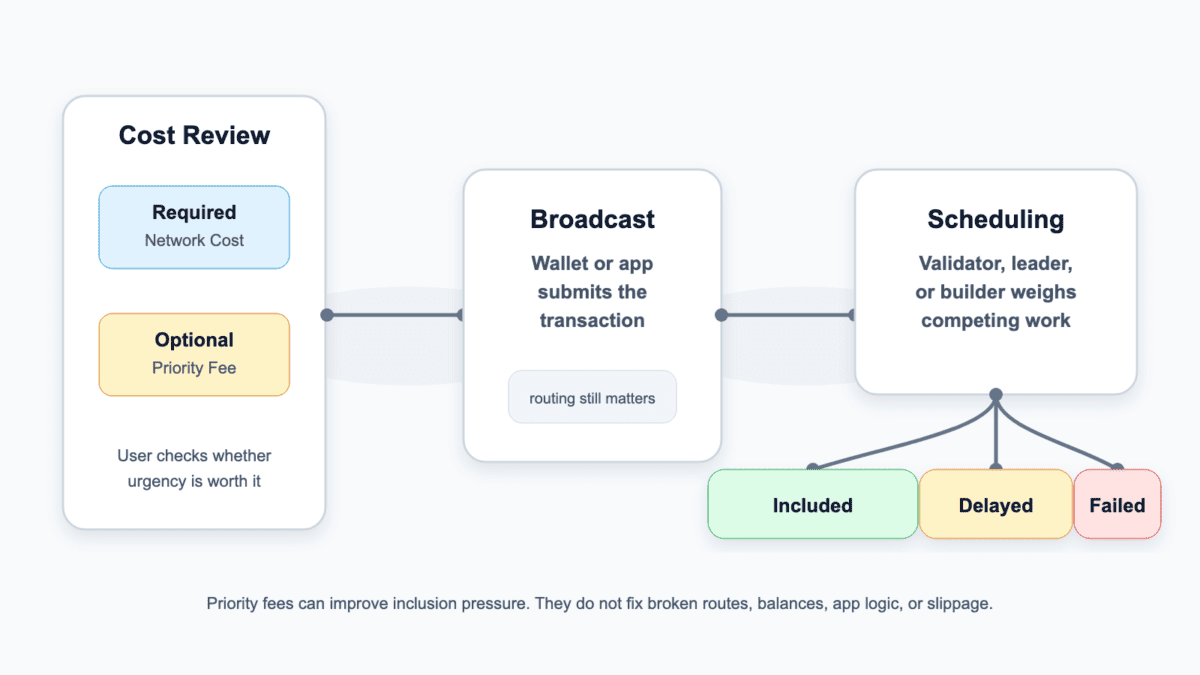
Before you sign, the app builds a transaction. That transaction includes the required fee fields for the chain and may include an optional priority setting. You approve a maximum or preset, then the wallet submits it through an RPC endpoint, wallet backend, relay, or app infrastructure.
After submission, the transaction still has to clear several practical gates:
On chains with a public mempool, block producers and builders may see pending transactions before inclusion. On Solana, the transaction path is different, but the current leader still has to schedule competing transactions into a slot.
The priority fee can make your transaction more attractive in that contest. It usually helps most when demand is high and many transactions are fighting for attention at the same time.
But priority is not price protection. A swap can land quickly and still fill poorly if slippage is loose or liquidity is thin. A transfer can move fast and still cost too much relative to the amount moved. Speed is useful only when the result is still worth the cost.
Priority fee confusion usually starts because wallets put several fee labels near each other. Some are required network costs. Some are caps. Some are trading settings. Some are app fees wearing a friendly hat.
Use this table to separate the common labels before you raise anything.
| Fee Label | What It Means |
|---|---|
| Base fee | The required network fee component charged before any optional urgency payment. |
| Gas fee | The broader execution cost on Ethereum and EVM-style chains. |
| Max fee | The cap a wallet can spend for a transaction under Ethereum-style settings. |
| Gas limit | The maximum execution work the transaction is allowed to use. |
| Priority fee | The optional extra payment used to improve inclusion or scheduling odds. |
| Platform fee | A charge from the app, bot, wallet, or trading interface. |
| Jito tip or bribe | A Solana trading incentive tied to a route, bundle, or MEV-aware path. |
| Slippage | The price movement you allow before a swap should fail. |
These labels can appear together because they belong to different layers. A Solana swap, for example, can show a base network fee, an optional priority fee, a platform fee, and a slippage setting. They are not duplicate names for one charge.
The costly mistake is raising every number after one failed attempt. Higher slippage may accept a worse price. A higher priority fee may improve scheduling. A higher platform fee may simply pay the tool. Each setting changes a different part of the outcome, so the fix should match the failure.
When a fee screen looks crowded, sort the labels into three buckets: network cost, urgency cost, and trading outcome. That minute can save more than the priority fee itself.
A priority fee on Ethereum is the tip portion of the transaction fee that goes to the validator. It sits inside Ethereum’s post-EIP-1559 gas model, alongside the base fee and wallet caps.
Ethereum users usually see several fields rather than one clean “fee” number. Keep the main ones separate before you edit anything:
Those fields interact. If the base fee rises before inclusion, your max fee may decide whether the transaction can still pay enough. If the priority fee is too low during congestion, the transaction may wait behind more attractive transactions. If the gas limit is too low, execution can fail even when the fee bid looked reasonable.
That last point surprises people. A failed Ethereum transaction can still consume gas if execution started and then reverted. You paid for the work attempted, not for a happy ending. The priority fee does not turn a bad contract call into a good one.
For normal wallet use, avoid manual gas editing unless you understand the fields. A wallet’s standard setting is often fine for non-urgent transfers. Raise priority only when timing has a clear reason, such as a time-sensitive contract interaction, a crowded mint, or a transaction that must land before conditions change.
A useful Ethereum check is simple. If the transaction is routine, the standard setting may be enough. If the action is urgent, check both the priority fee and the max fee. If execution itself is the problem, a larger tip only gets the failed attempt included faster.
A priority fee on Solana is an optional prioritization fee that can improve a transaction’s chance of being scheduled ahead of competing work. It is separate from the base transaction fee.
Solana documentation separates every transaction fee into a base fee and an optional prioritization fee. It also lists the base fee at 5,000 lamports per signature and gives the prioritization-fee formula as compute unit price multiplied by compute unit limit, converted from micro-lamports into lamports. That is the key Solana difference: the priority fee is tied to compute-budget settings, not just a simple speed tip.
Solana wallets and apps may hide that math behind presets. A simple transfer may look cheap. A Jupiter or Raydium swap can look more complex because the transaction may need more compute, more accounts, or a stronger bid during a busy route. Phantom, Solflare, Trust Wallet, and trading terminals can each present the settings differently.
Explorers can add another layer of confusion. On Solscan, a transaction may show both a fee and a priority fee. In that view, the fee is not necessarily a duplicate charge. It may be showing the base network fee plus the optional prioritization fee as separate components.
Jito tips and bribe labels are separate from Solana’s normal prioritization fee. They can show up in MEV-aware routes, bundles, or trading tools. A normal Solana priority fee uses Solana’s native fee path. A Jito tip or bribe may belong to a different submission route.
So when a Solana priority fee looks high, check what kind of transaction you are signing:
Same chain, very different plumbing.
A priority fee is worth paying when faster inclusion has real economic value. The fee should protect timing, not soothe impatience.
Good candidates usually have a narrow window. A swap may need to land before a quote goes stale. An NFT mint may close quickly. A liquidation, arbitrage, or collateral adjustment may punish delay. In those cases, a modest priority fee can be cheaper than missing the window.
Competitive trading is the obvious pressure zone. In PVP trading, other users and bots may be competing against your exact timing. A low-priority transaction can arrive after the price already moved, which turns a “cheap” fee into an expensive miss.
That same pressure appears in the trenches, where new Solana meme coins, crowded launches, and thin pools can make speed part of the trade. That does not make high fees wise by default. It only means timing is one of the costs.
Small speculative entries need harsher math. A lottery ticket trade can be fun until the fee stack eats the ticket. If a priority fee, platform fee, and sell-side cost take a large slice of the position, the trade needs a big move just to break even.
Use a priority fee when three things are true:
For slow transfers, portfolio moves, and low-value cleanup, patience is often cheaper. Paying for speed on a transaction that can wait is premium shipping for a box of air.
A priority fee does not guarantee that a transaction lands, succeeds, or produces the trade result you wanted. It can improve one bottleneck while other bottlenecks still break the transaction.
> Warning: A priority fee can help only after the transaction reaches the right scheduling path. It cannot repair weak routing, expired data, bad account state, or a trade with no real exit.
On Solana, a transaction may struggle because of packet drops, a weak RPC path, latency, an expired blockhash, or a congested route. Raising the priority fee may help if the transaction reaches a leader and competes for scheduling. It will not fix every upstream delivery problem.
On Ethereum, a transaction may fail because the gas limit was too low, a contract reverted, the token approval was wrong, or the onchain state changed before inclusion. A higher priority fee can get the attempt included sooner. It cannot make the contract accept an invalid action.
Trading adds its own traps. Bad slippage settings, thin liquidity, app outages, missing token accounts, low native-token balance, and token restrictions can all make a transaction fail or land badly. A fast bad trade is still bad. It just arrives sooner.
Priority also cannot save you from being late to a crowd. If you are buying after insiders, bots, or early wallets already own the flow, faster inclusion may only help you become exit liquidity sooner. That is not the kind of speed anyone should brag about.
Before raising the fee, identify the failure. Was the route stale? Did the wallet show insufficient native token? Did the app ask for a new token account? Did the quote expire? Did slippage block execution? If one of those caused the failure, the priority fee may be the wrong knob.
Checking a priority fee before signing means separating the fee layer from the action layer. You want to know what you are paying, who controls it, and whether the transaction still makes sense after the extra cost.
Start with the chain. Ethereum, Solana, and EVM Layer 2s can use different fee screens, even when the wallet uses familiar words. Then identify the action. A transfer, swap, mint, bridge, claim, and token-account setup can all create different costs.
Next, read the screen for separate labels. Look for network fee, priority fee, max fee, gas limit, platform fee, pool fee, route fee, slippage, and minimum received. The largest number is not the only risk. The final wallet balance cares about all of them.
The most useful pre-signing checks are simple:
Wallet design can make this easier or harder. A clear wallet separates network cost from urgency cost, shows the maximum you may pay, and does not bury platform charges behind one friendly total. A wallet that hides the difference can make expensive guesses feel normal.
If the fee looks wrong, pause before retrying. Switch from aggressive to normal speed when timing is not urgent. Try later if the chain is congested. Reduce the action size only if the app route still makes sense. Do not use a priority fee to compensate for a quote you do not understand.
Priority fee mistakes usually come from treating the setting as a universal fix. It is a specific tool: useful in the right place, expensive when swung at everything.
The most common mistake is overpaying on routine transfers. If you are moving funds between your own wallets and there is no deadline, the fastest option may add cost without improving the outcome. You get the same destination with a smaller balance.
Another mistake is confusing platform fees with network fees. A trading bot or swap interface may charge its own fee while also showing network cost, priority fee, bribe, or slippage. If you only look at one line, the trade can look cheaper than it is.
Watch for these repeat offenders:
Tiny balances make the mistake obvious. Moving dust can cost more than the useful value you recover, especially when priority settings or account setup costs enter the picture. Sometimes the cheapest move is doing nothing.
Price the full action before you pay for speed. If the transaction value is small, fee drag takes a bigger share. If the trade is crowded, failed attempts get expensive. If the route is broken, priority is just an expensive retry button.
Priority fee decisions connect to several nearby ideas. The overlap is useful, but the terms should stay separate. Each one answers a different question before you sign.
Wallet controls decide how clearly you can see the cost before signing. If your current app makes the fee stack hard to read, wallet fee controls are not just a comfort feature. They help you spot when a speed preset, app fee, or max-fee cap is doing the expensive part.
Dust explains why small balances and cleanup moves can become uneconomic. A wallet may show a spendable-looking amount, but tiny dust balances can lose their point once the network fee, priority fee, and account setup cost are counted.
Competitive trading terms explain why timing sometimes deserves a fee. They also show why faster inclusion can still be a bad outcome when you are entering a weak crowd. Those ideas are separate from priority fee mechanics, but they shape when paying for speed is rational.
Jito tips, bribe fees, gas limits, base fees, and slippage also sit near the same wallet screen. The clean habit is to ask what each setting changes. A base fee pays the network. A priority fee signals urgency. Slippage changes the worst price you accept. A platform fee pays the tool. A Jito tip or bribe may affect a specific Solana route.
That separation keeps the fee screen honest. A priority fee is one cost layer, not a full transaction diagnosis. Once you know which layer you are changing, the screen becomes less mysterious and slightly less rude.
A priority fee in crypto is an optional extra transaction fee used to improve a transaction’s chance of faster inclusion. It sits on top of the required network cost and signals urgency to validators, leaders, or builders.
No. A gas fee is the broader execution cost on Ethereum and similar chains, while a priority fee is the optional urgency tip inside that cost model. Some wallets show them together, which is where the confusion starts.
Yes, if the transaction includes an optional priority fee. The base Solana fee is the normal required network cost. The priority fee is an extra amount attached to compute-unit settings when the transaction bids for better scheduling.
A max priority fee on Ethereum is the highest validator tip per gas unit that your wallet is allowed to pay. It works alongside the max fee, which caps the total fee per gas unit including the base fee.
No. A higher priority fee can improve inclusion odds, but routing, RPC delivery, expired transaction data, gas limits, account state, slippage, liquidity, and app errors can still stop or spoil the transaction.
Yes, when the transaction is not urgent and the network is not heavily congested. Use a normal speed preset, wait for quieter conditions, and avoid reducing fees on time-sensitive swaps, mints, liquidations, or exits where delay changes the result.
Start with the fee layer, not the panic. A priority fee is useful only when urgency is the problem you are trying to solve.
Before signing, compare the added fee with the transaction value. A priority fee that is tiny on a large urgent swap can be reasonable. The same fee on a small cleanup move can be absurd.
Use this quick path:
Then choose the smallest setting that fits the problem. If a normal transfer can wait, let it wait. If a swap is time-sensitive, compare the extra cost with the expected improvement. If the app route keeps failing, change the route or pause instead of turning the fee slider into a wishing well.
If a transaction fails, do not blindly retry with a bigger fee. Read the error, check the route, confirm the native-token balance, and review slippage or gas settings. Then decide whether urgency was the real issue.
The best priority fee is the one attached to a transaction that still makes sense after it lands. Anything else is just paying extra for the privilege of being wrong faster.