Physical Address
304 North Cardinal St.
Dorchester Center, MA 02124
Physical Address
304 North Cardinal St.
Dorchester Center, MA 02124


Learn why reorg risk can change recent crypto transactions.
Reorg risk is the chance that recent accepted blockchain blocks get replaced, which can move, delay, or drop nearby transactions.
That sounds more dramatic than it usually is. A reorg does not mean someone can rewrite the whole chain like a bad spreadsheet. It means the newest part of a blockchain can still change before enough confirmations or finality make the transaction hard to disturb. For everyday users, reorg risk sits behind wallet status labels, exchange deposit waits, merchant payment rules, and bridge delays.
Reorg risk means a recent block that looked accepted may stop being part of the canonical chain. The canonical chain is the version of history that nodes currently accept as the valid one.
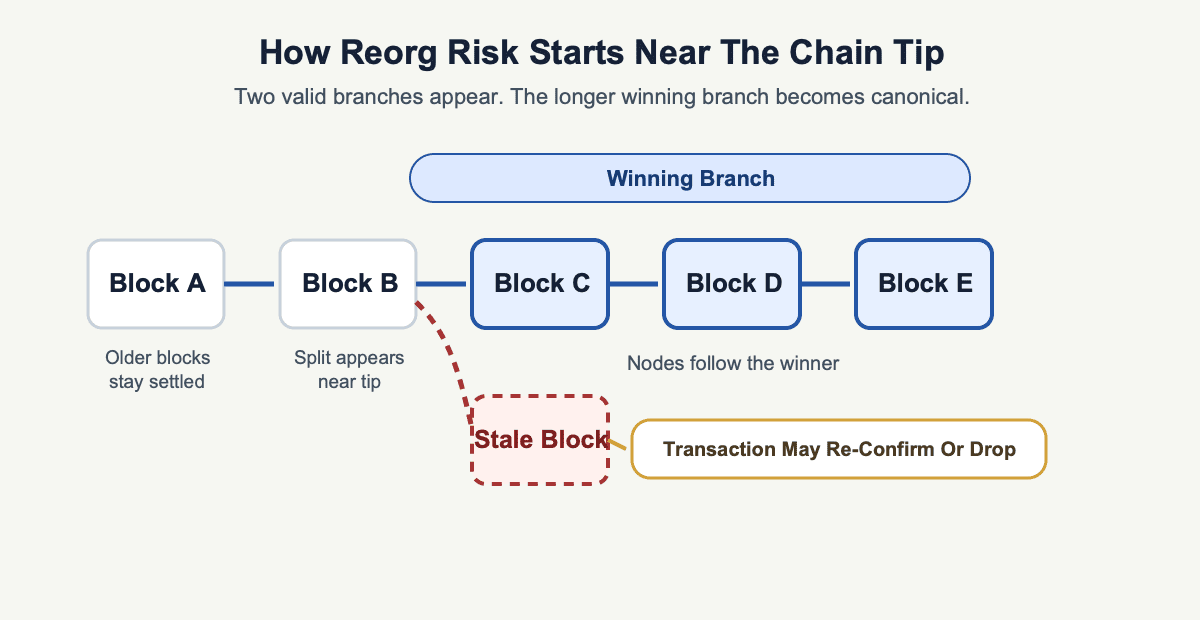
A blockchain reorg is the moment nodes stop following one recent branch and switch to another valid branch. The losing block becomes stale, and the transactions inside it need a new place in history.
Blockchains are not built by one central server handing out a perfect list. Miners, validators, and nodes see the network from different places. Near the chain tip, two valid versions of recent history can briefly compete.
Use this simple split when branches compete:
When the network later settles on one branch, transactions in the losing branch may need to be handled again. Some reappear in the winning branch. Some return to pending. A few may disappear if a conflicting transaction wins.
That is why the word “risk” is doing real work. Most shallow reorgs are normal network behavior, not a hack. The problem is acting as if the newest block is already as settled as older history.
The timing problem is what costs people money. If you act too quickly on a recent confirmation, you may assume settlement before the chain has really earned it. For small transfers, that may be fine. For a large deposit, bridge transfer, or shipped product, false comfort gets expensive.
Reorg risk starts when the newest blocks are still competing for acceptance. Two miners may find blocks at nearly the same time, or validators may see different heads because messages reached them in a different order.
For a short time, one group of nodes may build on one block while another group builds on a different block. Both branches can contain valid blocks.
The moving pieces are simple:
In proof-of-work systems, the winning branch is usually the one with the most accumulated work. In proof-of-stake systems, the rule depends on validator votes, weights, and protocol-specific fork-choice logic. Either way, nodes need a clean tie-breaker when the newest history conflicts.
A fork is the split. A reorg is the switch. During a temporary fork, two valid branches exist near the tip. During a reorg, nodes replace the branch they were following with the branch that wins.
The old block becomes stale or orphaned, and any transactions inside it need a new outcome. That does not make every fork dangerous. Many are shallow and resolve quickly. The risk grows when the losing branch had valuable transactions, app state, exchange deposits, bridge messages, or merchant payments that people already acted on.
Reorg risk changes because chains settle history in different ways. Bitcoin-style proof of work gives probabilistic finality, where confidence rises as more blocks build on top of a transaction.
Ethereum-style proof of stake still has a live chain head that can change before finality. But finalized checkpoints add a stronger boundary. On Ethereum, Ethereum.org puts that threshold at 66% of total staked ETH agreeing on two checkpoints.
Use this table as a quick map, not a universal safety ranking:
| Model Or Situation | What It Means For Reorg Risk |
|---|---|
| Proof of work | Risk falls as more blocks build on top of the transaction. |
| Proof of stake before finality | The chain head can still move if fork choice changes. |
| Proof of stake after finality | Reversal usually requires extreme validator coordination and penalties. |
| BFT-style finality | Ordinary reorg risk may be low after validator finalization. |
| Small or stressed chain | Reorg risk can rise if security, participation, or software quality weakens. |
| Bridge deposit | The bridge may wait longer than a wallet because the cost of a wrong credit is higher. |
Some chains also use Byzantine fault tolerant finality, where blocks are considered final once enough validators sign them. That can reduce ordinary reorg risk sharply, but it does not remove every other risk. Validator outages, client bugs, censorship, bridge design, and app mistakes can still cause trouble.
The useful habit is simple: ask which settlement model you are using. A Bitcoin confirmation, an Ethereum finalized checkpoint, and a fast bridge credit are not the same signal. That is why one chain may feel slow but conservative, while another feels fast but asks apps to manage more near-tip uncertainty.
Reorg risk can change what happens to a confirmed transaction when the block containing it leaves the winning chain. The transaction does not automatically vanish forever. It needs to find its place again.
In the cleanest case, the same transaction appears in a later block on the winning branch. In another case, it returns to pending and waits in the mempool. In the worst case, a conflicting transaction gets confirmed instead, creating the double-spend outcome users worry about. Wallets and explorers may show this as a status change.
Here is what the user may see:
| What The User Sees | What May Be Happening |
|---|---|
| Confirmed changes to pending | The old block lost, and the transaction is waiting again. |
| Block number changes | The transaction re-confirmed in a different winning block. |
| Explorer views disagree | Different nodes or indexers may be catching up to the reorg. |
| Deposit credit is delayed | The exchange or app is waiting for more confidence. |
| Payment looks reversed | A conflicting transaction may have won, or the original may be pending again. |
If one status update looks odd, slow down before doing anything expensive. Check the transaction hash on a reliable explorer, wait for more confirmations, and avoid delivering value until the receiving service marks the payment as final enough for that specific chain.
Good recordkeeping helps here. Save the transaction hash, note the receiving service’s status, and avoid sending a replacement payment until you understand whether the first one is pending, re-confirmed, or truly displaced.
Reorg risk is not the same thing as a 51% attack. Many shallow reorgs happen naturally when the network briefly disagrees near the tip.
A 51% attack is a more serious case. An attacker with enough hash power, stake influence, or validator control may try to build a competing branch and replace recent history. If value was delivered before the chain settled, that can become a double spend.
> A deep reorg is rare on major chains, but rare is not the same as impossible. The higher the value, the longer the wait should be.
The risk depends on depth and value. A one-block reorg on a strong network is usually routine noise. A deeper reorg on a weaker or stressed network can affect exchanges, merchants, bridges, and apps that acted too quickly.
Four variables drive severity:
Recent Monero and Litecoin discussions show two different worries. One centers on attack pressure and confidence. The other centers on a software bug and patch response. Both show why the word “reorg” does not carry one single severity level.
Double-spend risk is the part most users care about. If someone sends a payment, receives goods or credit, and then a competing transaction wins, the recipient may be left without the expected funds. That is why exchanges wait, bridges wait, and merchants set confirmation rules. This is also why “confirmed” alone is not enough context.
Do not confuse that with being exit liquidity in a market trade. A double spend is a settlement-history problem. Exit liquidity is about someone else finding a buyer for a position they want to leave.
Reorg risk shows up differently depending on where you are looking. Wallets care about user status, exchanges care about deposit credit, bridges care about cross-chain settlement, and apps care about clean data.
The pattern is delay. A service waits because it would rather be slower than credit funds, mint assets, ship goods, or update app state from a block that may disappear. Boring? Yes. Useful? Very.
Wallets usually show transaction states such as pending, confirmed, failed, or finalized, depending on the chain and interface. A wallet may display a first confirmation quickly, but that does not always mean the transfer is safe for high-value action.
A careful wallet setup will not remove reorg risk. It does make it easier to track transaction history, keep records, and avoid duplicate sends when an explorer view changes.
Exchanges set their own deposit rules because they absorb operational risk when they credit users too early. A fast deposit policy creates better UX, but it accepts more near-tip uncertainty. A slower policy frustrates users, but it reduces the chance of crediting a transaction that later falls out of the canonical chain.
Bridges are especially sensitive because they connect one chain’s settlement to another chain’s action. If a bridge credits the destination chain too early, a source-chain reorg can leave the bridge with a mismatch.
That is why bridges may use confirmation windows, finality checks, optimistic waiting periods, relayer controls, or risk limits. The faster the bridge feels, the more you should ask what trust or liquidity assumption makes that speed possible.
Indexers, dashboards, and apps read blockchain history so users can see balances, trades, votes, positions, and events. A reorg can make an app roll back data it already ingested. Good app design handles that by tracking block hashes, detecting replaced blocks, reconciling events, and avoiding irreversible updates from fresh blocks.
Poor app design may show stale balances, duplicate events, or phantom actions until it catches up. The practical lesson is simple. If a wallet, exchange, bridge, or app says “pending,” “processing,” or “waiting for confirmations,” that is not always incompetence.
To read reorg risk before moving funds, match the transfer size to the chain, service, and settlement signal. You do not need to audit consensus code. You need to avoid acting faster than the risk allows.
Start with the value at stake. A small test transfer can tolerate more uncertainty. A large bridge move, exchange deposit, treasury payment, or merchant sale needs more confirmations and a clearer finality signal.
Then separate the chain signal from the app signal. An explorer may show one confirmation while the exchange still says processing. That mismatch is not automatically a problem. It often means the service is waiting for its own safety threshold.
Use this checklist before important transfers:
After the checklist, look at the environment around the transfer. Recent chain incidents, client bugs, validator outages, attack rumors, or unusual explorer behavior all raise the cost of rushing. When the chain looks noisy, patience becomes cheap insurance.
For bridge moves, be extra patient with the source chain. The destination-side credit can look like the main event, but the bridge still depends on the source transaction staying accepted.
The best confirmation count is not one universal number. It depends on chain security, finality design, transfer size, and what happens if the transaction fails. Anyone selling one magic number is skipping the expensive part of the question. If the transfer would hurt to lose, wait.
Reorg risk is a protocol-settlement risk. It is about whether recent chain history near the tip remains in the winning chain.
That makes it different from team, market, custody, and personal-security risks. Those can lose money too, but they fail through different mechanisms. Mixing them together makes users ask the wrong questions.
Ask what actually changed. Did a recent block leave the canonical chain? Did a team drain liquidity? Did a trader sell into late buyers? Did a wallet key leak? The answer points to different evidence and a different response.
Use the failure path to separate them:
Reorg risk is different from all of those. It is about whether the transaction history you acted on remains accepted by the chain.
That distinction changes the next move. A reorg response starts with waiting, checking confirmations, and watching whether the transaction reappears. A scam response starts with contract, liquidity, team, or key-security checks.
It also changes who can help. A receiving exchange can explain its confirmation policy. A wallet can show transaction history. But neither one can fix a malicious project treasury, a poor trade entry, or a leaked seed phrase.
The practical takeaway is to name the failure path before responding. For reorg risk, wait for confirmations or finality. For project theft, inspect contracts and liquidity. For custody risk, secure keys and venues. For market risk, respect price, liquidity, and position size.
Reorg risk in crypto is the chance that recent blockchain blocks are replaced by another valid branch. That can move, delay, or drop transactions that looked confirmed near the chain tip.
It is mostly about timing. Older blocks are usually much harder to disturb. Newer blocks have less history built on top of them, so wallets, exchanges, bridges, and apps often wait before marking activity settled.
Yes, reorg risk can reverse or change a confirmed transaction if the block containing it leaves the winning chain. The transaction may re-confirm later, return to pending, or be replaced by a conflicting transaction.
The word “confirmed” does not always mean final. It often means the transaction appeared in at least one accepted block. More confirmations and stronger finality rules usually make reversal much harder.
No, reorg risk is broader than a 51% attack. Shallow reorgs can happen naturally when the network briefly disagrees about the newest block.
A 51% attack is a malicious version where an attacker tries to build a competing branch and replace recent history. That can create double-spend risk, especially when services credit value before waiting for enough confirmations.
More confirmations usually reduce reorg risk, but no single number fits every chain or transaction. The right wait depends on the chain, finality model, transfer size, and receiving service.
For low-value transfers, a small number of confirmations may be acceptable. For high-value exchange deposits, bridge transfers, or merchant payments, waiting longer is usually smarter. Follow the receiver’s policy when one exists.
Yes, proof-of-stake chains can still have reorg risk before finality. The live head of the chain can change as validators vote and the fork-choice rule selects the branch to follow.
Finality changes the risk profile. Once a proof-of-stake chain finalizes a checkpoint, reversal usually becomes much more expensive and punitive. Before that point, recent blocks can still be less settled than they look.
Bridges care about reorg risk because they may release or credit assets on one chain based on activity from another. If the source-chain transaction later disappears, the bridge can be left with a mismatch.
That is why bridges often wait for confirmations or finality before completing a transfer. Fast bridges may use liquidity, trust assumptions, risk limits, or insurance-style design to offer speed before full settlement.
Start with the transaction value. The more it would hurt if the transaction changed, the more confirmations or finality you should wait for.
Then match your behavior to the chain and service. A wallet status label, exchange deposit rule, bridge estimate, and explorer confirmation count are all signals. None of them should replace judgment when the amount is meaningful.
The simple rule is value first, speed second. If the amount is small, a fast confirmation may be enough. If the amount could damage your balance sheet, trade plan, or customer relationship, wait for stronger settlement.
Use these actions before moving serious funds:
If a status label changes, do less, not more. Do not rush into a second transfer, a replacement payment, or a support ticket with half the details. First, check whether the original transaction is pending, re-confirmed, or missing from the winning chain.
That small pause gives you better options. You can wait for the receiver’s policy, send evidence to support, or decide the transfer is too large for current chain conditions.
Reorg risk is not a reason to fear every transaction. It is a reason to understand settlement before acting on it. The chain may be fast. Your confidence should still arrive in the right order.
If something looks wrong, pause before adding more transactions. Recheck the hash, wait for the receiving service to settle its status, and keep records in case support needs the exact timeline.