Physical Address
304 North Cardinal St.
Dorchester Center, MA 02124
Physical Address
304 North Cardinal St.
Dorchester Center, MA 02124


A plain-English guide to dead chat, fake activity, and crypto risk.
Dead chat means a group, project channel, or social feed has gone quiet. In crypto, it often signals fading attention around a token.
The phrase started as internet and Discord slang for an inactive room. Crypto traders now use it for Telegram groups, Discord servers, X replies, Reddit threads, and token comment feeds that no longer feel alive. That silence can be useful, but it is not a sell signal by itself.
Dead chat in crypto means a project’s social room has gone quiet enough to raise questions about attention, support, or trust. The chat may still exist, but it no longer shows real questions, useful answers, active moderation, or people who seem to care.
You will usually see the phrase around Telegram, Discord, X, Reddit, Pump.fun comments, or token-screening feeds. Someone might write “dead chat” when a launch slows down, when admins stop answering, or when a memecoin room goes from frantic to silent.
The phrase does not prove the project failed. It points to missing social activity. That activity can matter because many crypto projects, especially small tokens, rely on visible participation to keep attention moving.
For example, an unanswered question about liquidity is more useful than a quiet meme thread at midnight. The first one touches market risk. The second may only show that people logged off.
Still, chat is only one signal. A project can have a quiet official channel because the team moved updates to X, GitHub, governance forums, or announcement posts. A loud group can also say very little. A wall of “LFG” can look alive while adding almost nothing.
Use dead chat as a prompt to check harder. It should make you ask what changed, who is still active, whether the token still trades cleanly, and whether official links still match the project’s real channels.
Dead chat hits memecoins harder because attention often does more work than product usage. A large asset can survive a sleepy Telegram room. A tiny meme token may rely on jokes, raids, replies, and community energy to keep demand from evaporating.
That does not mean chat creates value by itself. It means some tokens trade inside the attention economy, where narrative and participation can move faster than fundamentals. When that activity fades, buyers may wonder whether the story is also fading.
So a quiet room can feel larger than it is on a small launch. If the token has no product, no useful app, and no steady buyer base, the chat becomes part of the product. When that room stops producing jokes, questions, raids, or basic support, the market may lose the only signal it was watching.
Chat health carries the most weight in a few setups:
A quiet room hurts most when there is no other evidence of life. If volume is thin, admins are gone, links are stale, and holders only post coping memes, dead chat becomes part of a wider risk picture.
But do not grade every project by messages per hour. Serious teams can be quiet. Mature communities can chat less during flat markets. Look for real users, real updates, and real liquidity.
That check keeps the signal honest. Dead chat can show fading attention, but it should push you toward evidence, not panic.
Dead chat is a social signal. A dead coin is a broader failure where trading, liquidity, development, support, or demand has faded so far that the asset may no longer function as a realistic market.
That difference protects you from bad shortcuts. A token can have a quiet chat and still work. A token can also have a noisy room and still be a poor trade. The wider dead coin question needs more than vibes.
Start with the order of evidence. Dead chat begins when people stop answering. Dead coin risk shows up when the asset itself becomes hard to use, trade, support, or justify. The two can overlap, but they are not the same warning.
| Signal | What It Usually Means |
|---|---|
| Dead Chat | The social room is quiet, abandoned, or no longer answering useful questions |
| Dead Coin | The asset has broader problems with trading, liquidity, development, access, or demand |
| Quiet Official Channel | Updates may have moved elsewhere, or the channel may be announcement-only |
| Fake-Active Chat | The room looks busy, but activity may be bots, raids, slogans, or paid hype |
| Revived Chat | Attention returned, but the token still needs liquidity, trust, and real demand |
The table is a starting point, not a verdict sheet. Dead chat asks whether the community still responds. Dead coin asks whether the asset itself still has a working market and reason to exist.
So keep the phrases related but separate. If someone says “dead chat, dead coin,” slow down and check the evidence. The rhyme is catchy. It is not research.
The split also helps with revived projects. A chat can wake up before the market improves. Or a market can keep trading while the chat stays boring. Look for the condition that actually affects your next move.
Traders read a dead chat signal by pairing it with market, wallet, and project checks. The strongest warning appears when silence lines up with weak liquidity, fading updates, concentrated holders, and unanswered risk questions.
Start with what the silence hides. Are admins ignoring questions about liquidity? Did volume vanish after the first pump? Are top wallets still able to sell into thin demand? Those checks tell you more than a random gap between messages.
The goal is to turn a vibe into a test. A quiet room gives you a reason to inspect the token. It does not tell you what to do until the market and project evidence line up.
Use this checklist before turning dead chat into a trade decision:
Dead chat can overlap with a soft rug when updates fade, liquidity thins, and the public story stays hopeful while the real exit path gets worse. That pattern builds slowly, so casual chat-watching can miss it.
Avoid fixed time limits. A chat is not dead because nobody spoke for one hour. Time zones, market lulls, and muted announcement channels can all create silence. The better signal is whether meaningful activity has stopped where it should still be happening.
Also separate silence from avoidance. A team that says, “we will answer after the audit post” is different from mods deleting every question about selling. One is delay. The other is pressure with less information, which is a much worse setup for small traders.
Dead chat becomes a red flag when silence appears beside safety problems. A quiet Telegram is one thing. A quiet Telegram with fake verification links, ignored liquidity questions, and sudden DMs from “support” is a different beast.
The risk rises when admins vanish during stress. If users ask about locked liquidity, contract changes, withdrawals, listings, or wallet safety and get buried under hype, the silence is no longer neutral. It suggests the room cannot handle basic scrutiny.
Watch for these warning signs:
> Never connect a wallet, sign an approval, or share a seed phrase because someone in chat says verification is urgent.
That warning is not theoretical. The FBI’s 2025 Internet Crime Report says complaints involving cryptocurrency produced more than $11 billion in reported losses. Telegram pressure and private wallet help deserve a hard pause.
If silence sits beside disappearing liquidity or blocked exits, the risk can move toward a hard rug. If the problem is wallet prompts or fake verification, step away and review basic crypto wallet safety before touching anything.
Dead chat is not enough to panic when the project still has real updates, usable liquidity, stable official links, and activity in other places. Some communities are quiet because they matured, not because everyone fled.
Crypto groups also move. A Discord may look dead because the real discussion shifted to X. A Telegram may be announcement-only by design. A builder-heavy project may spend more time in GitHub, forums, docs, or governance posts than in public chat.
This is especially true outside fast meme launches. Infrastructure projects, wallets, protocols, and larger coins may have separate support desks, developer forums, and governance spaces. Their main chat can look sleepy while actual work continues elsewhere.
Silence is less alarming when you can confirm these points:
Market mood also changes behavior. During quiet periods, fewer users ask “wen moon” every five minutes. Honestly, that part can be an improvement.
Look for continuity, not constant noise. If the same official links work, the same admins answer calmly, and the market still supports normal exits, the quiet room may just be boring. Boring is allowed.
Context decides the risk. Do not sell a position only because a room slowed down. Do not ignore silence because you want the chart to recover. Check whether the project still has real reasons to exist.
If the evidence is mixed, reduce urgency. Watch another update cycle, use smaller size, or wait for a cleaner answer. A quiet chat becomes dangerous when it pushes you into guessing.
To check if a dead chat is really dead, compare the social room with independent signals. You want evidence that real users, real updates, and real market access still exist outside the chat’s mood.
Begin with official sources. Use the project website, established X account, verified docs, or known contract address before trusting any link dropped in Telegram. If those sources disagree with the chat, pause.
Then compare the chat with markets. A room can be quiet while liquidity remains stable. It can also be loud while the pool cannot support normal exits. The second setup is usually more dangerous.
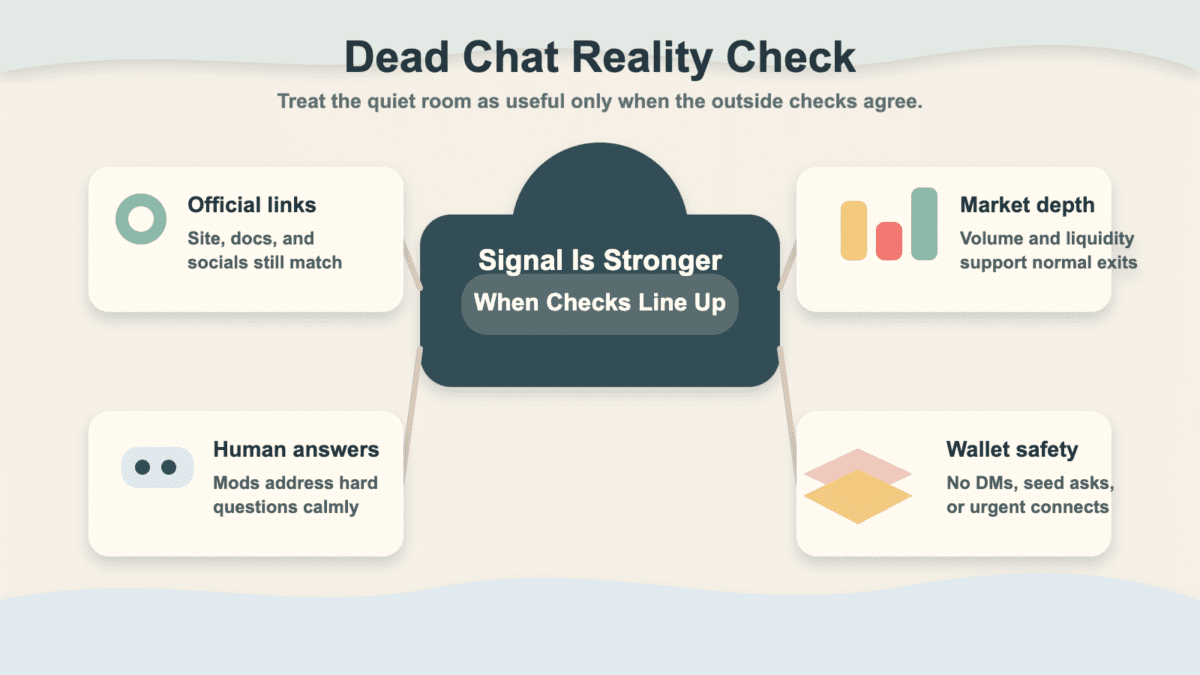
Work through a low-risk observation flow:
For high-risk meme trades, some users keep a separate wallet with limited funds. That can reduce blast radius, but it does not make a bad token safer. A burner wallet is a seat belt, not a license to drive into a wall.
The strongest signal is consistency. If the chat is quiet, liquidity is thin, admins dodge questions, and official links keep changing, the room may be showing a real problem. If only the chat is quiet, keep checking before reacting.
Dead chat, fake chat, and healthy chat can look similar if you only count messages. The useful difference is message quality, user variety, and whether the room helps people understand the project.
Noise is not health. A fake-active chat can be worse than a quiet one because it creates confidence while hiding weak demand. Copy-paste hype is cheap. Real answers take effort.
| Signal | What It Usually Means |
|---|---|
| Long silence after hard questions | Users may be gone, admins may be avoiding risk, or the room may be abandoned |
| Identical slogans from new accounts | Activity may be botted, paid, or coordinated |
| Giveaways and raids dominate the feed | The room may be farming attention instead of building trust |
| Calm answers from known moderators | The channel may still have real support and accountability |
| Varied users discuss specific issues | The community may still have genuine participation |
| Urgent buy pressure replaces answers | The room may be trying to create exit demand |
The table cannot read intent for you. It can only point out patterns worth checking. A healthy chat usually includes normal disagreement, practical questions, and specific answers. It does not need to chant in all caps to prove it is alive.
If the only “activity” is slogans, raids, and people yelling at others to buy faster, count that as a signal too. Sometimes the loudest room is just silence wearing a costume.
A dead chat can come back when moderators return, holders organize a community takeover, a product update lands, or a market rotation revives attention. Crypto attention is weirdly recyclable, especially around memes.
A comeback usually starts with coordination, not just chatter. New moderators clean links, answer old questions, explain what happened, and make the room useful again. If the only change is louder posting, the recovery is still mostly theater.
A revived chat still needs proof. New messages do not fix weak liquidity, damaged trust, unsafe links, or concentrated supply. A comeback is stronger when the group answers old questions, stabilizes official channels, and shows activity beyond slogans.
Check what changed before buying a revival story:
The late-entry risk is exit liquidity. A revived chat can attract new buyers just as earlier holders finally get a chance to sell. That can be a real turnaround, or it can be a cleaner exit lane for people who were stuck.
So give revival narratives a higher burden of proof. A chat waking up is interesting. A token becoming safer requires more than a busier scroll.
Start with the simplest definition: dead chat means the room is quiet or abandoned. Then ask whether that silence lines up with real project, market, or safety problems.
Next, separate observation from action. Seeing a quiet chat does not require an instant sell, and seeing a revived chat does not require an instant buy. The goal is to slow the moment down before the group mood writes your trade plan for you.
That slowdown is the whole edge. Crypto chats are built to make everything feel urgent. Dead chat can create fear, and revived chat can create FOMO. Both feelings are useful only after you check them against facts.
Use a short workflow before you act:
This keeps dead chat in its proper place. It is a useful warning label, not a full trading system. If the only reason to buy is that a chat suddenly got loud again, you may be the new audience for someone else’s exit.
The cleanest move is often patience. Watch how the room handles hard questions before you risk funds. A real community can survive basic scrutiny. A weak one usually tries to rush past it.
If the checks stay unclear, doing nothing is still a decision. You can wait for better updates, better liquidity, or a calmer entry instead of letting a silent room or a noisy comeback set the terms.
Dead chat in crypto means a project’s Telegram, Discord, social feed, or token comment stream has gone quiet or feels abandoned. Traders use it as a sign that community attention may be fading. It is useful slang, but it does not prove a coin is dead by itself.
No, dead chat does not automatically mean a coin is dead. It means the social channel looks weak. A dead coin is a broader condition involving liquidity, trading access, development, user demand, and support. Check those signals before making the jump.
Dead chat can be a reason to slow down and review the position, but it is not enough by itself. Look at liquidity, volume, admin updates, official links, holder concentration, and whether selling still works. If several signals are weak, the risk is stronger.
Dead chat can turn bullish if a real community takeover brings better moderation, stable links, deeper liquidity, and renewed participation. But a louder room can also attract late buyers for old holders. Revival claims need proof.
Dead chat is quiet or unanswered. Fake chat is busy but low-quality, often filled with repeated slogans, raids, giveaways, urgency, and new accounts. Healthy chat has varied users, specific questions, useful answers, and calm moderation during stress.
Memecoin traders care about dead chat because social attention can be a major part of demand. When a small token’s community goes quiet, the story may lose momentum. Even then, chat should be checked against liquidity, volume, holders, and wallet safety.