Physical Address
304 North Cardinal St.
Dorchester Center, MA 02124
Physical Address
304 North Cardinal St.
Dorchester Center, MA 02124


Retrodrop meaning, eligibility, farming risk, and claim checks.
A retrodrop in crypto is a retroactive token or reward distribution given to wallets that supported a project before any reward was announced.
Support can mean using an app, bridging funds, testing a network, joining governance, adding liquidity, or contributing to a community. Because the reward is retroactive, the project looks backward, decides which past activity counts, and then opens a claim if it chooses to reward those wallets.
A retrodrop can be a pleasant surprise. It can also become a gas-fee treadmill, a wallet-risk magnet, or a long tour through “maybe soon” Discord channels.
A retrodrop in crypto is a backward-looking reward. Instead of asking users to join a campaign first, a project reviews earlier wallet activity and gives tokens, points, NFTs, or another reward to addresses that meet its criteria.
The “retro” part is the whole point. A wallet may qualify because it swapped on a DEX, bridged funds, tested a product, voted in governance, held an NFT, added liquidity, or used a protocol before most people cared. The project may announce the reward after the snapshot has already happened, which is why users often cannot know the exact rules while they are doing the activity.
That uncertainty separates a retrodrop from a normal promotion. A banner that says “complete these tasks and receive X” is usually a campaign, not a retrodrop. A tokenless protocol later rewarding early users based on past on-chain activity is much closer.
Common qualifying signals can include:
None of those actions guarantee anything. A project can reward only large users, early users, specific products, or wallets that pass anti-abuse checks. It can also decide not to launch a token at all.
So the clean retrodrop meaning is simple: it is a possible reward for useful past activity. The messy part is proving that activity looked useful to the project, not just busy to you.
A retrodrop works by turning past activity into an eligibility list. The project looks at user data, applies rules, filters abuse, assigns rewards, then opens an official claim page if the reward is real.
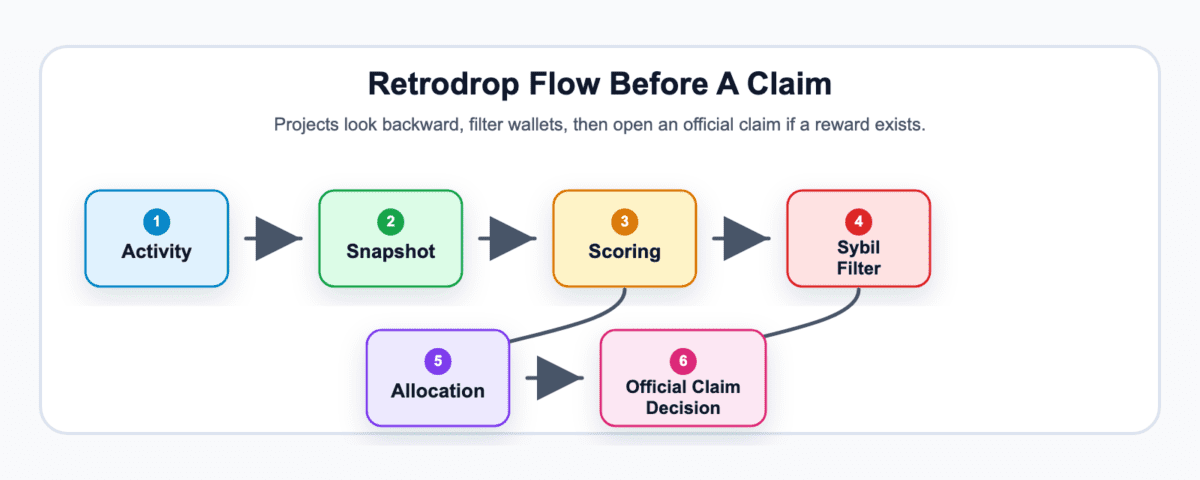
The first step is activity. A wallet may use a bridge, trade on a DEX, mint an NFT, stake, join a testnet, vote, or interact with a project over several weeks. The user usually does not know which actions count, which is why retrodrop farming can feel like trying to impress a teacher who refuses to publish the rubric.
Then comes the snapshot. A snapshot is a cutoff in time. The project records eligible wallet activity before or at that point, then later builds rules from that data. Activity after the snapshot may help a future campaign, but it usually will not fix a missed cutoff.
The middle of the process is where many users get surprised:
Sybil filtering is the hard part. A Sybil attack means one person acts like many separate users, often through dozens or thousands of wallets. Projects do not want all rewards captured by industrial farmers, so they look for linked funding sources, repeated patterns, identical transaction timing, and shallow activity.
The final step is the claim. A legitimate claim should come from official project channels and should show a wallet prompt that matches the action. If a page asks for a seed phrase, broad approvals, or strange signatures, the retrodrop has already become a different lesson.
A retrodrop is the reward event. Farming is the behavior users do before a possible reward. Blending those ideas into one noisy “free crypto” bucket makes the risk look simpler than it is.
The overlap is real. A user may farm a possible retrodrop by using a tokenless protocol. That same protocol may track points before launch. The user may also earn yield while funds sit in a pool. Still, the incentives are different, and confusing them leads to bad risk math.
Here is the clean split:
| Term | How It Differs From A Retrodrop |
|---|---|
| Airdrop | A broader token distribution. It may be retroactive, promotional, holder-based, or task-based. |
| Retrodrop | A reward based on past activity before the reward was known or fully defined. |
| Retrodrop farming | Speculative activity done to look eligible for a possible future retrodrop. |
| Points farming | Activity tracked by visible points, usually before token rules are announced. |
| Yield farming | Capital put to work for ongoing returns, fees, incentives, or emissions. |
The table shows why language matters. Retrodrop farming is not the same as guaranteed income. It is a bet that your past activity will be valued later. Points farming can give more feedback, but points are still not tokens unless a project converts them.
Yield farming has its own risks, but the expected return is usually framed around current incentives or fees. Retrodrop farming is fuzzier. You may spend gas, bridge fees, and hours for an allocation that never arrives.
If you want the broader term, farming in crypto covers the wider habit of using capital or activity to pursue rewards. A retrodrop is narrower: a past-use reward that may arrive only after the project decides who counted.
Crypto projects use the retrodrop model because rewards can turn early activity into distribution, attention, and loyalty. Done well, a retrodrop says, “You used the thing before the crowd arrived, so you get a stake.”
That is the generous version. The strategic version is colder. A project may want more wallets, more volume, more deposits, more test coverage, more governance participation, or more public attention before a token launch. A retrodrop can reward useful users and create a launch story at the same time.
Common project goals include:
The problem is that farmers see the same incentives. A 2024 TierDrop paper cited empirical work estimating that nearly 50% of Arbitrum airdrop recipient addresses were controlled by the same person. That is exactly the tension users feel: projects want active communities, while farmers want to look like valuable users at scale.
This is why modern retrodrops rarely reward only one simple action. A single bridge, one tiny swap, or one copied quest may look weak. Projects can prefer wallets with repeated, natural, multi-product use. They can also penalize activity that looks scripted.
For users, the takeaway is practical. A retrodrop is not charity with a claim button. It is an incentive system, and you are part of the data it sorts.
You qualify for a retrodrop by meeting whatever rules the project later chooses. Since those rules are often hidden until announcement, use products you would understand even without the reward rumor.
Real activity usually looks different from mechanical task completion. A wallet that swaps, bridges, tests features, votes, and returns later can look more like a user. A wallet that does one dust transaction on fifty protocols may look like a spreadsheet wearing a hoodie.
Useful signals can include:
The phrase “without chasing every rumor” is important. Retrodrop directories, X threads, and Telegram groups can list hundreds of possible campaigns. Many are guesses. Some are referral funnels. Some are stale pages dressed as alpha.
Start with projects that have a live product, credible user demand, clear official channels, and a reason a token might support governance or incentives. Avoid assuming that every tokenless app must reward you. Tokenless can mean “not yet.” It can also mean “never planned.”
Low-effort quests deserve special caution. A social follow, one testnet click, or a copied bridge route may help if a project wants broad reach. But when everyone can do the same task in three minutes, it often becomes a weak signal. Cheap signals attract cheap farming.
Use your time on a short watchlist instead. Pick a few protocols you actually understand. Use them carefully. Stop when fees, contract risk, or wallet exposure start to outweigh any plausible reward.
Retrodrop risk starts before the reward exists. The most common mistake is thinking the danger is only “I might not qualify.” Losing funds to a fake claim page is much worse than missing a maybe-token.
Fake retrodrop links often copy official branding, reply under real posts, or buy search ads. A scam page may show a fake allocation, ask you to connect, then request an approval or signature that has nothing to do with a claim.
Use this check before connecting:
| Risk Signal | What To Check |
|---|---|
| Unofficial link | Start from the project website, verified social account, or docs. |
| Seed phrase request | Close the page. No legitimate claim needs it. |
| Broad token approval | Check whether the permission matches the claim. |
| Lookalike domain | Compare spelling, subdomain, and HTTPS certificate. |
| Wallet clustering | Avoid funding many wallets from one obvious source if eligibility matters. |
| Hidden costs | Count gas, bridge fees, spreads, and tax records. |
Wallet hygiene is not optional here. Keep long-term holdings away from claim experiments. Use a separate wallet for higher-risk retrodrop farming, and fund it only with amounts you can afford to expose. Good wallets habits will not make a bad contract safe, but they can limit the blast radius.
Sybil risk sits beside scam risk. If you use many wallets, copy the same actions, and fund them from one source, a project may cluster them and reduce or remove eligibility. Worse, you can spend real fees on wallets that later get filtered.
Recordkeeping is another quiet cost. Farming across many chains and wallets creates transaction history that can become painful at tax time. If you cannot explain what you did, when you did it, and what you received, the “free” reward may arrive with paperwork attached.
Retrodrop farming is worth considering only when the possible reward is larger than the total cost of time, fees, risk, and attention. That sounds obvious. It is also the part most hype threads skip.
The upside can be real. Some early users have received meaningful allocations from major protocols. But those examples attract more farmers, better bots, and stricter filters. By the time a rumor is obvious, the easy edge is often gone.
Count the full cost stack before you start:
This is why retrodrop farming often behaves like a lottery-ticket trade. The entry cost may look small, the payoff may look exciting, and the odds are hard to estimate. That structure is fine only if you size it like uncertainty, not like salary.
Small wallets can still have a chance when projects reward breadth, early use, governance, testing, or unique contribution. But a small wallet should avoid playing a whale’s game. If a campaign quietly favors high volume, large deposits, or deep liquidity, forcing it can turn into fee burn.
Borrowed funds make the math worse. A retrodrop rumor is not a reason to take liquidation risk or loop capital through products you do not understand. If a reward requires you to stretch balance-sheet risk for an unknown allocation, the project is not the only one doing filtering.
A good rule is boring and useful: stop when you would not make the same transaction without the retrodrop rumor. That one sentence saves a surprising amount of gas and dignity.
A retrodrop opportunity deserves a closer look when the project has a real product, clear official channels, visible user demand, and a plausible reason to distribute ownership or rewards. Rumor alone is not enough.
Start with the project itself. Does the product solve something specific, or is it just a landing page and a points dashboard? Is there real activity beyond farmers talking to farmers? Are the docs clear enough that you can understand what you are signing?
Use these filters before putting a wallet to work:
Team opacity needs judgment. Some crypto builders are pseudonymous for legitimate reasons, but an unknown team with no track record, no security detail, and aggressive reward language is a bad mix. If the project leans on an anonymous team story, check whether there is any real work behind the mask.
Be careful with dashboards that rank “potential drops” like a shopping list. They can be useful for discovery, but they also make weak campaigns look equal to strong ones. A good retrodrop candidate should survive outside the dashboard.
Then ask one final question: who benefits if you farm this? If the answer is mostly the directory, referral poster, or protocol vanity metrics, step back. Strong opportunities do not need you to suspend basic suspicion.
After a retrodrop goes live, eligible users usually check an official page, connect the eligible wallet, review the claim details, pay any required gas, and decide what to do with the reward. The claim is not the finish line.
First, confirm the source. Open the claim from the project’s official website, verified social profile, governance forum, or docs. Avoid reply links and sponsored lookalikes. Then check the wallet prompt before signing. A claim should not ask for your seed phrase or broad approvals over unrelated assets.
Next, understand what you actually received. A claim may produce liquid tokens, vested tokens, governance rights, locked rewards, or a placeholder for later distribution. Those states feel similar in a claim checker, but they are very different in a wallet.
Post-claim checks should include:
Price action can be ugly after a large retrodrop. Farmers may sell quickly, market makers may be thin, and early liquidity can move hard. If many recipients rush for the door, the token can become exit liquidity for faster sellers rather than a clean reward for slower ones.
An example helps. A wallet sees a claim worth a headline amount, pays gas, receives tokens, then finds only thin DEX liquidity. Selling all at once moves the price. Holding exposes the user to future releases and sell pressure. Neither choice is automatically wrong, but both require more thought than “free money.”
Keep records the same day. Save the claim date, transaction hash, token amount, estimated value, and any sale or transfer. Future you will not enjoy reconstructing twelve wallets from vibes.
A retrodrop in crypto is a reward given after the fact to wallets that used, tested, funded, governed, or supported a project before the reward was announced.
No, a retrodrop is not guaranteed. A project may never launch a token, may exclude your wallet, or may change eligibility rules before the claim opens.
You qualify for a retrodrop by meeting the project’s final eligibility rules. Those rules can include past product use, snapshots, wallet scoring, Sybil filters, governance activity, or community contribution.
Retrodrop farming can be worth it for a small wallet only when fees, time, and wallet risk stay low. Small wallets should avoid campaigns that quietly reward large volume or locked capital.
Yes, a retrodrop can be used as scam bait. Fake claim pages, lookalike domains, malicious approvals, and seed phrase requests are bigger dangers than simply missing a reward.
Retrodrop rewards may be taxable depending on your country, when you gain control, and what you later do with the tokens. Keep transaction records and ask a qualified tax professional when amounts are meaningful.
Start by learning the project before touching the claim or farm. A real retrodrop opportunity should make sense as a product, not only as a possible payout.
Set a small budget before you act. Decide which wallet you will use, which chains you are willing to touch, and how much in total fees you can lose without caring. A cap turns vague FOMO into a defined experiment.
Also decide what you will not do. Do not bridge to chains you cannot monitor, sign unfamiliar approvals from a main wallet, or lock funds you need elsewhere. A retrodrop plan should limit curiosity before the rumor machine starts spending for you.
Keep the first pass small and boring:
Before adding a project to your list, write down why it deserves wallet interaction. Name the product, the chain, the risk, the likely reward logic, and the maximum cost you are willing to spend. If you cannot explain those pieces in plain English, keep watching instead of clicking.
Retrodrops can reward early curiosity. They can also reward scammers, fee markets, and referral farmers. If an opportunity needs urgency, mystery, and twenty wallet connections to feel exciting, let someone else pay tuition.
The best retrodrop habit is restraint. Use products because they are useful, document what you do, and view any later reward as extra upside. That keeps the chase from becoming the product.