Physical Address
304 North Cardinal St.
Dorchester Center, MA 02124
Physical Address
304 North Cardinal St.
Dorchester Center, MA 02124


A plain guide to restaking vaults, rewards, and risk.
A restaking vault is a smart-contract container that routes staked crypto into extra security work for possible rewards and added risk.
The word vault can sound like storage. In DeFi, this vault is active: it holds collateral, follows a strategy, tracks deposits, and passes results back to users. That extra work is the appeal and the warning label.
A restaking vault works by accepting approved collateral, recording each user’s claim, and allocating that collateral under a restaking strategy. The vault is the container. The strategy decides how the deposited assets support operators, networks, or services.
Symbiotic frames a vault as an on-chain container for collateral, delegation, slashing, rewards, and withdrawals. That framing is useful because it keeps the vault from sounding like a passive wallet. A clean flow looks like this:
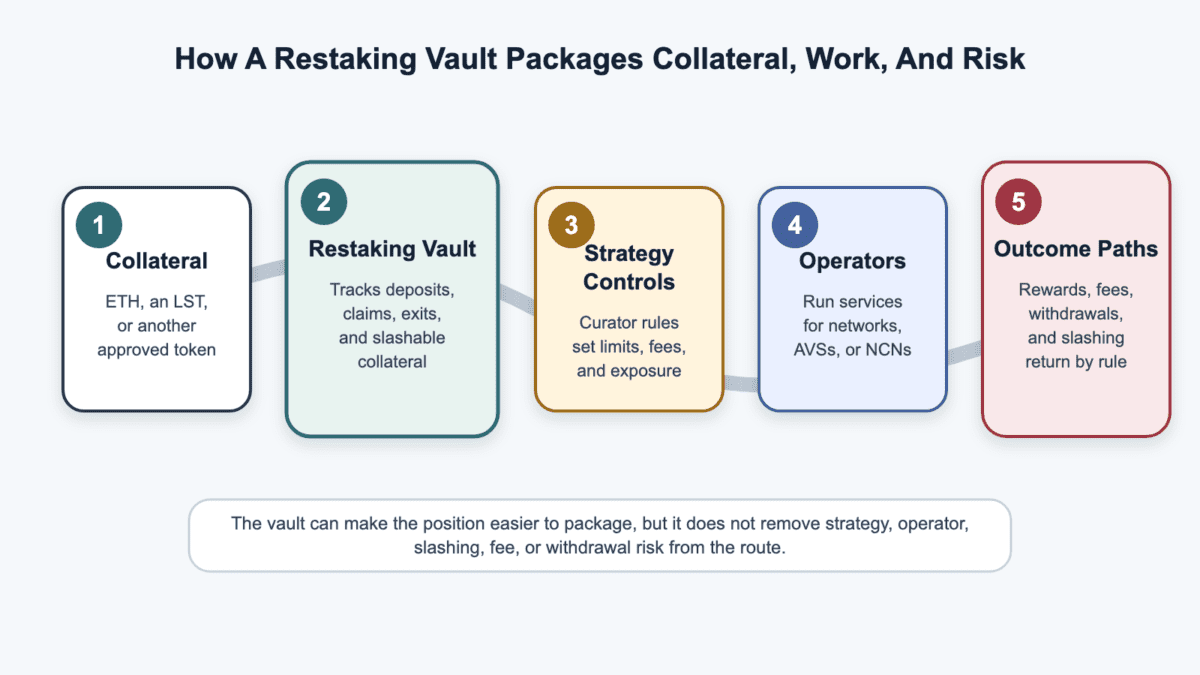
The hard part is accounting. A vault needs to know who deposited, what token entered, what part is active, what part is pending withdrawal, and what remains exposed to slashing. If a receipt token exists, that token is only the visible wrapper around the deeper route.
So the restaking vault is not a magic yield box. It is a contract-based strategy container. The contract can simplify the user experience, but it cannot delete the risk created by extra security work.
A restaking vault uses deposited assets as collateral for extra security tasks. Those assets may be ETH, an LST such as stETH or rETH, wrapped stETH, another ERC-20 token, or a chain-specific staking asset.
The exact route depends on the protocol. In EigenLayer restaking, users often think in terms of ETH, LSTs, operators, and AVSs. In a Symbiotic vault, the vault is more explicitly built around a single collateral token, delegation rules, and slashing logic. A Mellow restaking vault may package a curated strategy above that kind of infrastructure.
The asset flow usually has a few common checkpoints:
This can resemble farming in crypto because users are chasing extra return from deployed assets. The difference is the engine. Restaking vault yield is tied to security services and operator performance, while broader farming can come from emissions, fees, lending demand, or campaign incentives.
Do not assume the asset simply sits idle after deposit. If the vault’s job is to earn more than basic staking, the position must take on extra dependencies. Those dependencies decide whether the extra yield is worth the added work.
Restaking vaults, staking, liquid staking, and LRTs all touch staked assets, but they change different parts of the user’s position. Mixing them together makes the yield look cleaner than it is.
Staking starts with network validation or validator exposure. Liquid staking adds a transferable receipt token for staked exposure. Restaking reuses staked exposure for extra services. A restaking vault packages the reuse inside a strategy container, sometimes with a receipt token on top. The route is easier to read in a simple table.
| Term | What Changes For The User |
|---|---|
| Staking | The user earns network staking rewards and accepts validator, lockup, custody, or platform risk. |
| Liquid staking | The user receives an LST that can move while the underlying position remains staked. |
| Restaking | The user reuses staked exposure to help secure extra services, adding operator and slashing rules. |
| Liquid restaking vault | The user deposits into a vault strategy that may issue or connect to a liquid restaking token. |
| LRT | The user holds a receipt-style token that represents restaked exposure, with its own liquidity and price risk. |
The table hides one important detail: these can stack. A user may start with ETH, receive an LST, deposit that LST into a restaking vault, receive an LRT, and then use that LRT elsewhere in DeFi.
At that point, the position is no longer “just staking.” It is a layered claim with contract, operator, market, and withdrawal paths. The language may sound tidy. The risk stack is less tidy, because crypto hates leaving a good acronym alone.
A restaking vault is shaped by the people and systems allowed to control strategy, run infrastructure, and define the security work. The user may deposit with one click, but several roles can affect the outcome.
The curator is usually the strategy brain. A curator may set collateral rules, operator limits, network exposure, caps, or other constraints. A strong curator makes the vault easier to understand. A vague curator turns “managed strategy” into “please trust the box.”
Operators are the work layer. They run the infrastructure that supports networks or services. If they perform poorly, miss duties, or break rules, the vault’s collateral may face penalties depending on the design.
Keep the roles separate:
Wallet boundaries still matter here. Depositing into a vault begins with connection, signing, and token approval. If those steps feel unclear, start with wallet approvals before touching a restaking strategy.
Centralization risk enters when too much depends on one curator, one operator set, one admin path, or one narrow service group. A vault can be technically sound and still concentrate risk in places a beginner never sees from the APY card.
Restaking vault rewards can come from several sources, and they do not all deserve the same trust. A dashboard may show one yield number, but the number can blend durable rewards, temporary incentives, fees, and market pricing.
Base staking rewards are the cleanest piece to understand. Extra restaking rewards may come from networks or services that use the collateral. Points campaigns can add speculative upside, but points are not the same as paid yield. Read the split before you compare APY.
| Reward Component | What To Check |
|---|---|
| Base staking rewards | Whether the deposited asset already earns ordinary staking yield. |
| Network rewards | Who funds the extra rewards and whether they are live or expected. |
| Points or incentives | Whether the campaign has clear rules or only marketing gravity. |
| Vault fees | What the curator, protocol, or operator takes before the user sees returns. |
| Receipt-token pricing | Whether the receipt trades near, above, or below the value users expect. |
Late entry can be rough when incentives do the selling. A points season may attract deposits before real rewards arrive, and the exit can depend on who still wants the receipt token later. That is where exit liquidity stops being a joke and starts becoming the price of leaving.
Avoid comparing restaking vaults by headline APY alone. Ask what portion is base yield, what portion is extra network reward, what portion is temporary incentive, and what portion disappears after fees. If the answer is one blended number, the work is not done.
Restaking vault risks start with the same fact that makes them interesting: the collateral is being reused for extra security work. More use can mean more reward routes, but it also creates more ways for loss, delay, or bad pricing to enter.
Slashing is the restaking-specific risk most users ask about first. If an operator violates rules tied to a secured service, the system may penalize collateral. The exact path depends on the vault, network, operator, and slashing module. The main risk groups are worth naming plainly:
There is also a difference between normal protocol risk and malicious behavior. A well-built vault can still lose money through slashing or market stress. A malicious vault, fake front end, or abusive admin path sits closer to hard rug territory.
That distinction helps with response. Protocol risk calls for checks on audits, caps, operator lists, slashing terms, and exit rules. Malicious-risk checks start with official URLs, contract verification, token approval limits, admin controls, and whether the vault came from a credible route at all.
Withdrawal risk deserves special attention. Some vaults let users request withdrawals at any time but keep the requested amount exposed until a later epoch or claim window. Others depend on receipt-token markets for faster exits. Either path can be fine, but neither should be discovered during panic.
Check a restaking vault by tracing the asset, the strategy, the controls, and the exit before you sign anything. If you cannot explain those four pieces, keep the deposit theoretical.
Start with the collateral. Know exactly which token leaves your wallet, which network it uses, whether it is an LST, whether it has its own redemption rules, and whether the vault accepts only one token or a wrapped version. Then inspect the strategy with a short checklist:
Position sizing belongs in the same checklist. A restaking vault can look safer when it uses familiar assets like ETH or stETH, but familiar collateral does not make the strategy familiar. Going full port into one vault is a concentration bet, not a yield plan.
Also look at the receipt token, if one exists. Can it be redeemed through the protocol, traded in deep markets, or used elsewhere only because incentives are hot? A receipt token with thin liquidity can become a slow exit wearing a fast name tag.
The final check is personal. If the position needs a thread, a dashboard, a bridge, a receipt token, and three abbreviations to explain, it should be sized like something that can surprise you.
A restaking vault may make sense for users who already understand staking, DeFi wallets, token approvals, withdrawal queues, and strategy risk. It is not the clean starting point for someone still learning how an LST works.
The product can be useful when the user wants managed restaking exposure and accepts that the vault adds another layer. It can also help institutions or advanced DeFi users keep collateral inside clearer strategy limits than a fully manual route.
That does not make the vault a shortcut. It makes the vault a managed route that still needs checking. If the user can name the collateral, the curator, the operators, the secured services, the fees, and the exit path, the conversation is serious enough to continue. These signals point toward “maybe”:
These signals lean toward “skip for now”:
There is also a middle path. A user can study the vault, test a tiny deposit, withdraw it, and still decide the reward spread is not worth the moving parts. That is a good outcome. The point is not to find a heroic yield story. It is to avoid learning withdrawal mechanics after the market has already made the lesson expensive.
Base staking or plain liquid staking can be a cleaner learning path for many users. A restaking vault is a higher-complexity tool. Legitimate does not mean beginner-friendly, and “extra yield” rarely travels alone.
Related restaking vault terms help decode vault pages, dashboards, and strategy notes. The goal is not to memorize every acronym. It is to know which part of the risk stack each term touches.
Start with the asset labels. An LST is a liquid staking token, such as stETH or rETH, that represents staked exposure. An LRT is a liquid restaking token that represents restaked exposure. A VRT is a vault receipt token, often used to represent a vault position. Those labels answer one question first: what token, receipt, or claim are you actually holding?
Then separate the work roles. An AVS is an actively validated service that may receive security from restaked collateral. An NCN is a Solana restaking term for a network that receives similar support. A curator sets or manages strategy constraints. An operator runs the infrastructure. Slashing is the penalty path that can reduce collateral after rule violations.
Those terms point to practical next checks. Exit liquidity helps when the receipt token can trade below the value a dashboard implies. Full port risk helps frame why one vault should not quietly become the whole position.
Once those answers are visible, the restaking vault stops looking like one neat product. It becomes a route with moving parts. That is less exciting than a yield card, but much more useful.
A restaking vault in crypto is a smart-contract container that holds collateral and allocates it into restaking strategies. It can track deposits, manage withdrawals, connect to operators or networks, and pass rewards or penalties back through its rules.
A restaking vault works by accepting an approved token, recording the user’s claim, and applying a strategy to that collateral. The strategy may allocate exposure to operators, AVSs, NCNs, or similar services, then route rewards, fees, withdrawals, and possible slashing through the vault.
Yes, a restaking vault can be exposed to slashing if the design connects collateral to services with penalty rules. The exact loss path depends on the protocol, operator behavior, network rules, and how the vault applies penalties.
No, a restaking vault is not the same as an LRT. The vault is the container or strategy route. An LRT is a token that may represent restaked exposure from a protocol or vault route.
A restaking vault is usually more complex than liquid staking. Liquid staking mainly adds LST, validator, protocol, and redemption risk. A restaking vault can add curator, operator, extra-service, slashing, receipt-token, and withdrawal risk on top.
Before using a restaking vault, check the collateral token, contract, curator, operator set, secured networks, audits, admin controls, fees, withdrawal timing, receipt-token liquidity, and official app URL. Then test small, if you use it at all.
Start with the route, not the reward. A restaking vault should be readable as collateral, strategy, operators, services, rewards, penalties, and exit. If one part is missing, the yield number is not ready for your money.
Then ask what problem the vault solves for you. If the goal is basic staking exposure, a restaking vault may add more machinery than the job needs. If the goal is managed restaking exposure, the route still needs to be clear enough that you can explain it without repeating a dashboard slogan.
Use this sequence before taking action:
After the test, judge the boring parts. Did the approval make sense? Did the receipt token show the claim clearly? Did the withdrawal path behave as described? Did fees, epochs, or liquidity change the result? Those answers carry more signal than the headline return.
Restaking vaults can be useful for users who want managed exposure to extra security work. They can also be too much machinery for a small yield spread. If the route is unclear, waiting is not cowardice. It is just good wallet hygiene.