Physical Address
304 North Cardinal St.
Dorchester Center, MA 02124
Physical Address
304 North Cardinal St.
Dorchester Center, MA 02124


Restaked points explained without airdrop fog.
Restaked points are a protocol or provider score that measures how much restaked exposure a user contributed over time, usually for possible rewards, reputation, or airdrop eligibility rather than immediate cash value.
You will usually see the term on EigenLayer, liquid restaking token, vault, or staking-provider dashboards. It can look like a reward balance. Until the protocol or provider explains the rules, though, it is closer to a scoreboard. That distinction helps because restaked points often sit next to real risk.
Restaked points are scorekeeping units tied to restaking activity. They usually track how much eligible exposure you supplied and how long that exposure remained active.
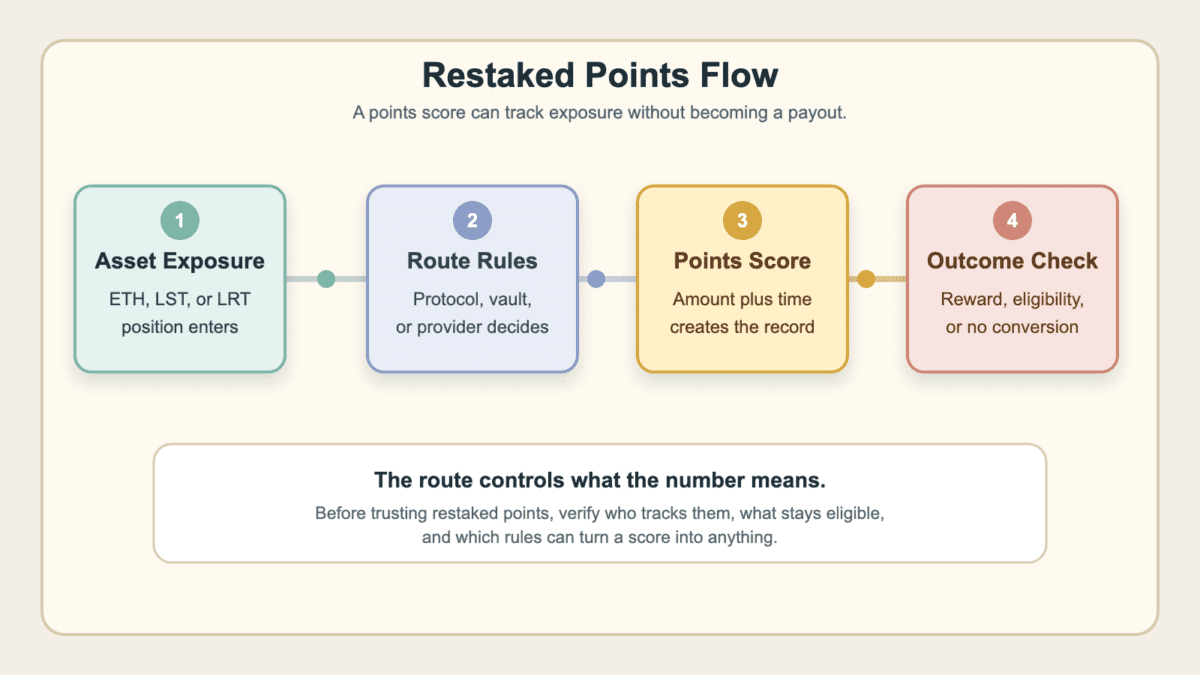
The phrase can mislead beginners. It does not mean you earned points and then staked them again. In DeFi usage, restaked points usually mean a score created by a restaking protocol, LRT provider, vault, or staking service. Read that score in three layers:
Restaking itself means using already-staked crypto exposure to help secure additional services. In Ethereum restaking, the stack often includes ETH, liquid staking tokens, liquid restaking tokens, operators, and AVSs, short for Autonomous Verifiable Services.
A simple example helps. If a protocol tracks eligible ETH exposure over time, a user with more eligible ETH for longer usually earns more points than a user with less exposure for a shorter period. That example gives you the basic shape:
But the score is not the same as yield. It is a record. That record may later affect rewards, access, reputation, airdrop eligibility, campaign tiers, or nothing at all.
So the first useful question is not “How much are my restaked points worth?” It is “Who records these restaked points, and what rules explain them?” If the answer lives on a third-party dashboard, keep digging.
Restaked points are usually calculated from eligible restaked amount and time. More eligible exposure for more time tends to create a higher score.
A simple public example from Bedrock uses an ETH-hour idea: 1 ETH restaked for 1 hour earns 1 restaked point. For a quick mental model, think “eligible amount times eligible time.” If 2 ETH counts for 10 hours, the base activity could equal 20 ETH-hours. Then ask what can interrupt that simple model:
The clean math stops there. Restaked points can depend on provider delays, route rules, balance snapshots, caps, multipliers, supported assets, wallet ownership, and dashboard updates. A provider can also track its own points beside protocol-level points.
That is why liquid restaking points can confuse users. You may see one number from a protocol and another from an LRT provider. Both can be real scores, but they may not represent the same claim path.
The formula helps, but the route controls the user-level meaning. A clean ETH-hour example can become messy once an LRT, vault, custodian, or yield market stands between you and the underlying restaked asset.
Before trusting any number, check the formula source, eligible asset list, update delay, withdrawal treatment, and whether points keep counting after you move the position.
Restaked points, rewards, Eigen points, LRT points, and tokens are related labels, but they do not give users the same thing. The clean move is to separate the score from the payout.
A points number is usually a record of activity. A reward is something claimable or paid under rules. A token is an asset with its own market, transfer, and governance risks. This decoder keeps the labels from doing too much work.
| Term | What The User Should Understand |
|---|---|
| Restaked points | A score tied to eligible restaked exposure over time. |
| Restaking rewards | Claimable or accrued rewards from staking or restaking activity. |
| Eigen points | A narrower EigenLayer-related participation score. |
| LRT points | A third-party score from a liquid restaking protocol. |
| AVS rewards | Rewards tied to services secured by restaked operators. |
| Token rewards | Actual tokens distributed under campaign or protocol rules. |
| Airdrop eligibility | A status that may use points, snapshots, and filters. |
The table is useful because dashboards often stack these labels. One page might show restaked assets, EigenLayer restaked points, an LRT campaign score, and an estimated reward.
That does not mean every line is yours in the same way. A wallet token can usually be transferred. A reward may need a claim. A points score may only sit inside a dashboard. When several labels appear together, ask three questions:
EigenLayer points are also not the whole restaked-points category. EigenLayer made the language famous, but other providers can use similar scoring for their own campaigns or routes. LRT points add another layer because the provider may track protocol points, its own points, or both.
The takeaway is boring but sturdy: name what you actually own. A token balance, a vault share, an LRT, and a dashboard score carry different rights.
Restaked points show up wherever a restaking route needs to track user exposure. The route determines who records the score, who displays it, and who may control any later reward flow.
Direct restaking is the cleanest case. The user interacts closer to the protocol and can often inspect the wallet, delegation, and position more directly. Wrappers can add convenience, but they also add accounting questions. Before assuming points count, map the route in plain English.
| Route | What To Check Before Assuming Points Count |
|---|---|
| Native restaking | Whether the wallet, EigenPod, operator delegation, and withdrawal status are eligible. |
| LST restaking | Whether the supported liquid staking token earns points directly or through a provider. |
| LRT protocol | Whether the provider tracks restaked points, its own LRT points, or both. |
| Vault strategy | Whether the vault owns the route and how it allocates future rewards. |
| Pendle-style route | Whether points follow the principal token, yield token, or special campaign terms. |
| Custodial provider | Whether the platform passes points or rewards through to the user. |
The same ETH exposure can feel very different across those routes. A native restaker may see protocol-level records. An LRT holder may rely on a provider dashboard. A vault user may hold a strategy share rather than the raw restaking position.
This is where farming in crypto overlaps with restaked points. A user may be farming exposure through several layers, while the actual points sit one layer deeper than expected. Two route traps deserve extra attention:
The rule is simple: follow the route before you count the points. If the route changes, the point treatment can change with it.
Restaked points can become useful only if future rules give them use. They may help with a token allocation, a reward campaign, an eligibility tier, reputation, or provider perks.
They can also become nothing. A score can remain a score. Crypto does not lack dashboards that looked meaningful until the rules arrived and ruined the mood. Common outcomes include:
The airdrop question is the loudest one. Restaked points may help explain why a user qualifies, but they do not guarantee a restaked points airdrop. Snapshot dates, minimum activity, route eligibility, provider terms, and Sybil filters can all affect the result.
Route ownership can also change the outcome. A native restaker, an LRT holder, and a vault depositor may all see restaked points, but the later claim path may not sit in the same place. One route may credit the wallet directly. Another may leave a provider to allocate any future reward.
Selling restaked points is also not straightforward. If there is no official transferable asset, users may see point IOUs, private deals, or pre-market claims. Those can turn into exit liquidity if buyers assume value that later rules do not support. Even when points influence a token claim, timing can change the outcome.
Restaked points can cost money long before they pay anything. The score may be free to view, but the route behind it can carry real DeFi risk.
Restaking can involve smart contracts, operators, AVSs, LSTs, LRTs, bridges, vaults, and wallet approvals. Each extra step can add a new failure point. The points dashboard will not show all of them. The risk stack usually breaks into a few buckets:
Slashing is the risk most users notice first. If restaked assets back operator work, bad performance or rule violations can expose capital under the relevant protocol rules. The details depend on the route and service.
But slashing is only one part of the stack. A liquid staking token can depeg. An LRT can trade below its expected redemption value. A vault can add withdrawal friction. A bridge can fail. A fake claim site can drain assets before any AVS gets involved. Run this checklist before chasing restaked points:
Fake claim pages deserve special attention. A user hunting an airdrop can approve a malicious spender while thinking they are only checking eligibility. That is hard rug risk in its fastest, ugliest form.
Oversizing is the quieter danger. Going full port into a restaked points route because a dashboard looks promising is not conviction. It is a scoreboard wearing a cape. Two boring costs also belong in the same review:
A cleaner habit is to write down the route, expected upside, exit plan, and worst-case failure before depositing. If the answer depends on “airdrop soon” and nothing else, the risk is carrying the whole thesis.
Checking restaked points safely means verifying the official source before connecting a wallet, signing a message, or trusting a claim link. Points curiosity is a common path into bad approvals.
Start from known protocol or provider domains. Do not start from random replies, DMs, copied screenshots, search ads, or urgency posts. A real claim does not need a stranger to rush you. Use a simple safety routine:
Wallet hygiene is part of the points check, not a separate chore. CryptoProcent’s crypto wallets category is the right place to think about custody, approvals, account separation, and setup before a claim link starts waving at you.
Add two final checks before signing anything:
The clean path is boring: official source first, minimal permissions second, records third. If a page asks for more power than a score check needs, close it.
Restaked points are worth paying attention to when you already have restaking exposure or need to understand a route you are using. They are a weak reason, by themselves, to add new risk.
That answer feels less exciting than an airdrop thread. Good. The points rush has taught DeFi users that a shiny score can hide uncertain rewards, high costs, and awkward exits. Pay attention to restaked points if:
Be careful if:
The worth-it check starts with cost. Add entry costs, exit costs, withdrawal delays, tax records, lost alternative yield, and the chance that points do nothing. Then compare that to the actual reward terms, not to a timeline full of confident guesses.
Size changes the answer:
Restaked points sit near several terms that sound similar but do different jobs. Keeping them separate prevents the article from turning into a bucket of dashboard soup.
Exit liquidity is the useful warning label when points claims become tradeable before rules are clear. It reminds users that someone may be buying a hope-shaped receipt from someone who wants out.
Full port belongs here because position size is often where points farming goes wrong. A dashboard score may be interesting, but it should not decide how much capital sits inside one route.
Eigen points, LRT points, restaking rewards, offchain points, airdrop eligibility, and liquid restaking all orbit the same question: who records the activity, who controls the route, and what can the user actually claim? Related terms are helpful only if they sharpen that route.
No. Restaked points are usually an activity score, while restaking rewards are claimable or accrued rewards under specific rules. A points score may help with reward eligibility, but it is not itself a guaranteed payout.
No. Restaked points do not guarantee an airdrop. A protocol or provider can use points as one input, then apply snapshots, route rules, minimums, anti-Sybil checks, regional limits, or no conversion at all.
Restaked points are often calculated from eligible restaked amount over eligible time. A simple model is amount times time, but each route can add delays, multipliers, caps, supported-asset rules, or provider-level accounting.
Usually not as an official token unless a protocol or market creates a recognized transfer path. Private point deals and IOUs can be risky because future rules may not honor them.
Some LRT routes can earn restaked points, provider points, or both. The key question is who controls the route and whether any future claim passes through to the LRT holder.
Restaked points may be worth tracking if you already use a restaking route. Farming them with fresh capital is harder to justify unless the costs, risks, exits, and reward rules make sense without a guaranteed airdrop.
Start with the route, not the reward rumor. Restaked points only become useful after you know what asset is exposed, who tracks the score, and which rules could turn it into anything.
That route check should be plain enough to explain without a dashboard screenshot. If you cannot name the asset, provider, wrapper, operator path, and exit method, the points number is ahead of your understanding. That is when small assumptions become expensive.
Use this quick sequence before acting:
Then write down your reason for using the route in one plain sentence. If the sentence collapses without “maybe points,” slow down. A good reason can survive without a promised conversion rate, a leaked snapshot date, or a thread that sounds certain because it uses charts.
The final check is the exit. Know whether you can withdraw, sell, wait through a queue, or only hope a provider handles the next step cleanly. Points can make a route feel active, but the exit decides whether that activity was worth the risk.
Restaked points can be useful records, and they can also be shiny distractions. The difference is whether you understand the route before the dashboard starts making promises it may not be allowed to keep.