Physical Address
304 North Cardinal St.
Dorchester Center, MA 02124
Physical Address
304 North Cardinal St.
Dorchester Center, MA 02124


A plain guide to onchain sleuths, wallet tracing, and crypto evidence limits.
An onchain sleuth is a crypto investigator who follows public blockchain transactions and off-chain clues to explain suspicious wallet activity.
The term usually appears after a hack, scam, token dump, or public wallet thread. The work can help investors read suspicious flows, help victims organize evidence, and help everyone slow down before a wallet label turns into a public accusation. Crypto leaves receipts, but receipts still need context.
An onchain sleuth in crypto reads blockchain records, follows wallet trails, and adds off-chain context to explain what likely happened. The role sits between research, security work, OSINT, journalism, and formal blockchain forensics.
The phrase overlaps with several nearby terms. Crypto users may say blockchain sleuth, crypto detective, onchain investigator, or blockchain investigator. In casual use, they often point to the same work: tracing public wallet activity and explaining it in plain English. ZachXBT is the best-known public example, but the role is broader than one account.
In practice, an onchain sleuth might start with a suspicious transfer, follow the funding wallet, notice a bridge route, and compare that path with public posts or project wallets. The result should be a narrow explanation, not a courtroom verdict.
These labels overlap, but the differences are useful:
| Term | Plain-English Meaning |
|---|---|
| Onchain Sleuth | A person who traces wallet activity and explains what it may show. |
| Blockchain Sleuth | A close synonym, often used in beginner articles. |
| Crypto Detective | A less formal phrase for the same public investigation work. |
| Blockchain Forensics | A more formal process used in compliance, legal, or law-enforcement settings. |
The evidence bar carries more weight than the nickname. A good onchain sleuth starts with transaction hashes, wallet behavior, and public records, then makes a careful claim. A weak one starts with a hunch and adds arrows until the chart looks guilty.
Onchain sleuths help crypto investors when markets move before the full story is clear. A token may be dumping, a bridge may be draining, or a promoted memecoin may be sending supply to wallets that do not look very retail.
Most users do not have time to read raw transactions during a panic. They see a price candle, a rumor, and a thread on Crypto Twitter all at once. A useful sleuth can turn that noise into a trail: which wallet moved, where funds went, and which claim still needs proof.
For investors, the value usually falls into a few buckets:
Good sleuthing can narrow the information gap. Retail buyers often become exit liquidity when insiders, early holders, or promoters sell into attention. A wallet trail cannot guarantee that a dump is coming, but it can reveal whether the visible story matches the public receipts.
The danger is speed. Fast threads can help, but speed can flatten nuance. A public wallet label may be right, stale, shared, or incomplete. Good investors use sleuthing as a research input, not as a substitute for thinking.
An onchain sleuth follows the money by starting with a transaction hash or wallet address, then moving outward through related wallets, contracts, bridges, exchanges, and off-chain clues. The process is usually a confidence ladder, not a single magic lookup.
The first receipt is the anchor. A screenshot can be cropped or fake. A transaction hash lets anyone inspect the chain record, timestamp, token, sender, receiver, contract call, fees, and linked events. From there, the sleuth checks old funding sources, approvals, repeated counterparties, and behavior around the suspicious event.
| Step | What The Sleuth Checks |
|---|---|
| Transaction Hash | The exact transfer, contract call, token, timestamp, and receiving address. |
| Wallet History | Prior funding, past transfers, approvals, NFT activity, and repeated patterns. |
| Related Wallets | Addresses funded together, used together, or moving assets in similar ways. |
| Bridge Or Swap | Cross-chain movement, DEX routes, mixer use, or asset conversion. |
| Known Service | Exchange deposit addresses, stablecoin issuers, bridges, or labeled contracts. |
| Off-Chain Clue | Domains, Telegram handles, Discord posts, GitHub commits, ENS names, or public filings. |
| Final Claim | What the trail supports, what remains uncertain, and what evidence would improve confidence. |
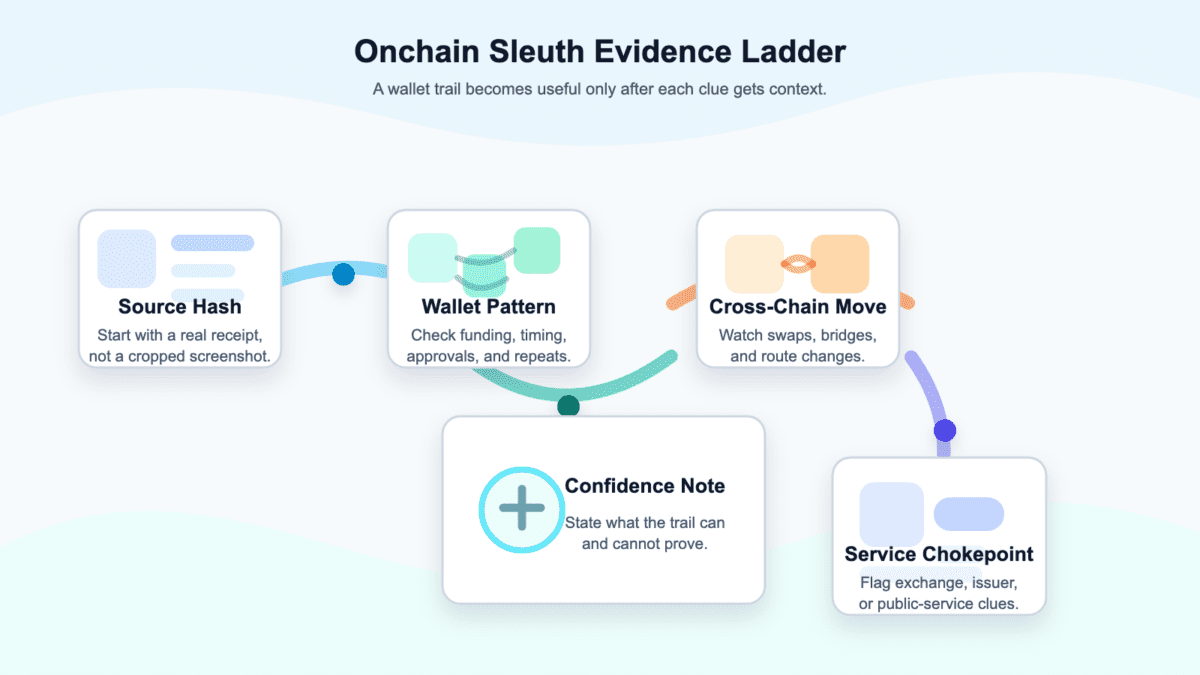
Bridges, swaps, and mixers make the trail harder. They may break a simple chain of custody, convert assets, or move funds to another network. But they do not always erase context. Timing, deposit patterns, reused wallets, and later off-ramp activity can still add weight.
The final output should explain the path and the limits. A useful report says, “this wallet funded that wallet, which then moved funds through this bridge and into a known service.” It should not quietly become, “this named person did it,” unless the identity evidence is much stronger.
Onchain sleuth evidence has two parts: public blockchain data and off-chain clues. Blockchain data shows what happened on-chain. Off-chain clues help explain who may be connected, why the flow matters, and which alternative explanations remain open.
Public transactions are strong for movement. They show that a wallet sent funds, called a contract, approved a spender, minted an NFT, bridged assets, or deposited into a known service. They are weaker for identity and intent. A wallet is not a passport.
| Evidence Type | What It Can Support |
|---|---|
| Transaction Hash | A specific transfer, swap, approval, bridge, or contract call happened. |
| Wallet Cluster | Several addresses may be linked by funding, timing, or repeated behavior. |
| Address Label | A tool or public source associates an address with a service or entity. |
| ENS Or NFT Activity | A wallet may connect to a public identity, brand, collection, or social account. |
| Public Post | A user may have linked themselves to a wallet or transaction. |
| Domain Or GitHub Record | A technical clue may connect infrastructure to a person, team, or project. |
| Exchange Behavior | A deposit to a known service may create a place where official requests can matter. |
The best work combines these sources without pretending they are equal. A transaction hash is a hard record. A social post is context. A wallet label is a clue. A leaked chat, court filing, or exchange response may add weight, but each item still needs a quality check.
The cleanest claims are narrow. “Funds moved from wallet A to wallet B” is much stronger than “this person stole the money.” That second claim needs identity evidence, motive context, and usually official process. Wallet charts can be sharp, but they do not get a free pass on due process.
An onchain sleuth can uncover patterns that are hard to see from price charts alone. That includes stolen-fund routes, related wallets, suspicious token distribution, project-wallet movement, phishing infrastructure, and repeated deposits into known services.
For scam victims, the trail may show where stolen funds moved after a wallet drain. A sleuth may find swaps, bridges, new holding wallets, or a deposit address at a centralized exchange. That can help a victim organize a report, even when it does not return the funds.
For token investors, the use cases are different:
Those patterns can be relevant when evaluating a hard rug, where liquidity or access disappears abruptly. They can also help explain soft-rug warning signs, where insiders may slowly bleed value while the public story stays upbeat.
Influencer-linked wallets are a trickier lane. Onchain data can show whether a wallet bought before a post, sold into attention, or received tokens from a project. It cannot prove payment terms, private agreements, or intent by itself. Careful wording keeps the claim honest. Suspicious is not proven.
An onchain sleuth cannot prove real-world identity, criminal intent, or recovery by wallet data alone. Blockchain records can be powerful, but they do not read minds. Convenient technology still refuses to do courtroom drama on command.
False positives happen. Wallets can be shared. Custodial services can pool user funds. Market makers can move inventory across venues. Bridges can batch flows. Privacy coins and mixers can lower confidence. Attackers can also route funds through innocent-looking addresses or copy another wallet’s behavior to muddy the trail.
Use this checklist before trusting a public sleuth thread:
The phrase “wallet attribution” deserves care. A label can be useful if a known exchange, contract, bridge, treasury, or public wallet is involved. But a label is not a confession. It may come from a tool, old public data, user reports, or clustering logic that is not visible to you.
Recovery claims need even more caution. A sleuth can trace funds, identify likely chokepoints, and help prepare a report. They cannot reverse a transaction, force an exchange to act, or guarantee that stolen funds come back. Anyone promising guaranteed recovery for an advance fee deserves the coldest possible tab close.
Onchain sleuths often need exchanges, stablecoin issuers, and law enforcement because public tracing alone cannot freeze or return funds. The blockchain may show the route, but centralized chokepoints are where real intervention can become possible.
If stolen funds land at a centralized exchange, the exchange may have account records, device logs, KYC information, and compliance processes. If stolen stablecoins remain on a network where an issuer can freeze funds, timing can matter. If the case is large enough, law enforcement may seek records through official channels.
The main chokepoints usually fall into three groups:
Chainalysis estimated that crypto scams and fraud stole $17 billion in 2025, with impersonation tactics rising sharply. That is why the boring steps count after a theft: save hashes, preserve messages, and report quickly before funds scatter through bridges, DEXs, or new wallets.
There is a custody caveat. The same exchange chokepoint that may help a victim can also make ordinary users nervous. Accounts can be frozen, support queues can drag, and shared deposit infrastructure can create confusion. Centralized services are useful in investigations, but they are not a magic safety blanket.
Good sleuthing keeps the roles straight. Public investigators can organize evidence. Exchanges and issuers can sometimes act on accounts or assets. Law enforcement can request records and pursue legal remedies. Those are related steps, not the same step.
Traders can use onchain sleuthing to improve token research, but it should not become a horoscope with gas fees. Wallet activity can show risk signals. It does not tell you what the next candle must do.
Useful checks include holder concentration, deployer wallet history, treasury movement, liquidity changes, CEX inflows, contract changes, bridge exits, and promotion timing. Compare the public story with the wallet trail.
| Useful Check | What It Does Not Prove |
|---|---|
| Holder Concentration | That large holders will sell soon. |
| Deployer Wallet History | That the current project is fraudulent. |
| Treasury Movement | That a team is dumping without more context. |
| CEX Inflow | That a sale already happened or must happen. |
| Liquidity Change | That every withdrawal is a rug pull. |
| Contract Change | That a change is malicious without code context. |
| Promotion Timing | That an influencer was paid or knowingly misleading. |
The best habit is to look for clusters, not single sparks. One whale transfer can mean custody reshuffling, collateral movement, market-making, or a sale setup. A pattern of related wallets selling into promotions is more interesting. Even then, language should stay careful.
Copy-trading from sleuth threads is especially dangerous. By the time a wallet trail is public, the cleanest edge may already be gone. Use sleuthing to avoid obvious traps, slow down on hype, and ask better questions. Do not use it as a button that says “buy what the chart accused.”
Onchain sleuthing affects wallet privacy because most public blockchains are pseudonymous, not anonymous. Your wallet address may not show your legal name, but it can still show patterns that point toward you.
Address reuse is the big leak. If the same wallet pays for NFTs, claims airdrops, receives funds from an exchange, posts an ENS name, and signs into public apps, the trail can become a profile. Public posts can make it worse, and a casual “my wallet” screenshot can do more work than a hundred analytics tags.
Privacy risks often come from ordinary habits:
Wallet hygiene is not about becoming impossible to trace. It is about reducing unnecessary exposure, protecting keys, and separating public identity from holdings where sensible. CryptoProcent’s wallet safety resources are a better next step than learning evasion tricks from a random thread.
There is also a social risk. When wallet identity clues connect to a real person, the issue moves toward being doxxed. Public accountability can expose scams. Public exposure can also harm innocent users when the claim is wrong. Both things can be true, which is annoying but useful.
If you need an onchain sleuth after a scam, start by preserving evidence and protecting what remains. Panic makes victims easier to hit twice, especially by fake recovery services.
Do not share seed phrases, private keys, remote access, or wallet screenshots with sensitive details. A real investigator does not need your seed phrase to inspect public transactions. Anyone asking for it is not helping you. They are shopping.
| Do Now | Why This Helps |
|---|---|
| Save Transaction Hashes | Hashes are the strongest starting receipts. |
| Screenshot Wallet And Dapp State | Interfaces may change after the scam. |
| Revoke Token Approvals From A Clean Device | Old permissions can keep exposing assets. |
| Move Remaining Funds To A Fresh Secure Wallet | The compromised wallet may still be risky. |
| Save Messages, URLs, Handles, And Domains | Off-chain clues help connect the story. |
| Contact An Exchange If A Deposit Address Is Visible | A known service may have a reporting path. |
| File Official Reports Where Relevant | Some actions need legal or platform process. |
This checklist cannot guarantee recovery. It gives you a cleaner packet for an exchange, investigator, platform, or official report. The faster you preserve facts, the less you rely on memory and the fewer gaps a scammer can exploit.
The recovery-scam warning is simple: do not pay strangers who promise guaranteed asset recovery. Be especially suspicious of upfront fees, “activation” payments, secret tools, private Telegram referrals, and anyone claiming they can reverse a blockchain transaction. Tracing can support action. It cannot rewrite finality.
Onchain sleuth terms help you read wallet threads without drowning in tool slang. You do not need every platform name first. You need the few words that explain what the evidence actually is.
| Term | Why The Term Helps |
|---|---|
| On-Chain Data | Public blockchain records such as transfers, balances, swaps, mints, and approvals. |
| OSINT | Public outside evidence, such as posts, domains, handles, filings, and archived pages. |
| Wallet Clustering | Grouping addresses that may be controlled by the same person or system. |
| Address Label | A tag that links a wallet to a service, contract, exchange, or public entity. |
| CEX Deposit | A transfer into a centralized exchange address or deposit route. |
| Bridge | A tool for moving assets or messages between blockchains. |
| Mixer | A tool that can obscure the link between incoming and outgoing funds. |
| Privacy Coin | A cryptocurrency designed to hide transaction details more strongly. |
| Token Approval | A wallet permission allowing a smart contract to move specific tokens. |
The terms share one lesson: each clue has a strength and a limit. A bridge can show movement across chains, but not identity. A label can add context, but not certainty. A token approval can explain how funds were drained, but not always who set the trap.
That is the whole skill in miniature. Read the record, add context, state confidence, and resist the urge to turn every arrow into a guilty verdict.
An onchain sleuth and a blockchain investigator often do similar wallet-tracing work, but the wording usually signals formality. “Onchain sleuth” is common in public crypto threads, while “blockchain investigator” can refer to professional, compliance, legal, or law-enforcement work.
Both may read transaction hashes, wallet histories, exchange deposits, and off-chain clues. The difference is usually process, access, and evidence standards.
An onchain sleuth can help trace stolen crypto, but they usually cannot recover it alone. Recovery often needs an exchange, issuer, platform, law-enforcement channel, exploiter mistake, or negotiated return.
The practical value is evidence. A clean wallet trail can support reports and make action faster if funds hit a known service.
An onchain sleuth can sometimes connect a wallet to a person, team, exchange, service, or public identity, but a wallet address alone is not identity proof. The claim needs outside clues and careful confidence language.
Strong identity clues may include public wallet posts, ENS names, repeated funding links, domain records, official filings, or exchange records. Weak clues should stay weak.
Onchain sleuthing is generally based on public blockchain data, but legality depends on methods and location. Reading public transactions is different from hacking accounts, stealing data, harassing people, or publishing private personal information.
If a claim could affect someone’s safety, reputation, funds, or legal position, the evidence standard should rise. Public data does not remove responsibility.
Onchain sleuths use block explorers, wallet-labeling tools, dashboards, DEX and bridge records, approval checkers, and OSINT sources. Common names include Etherscan, Arkham, Nansen, Dune, Chainalysis, TRM Labs, Elliptic, and MetaSleuth.
The method is more important than the tool. A beginner with a transaction hash and patience can beat a sloppy dashboard user with ten tabs open.
Traders can use onchain sleuthing before buying a token to check holder concentration, deployer history, liquidity movement, team wallets, exchange inflows, contract changes, and suspicious promotion timing.
Those checks can reduce obvious risk, but they are not a price signal by themselves. A clean wallet trail does not make a token good. A suspicious one does not prove fraud without context.
Where to start with onchain sleuthing depends on whether you are researching a token, responding to a scam, or protecting privacy. Start small. Clean evidence beats a dramatic thread.
Pick the lane first. If you are researching a token, start with holder distribution, deployer history, and liquidity movement. If you are responding to a drain, save hashes before chasing theories. If privacy is the concern, map your own address reuse before someone else does.
Do not begin with paid tools or a public accusation. Begin with records you can reopen later. A transaction link, a timestamp, and a short note about what you think happened will age better than a screenshot folder named “maybe scam.”
Try these practical steps first:
The best beginner habit is separating what the chain proves from what you infer. If you can say, “this transfer happened, this wallet may be linked, and this part is uncertain,” you are already ahead of most panic threads.
That habit also protects you. It keeps scam reports cleaner, token research calmer, and privacy decisions less reactive. When the stakes are high, boring notes beat loud guesses.
Onchain sleuthing is not magic. It is public receipts plus careful context. In crypto, that is often enough to save you from the worst stories before they become your story.