Physical Address
304 North Cardinal St.
Dorchester Center, MA 02124
Physical Address
304 North Cardinal St.
Dorchester Center, MA 02124


Track mindshare rotation without becoming the late buyer.
Mindshare rotation is the movement of crypto attention from one asset, sector, narrative, or creator cluster to another.
Traders care because attention can pull liquidity, content, influencer coverage, listings, and retail flow. But mindshare rotation is still an attention signal. It can show where the crowd is looking before money moves, or where the crowd arrived after the easy part is already gone. That tension is the whole game.
Mindshare rotation means one crypto topic starts taking attention from another. The shift can happen between Bitcoin and Ether, AI coins and meme coins, privacy coins and RWA tokens, or one creator cluster and another.
In normal language, mindshare means share of attention. In crypto, the term has a more specific edge. Users watch mindshare because attention can become demand, and demand can become liquidity when enough people act on the same story.
The rotation usually shows up in a few places first:
That connects mindshare rotation to the broader attention economy. Crypto does not only trade cash flows. It also trades visibility, belief, status, urgency, and the fear that everyone else found the next thing first.
The community use is important. Mindshare rotation is not just generic brand awareness. It usually means attention moving across markets in a way traders might monitor, score, or trade around.
A clean example looks like this:
The mistake is treating the first bullet as proof. Attention can invite money, but it does not command it. A noisy sector can still be thin, illiquid, manipulated, or already exhausted.
So mindshare rotation is best used as an alert. It tells you where to look next. It does not tell you to buy without checking the market underneath.
Mindshare rotation can affect liquidity because attention changes who is watching, quoting, posting, market-making, and waiting to buy. When a narrative becomes the daily conversation, more wallets notice it, more traders add it to watchlists, and more creators explain it to their audience.
That can improve liquidity before price clearly confirms the move. Buyers show up earlier, spreads may tighten, and market makers may care more because demand is easier to find. But the order is not fixed. Sometimes attention moves first. Sometimes price moves first, then people invent the story after the chart already ran.
Use this signal-order map before assuming mindshare rotation is predictive:
| Signal Order | What It Usually Means |
|---|---|
| Attention rises before price | Watch liquidity, source mix, and whether new buyers are appearing. |
| Price moves before the story | Check volume and catalysts before accepting the narrative. |
| Attention and price rise together | Look for confirmation, but avoid oversized entries. |
| Attention spikes after a large move | Crowding and exit-liquidity risk become the main issue. |
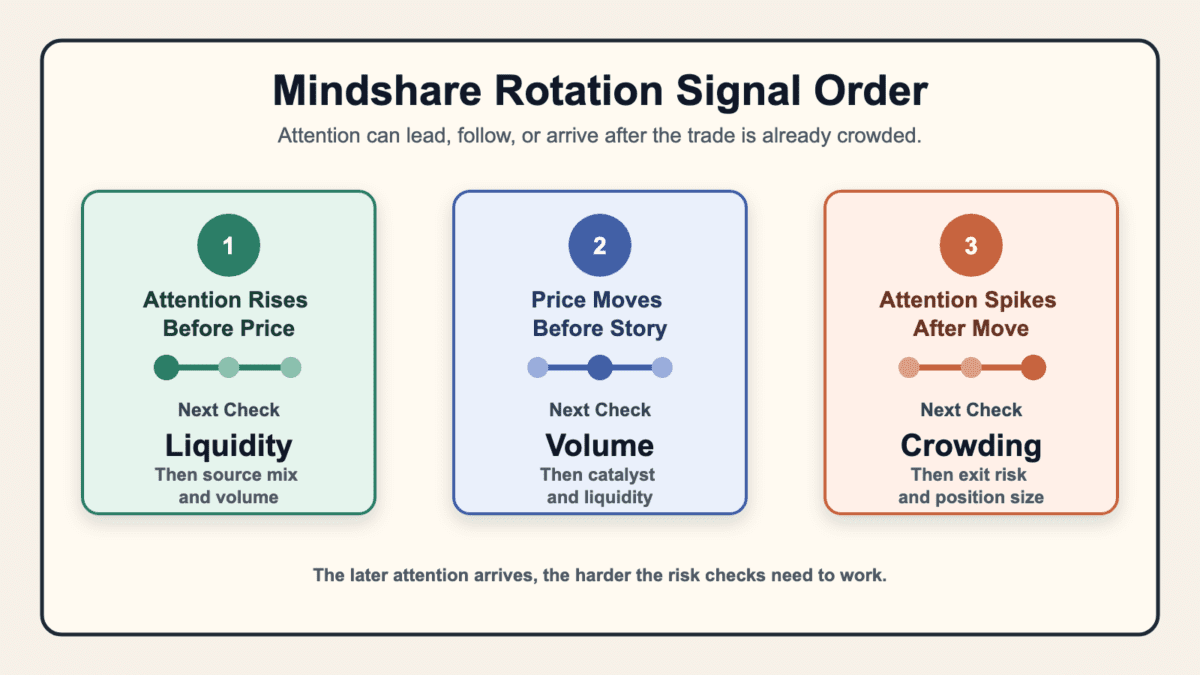
This is where broader crypto rotation context helps. Capital rotation is about money moving between assets. Mindshare rotation is about attention moving first, or at least moving loudly enough that traders start watching for capital to follow.
Confirmation hunting is the cleaner use. If attention rises and liquidity also improves, the signal is stronger. If attention rises while volume stays weak and spreads stay wide, the market may be all noise and no bid.
Mindshare rotation is easy to confuse with other crypto metrics because tools and traders often throw the same words into one bucket. The cleaner split is simple: mindshare tracks attention, sentiment tracks tone, market share tracks size, and adoption tracks use.
Narrative rotation is the closest cousin. It describes market interest moving from one story to another, such as AI, memes, privacy, DePIN, or RWAs. Mindshare rotation is one way to see that movement, but it does not prove money has followed.
Keep the terms separate:
| Metric | What It Can And Cannot Show |
|---|---|
| Mindshare | Shows share of attention, but not whether buyers have real depth. |
| Narrative rotation | Shows themes gaining focus, but can lag price action. |
| Sentiment | Shows bullish or bearish tone, but not total attention size. |
| Market share | Shows relative size, but not whether attention is rising. |
| Volume | Shows trading activity, but not whether it is durable. |
| TVL or adoption | Shows usage, but not whether traders care today. |
Tools such as Kaito, Cookie.fun, Dune, DefiLlama, and TradingView can help you inspect different parts of that picture. A mindshare score may highlight attention. A market dashboard may show volume or TVL. A chart may show whether the trade already moved.
The gap between those views is where bad trades hide. A project can have strong adoption and falling mindshare. A meme can have huge attention and almost no durable use. So keep the labels separate.
Traders spot mindshare rotation by watching attention changes, then testing whether the attention is clean, early, and backed by market data. The goal is not to live on CT all day. The goal is to catch a useful signal before it becomes the timeline’s loudest group project.
Start with a dashboard or watchlist, but do not outsource judgment to a score. Sharpe AI says its mindshare formula weights watchlist users at 70%, sentiment at 20%, and Telegram members at 10% after a cap, while other tools may weight X posts, creator graphs, project mentions, or engagement differently. That means Kaito mindshare, Cookie.fun mindshare, Sharpe mindshare, and custom Dune dashboards are not interchangeable.
A practical workflow looks like this:
Source mix matters. Ten respected analysts explaining a new sector is different from ten thousand low-quality replies farming rewards. A real builder update is different from a copied thread with a chart and rocket fuel.
Then check the market. If attention is rising before price, liquidity is improving, and volume is broadening, the rotation deserves more work. If a reward campaign is paying people to post, read the score like a smoke alarm near a toaster.
Mindshare rotation turns into a top signal when attention arrives after price, after early buyers, and after the same ticker has become unavoidable. At that point, the signal may be telling you that new buyers are late rather than early.
This is the fear behind many exit-liquidity comments. A sector can look strongest right when the easy liquidity is already committed. Everyone is posting. Influencers are explaining. New accounts are asking how to buy. That is why a late mindshare spike should push you toward top signal checks, not instant action.
Watch for late-stage signs like these:
That last setup is where exit liquidity becomes the real risk. You may be buying from someone who needed the crowd to arrive before they could sell size.
Rising mindshare is not bad by itself. It gets dangerous when the attention is late, the market is crowded, and your entry depends on even later buyers showing up. That is not a signal. That is a queue.
Mindshare rotation overlaps with the old BTC-to-altcoin cycle, but it does not follow that ladder cleanly anymore. The classic map says attention and capital move from Bitcoin to Ether, then large-cap alts, then smaller alts, and finally the highest-risk end of the market.
That model still shapes how traders talk about alt season. When Bitcoin slows after a strong move, users start watching ETH/BTC, large-cap alts, and then smaller narratives for signs that risk appetite is spreading. But modern mindshare rotation can jump around.
Several forces make the map messier:
So the old ladder is useful background, not a law. It can explain why traders expect BTC strength to spill into ETH and alts. It cannot explain every attention jump across modern crypto sectors.
Use the old cycle as a map of risk appetite, then check whether the market is actually following it. If BTC cools but ETH/BTC is weak, volume is narrow, and only one meme cluster is loud, broad alt rotation may not be happening. Attention moved, but the money may still be picky.
A cleaner read compares several layers at once:
For mindshare rotation, sequence tells you more. Is attention moving because capital is spreading, or because social feeds found a new story before capital cared? Those are different markets, even if the posts sound the same.
Mindshare rotation and fundamentals can disagree for long stretches. A useful project can lose conversation share while a noisy token runs, because markets do not always reward quality on your preferred schedule.
Old alt holders know this pain well. A project can still build, ship, and retain users while traders ignore it because the story feels tired. Meanwhile, a newer narrative can pull attention because it is simple, visual, easy to meme, or easy to explain in one chart.
That creates two uncomfortable truths:
That is why narrative-driven coins can move hard even when usage is thin. The trade is often about crowd attention, positioning, and the story buyers are willing to repeat. Fundamentals still matter, but they may matter later.
Use this split when attention and quality disagree:
This is especially clear in privacy, AI, meme, and RWA cycles. Privacy can gain serious mindshare because the theme feels timely. Meme coins can gain mindshare because the crowd enjoys the game. AI tokens can gain mindshare because the story is easy to carry across crypto and tech feeds.
Each case needs a different check. Adoption, liquidity, holders, token supply, builder progress, and exchange access all matter. Mindshare just tells you where the room is looking.
The biggest risk in trading mindshare rotation is mistaking manufactured attention for real demand. Crypto is excellent at making noise look organized, especially when rewards, points, referrals, or paid KOL campaigns are involved.
Bots can inflate mentions. Sybil accounts can fake community size. Reply farmers can push low-quality posts into visibility. Paid influencers can make a narrative look organic while the sponsor quietly waits for liquidity. Market risks can be just as blunt.
Before rotating into a hot narrative, run the checks that can save you from the obvious traps:
| Check | What It Tells You |
|---|---|
| Liquidity depth | Whether you can enter and exit without moving the market too much. |
| Volume quality | Whether activity looks broad or concentrated in a few venues. |
| Source mix | Whether attention comes from credible accounts, bots, or paid campaigns. |
| Token supply | Whether vesting releases or insider allocations could pressure the trade. |
| Venue access | Whether you need a thin DEX, a bridge, or a risky route. |
| Position size | Whether the trade can fail without wrecking the portfolio. |
This is where a conviction play differs from attention chasing. A conviction play has a reason to survive noise. A mindshare chase needs the crowd to keep caring.
Borrowed exposure makes the problem sharper. If you rotate late into a crowded perp trade, liquidation risk can matter more than your narrative read. Taxes and churn also count.
Mindshare rotation becomes easier to understand when you strip away the ticker shilling. The pattern is attention moving, then the market deciding whether that attention deserves liquidity.
One common example is Bitcoin to Ether attention. Bitcoin may dominate during macro, ETF, treasury, or store-of-value narratives. Then Ether can regain attention when traders start discussing staking, fees, L2 activity, or ETH/BTC rotation. That does not mean every alt is ready. It means the first attention bridge may be forming.
Another example is AI to meme attention. AI tokens can pull mindshare when traders want a clean technology story that also fits broader tech headlines. Meme coins can pull that same attention away when speed, culture, and liquidity matter more than product roadmaps.
You can also see the pattern in sector fatigue:
None of these examples require a live price claim. The point is the pattern, not the prediction. A useful example shows what changed first, what the market confirmed next, and what late buyers still had to check.
A strong rotation example has three pieces. Attention moves, the market confirms or rejects it, and late buyers learn whether they caught a trend or volunteered for distribution duty.
When you study examples, avoid cherry-picking the winning chart after the fact. Write down the attention signal you would have seen at the time, then compare it with price, volume, liquidity, and who was posting. That habit keeps the lesson useful after the timeline moves on.
Mindshare rotation in crypto means attention is moving from one asset, sector, narrative, or creator group to another. Traders watch it because attention can pull liquidity, but it still needs confirmation from price, volume, and market depth.
Mindshare rotation is not the same as narrative rotation, though the two often overlap. Mindshare rotation tracks attention flow, while narrative rotation tracks market focus moving between themes such as AI, memes, privacy, DePIN, or RWAs.
Mindshare rotation can sometimes appear before price, but it does not reliably predict price by itself. It works better as an alert to check liquidity, volume, catalysts, and crowding before acting.
Tools that can help track crypto mindshare rotation include Kaito, Cookie.fun, Sharpe, Dune dashboards, DefiLlama, TradingView, and custom watchlists. Each tool uses different inputs, so compare signals instead of trusting one score.
Bots and paid influencers can make mindshare rotation look stronger than it is. They can inflate mentions, engagement, and creator coverage without proving real demand, so source mix is a core risk check.
Beginners should be careful with mindshare rotation because the signal can arrive late and liquidity can disappear fast. It is better to use it for watchlist building and risk checks before using it for active rotation.
Start mindshare rotation research by writing down the narrative first. If you cannot explain what is gaining attention, who is driving it, and why buyers would care, the signal is too fuzzy to trade.
Then compare timing. Attention before price is a possible early alert. Attention with price is confirmation. Attention after a huge move is crowding until proven otherwise.
Keep the process boring on purpose. Mindshare rotation feels exciting because it shows up where people are loud, fast, and certain. Your notes should be quieter: date, narrative, source mix, price location, volume, liquidity, catalyst, and invalidation.
Use this final checklist before rotating:
After that, decide whether the action is research, a watchlist change, a smaller test position, or no trade at all. No trade is still a decision when the signal is late, the liquidity is thin, or the feed is full of paid enthusiasm.
If the signal survives those checks, keep the next step narrow. Track the asset or sector for another session, compare it with two or three nearby narratives, and note what would prove you wrong. Mindshare rotation is useful when it makes your research sharper. It gets expensive when it makes every loud chart feel urgent.
The best use of mindshare rotation is not blind chasing. It is organized suspicion. Let attention tell you where to look, then make liquidity, source quality, and risk controls earn the trade.