Physical Address
304 North Cardinal St.
Dorchester Center, MA 02124
Physical Address
304 North Cardinal St.
Dorchester Center, MA 02124


A practical guide to crypto mindshare, fake hype, attention markets, and safer checks before trading attention.
Mindshare is the share of attention, conversation, and narrative visibility a crypto project, asset, sector, meme, or idea holds against others.
In crypto, mindshare explains why one chain, token, or narrative can suddenly own feeds, group chats, watchlists, and trader dashboards. It can show where attention is moving before hard numbers catch up.
But attention alone is not market cap, liquidity, usage, revenue, developer activity, or proof that a trade is still early.
The word now does several jobs at once. Traders use mindshare as a social signal, tools turn it into a metric, attention markets make it tradable, and MINDSHARE also appears as an exact-name token on price pages. Same word. Very different jobs.
Mindshare in crypto means how much mental space a project, asset, sector, meme, or idea occupies inside the market’s conversation. It is the gap between a quiet coin and one everyone suddenly has an opinion about.
That attention can come from X posts, Reddit threads, Telegram groups, Discord servers, podcasts, news coverage, dashboards, search interest, wallet tracking, or plain old group-chat panic. A project with high crypto mindshare keeps showing up before you even look for it.
Crypto uses the word more narrowly than old marketing language. In traditional branding, mindshare often means how quickly a customer thinks of a product category.
In crypto, it usually means narrative presence inside a market that reacts to attention at ridiculous speed.
That speed is the crypto twist. Attention can pull liquidity, talent, integrations, memes, and speculation toward the same place. But it can also pull tourists, paid promoters, and late buyers who are just following the loudest room.
Think about a Solana meme coin, an AI token basket, or Ethereum during a major scaling debate. Each can have mindshare for different reasons. One may be cultural and funny. Another may be a serious technical story. Another may be loud because holders are nervous.
Here, mindshare means the concept, not the MINDSHARE token. If you landed here from a price-page result, keep that split clear. The token may have its own chart, liquidity, holders, and risks, but the broader concept explains attention around any crypto topic.
Mindshare also sits close to the attention economy because both ideas explain how attention can steer crypto behavior. Mindshare measures who owns attention. The attention economy explains why that attention can become valuable.
Crypto traders watch mindshare because attention often moves before slower signals do. A new narrative can start in small circles, spread across trading chats, hit dashboards, and only then show up in obvious volume or price action.
That does not make mindshare a buy signal. It makes it a clue. Ask whether attention is forming, confirming, or already overheated.
You can usually sort mindshare into three rough phases:
The first phase can be useful because the crowd has not fully arrived. A developer thread, a niche Telegram discussion, or a few serious analysts may point to a theme before it becomes a ticker-wide chant.
The second phase is where mindshare gets easier to see but harder to act on. More traders notice the same story. More liquidity may arrive. More content appears. This is where fast-moving crypto trenches language becomes useful. Social attention can shift before the slower parts of the market react.
The third phase is the dangerous one. By the time every account is posting the same ticker, attention may still be rising while the trade is getting worse. That is the classic crypto trick: the signal looks strongest right when the edge is fading.
That social layer gives mindshare value. It also invites abuse. A market that reacts to attention rewards anyone who can manufacture attention cheaply.
Mindshare is not a replacement for market data. It tells you how visible something is. Market cap, volume, liquidity, and TVL tell you different things about valuation, activity, exit depth, and capital commitment.
A project can dominate the conversation while still having thin liquidity. Another can have deep liquidity and low social noise. A DeFi protocol can show serious TVL while its token barely owns the timeline. These splits are normal.
Use mindshare as one input beside harder checks:
| Metric | What It Actually Tells You |
|---|---|
| Mindshare | How much attention and narrative visibility a topic holds |
| Market Cap | What the market is valuing the token at on paper |
| Trading Volume | How much activity is passing through markets |
| Liquidity | How easy it may be to enter or exit without moving price |
| TVL | How much capital is deposited in a protocol or app |
The gaps between those metrics often teach more than the metrics alone. High mindshare with weak liquidity can mean the conversation is larger than the market can support. High volume with shallow liquidity can mean the exits are worse than the headline suggests.
Low mindshare is not always bad either. Some projects build quietly before attention arrives. Others stay quiet because nobody cares. The difference shows up in product use, developer work, funding quality, integrations, holder behavior, and whether attention starts crossing from one small circle into broader crypto conversation.
So do not judge mindshare in isolation. Ask what it confirms. If attention rises while liquidity, users, builders, and credible market activity improve, the signal has more weight. If attention rises alone, the room may just be loud.
Crypto mindshare comes in several forms, and they should not be mashed together. A project can dominate social feeds while losing developer interest. A chain can attract builders while retail barely notices. A meme can own culture for a week and still have no durable base.
The type of mindshare you measure changes the conclusion. Social chatter can help with short-term flows. Developer attention can help with long-term depth. Product attention can show whether users are doing more than posting.
Here is a clean way to separate the main types:
| Type Of Mindshare | What To Check |
|---|---|
| Social Mindshare | Who is talking, how often, and across which platforms |
| Developer Mindshare | Repos, releases, grants, apps, integrations, and technical discussion |
| Product Mindshare | Whether people use the app or protocol beyond speculation |
| Network Mindshare | Whether a chain attracts users, builders, liquidity, and culture |
| Media Mindshare | Whether coverage is reporting substance or repeating hype |
| App-Specific Mindshare | What a tracker measures inside its own data model |
Narratives add another layer. Some assets gain attention because they represent a story, not because they have the strongest standalone fundamentals. That is where narrative coins can blur the line between theme exposure and actual project quality.
Markets also group attention around a broader crypto meta. AI, restaking, Solana memes, privacy, gaming, and real-world assets can each become the theme of the week. The winning project inside that theme may change fast.
So define the type before comparing projects. “This has mindshare” is not enough. Social mindshare, builder mindshare, and app-specific dashboard mindshare can point in different directions.
Traders measure mindshare by combining social feeds, dashboards, search behavior, community channels, media flow, and market confirmation. No single tracker sees the whole market, and no leaderboard removes the need for judgment.
Start with where the attention appears. X can show speed. Reddit can show objections and user language. Telegram and Discord can show whether a community is alive or just recycling slogans. Search demand can show whether casual users are arriving. News flow can show whether a topic has crossed into broader visibility.
Then look at tool-specific data. Kaito mindshare, Sharpe-style trackers, Cielo-style metrics, watchlists, wallet feeds, and trend dashboards can all help. But each one measures a slice. A tracker may weight certain platforms, accounts, wallets, sentiment inputs, or user behavior in ways that do not match your trade.
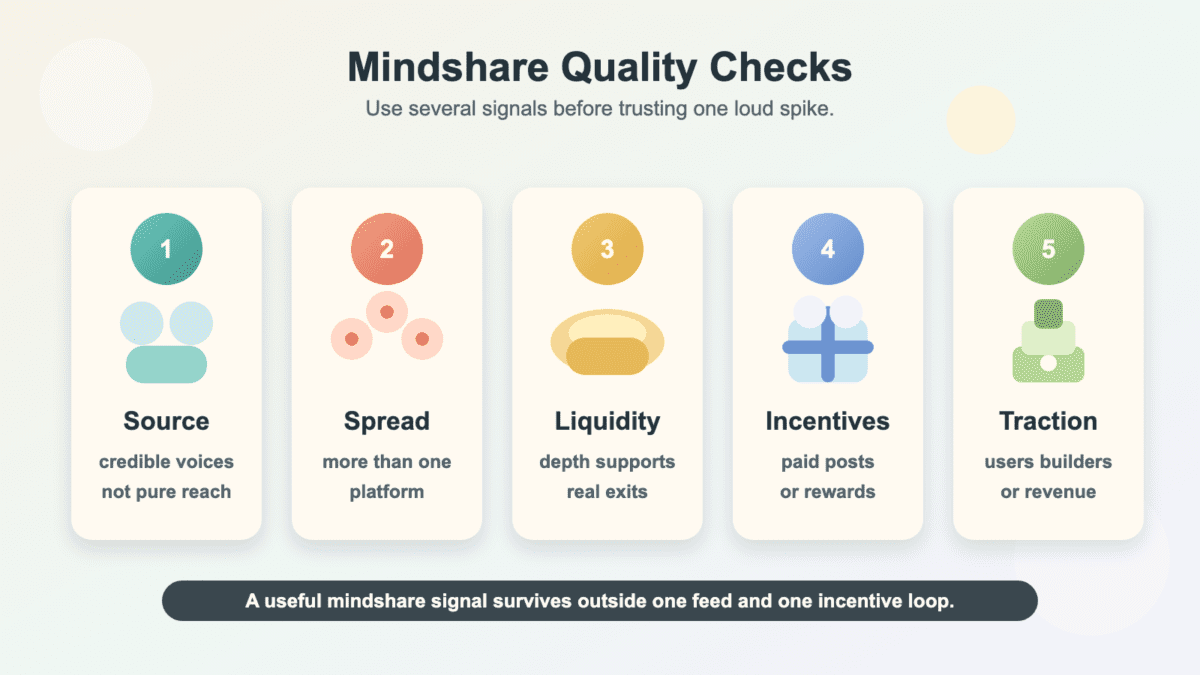
Start with source quality. Before acting on a mindshare spike, ask:
The strongest mindshare usually survives outside one platform. If a token is loud only because one KOL thread went viral, that is not the same as attention spreading through traders, builders, users, and market data.
Volume needs the same skepticism. A spike can confirm interest, but it can also come from thin books, circular trading, bots, or short-lived promotion. Ask whether people can actually enter and exit at realistic size.
One more check helps: watch how the conversation changes. Early discussion is often messy, specific, and full of questions. Manufactured hype tends to sound synchronized. If every post uses the same phrases, screenshots, and urgency, someone may be paying for volume in the room.
Fake mindshare is attention that looks organic but is pushed by incentives, paid promotion, bot activity, coordinated posting, or short-lived campaigns. It can still move prices for a while, which is why it fools people.
The trap is not always obvious. A token can have a busy feed, rising mentions, and excited holders while the real market remains shallow. Social momentum may look like demand, but the actual exit path can be tiny.
Watch for red flags that make mindshare weaker:
This is where mindshare can turn into exit liquidity. Late attention brings fresh buyers into a market where earlier entrants, insiders, or faster traders may already be looking for exits.
Memecoins make this easy to see. Culture and jokes can create real attention. They can also create a room where every holder has the same job: convince the next buyer that the room is still early.
The fix is not paranoia. It is sequencing. Check whether attention came before liquidity, after liquidity, or after a vertical move. Check whether serious users remain when the rewards stop. Check whether volume improves without the feed needing constant hype CPR.
Fake mindshare is not harmless noise. It changes how people size trades, chase entries, and ignore exits. If the only reason to act is that the feed feels unavoidable, the setup deserves a slower look.
Mindshare as a concept is different from the MINDSHARE token, a crypto mindshare tracker, or an attention market. Search results mix these meanings, so separate them before you act on anything.
The general concept describes attention around any asset, sector, chain, meme, project, or idea. The MINDSHARE token is a separate asset with its own market data and risks. A price page for that token does not define crypto mindshare for the whole market.
Trackers are another category. A crypto mindshare tracker turns attention inputs into scores, rankings, charts, or dashboards. Those outputs can be useful, but they are not universal truth. They reflect the tool’s sources, weights, filters, and incentives.
Attention markets go one step further. They let users trade outcomes tied to attention, sentiment, or mindshare metrics. Forbes reported in February 2026 that Polymarket planned attention-market products in partnership with Kaito, which is a clear example of measured attention becoming a market input.
That does not mean every mention of mindshare is an attention market. A trader watching Kaito, Sharpe, Cielo, Reddit, X, and wallet activity is analyzing attention. A user trading an attention-market contract is taking a specific position on how a defined metric will resolve.
The difference is important because incentives change behavior. When attention becomes measurable, people try to improve the metric. When it becomes tradable, people may try to move the metric. The measurement can start shaping the thing it measures.
So keep three buckets separate: the concept, the tools, and the tradable products. Confusing them leads to bad assumptions, especially when a token page or dashboard uses the same word with a narrower meaning.
Use mindshare as a filter, not a command. It can help you notice where attention is moving, but it should never replace liquidity checks, risk sizing, project research, or a clear exit plan.
The highest-risk version is the loudest one. When every post makes the same trade feel obvious, you may be closer to a top signal than an early entry. The crowd can be right about the story and late on the trade.
Before acting on a mindshare spike, run a short pre-action checklist:
This keeps the analysis grounded. A small, illiquid token can have huge mindshare relative to its actual market. A large asset can have lower excitement but far better exit depth. Neither fact is bullish or bearish on its own.
Also separate discovery from execution. Mindshare can help you discover a theme. Execution asks a different set of questions: entry price, liquidity, invalidation, position size, time horizon, and whether the trade still makes sense after fees and slippage.
If attention only exists inside an incentive loop, be careful. Points campaigns, reply contests, paid KOL pushes, and coordinated raids can make a project look unavoidable. The cleaner signal is attention that remains after the easy rewards fade.
The goal is not to ignore loud markets. It is to know what the noise is actually telling you. Sometimes it says, “People are finally noticing.” Sometimes it says, “You are the person they are hoping notices next.”
No. Mindshare measures attention and narrative visibility, while market cap measures a token’s paper valuation. A project can have high mindshare and a small market cap, or a large market cap with quiet social attention.
Market cap can also mislead when liquidity is thin. A token may look large on paper, but exits can still be poor if order books or pools cannot absorb real selling.
Mindshare can be a useful trading signal, but it is not reliable by itself. It works best when attention is matched by liquidity, volume quality, credible traction, and a clear reason the narrative is spreading.
It is weakest when attention is one-platform, incentive-driven, or already saturated. Loud does not always mean early.
Yes. Crypto mindshare can be faked through paid KOL posts, bot replies, coordinated raids, giveaway farming, point campaigns, and repeated talking points.
Fake mindshare often looks strong until you check the source. If the same accounts repeat the same message and market depth stays thin, the attention may be more manufactured than organic.
Kaito mindshare usually refers to attention data or rankings inside Kaito’s InfoFi and attention products. It is one way to measure crypto attention, not the definition of mindshare everywhere.
Use it as an input. Then compare it with other sources, liquidity, volume, and non-social traction.
No. Mindshare is the broader attention concept, while attention markets are products that let users trade outcomes tied to attention, sentiment, or similar metrics.
A trader can study mindshare without using an attention market. An attention-market user is taking a position on a specific market rule or metric.
No. MINDSHARE can refer to an exact-name token in market-data results, while mindshare in this article means crypto attention and narrative visibility.
If you are researching the token, check token-specific liquidity, holders, contract details, venues, and risks. Do not use a concept explainer as token due diligence.
Start by naming the type of mindshare you mean. Social buzz, developer attention, product use, media coverage, and app-specific scores can all point to different conclusions.
Then check more than one source. A real attention shift usually travels across platforms and survives outside the first loud account. If it only exists in one feed, slow down.
For a cleaner read, write down the claim before looking at the chart. Is the claim that developers are choosing a chain, retail traders are chasing a meme, or one dashboard ranks a token highly? Each claim needs different proof.
For longer-term projects, look for boring confirmation too. Releases, integrations, active users, serious criticism, and liquidity that survives quiet days can say more than a feed that only wakes up during promotions.
Use this simple order before acting:
If those checks give mixed answers, narrow the conclusion. Say “attention is rising” instead of “the project is good.” Say “liquidity is improving” only when depth, spreads, and volume support it.
Mindshare can help you notice markets before they become obvious. It can also lure you into a trade after the easy move has passed. The edge is not hearing the noise first every time. It is knowing when the noise has stopped being useful.