Physical Address
304 North Cardinal St.
Dorchester Center, MA 02124
Physical Address
304 North Cardinal St.
Dorchester Center, MA 02124


A practical guide to depeg risk, stablecoins, DeFi exposure, and panic exits.
A depeg is when a crypto asset expected to track a fixed reference value stops trading close to that value.
The term shows up most often with stablecoins, but it can also apply to wrapped tokens, liquid staking tokens, synthetic dollars, and other assets that promise parity. A depeg is not always a collapse. It is a warning that the price promise now depends on liquidity, redemption, reserves, venues, chains, and confidence.
So do not stop at “what does depeg mean?” Ask what broke, how wide the break is, and whether your exit route could make the damage worse.
Depeg means a crypto asset has stopped closely tracking the reference value it is supposed to follow. For a dollar stablecoin, that reference is usually one U.S. dollar. For a wrapped asset, it may be the original coin. For a liquid staking token, it may be the underlying staked asset.
Stablecoins are the main use case because their whole pitch is price stability. If USDC, USDT, DAI, or another dollar-linked token trades meaningfully below or above one dollar, people call that a stablecoin depeg. Downward moves create the most fear because holders may be stuck selling a “dollar” for less than a dollar.
You will usually see depeg used around assets like these:
A depeg can happen above the target too. That usually signals a shortage, blocked redemptions, regional limits, or uneven market access. The asset is still failing to behave like the reference value, just in the other direction.
Scope decides how worried you should be. One bad quote on a tiny market is not the same as a broad depeg across major exchanges, DEX pools, issuer redemptions, and lending markets. Crypto loves one-word panic. Your wallet prefers the slower version.
Normal drift is small, short-lived price movement around the peg. A real depeg is broader, lasts longer, and starts changing how users can exit, redeem, borrow, lend, or swap.
There is no universal cutoff that turns drift into a depeg. A one-cent move can be harmless for a casual spot holder and serious for a large borrowed DeFi position. Read the move through size, time, venue breadth, liquidity depth, pool balance, and redemption status.
Use this table as a practical severity guide, not a courtroom definition:
| Signal | What It Usually Means |
|---|---|
| Tiny move on one thin venue | Usually normal drift, bad routing, or weak local liquidity. |
| Discount lasts for hours | Worth checking deeper venues, issuer status, and pool balance. |
| Several major venues diverge | The market may be repricing redemption, reserves, or confidence. |
| DEX pools become badly imbalanced | Liquidity providers may be holding more of the weaker asset. |
| Direct redemption slows or closes | Secondary-market prices can detach faster from the promised value. |
| Withdrawals or bridges stop working | The ticker may carry different risk on different chains. |
Stablecoin depeg meaning changes by use. If you hold a small amount on an exchange, your main concern is exit price. If you use the asset as collateral, a small persistent drift can change liquidation math before the headline panic arrives.
So start with the broken price, then ask where the break appears. A depeg on one chain, one exchange, or one pool may still be serious, but it does not prove the entire asset has failed.
A stablecoin depeg happens when the market loses a clean path between the token and the value it tracks. That path can break through liquidity, redemption, reserves, smart contracts, or access to banks, chains, and bridges.
Different failures need different responses. A thin DEX pool may recover when arbitrage returns. A broken redemption route, reserve shock, or reflexive algorithmic design can create deeper damage.
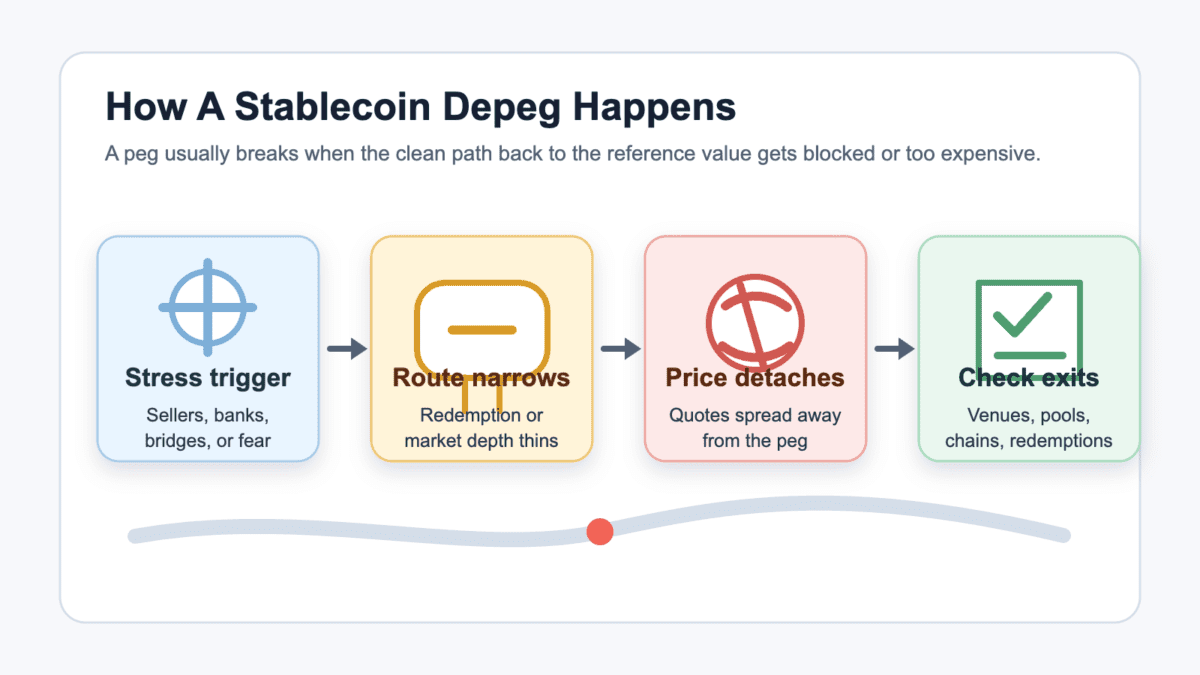
Liquidity stress can push a stablecoin away from its peg when buyers disappear or sellers all want out at once. The asset may still have a plausible redemption story, but the market price breaks because the immediate exit door is crowded.
This is common in DEX pools and smaller venues. If one pool holds too much of the weaker stablecoin, swaps start pricing that imbalance. Arbitrage can fix it only when traders can move funds, redeem, and earn enough to justify the risk.
Redemption friction appears when holders cannot easily turn the token into the reference asset. Some issuers redeem only for approved institutional customers. Some routes pause over weekends, bank holidays, compliance reviews, or stress events.
Small users then rely on secondary markets. Buyers can demand a discount if they must carry uncertainty, wait for redemption, or route through a venue with poor depth.
Reserve or collateral doubts hit confidence in the backing behind the peg. For fiat-backed stablecoins, users care about cash, Treasury bills, custodians, bank access, attestations, and legal claims. For crypto-backed designs, collateral quality, liquidation speed, and oracle prices matter more.
Backing is not just a balance-sheet question. The assets also need to support redemptions when everyone asks at the same time. A reserve stack that looks fine on a calm day can feel very different during a bank run or market crash.
Smart contract, oracle, or liquidation problems can turn a peg into a technical failure. A bug can freeze movement. A bad oracle can feed wrong prices into lending markets. A liquidation cascade can force sales into weak markets.
DeFi stablecoins add more moving parts. Collateral, governance, vault rules, oracle sources, liquidation bots, and liquidity pools all interact. When one part fails, the market may price the stablecoin below peg before casual holders understand the cause.
Regulation, banking, chain, and bridge problems can block the normal routes that keep a peg tight. A bank can limit access to reserves. A regulator can pressure an issuer. A chain outage can trap liquidity. A bridge problem can make the same ticker trade differently across networks.
The U.S. policy backdrop is still changing. The U.S. Treasury sought public comment on GENIUS Act implementation in 2025, which shows why stablecoin rules, issuers, and access can affect confidence even when the token still trades.
Stablecoins are the headline case, but anything that promises to track another asset can depeg. In broader crypto usage, depeg covers wrapped assets, staking tokens, restaking tokens, synthetic dollars, and hybrid collateral products.
The recovery path depends on what the token represents. A wrapped token needs the bridge or custodian to work. A staking token needs redemption, liquidity, and confidence in the staking system. A synthetic dollar needs its collateral and hedges to hold up under stress.
Wrapped assets can depeg when the wrapper no longer trades cleanly against the original asset. That can happen through bridge risk, custody concerns, frozen withdrawals, chain congestion, or weak liquidity.
If wrapped BTC trades below BTC, the market may be asking whether the wrapper can still be redeemed. It may also be reacting to a local chain problem, not the original Bitcoin market.
Liquid staking and restaking tokens can depeg when secondary-market liquidity moves faster than the redemption path. A token may represent a claim on staked ETH, but that does not mean it always trades exactly like ETH.
This is not always fraud or failure. It can be duration risk, withdrawal timing, validator risk, or plain market fear. But if you use the token as collateral, even a temporary discount can become painfully real.
Synthetic dollars and hybrid stablecoins can depeg when hedges, collateral, funding markets, or issuer controls stop supporting the peg. These products can look dollar-like while depending on trading strategies underneath.
That does not make every synthetic dollar doomed. It means the risk is not the same as a bank-deposit-style dollar claim. You need to know what mechanism keeps the price near peg.
A depeg hits traders, DeFi users, and yield products because the asset often sits inside other positions. It may be collateral, a pool leg, a borrow asset, a settlement unit, or the token a vault must unwind.
That is why “it only moved a little” can be a bad comfort blanket. A small discount can hurt if the position is large, borrowed, illiquid, or tied to automated liquidation rules.
These are the common impact paths:
Stablecoin yield deserves special caution. Yield farming can bundle peg risk with smart-contract risk, platform risk, pool risk, and withdrawal risk. A headline APY does not tell you which layer is paying you.
The DeFi issue is mechanical. Lending protocols use prices and collateral rules. If the stablecoin price drifts, health factors can change. If an oracle lags or a pool thins out, users may see liquidations, blocked withdrawals, or worse execution than the simple dollar label suggested.
Depeg examples help when each one teaches a failure mode. They are less useful as a disaster list, because different designs fail for different reasons and recover through different routes.
Here is the cleaner way to read common examples:
| Example | What It Shows |
|---|---|
| TerraUSD and LUNA | Reflexive algorithmic designs can fail terminally when confidence and support vanish together. |
| USDC during the SVB stress | Bank access and reserve availability can affect even a major fiat-backed stablecoin. |
| DAI during USDC stress | Crypto-collateralized assets can inherit risk from collateral they hold or accept. |
| BUSD issuer transition | Regulatory and issuer changes can affect access, confidence, and market depth. |
| USDR-style collateral stress | Real-world-asset backing can still create liquidity and redemption problems. |
| Synthetic dollar products | Hedges and collateral mechanics can become part of the peg risk. |
TerraUSD is the clearest terminal example. The SEC described UST as an algorithmic stablecoin linked to LUNA and noted that UST depegged in May 2022 while related tokens fell close to zero. That is not normal drift. It is a broken design meeting a rush for the exits.
USDC showed a different failure layer. A Federal Reserve FEDS Notes analysis of the Silicon Valley Bank event said Circle announced it could not withdraw $3.3 billion of USDC reserves from SVB during the March 2023 crisis, around 8% of total reserves at the time. The lesson is not that every fiat-backed stablecoin fails. It is that banking access can become peg risk.
These examples also explain the difference between a temporary depeg and a token that becomes bagholder risk or, in the worst case, dead coin risk. A recovery needs more than a hopeful chart. It needs functioning redemption, credible backing, usable liquidity, and market trust.
When a stablecoin depegs, check where the break is happening before you act. A single exchange quote, one DEX pool, or one chain can mislead you when liquidity is thin or transfers are blocked.
Start with the market map. Compare major centralized venues, DEX pools, direct issuer redemption if you have access, and the chain where you actually hold the token. If the discount exists only in one thin pool, you may be looking at bad local depth. If it appears everywhere, the problem is broader.
Run these checks in order:
Exit liquidity is the central check. If the only available buyers demand a harsh discount, selling fast may lock in more damage than the depeg itself. Waiting is not always right either. The exit path deserves its own calculation.
Be careful with stablecoin rotation too. Moving from one dollar token to another can reduce one risk while adding another. During stress, crypto rotation can become a crowd trade with bad spreads, paused routes, and awkward timing.
Custody and chain location also matter. If the token sits in a wallet on a chain with weak liquidity, your choices differ from an exchange balance with deep books. Check your wallets and chain records before you bridge, withdraw, or swap.
You reduce depeg risk before it happens by planning exits, limiting concentration, and understanding the stablecoin’s actual support system. Diversification helps, but it does not remove risk. It just stops one failure from owning your whole balance.
Start with the boring checks. What backs the stablecoin? Who can redeem directly? Which venues have deep liquidity? Which chains have the best support? What happens on weekends, during bank stress, or when bridges slow down?
Then check your own use case:
A farm position can look like higher interest until the peg, pool, platform, and exit route all get tested at once. Stablecoin yield is rarely free money. It is usually compensation for risks that are easy to ignore on quiet days.
Also separate issuer risk from venue risk. A stablecoin can be fine while one exchange has local liquidity trouble. The reverse can happen too: broad venue support can mask growing concern about reserves, redemption, or regulation.
The pre-event plan should be simple enough to use under pressure. Know your main exit route, your backup route, your DeFi exposure, and the maximum loss you are willing to take before you start clicking like the market personally insulted you.
Related crypto terms can help you read depeg risk without turning every price break into the same story. The useful terms are about liquidity, project failure, exit behavior, and market psychology.
Exit liquidity is the closest idea. If you can exit only by selling to buyers demanding a harsh discount, liquidity has become part of the loss.
Use these terms to sort the next question:
A temporary depeg may recover. A terminal depeg can leave holders with a token that still trades, but only because someone somewhere will buy the wreckage for scraps.
The point is precision. A depeg tells you the price promise broke. These adjacent terms help you ask whether the break is liquidity, design, control, abandonment, or fraud.
When depeg risk is on your screen, slow down long enough to identify the failure layer. You are trying to avoid two bad outcomes: ignoring real structural damage or selling into the worst available price.
Use this short action list before making the next move:
If you are in DeFi, check account health before moving collateral. A cleaner spot exit can still create a liquidation problem if you remove the asset a loan depends on.
Then choose the actual next action: sell, redeem, bridge, hedge, reduce borrowing, or wait for deeper liquidity. The right move depends on the failure layer, not on red candles alone.
None of those steps guarantees a clean exit. They do give you a better map than “the chart is red, therefore click something.” In a depeg, the first useful edge is knowing whether the problem is price noise, liquidity stress, blocked redemption, or a broken promise.
Depeg means a crypto asset has moved away from the value it is supposed to track. The term usually describes stablecoins losing their dollar peg, but it can also apply to wrapped assets, staking tokens, and synthetic assets.
There is no universal depeg threshold. A tiny one-venue move may be normal drift, while a broader discount across major venues, deep pools, and redemption routes is more serious.
Yes, a stablecoin can depeg and recover if liquidity returns, redemption works, confidence improves, and the backing remains credible. A recovery is much less likely when the design, reserves, or redemption promise is broken.
No, a depeg is not always caused by bad reserves. It can come from liquidity stress, blocked redemption, weak venue depth, chain issues, bridge problems, oracle failures, regulation, or sudden loss of confidence.
If a stablecoin depegs on one exchange, compare deep venues, DEX pools, direct redemption status, deposits, withdrawals, and chain access before acting. One local quote may reflect venue liquidity rather than issuer-level failure.
Yes, wrapped assets and staking tokens can depeg when they stop trading close to the asset they represent. The cause may be bridge risk, custodian risk, redemption timing, weak liquidity, or market fear.