Physical Address
304 North Cardinal St.
Dorchester Center, MA 02124
Physical Address
304 North Cardinal St.
Dorchester Center, MA 02124


A practical guide to bridge exploit risk, exposure, and safer cross-chain checks.
A bridge exploit is an attack that breaks a crypto bridge’s transfer or messaging system, causing funds to be released, minted, or drained improperly.
The risk shows up in plain ways. A bridge exploit can hit a route between chains, a wrapped token, a liquidity pool, a lending market, or the withdrawal path you expected to use.
The awkward part: both connected blockchains can keep running normally. Ethereum can still produce blocks. Solana can still produce blocks. The bridge between them can still be the thing that failed.
A bridge exploit in crypto is a failure in the bridge layer that lets an attacker move value across chains without the normal backing, approval, or accounting on the other side.
A bridge exists because blockchains do not naturally share state. Bitcoin does not natively know what happened on Ethereum. Ethereum does not automatically know what happened on Base, Arbitrum, BNB Chain, or Solana. The bridge tries to connect those separate ledgers.
Most bridges do that with a few moving parts:
A bridge exploit happens when one of those checks lies, breaks, or can be bypassed. The destination side may release USDC, Wrapped BTC, ETH exposure, rsETH, or another token even though the matching source-side event never happened. That is why bridge incidents can feel strange.
The attacker may not crack your wallet. They may not stop the underlying chain. Instead, they can convince the bridge that a valid deposit, burn, or message exists when it does not. If a bridge releases tokens on Ethereum after accepting a fake burn message from another chain, the released tokens have no real backing. The bridge did what it was told. The problem is that it was told a lie.
A bridge exploit moves funds by corrupting the normal cross-chain sequence: value is locked or burned on one side, then released or minted on the other.
In a basic lock-and-mint bridge, you deposit an asset into a contract on the source chain. The destination chain mints a wrapped version. When you return, the wrapped version is burned and the original asset is released. In a burn-and-release route, the bridge destroys or marks tokens on one side, then releases matching assets from a reserve on the other.
Liquidity-pool bridges can look different on the surface, but they still depend on accounting. One side pays out because the system believes the other side received, burned, or settled value.
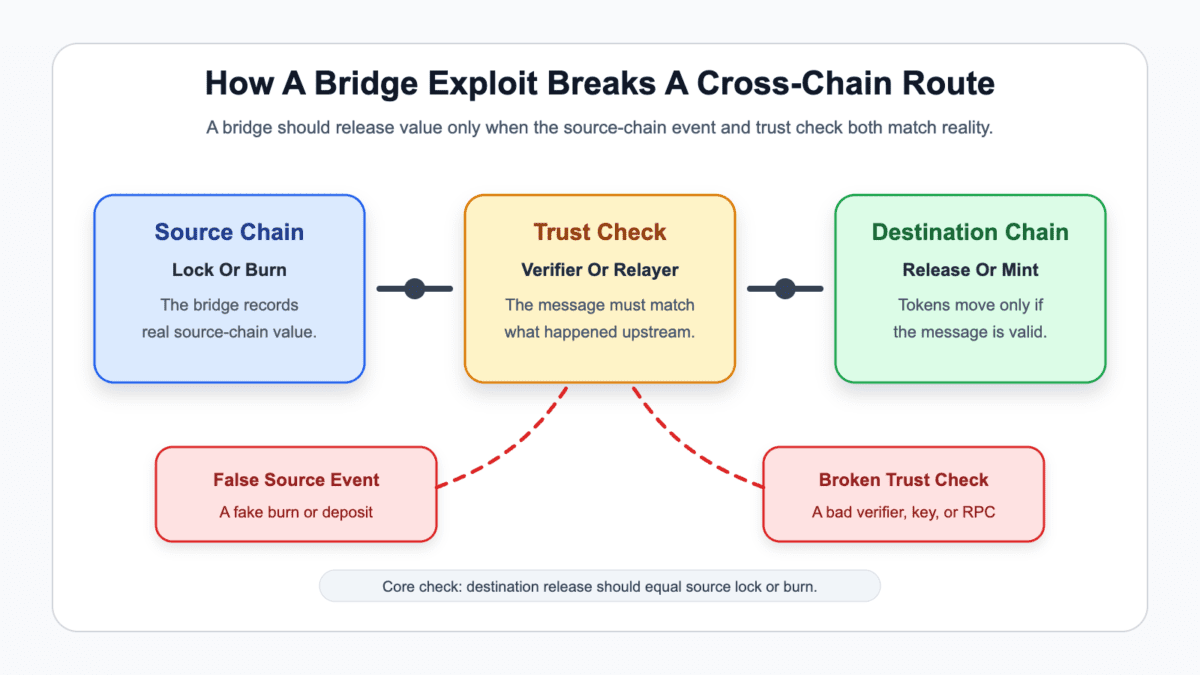
Message-based bridges add another layer. Instead of only moving token balances, they pass instructions between chains. A cross-chain app may use that message to release tokens, update a position, or trigger another action. A bridge exploit attacks the trust point in that chain of events.
The KelpDAO case is a useful current example. In an April 2026 incident write-up, Chainalysis reported that roughly $292 million in rsETH was released against a source-chain burn that had not actually happened.
That does not mean every bridge exploit works the same way. It shows the core danger. If the destination side believes a false message, it can perform a real transfer based on a fake event. It may also accept a bad validator approval, a compromised key, a logic bug, or false data from infrastructure reading the source chain.
So do not check only whether the transaction executed. Check whether it matched reality on the other chain. Bridges fail when that second answer is no.
A bridge exploit can hit people who never clicked the bridge because bridged assets often circulate inside the wider market after they are minted or released.
If you hold a wrapped token, provide liquidity, borrow against bridged collateral, or use an app that accepts the bridged asset, you may depend on bridge backing without realizing it. That is the quiet risk. The bridge can sit upstream from your position.
This is where the exposure map helps. Start with what you actually hold or did, then check the first weak point.
| Your position | What to check first |
|---|---|
| You bridged recently | Confirm both-chain settlement and bridge status notices. |
| You hold a wrapped asset | Check whether the backing asset is still fully matched. |
| You provide liquidity | Watch pool imbalance, depegs, paused swaps, and withdrawal limits. |
| You borrowed against bridged collateral | Check liquidation risk, oracle updates, and market pauses. |
| You hold the protocol token | Watch governance notices, recovery plans, and treasury exposure. |
| You are waiting on a withdrawal | Save transaction hashes and avoid re-submitting through recovery links. |
The table is not a panic button. It is a sorting tool. A wallet with native ETH on Ethereum has a different risk than a wallet holding a bridged ETH representation on another chain. Wrapped-token holders can get stuck with an asset that trades below its expected value. That is classic bagholder risk with cross-chain plumbing underneath it.
The next split is about where the damage can land:
Wallet exposure is narrower but still worth checking. A bridge exploit does not automatically mean your private key is compromised. Still, reviewing approvals through trusted wallet tools and keeping separate wallets for DeFi activity can limit the blast radius when things get noisy.
Common bridge exploit types include forged messages, false deposit events, validator compromise, private-key theft, smart contract bugs, admin weakness, and failures in off-chain infrastructure.
The same headline can hide very different failures. “Bridge hacked” may mean the bridge accepted a fake message. It may mean a signer key was stolen. It may mean a contract skipped a check that should have stopped a payout. Use this table to decode the first wave of incident language.
| Failure mode | What users may notice |
|---|---|
| Fake deposit or burn event | Tokens are released even though no matching source-chain event exists. |
| Forged cross-chain message | A destination contract acts on an instruction that did not really happen. |
| Validator or verifier compromise | The bridge accepts a bad transfer because enough approval power is under attacker control. |
| Private-key compromise | A privileged signer approves withdrawals or messages it should reject. |
| Smart contract logic bug | Edge cases bypass checks around deposits, burns, balances, or message validation. |
| Admin-key weakness | Emergency controls are abused, captured, or changed too quickly. |
| Oracle, RPC, or relayer failure | The bridge reads bad state or receives misleading delivery data. |
| Monitoring gap | The attack looks normal until balances or backing no longer match. |
Warning signs are rarely as clean as the table. A bridge may pause transfers, a token may depeg, liquidity may vanish, or a protocol may ask users to wait while it reconciles transactions. The first update may be incomplete, because teams often need time to compare source-chain events with destination-chain payouts.
Avoid diagnosing too early. A forged message and a stolen private key can both produce a drained bridge, but the user response may differ. Approval cleanup helps with wallet hygiene. It does not fix a broken bridge reserve.
Good incident updates usually separate three facts: what was affected, what has been paused, and what users should avoid doing. Bad updates often jump straight to blame or vague promises. If a bridge exploit headline appears while you have an open transaction, do not chase random support DMs. The bridge may be broken, but scammers still know how to read a trending tab.
Bridge exploit size and real loss can differ because an attacker may mint or release more value than they can actually sell, move, or keep.
This distinction changes how you read a huge headline number. A bridge exploit can create unbacked tokens, but those tokens still need liquidity if the attacker wants to turn them into ETH, stablecoins, or another asset.
Here is the cleaner way to read incident numbers.
| Number in the headline | What it may actually mean |
|---|---|
| Minted or released amount | The maximum value the exploit made available to the attacker. |
| Swapped amount | The portion sold into available market liquidity. |
| Frozen amount | Funds blocked by contracts, governance action, exchanges, or validators. |
| Bad debt | Loss pushed into lending markets or protocols that accepted the asset. |
| Recovery amount | Funds returned, seized, clawed back, or otherwise made unavailable to the attacker. |
Thin liquidity can turn a headline into a trap. If the attacker mints a large amount of a bridged asset, selling it can crush the price before the full amount is realized.
That does not make the bridge exploit harmless. A small realized sale can still reveal a severe accounting failure. It can also create panic, liquidations, frozen pools, and a long argument over who absorbs the gap. Traders sometimes become exit liquidity during that confusion. They buy the damaged asset because it looks cheap, then learn the backing problem is still open.
Use headline size as a starting point, not the verdict. Better follow-up checks are liquidity depth, depeg size, frozen funds, official pause notices, lending-market exposure, and credible recovery updates.
A bridge exploit is different from a wallet hack, chain hack, bad approval, or rug pull because the failed component is the bridge or cross-chain messaging path.
Crypto disasters can look similar from the outside. Funds move. Tokens drop. Withdrawals pause. Social channels get loud. The cause decides what you should do next. This comparison keeps the labels clean.
| Problem | What usually broke |
|---|---|
| Bridge exploit | The cross-chain route, message validation, reserve accounting, or verifier layer. |
| Wallet hack | A private key, seed phrase, device, session, or malicious signing flow. |
| Chain hack | The underlying blockchain’s consensus, validator set, or core protocol rules. |
| Bad approval | A token allowance lets a malicious contract pull funds from your wallet. |
| Hard rug | A project deliberately drains liquidity, disables selling, or steals funds. |
| Soft rug | A project fades, abandons support, or slowly extracts value without one clean drain. |
The wrong label creates bad action. If your wallet was hacked, you move clean funds to a safer wallet and stop using the compromised setup. If the bridge was exploited, your wallet may be fine, but the bridged asset or route may not be.
Paused withdrawals can feel like a hard rug because users cannot get out. That does not prove the team intentionally drained funds. It may mean the bridge was paused to stop further damage.
A long, vague recovery process can feel closer to a soft rug when updates slow down and liquidity never fully recovers. Still, the cause decides the right response. A technical exploit, bad incident response, and deliberate abandonment are not the same event. For users, the split is simple: secure the wallet after a wallet hack, verify backing and route status after a bridge exploit, and review liquidity and team control after a rug-pull warning.
If you used a bridge before a bridge exploit, stop interacting with the affected route and confirm your transaction status from trusted sources before taking new action.
Do not rush to “fix” the transaction through links in replies, DMs, or Telegram comments. Attackers and impersonators move fast after bridge incidents because scared users click fast.
Start with the calm checklist.
Approval revocation is useful hygiene, but it is not a cure for every bridge exploit. If the failure was a forged message or compromised verifier, your wallet approval may not be the root problem. Still, approvals can create separate risk. If you approved a bridge contract, router, or token you no longer trust, reviewing and reducing allowances is sensible.
If your transaction is pending, avoid repeatedly sending new transactions through the same route. That can turn one unclear problem into several. Check nonce status, bridge status, and destination-chain settlement before trying again.
If you hold the affected bridged asset, do not assume the displayed wallet balance equals clean value. Check pool liquidity, redemption status, and whether major apps have paused deposits, withdrawals, or collateral use. Use the real approval tool, not a fake link pushed during the incident.
The goal is not hero mode. It is damage control: stop new exposure, verify what settled, preserve records, and avoid turning a bridge exploit into a wallet exploit.
You check a bridge before a bridge exploit by looking at its trust model, controls, liquidity, route support, and failure history before sending meaningful size.
No bridge is risk-free. The useful question is whether the route’s risk matches the amount, urgency, and reason for the transfer. A $25 test transfer and a six-figure treasury move should not get the same level of checking. Run these checks before using a bridge for anything you would hate to explain later.
For a one-off Bitcoin-to-Ethereum move, a centralized exchange may be operationally simpler than a bridge. That does not make it automatically safer. It swaps bridge risk for custody, KYC, withdrawal, account, and venue risk.
The tradeoff changes by user. If you already use an exchange and need a simple transfer, the exchange route may reduce wrapped-token complexity. If you need self-custody, DeFi composability, or a specific destination chain, a bridge may still be the better tool.
Bridge aggregators can improve routing, but they do not delete bridge risk. They may route through several systems, each with its own contracts, liquidity, and settlement assumptions. The clean habit is to size the transfer to the trust model. If the bridge uses a small verifier set, thin liquidity, unclear monitoring, and a vague refund process, do not send money as if it were a bank wire with a cape.
Start with the accounting problem. Check what is actually backed, settled, liquid, and still safe to touch.
Before your next bridge transfer, take these steps. They are boring on purpose. Boring checks beat exciting apology threads.
After a bridge exploit, slow down. Do not buy the dip just because a wrapped asset is trading below peg. Cheap can mean mispriced. It can also mean the market knows the backing is broken. The same caution applies to liquidity pools, lending collateral, and withdrawal routes that depend on the affected bridge.
For larger transfers, write down your route before you move funds: source chain, bridge, destination chain, expected token contract, expected fee, expected time, and backup plan. That tiny note can save hours when a status page, explorer, or support channel starts speaking in acronyms. It also gives you cleaner records if you need to compare both-chain settlement later.
A bridge is a tool, not a trust blanket. Use it when the route earns the risk. If the route depends on unclear signers, thin liquidity, vague pause controls, or a wrapped asset you cannot verify, reduce the size or pick a simpler path. The point is not to avoid every bridge forever. The point is to stop letting cross-chain convenience hide cross-chain risk.
A bridge exploit in crypto is an attack or failure that lets a bridge release, mint, or move value across chains without the correct source-chain backing or validation. The connected blockchains may still work normally while the bridge layer fails.
Yes, a bridge exploit can affect you indirectly if you hold the bridged asset, provide liquidity, borrow against bridged collateral, or use an app that accepts the affected token. Your wallet may be fine, but the asset backing or market liquidity can still be damaged.
A centralized exchange can be simpler for a one-off transfer, but it is not always safer. It replaces bridge smart contract and wrapped-asset risk with custody, account, KYC, withdrawal, and venue risk. The safer route depends on amount, urgency, asset, and destination chain.
A bridge exploit usually breaks the cross-chain bridge, message layer, reserve accounting, or verifier system. A blockchain hack would affect the underlying chain’s consensus or core rules. A bridge can fail even when both connected chains keep producing valid blocks.
You should review approvals after using a bridge, especially if the bridge, router, or token becomes suspicious. Revoking approvals can reduce wallet-level risk, but it does not fix every bridge exploit. Some bridge exploits happen through forged messages or reserve failures, not your personal allowance.