Physical Address
304 North Cardinal St.
Dorchester Center, MA 02124
Physical Address
304 North Cardinal St.
Dorchester Center, MA 02124

A plain-English guide to cooking in crypto, hype, and risk.
Cooking in crypto is slang for a trader, project, coin, or community that appears to be building momentum or performing well.
The phrase often sounds positive, but it is not a market signal by itself. In crypto chats, “devs are cooking” can mean a team is building, “let him cook” can mean give someone more time, and “I am cooked” usually means a trade has gone badly wrong.
Cooking in crypto means people think a trader, team, coin, or community is making progress, performing well, or setting up something promising. It can describe developers shipping updates, a trader making strong calls, a coin gaining attention, or a community becoming more active.
The phrase comes from broader internet slang where cooking means creating, performing, or being given room to finish. Crypto uses it because markets move quickly and communities often react to mood before facts are clear.
Common examples include:
The language helps when it points to something specific. It gets weaker when it replaces evidence. A post that says “they are cooking” without naming the update, source, contract, liquidity, or risk is mostly a mood signal.
Start by reading it as sentiment. Cooking tells you the crowd feels positive or curious. It does not prove that the chart will keep moving, that the team is honest, or that late buyers will have a clean exit.
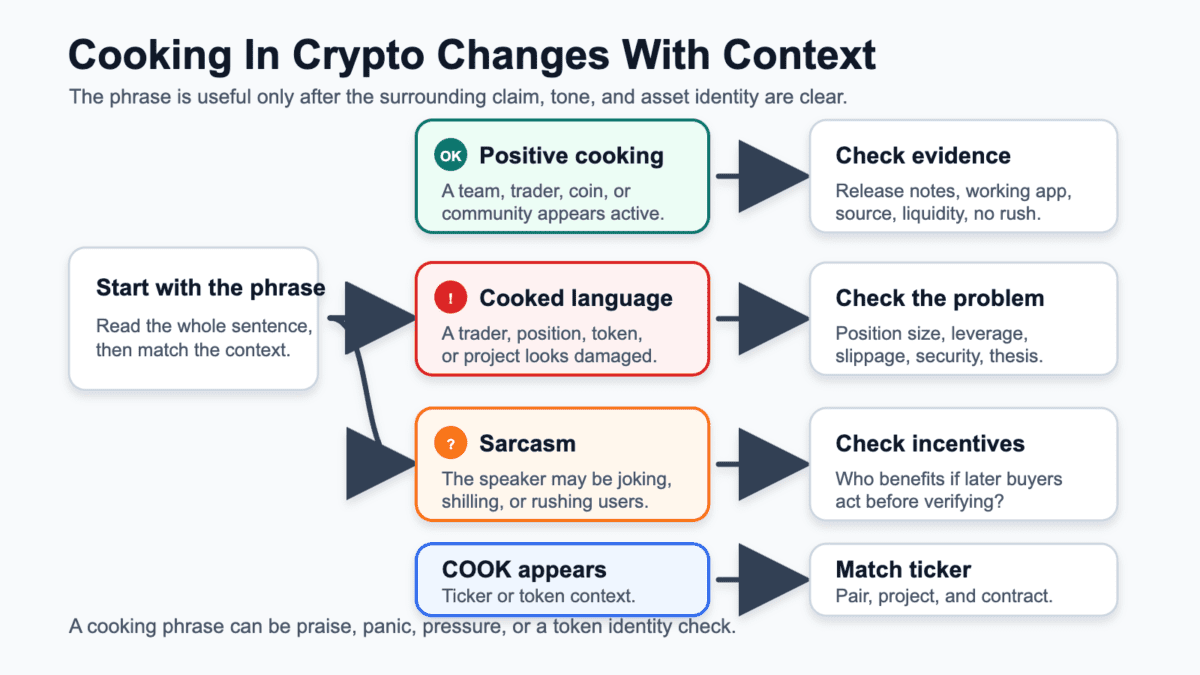
Cooking in crypto changes by context because the same word family can signal praise, patience, sarcasm, panic, or token-name confusion. The surrounding sentence usually tells you more than the word itself.
Read the phrase beside the chart, project update, wallet action, or chat tone that triggered it. A builder update, a meme reply, and a loss confession can all use cooking language in different ways.
| Phrase | Most Likely Meaning |
|---|---|
| The devs are cooking | The team appears to be building, updating, or preparing a launch |
| Let him cook | Give the trader, founder, or influencer more time before judging the result |
| That trader cooked | The trader made a strong call or executed well |
| The coin is cooking | The coin is gaining attention, price strength, or community momentum |
| Who let him cook | The speaker thinks the idea, trade, or claim may be bad or reckless |
| I am cooked | The speaker feels trapped, overexposed, or badly down on a trade |
| That project is cooked | The project looks damaged, abandoned, exploited, or unlikely to recover soon |
| COOK token | The reference may be a ticker, token name, or project, not slang |
That range is why a single definition can mislead. “The coin is cooking” sounds hopeful, while “I am cooked” sounds anxious. “Who let him cook” can be sarcasm after a poor trade idea.
Tone also changes quickly in meme-coin chats. A group can call a coin cooking while holders are trying to attract buyers, then call the same coin cooked after liquidity fades. The phrase should start the check, not end it.
Cooking in crypto is positive when it points to visible progress or performance that can be inspected. The strongest use is tied to a real update, clear trade execution, growing usage, or a community action that has evidence behind it.
A project may be cooking if a team ships a product update, publishes release notes, fixes a known issue, or reaches a roadmap milestone. A trader may be cooking after a series of accurate calls, but past calls still do not remove the risk in the next one.
Look for signs that the positive slang is attached to something concrete:
Compare the wording. “The devs are cooking because the swap feature is live” points to a checkable change. “The devs are cooking, do not fade this” mostly points to pressure.
Positive cooking language becomes more useful when the claim survives a slower read. If the update is public, the contract is clear, and the pressure is low, the phrase may be describing real momentum. If the post is vague, urgent, and full of screenshots, the phrase may be only a sales pitch.
Cooking in crypto turns into cooked when the conversation shifts from progress to damage. Cooked usually means a trader, position, token, or project looks badly hurt, overexposed, liquidated, hacked, rugged, or unlikely to recover soon.
Someone might say “I am cooked” after buying near a local high, using too much leverage, holding a weak meme coin through a sharp drop, or realizing that liquidity is too thin to exit cleanly. A project might be called cooked after a hack, an abandoned roadmap, a drained liquidity pool, or a loss of community trust.
> Do not let “am I cooked” replies become financial advice. Anonymous replies can push panic, false confidence, or jokes when the real issue is position size, leverage, liquidity, security, and whether the original reason for the trade still exists.
Break the problem into practical checks before accepting the crowd’s verdict:
Cooked does not always mean zero. It can mean the odds look worse, the trade has become emotional, or the project has lost trust. A liquid spot position, a leveraged position near liquidation, and a fake token problem all need different responses.
The phrase is most dangerous when it turns uncertainty into crowd drama. A yes-or-no reply from a chat cannot tell anyone whether to hold, sell, secure a wallet, reduce leverage, or simply accept that the original trade was too large.
Cooking in crypto is slang, but COOK can also appear as a ticker, token name, hashtag, or project brand. That overlap creates risk because search results and exchange pages may mix language explainers with actual asset pages.
COOK, Let Him Cook, Cooking.City, mETH Protocol references, and kitchen-themed meme coins may point to real token or protocol pages rather than definitions of the phrase. None of those names makes an asset safer, stronger, or worth buying.
| What You Saw | How To Check It |
|---|---|
| Slang in a chat | Read the sentence around it and decide whether it means progress, hype, sarcasm, or trouble |
| Token ticker | Confirm the exact ticker, market pair, exchange page, and contract address |
| Exchange result | Check whether the page describes a tradable asset rather than a slang definition |
| Contract address | Match it against official channels before trusting token identity |
| Project website | Separate branding claims from token mechanics, liquidity, and permissions |
| Kitchen-themed meme coin | View the theme as marketing until the contract, holders, and liquidity are checked |
| Protocol token | Verify what the protocol does and whether COOK is actually part of that system |
Keep the word and the asset separate until the context is clear. A message saying “the coin is cooking” does not identify a token contract. A COOK ticker does not explain the slang by itself.
That separation helps most around screenshots and copied tickers. A token can borrow a viral phrase, and a community can repeat the phrase without proving that the asset behind it has liquidity, users, or durable demand.
Read cooking claims as prompts for verification, not buy signals. The phrase tells you what the crowd wants you to notice, but it does not tell you whether the setup is real, fair, liquid, or already late.
Start with the specific claim. “They are cooking” is weak. “The team released a working bridge, published release notes, and updated the contract address in official channels” is stronger because each part can be checked.
The stakes are real: the FBI reported that Americans submitting cryptocurrency-related complaints to IC3 in 2025 reported more than $11 billion in losses.
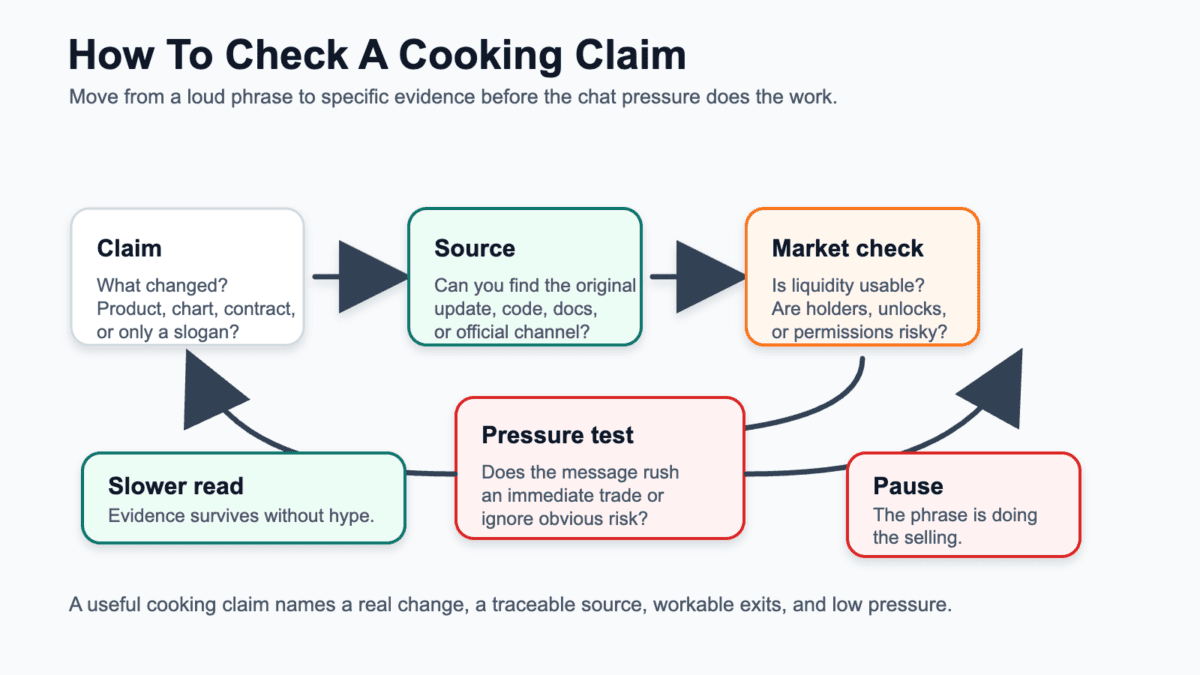
Use this checklist before acting on a cooking claim:
Compare two versions. If a chat says “devs are cooking” because a wallet integration is live and users can test it, the phrase points to a visible change. If the same chat says “devs are cooking” while offering no source and urging everyone to buy before a pump, the phrase is hype.
Watch the incentives behind the message. Founders, influencers, early holders, and private groups may benefit when later buyers turn excitement into liquidity. Name what changed, find the original source, check the token identity, inspect liquidity, and decide whether the risk still makes sense without the slang.
If the setup only sounds convincing while the chat is loud, the claim is probably carrying more emotion than evidence.
Related crypto slang helps you read the tone of a conversation. The terms around cooking in crypto often reveal whether a chat is excited, promotional, panicked, or warning-heavy.
Loss and panic terms make cooking language darker:
Hype and promotion terms can make cooking language more aggressive:
Patience and culture terms can soften the tone:
When a slang term points to mechanics you do not understand, the broader crypto guide library can help connect the phrase to wallets, liquidity, token risk, and market behavior. Cooking language is easier to read when the market mechanics behind the joke are clear.
Cooking in crypto means a trader, developer team, project, coin, or community appears to be building, performing well, gaining momentum, or preparing something promising.
It is usually positive, but it is still slang. The phrase should lead to a checkable source, not an automatic trade.
Cooking in crypto can be good or bad depending on context. “Devs are cooking” usually sounds positive, while “I am cooked” usually means someone feels trapped or badly down.
Read the full conversation before reacting. A bullish phrase can still be part of a shill, and a negative phrase can be panic rather than a clear risk assessment.
“Let him cook” means let the trader, founder, developer, or influencer keep going before judging the result. In crypto chats, it often appears when someone is making a call, teasing an update, or defending an unpopular idea.
The phrase is playful, not proof. A person can be entertaining, early, or confident and still be wrong about a trade or project.
Cooked in crypto means a person, position, token, or project looks in serious trouble. It can describe losses, liquidation risk, weak liquidity, an abandoned project, a hack, or a trade that moved sharply against someone.
It does not always mean total failure. Sometimes it means the position has become risky enough that users should reassess calmly instead of relying on chat replies.
COOK can be a token ticker or project name, and cooking can also be slang. The two meanings should be checked separately.
If you see COOK on an exchange, token page, or contract address, verify the asset details through official channels. If you see “cooking” in a chat, read it as language first, not as a token recommendation.
No, not for that reason alone. When people call a coin cooking, they may be excited, confident, promotional, or joking.
Before acting, check what changed, who benefits from the message, whether liquidity is real, whether holders are concentrated, and whether the risk still makes sense without the slang.


