Physical Address
304 North Cardinal St.
Dorchester Center, MA 02124
Physical Address
304 North Cardinal St.
Dorchester Center, MA 02124


Learn what a copy wallet means before funding one.
A copy wallet in crypto is usually a separate wallet or account that executes copied trades, or the target wallet whose trades are being mirrored, while copy wallet address simply means copying a receive address for a transfer.
That messy meaning is the whole issue. In trading products, a copy wallet can hold the funds that follow another trader. In wallet-copying chatter, it can mean the wallet being watched. In a deposit screen, it can mean copying your own address without fat-fingering a transfer.
The risk starts when those meanings blur. A separate copy wallet can limit the blast radius of a bad setup, but it does not make a target wallet skilled. And copying an address correctly is a safety task, not a trading strategy with a cleaner shirt.
A copy wallet in crypto is a wallet-role phrase, not one single product type. In trading, it often means the funded wallet or sub-account that copies another trader. It can also mean the target wallet being copied.
Context tells you which one is meant. If a platform asks how much to deposit into a copy wallet, it probably means a dedicated wallet for copied trades. If a trader says they found a copy wallet, they may mean a target wallet worth watching. If a wallet app says copy wallet address, it means copy the receive address.
So the first question is not “is this wallet profitable?” The first question is “what role is this wallet playing?” A copy-trading wallet exposes your funds. A target wallet exposes public behavior. A copied receive address exposes a transfer destination.
That split creates three practical checks before you do anything:
A copy wallet is not proof that the copied trader has a working strategy. It is just the container, source, or address involved in the action. The trade still needs judgment, and the address still needs checking.
For beginners, that distinction prevents two expensive mistakes. One is funding a copy-trading setup as if the target wallet’s past wins will repeat. The other is treating a pasted wallet address as safe before checking the chain and the full destination.
Copy wallet language shows up in bots, exchange copy products, wallet apps, dashboards, and support flows. The words can look similar while the risk changes completely.
Use the phrase as a role label. Ask whether the wallet is holding your funds, being watched by a tool, or receiving a transfer. That answer decides which risk you are taking.
| Phrase | What It Means For You |
|---|---|
| Dedicated copy wallet | A separate wallet, balance, or sub-account holds funds for copied trades. Your main funds should stay outside it. |
| Target wallet | The wallet being watched or copied. Its public activity may guide copied trades, but it does not prove skill. |
| Wallet tracker | A read-only tool watches wallet activity. It can alert you, but it should not move funds. |
| Copy-trading bot | A bot or platform watches a wallet or trader, then tries to execute matching orders under your settings. |
| Copy wallet address | You copy a receive address before sending or receiving crypto. The main risk is a wrong, poisoned, or wrong-chain address. |
The cleanest rule is simple. Watching a wallet is observation. Funding a copy wallet is exposure. Copying an address is a transfer-safety task.
Mixing those up is how users give a bot too much access, send funds to the wrong address, or copy a trader whose edge disappeared three trades ago. The same two words can move from harmless research to live execution very quickly.
That is why the surrounding screen matters. A copy button beside a receive address is a transfer action. A copy button beside a lead trader, target wallet, or smart-money profile may connect your funds to someone else’s next move.
A copy wallet works by allocating your funds to a setup that mirrors another trader, wallet, or strategy. The tool reads the target action, applies your settings, then places a copied order for your wallet.
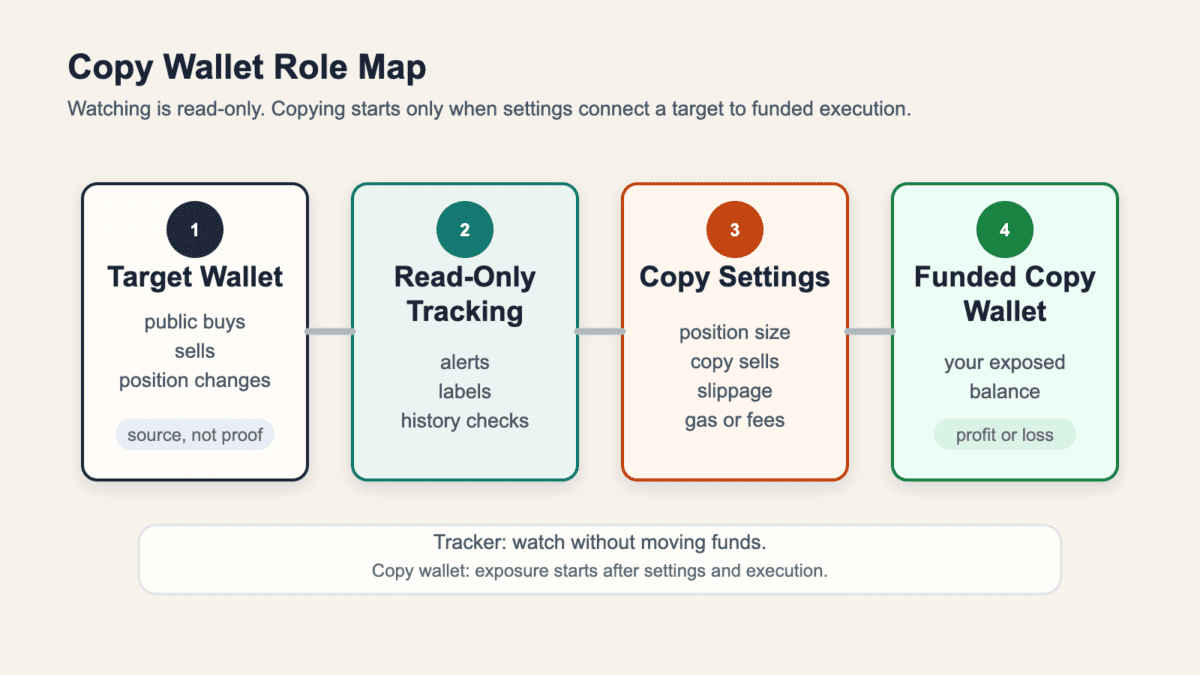
_A copy wallet carries exposure only after settings connect a target to funded execution. A tracker just watches._
One product example comes from Legend’s copy-trading documentation, where each copy profile creates a separate sub-wallet and very small copied orders below $10 are skipped. That shows why the phrase can mean an isolated execution account with product-level guardrails, not only a normal self-custody wallet.
Most copy-trading wallet flows follow the same basic sequence:
The settings carry real weight. Copy sells decide whether your wallet exits when the target exits. Priority fees or gas settings affect whether your transaction lands quickly. Slippage settings affect how bad a fill you will accept.
A separate copy wallet helps because it makes the exposed balance visible. It also keeps copied PnL away from long-term funds. But it is still your money doing the copying, so small tests beat heroic deposits.
The key difference is control. A read-only tracker can show a target wallet without touching funds. A funded copy wallet can place orders under whatever permissions, limits, and stop rules you accepted. Read that setup like money is already on the table, because it is.
A copy wallet, target wallet, and wallet tracker sit in the same workflow, but they do different jobs. The target wallet is watched. The tracker observes. The copy wallet is where your copied trade can happen.
That difference matters when a tool asks for permissions. A tracker should only need a public address. A copy wallet or bot may need transaction authority, API access, or a funded balance. Those are very different trust levels, so use this split before connecting anything:
Watching a wallet can be useful research. It can show entry timing, token choices, sell behavior, and whether a wallet keeps returning to the same playbook. It can also show when a wallet changes style, starts trading smaller pools, or begins taking faster exits.
But watching is not trusting. A target wallet may have private information, faster infrastructure, lower fees, better entry timing, or a completely different bankroll. Your copy wallet only sees the public move after it appears.
The permission screen is the dividing line. If a tool only asks for a public address, it is probably tracking. If it asks for a funded balance, API key, spending approval, or signing access, the setup has moved into execution. That is where small balances and clear stop controls become non-negotiable.
There is also a timing gap. A tracker can be slow and still useful for learning. A copy wallet that is slow can turn a good target entry into a bad follower entry. Same source, different consequence.
A copy wallet can lose while the target wallet wins because copied execution arrives later and under different conditions. The target gets the first fill. You get whatever liquidity remains.
That gap is brutal in thin markets. A target wallet may buy a meme coin early, then followers rush in after the price moves. By the time your copied order lands, you may be paying the markup that helps the target exit. That is basic exit-liquidity risk in wallet copying.
Several details can widen the gap:
Fast meme-coin markets make the problem louder. A few seconds can separate a clean entry from a chart that already ran. If your transaction lands after a crowd of other followers, the copy wallet may inherit the late price and the first wave’s exit pressure.
Prediction-market copying can break in a similar way. A whale may enter when odds are stale. Your copy wallet sees the move after the price adjusts, so the copied trade inherits less edge and more downside.
Copied sells can create another gap. If the target exits in pieces, uses faster routing, or sells into liquidity before followers react, your copy wallet may close later or only partially close. A copied entry without a reliable copied exit is just a borrowed idea with your own downside.
This is why target performance is only the first screen. You also need to know whether your wallet can copy the same size, speed, chain, token type, and exit behavior. If those conditions do not match, the copied result can look like a knockoff with worse timing.
Copy wallet risk is not only “the trade can go down.” The deeper risk is letting a tool, target wallet, or leaderboard define your position before you understand what it is doing.
The obvious trap is overfunding. A dedicated wallet is useful because it caps blast radius. It becomes pointless if you pour in the same bankroll you would use for long-term holdings or start going full port because a leaderboard looks clean.
Use this red-flag table before funding a copy wallet:
| Risk Signal | What To Check |
|---|---|
| Seed phrase request | Stop. No legitimate copy setup needs your seed phrase. |
| High slippage default | Lower it or skip the tool if fills would be reckless. |
| Hidden open losses | Check closed trades, drawdown, and current exposure. |
| Tiny-liquidity tokens | Make sure your size can enter and exit without moving the market. |
| Broad API permissions | Remove withdrawal access and restrict the key where possible. |
| Copy sells disabled | Know how your position exits if the target sells first. |
The sharper trap is permission risk. A bot that asks for a seed phrase is not a copy-trading setup. It is a wallet-draining audition. API keys also need strict scope, withdrawal limits, and a clear way to revoke access.
Leaderboard numbers can hide survivorship bias, borrowed exposure, open losses, and short history. A wallet can look like smart money because the ugly trades are invisible, unrealized, or spread across other addresses.
The last beginner trap is psychological. Once a copied trade falls, users often wait for the target to save them. That is how a copied entry can turn into a stuck position with a prettier dashboard.
Use the dashboard as a tool, not a parent. If the target wallet changes behavior, starts trading tiny-liquidity tokens, or stops selling cleanly, the copy wallet should be paused before the next trade tests your optimism.
Check a target wallet before funding a copy wallet by looking for repeatable behavior, not one heroic trade. A clean-looking ROI chart is not enough.
Start with closed history. You want to know how the wallet exits, how often it loses, and whether its wins came from one lucky launch. Then check whether its trade size matches liquidity you can copy without becoming the exit.
A useful target-wallet review includes:
Be careful with “smart money” labels. They can be useful shorthand, but they are not a verdict. A wallet can look smart because it snipes early, receives insider allocations, rotates through many addresses, or had one lucky week.
Also check speed. If the target trades too fast, uses tiny pools, or exits in seconds, a normal copy wallet may only catch leftovers. That is not copying an edge. That is arriving after the edge left.
The review should continue after funding. A target that looked steady last week can become crowded, bored, reckless, or inactive this week. If the wallet starts trading different assets, using different sizes, or holding losers much longer, the original reason to copy it may no longer exist.
Finally, compare the target’s actual fills with your copied fills. If your copy wallet keeps entering higher, exiting lower, or skipping important sells, the problem is not your mood. The setup is telling you it cannot reproduce the target well enough.
Copy wallet address safety is the non-trading branch of this term. It means copying a receive address correctly before a crypto transfer.
The danger is that crypto transfers are usually hard to reverse. If you copy the wrong address, choose the wrong chain, or trust a poisoned address from your history, the mistake can become permanent.
Use a short transfer check:
Address poisoning deserves special attention. Attackers may send tiny transactions from lookalike addresses so a fake address appears in your history. If you copy from history instead of your wallet’s receive screen, you can hand them the transfer.
Clipboard malware is another quiet risk. If the address changes after you paste it, stop. Re-copy from the wallet, verify the full destination, and check the chain again. A correct-looking first few characters are not enough when the amount is meaningful.
If you are still choosing a wallet, compare basic wallet options after you understand address and chain safety. A nicer interface helps, but it cannot save a careless paste.
The address-copy meaning is boring compared with trading bots. Good. Boring is exactly what you want when a wrong-chain send can turn into a support ticket with no happy ending.
A copy wallet makes sense when it is small, isolated, easy to monitor, and used for a clearly limited experiment. It should not become your main portfolio in a costume.
The strongest use case is controlled learning. A separate wallet lets you see how copied trades behave without mixing results with long-term holdings or manual trades. It can also help when you want to test a tool before trusting it.
Fund a small amount, copy one target, record every copied entry and exit, then review whether the results match the pitch. Good copy wallet use usually looks like this:
You can also use wallet activity as a signal without full automation. That means watching the target, studying the setup, and placing your own trade only when the idea still makes sense. Less glamorous. Often less expensive.
The copy wallet also works as a boundary. If the experiment goes badly, the loss stays visible and contained. If it goes well, you still have to prove the result came from repeatable behavior, not one lucky window.
Keep written rules. Set a maximum balance, maximum loss, and stop condition before the first copied trade. If you invent those rules after the first drawdown, the wallet is already negotiating with you.
Avoid a copy wallet when you cannot explain the tool, permissions, target behavior, or exit process. Confusion is not a harmless setup cost here.
The cleanest stop sign is a seed phrase request. Another is a platform or bot that hides how to pause copying, close positions, revoke permissions, or withdraw remaining funds.
Skip or stop using a copy wallet when you see these signs:
Also stop when the wallet becomes crowded. If a target starts attracting public attention, the next trade may behave differently from the old ones. Followers can change the market they are trying to copy.
The final warning is personal. If you keep adding funds after losses because the target “has to recover,” you are no longer testing a copy wallet. You are drifting into bagholding risk with extra steps.
A copy wallet is easiest to leave when the balance is small and the rules are written down. Once pride, sunk cost, or leaderboard envy enters the setup, the tool stops feeling like a test and starts acting like a trap.
That is the point to walk away. If the target wallet no longer behaves like the target you chose, or the tool no longer gives you clean control, the copy wallet has stopped doing its job.
Related copy wallet concepts help separate the tool from the behavior around it. If you are choosing between exchange leaderboards, bots, and wallet mirroring, the broader copy trading guide covers lead traders, sizing, fees, and copied execution.
For transfer safety, address poisoning is the next concept to understand. It explains why a copied wallet address from transaction history can be riskier than an address copied from the current receive screen.
Keep the nearby terms clean. Smart-money labels are clues, not proof. Exit liquidity is about who buys last. Full port means oversized allocation. A bagholder is what copied confidence can become after a bad entry.
Keep those ideas separate, and the copy wallet choice gets clearer. You are not asking whether a wallet looks interesting. You are asking whether your funds should follow it under real execution conditions.
Start with a tiny copy wallet, one target, and written rules. If the setup cannot survive that level of discipline, it does not deserve more money.
Before funding anything, verify the tool, read the permissions, and confirm how to pause, close, revoke, and withdraw. Then test a small trade and compare your result with the target wallet’s result.
Use this starter checklist:
The first test should be small enough to feel boring. You are checking whether the setup copies what it claims, whether sells fire correctly, and whether fees make the copied result worse than expected.
Do not make the first goal “find a wallet that prints.” Make the first goal proving the setup is understandable, reversible, and small enough to survive being wrong.
After the first week, review closed trades only. Open PnL can flatter a bad setup, especially when losing positions are left open and winners are closed quickly. You need the actual exits, fees, skipped trades, and failed sells.
Then decide whether the copy wallet still deserves even the same small balance. Increasing size should come last, after the tool, target, permissions, and exit process have all behaved under real conditions.
If the results are unclear, pause instead of adding funds. A copy wallet that cannot explain its own fills, exits, and costs is not ready for more capital.
That is the right posture for a copy wallet. Curious, skeptical, and allergic to magic buttons.
No. A copy wallet is usually one part of copy trading, while copy trading is the broader strategy of mirroring another trader, wallet, or system.
The copy wallet may hold the funds that execute copied trades. The target wallet is the source being copied. The bot or venue is the execution layer.
Yes. A copy wallet can lose money because copied trades can lose, execution can be late, slippage can be worse, and fees can turn a thin edge negative.
It can also lose because the copied wallet changes behavior, trades illiquid tokens, uses borrowed exposure, or sells before followers can exit.
No, not for active copy trading. A separate copy wallet or isolated copy balance is safer because it limits how much capital is exposed to automation, bot permissions, and trading mistakes.
Keep long-term holdings away from copied execution. The point of separation is to make losses visible and capped.
A target wallet is the wallet being watched or copied. Its transactions may trigger alerts, copied buys, copied sells, or manual research.
A target wallet can be useful, but it is not automatically trustworthy. Check its history, liquidity, exits, losses, and whether many followers already crowd the same trades.
Copying a wallet address is safe when the address comes from a trusted receive screen, the chain is correct, and you verify the full address before sending.
It becomes risky when you copy from chat, transaction history, or a fake lookalike address. For larger amounts, a small test transfer can catch mistakes before they get expensive.