Physical Address
304 North Cardinal St.
Dorchester Center, MA 02124
Physical Address
304 North Cardinal St.
Dorchester Center, MA 02124


Address poisoning is the fake-wallet-address trap to check before you send crypto.
Address poisoning is a crypto scam that plants a fake wallet address in your history so you might send funds to it later.
The scam works because crypto addresses are long, public, and easy to skim under pressure. A poisoned entry usually does not mean your seed phrase leaked or your wallet was hacked. It means someone is trying to make the wrong address look familiar before your next send.
That is enough to be dangerous. If you move stablecoins, fund exchange accounts, rebalance DeFi positions, or send between hot and cold wallets, address poisoning attacks the habit you probably trust most: copy, paste, confirm, move on with life.
Address poisoning in crypto is a wallet-history scam where an attacker makes a fake recipient address look like one you have used before. The attacker does not need to break the blockchain. They need you to copy the planted address later.
The scam often uses a tiny or zero-value transfer from a lookalike address. The poisoned entry then sits in your wallet app, exchange history, or block explorer record beside real activity. The important clue is not the amount. It is where the fake address lands: in a place you may later treat as trusted.
Imagine you once sent USDT from a wallet to an exchange deposit address. A scammer watches that public transfer, creates a lookalike address with similar beginning and ending characters, and sends you dust from it. Weeks later, you need the same exchange deposit address and copy the newest familiar-looking entry from history.
That is the trap. The wallet may still work. Your seed phrase may still be private. The loss happens because the recipient address in the signed transaction is wrong.
Keep three facts separate before you react:
Address poisoning is why “I checked the first and last characters” is not enough. The scam is built around those characters being the easy part to fake.
Address poisoning works by turning normal public wallet activity into a future copy-paste mistake. The attacker wants the poisoned address to appear close enough to a real address that you accept it under pressure.
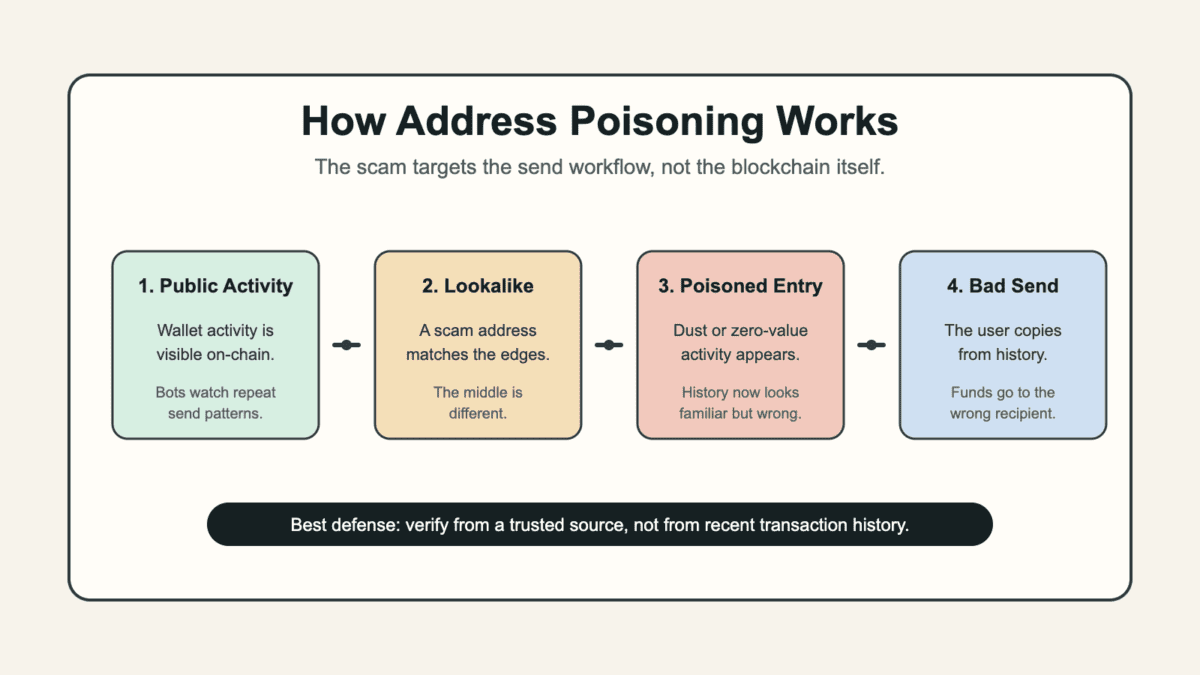
_Address poisoning usually becomes expensive at the final send step, not when the junk entry first appears._
Most blockchain activity is public. If you send tokens from one address to another, outside observers can often see the sender, recipient, asset, and timing.
That visibility does not automatically expose your real-world identity. It does give scammers enough data to spot repeat flows, such as stablecoin deposits, exchange funding, hot-to-cold wallet moves, and payments to the same counterparty.
They tend to care about habits. A wallet that repeatedly sends USDT to one deposit address is more useful than a wallet that never repeats a route. Repetition gives the scam a destination to imitate.
The attacker then creates an address that resembles a real one at a glance. The match is usually strongest at the beginning and end, because many wallet interfaces shorten the middle.
This is often described as a vanity-style address. For a user, the technical detail matters less than the visual result: a fake wallet address can look familiar when the display hides most of the characters.
There is nothing mystical here. The scam is pattern matching against a long string that humans are bad at reading.
Next, the attacker sends a tiny transfer, fake token event, NFT, or zero-value entry involving the lookalike address. The goal is to place the fake address inside your recent activity.
On some chains, the entry looks like dust. On others, it looks like a token movement that did not really move value. Either way, the wallet history becomes noisier.
The poisoned entry may be harmless while ignored. It becomes risky when it turns into a source you trust.
The final step is human. You need to send crypto. You search recent transactions, recognize a familiar-looking address, copy it, and approve the transfer.
If the address is the poisoned one, the blockchain does exactly what you told it to do. It sends funds to the attacker-controlled recipient.
That is why prevention belongs in the send flow. Cleaning old history helps less than refusing to use history as the source for important destination addresses.
Address poisoning fools careful users because it abuses normal habits that usually reduce mistakes. Copy-paste, test transfers, truncated displays, and recent-history shortcuts are convenient until a fake address slips into the same path.
Most people do not read a full wallet address every time. They compare a few characters, trust a label, notice a familiar flow, or rush through a send on mobile. That is not stupidity. It is a bad interface meeting a costly asset.
A test transfer can reduce risk, but only if you keep using the verified source address. It helps when you copy the small send address from the exchange deposit screen, saved contact, hardware wallet receive screen, or directly from the recipient.
It fails when the next step changes the source. If you send a small test, then copy the follow-up address from recent history, you may have handed the scammer a perfect timing cue. The poisoned entry can appear after the test and before the larger send.
> A test transaction is not a magic amulet. It is useful only when the final send uses the same verified address source.
Wallets and explorers often shorten addresses because full strings are hard to display. Mobile screens make this worse. Labels, favorites, and recent-history cards can also make the wrong entry look official.
That does not mean every wallet app is unsafe. It means the interface cannot be your only defense. A cleaner workflow beats a confident glance.
The stronger check is boring and repeatable:
Address poisoning works best when the user is in motion. Slow down enough to break the shortcut.
Address poisoning is often confused with dusting, clipboard malware, approval phishing, and wallet drainers. The safer response depends on the threat, so lumping them together can create the wrong fix.
A dusting attack may overlap with poisoning, because a tiny transfer can be the delivery method. But dust in crypto is a broader idea that includes harmless leftovers, tracking attempts, spam tokens, and tiny balances that cost too much to move.
| Threat | How To Tell It Apart From Address Poisoning |
|---|---|
| Address poisoning | A lookalike address or fake transfer appears in history, hoping you copy it later |
| Dusting | A tiny balance appears, often to track, lure, or clutter a wallet rather than mimic one recipient |
| Clipboard malware | The address changes after you copy it, usually because the device or clipboard is compromised |
| Wallet drainer | The danger is a malicious signature, token approval, or contract interaction |
| Credential theft | The seed phrase, private key, or exchange login is exposed, so the attacker may move funds directly |
The main difference is control. Address poisoning usually waits for you to send to the wrong recipient. A wallet drainer or stolen seed phrase can create unauthorized movement without that same copy-from-history mistake.
That difference changes the first move. For address poisoning, fix the send source. For dust, avoid interaction. For clipboard malware, inspect the device. For approvals, revoke risky permissions from a trusted tool. For credential theft, move cleanly from a safe device and consider the old wallet or account compromised.
Seeing address poisoning in your wallet usually does not mean the wallet is hacked. Public addresses can receive unsolicited transfers, fake token events, and junk entries without the sender knowing your seed phrase.
The distinction prevents panic cleanup. Do not click a strange token, call a random support number, or connect to a “remove scam transfer” site. That is how a nuisance becomes a second attack.
A public wallet can also be watched without automatically exposing who you are. Real-world identity only connects to on-chain activity when labels, behavior, leaks, or public claims tie them together.
Use this checklist before you decide the incident is worse than address poisoning:
If balances did not move and you did not sign anything strange, the practical response is simple. Ignore the poisoned entry, label trusted addresses, and stop using recent history as a destination source.
If balances moved without your intent, investigate beyond address poisoning. Unauthorized movement points to approvals, malware, a leaked key, or account compromise.
The best way to avoid address poisoning is to stop copying meaningful destination addresses from recent transaction history. Use a verified source that starts outside the poisoned history feed.
For repeat sends, use an address book, saved contact, exchange withdrawal allowlist, hardware-wallet receive screen, verified QR code, or recipient screen opened fresh. When comparing wallets, favor tools that make trusted contacts, full-address checks, warnings, and spam hiding easy to use.
Build the send flow before you need it:
For large transfers, split the process into two mental steps. First, identify the destination from a trusted source. Then verify the transaction prompt matches it. If either step depends on recent history, stop.
This can feel slower than copy-paste. That is the point. The scam is designed for the moment when speed feels normal.
After an address poisoning mistake, assume the transfer may not be reversible and focus on documentation, escalation, and future containment. Crypto transfers normally cannot be undone by a wallet app after confirmation.
Start by preserving clean records. Save the transaction hash, sender address, wrong recipient address, asset, time, wallet screenshots, and any related exchange or support ticket numbers. Do not send more funds to “prove” ownership or test whether the address responds.
If the transaction is still pending, do not improvise from panic. Some wallets support replacement or cancellation on specific networks, but that depends on the chain, wallet, fee market, and transaction state. Use only the wallet’s normal controls, and do not connect to a third-party “cancel” site from a search result.
Then take practical steps in order:
If the transfer touched a centralized exchange, support may be able to flag related account activity, but that is not the same as a refund guarantee. Be precise, fast, and boring in the evidence you provide.
The hardest part is not chasing the loss into a second scam. Recovery scammers look for people who already feel rushed, embarrassed, and desperate. That is exactly when they get persuasive.
After the report, fix the workflow that failed. Remove the poisoned address from any local labels if your wallet allows it, rebuild trusted contacts from original sources, and use a fresh receive screen for the next important transfer.
Traders and investors face address poisoning risk because active wallets create more repeat routes to imitate. The more often you move funds, the more useful your history becomes to an attacker.
The scale is not theoretical: the 2025 arXiv paper Blockchain Address Poisoning measured 270 million on-chain attack attempts across Ethereum and BNB Smart Chain.
Stablecoin movers are natural targets. A user who repeatedly sends USDT or USDC between an exchange and self-custody wallet may build muscle memory around one route. DeFi users do the same when they rebalance between hot wallets, vaults, bridges, and cold storage.
High-value users also face more operational pressure:
None of those workflows are beginner-only. A careful trader can still copy the newest familiar-looking address if the process rewards speed over verification.
Address poisoning spam can also muddy on-chain activity. Tiny transfers and fake history entries may look like more organic wallet movement than they really are. For investors watching chain activity, small-transfer spikes need context before they become proof of demand or an exit liquidity story.
So make every repeat send a controlled process, especially when stablecoins or treasury funds are involved. If the destination is important, recent history is the worst place to source it.
Teams should separate who finds the address from who approves the send when the value is meaningful. Even a simple second-person check can catch a poisoned address before the signature happens. Fancy treasury tooling helps, but clear roles help too.
Address poisoning sits near several other wallet-safety concepts. Start with the two closest ideas:
Clipboard malware changes the address after copying. Wallet drainers rely on a dangerous approval or transaction. Seed phrase theft gives the attacker direct wallet control.
Privacy exposure is the softer edge. Public addresses can be watched, labeled, clustered, and misunderstood. That does not make every watched wallet compromised, but it does mean wallet habits leave a trail. Address poisoning turns that trail into a trap.
No. Address poisoning plants a lookalike address in your history so you may copy it later. Dusting is a broader pattern where tiny unsolicited transfers may be used for tracking, luring, or clutter.
Address poisoning does not steal your seed phrase by itself. The usual scam depends on you sending funds to the wrong address, not on the attacker learning your private key.
A hardware wallet helps only if you verify the destination address on the device before signing. It cannot protect you if you intentionally confirm a transaction to a poisoned recipient.
A test transaction helps when the final send uses the same verified address source. It does not help if you copy the next address from recent history after the test.
Address poisoning scams use matching first and last characters because many wallets shorten the middle of long addresses. A fake address can look familiar when only the edges are visible.
Address poisoning can appear wherever wallet activity, low-cost transfers, or misleading history entries make a lookalike address visible. It is common on Ethereum-style networks, but users should also stay alert on TRON, Bitcoin tools, and exchange flows.
Start by changing the one habit address poisoning needs most. Do not copy important recipient addresses from transaction history.
Pick one safe source for each repeat recipient. That can be a saved contact, an exchange allowlist, a hardware-wallet receive screen, a counterparty invoice, or a verified QR code. The source should be something you control or requested directly, not something that appeared after a transfer.
Use this workflow this week:
For shared funds, write the workflow down. A two-person check, a named address source, and a no-history-copy rule will prevent more damage than another vague reminder to “be careful.”
If you already see poisoned entries, do not try to scrub the chain. Hide spam inside the wallet UI if the feature is safe. Then label the trusted contacts you actually use and make the next send from a clean source screen. The old junk can stay on-chain without becoming your instruction manual.
For personal wallets, the biggest upgrade is repetition. Use the same safe route for every meaningful send until it becomes automatic. When a rushed send appears, the habit should feel dull enough that you notice anything new, tiny, or weird in the flow.
Then rehearse the boring version before the urgent version. When the market is moving and your hand is already on the send button, you will use the process you already practiced.