Physical Address
304 North Cardinal St.
Dorchester Center, MA 02124
Physical Address
304 North Cardinal St.
Dorchester Center, MA 02124


Agent economy explained without the AI-token fog.
The agent economy is a crypto-adjacent market where AI agents use tools, data, wallets, and payment rails to complete bounded tasks.
That sounds like a grand future where software hires software, pays invoices, trades assets, and books services while humans sip coffee. The useful version is narrower. Agents need limits, logs, payment controls, and a person or business accountable when the machine gets clever at the wrong moment.
The agent economy in crypto is the stack of AI agents, wallets, data sources, payment rails, smart contracts, and human policies that let software take limited economic actions. A 2026 arXiv paper frames autonomous agents as machine economic actors and proposes a five-layer architecture for the agent economy.
For normal users, the caveat matters more than the architecture: useful autonomy is bounded.
An AI agent might compare data feeds, pay for an API result, rebalance a small test wallet, or request approval before signing a transaction. That is different from giving a chatbot your main wallet and hoping it develops risk management by sunrise. Hope is not a permission system.
Here is the clean split:
| Term | How It Differs |
|---|---|
| Agent economy | The wider network where agents discover tools, pay for resources, and coordinate tasks. |
| AI agent | The software actor that plans, calls tools, and acts inside a goal or policy. |
| Trading bot | A narrower system that follows predefined trading rules or signals. |
| Agentic payments | Payment flows where software can request, approve, or settle value for a task. |
| AI agent token | A crypto asset tied to an agent app, network, marketplace, or narrative. |
This split helps because the phrase gets mushy fast. A project can have an agent token without useful agent demand. A payment protocol can help agents without making every AI coin valuable. The agent economy is the operating map, not a buy list.
AI agents become part of the agent economy when they move from answering questions to completing bounded tasks. A chatbot gives text back. A stronger agent can read context, choose a tool, request payment, call an API, prepare a transaction, and report the result.
The economic part appears when the agent needs scarce resources. It may need model inference, data access, compute, storage, a wallet signature, or another agent’s service. Once a task has cost, permission, settlement, and accountability, the agent is no longer just a fancy autocomplete box.
The basic loop looks like this:
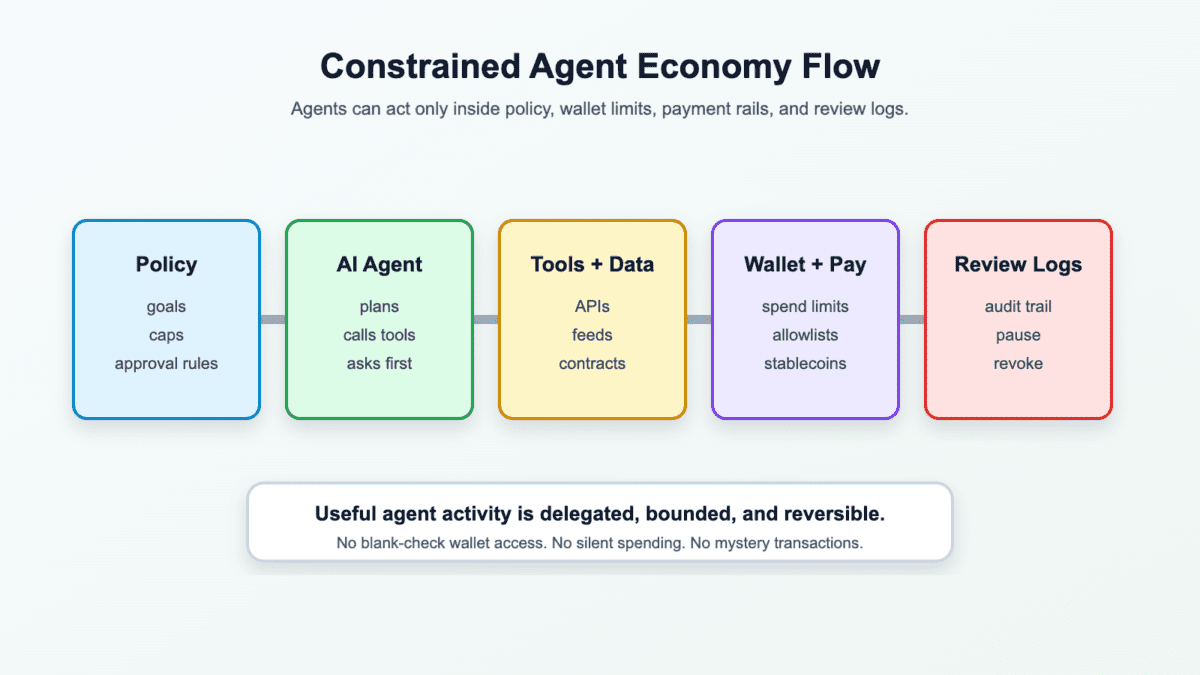
A simple crypto example is a research agent watching onchain data. It spots a change in liquidity, pays a small fee for a higher-quality data endpoint, summarizes the result, and asks before placing any trade. The wallet does not need broad control. It needs scoped authority for one narrow job.
That distinction separates agents from old bots. A bot can run one strategy forever. An agent can adapt its route. But the spending and signing layer should still be boring. Boring is underrated when money moves.
Crypto fits the agent economy because it offers programmable assets, public records, and payment rails that software can use without waiting for a human checkout form every time. Stablecoins can settle small payments. Smart accounts can enforce limits. Onchain data can show whether a transaction happened.
That does not make crypto the only answer. Many human-approved purchases may still run through cards, bank rails, app stores, or platform balances. Crypto becomes more interesting when the payment is tiny, frequent, global, automated, or tied to a smart contract.
A clean example is a market-monitoring agent. It may need a verified price, a liquidity check, and a paid data response before it can finish a report. Crypto rails can put payment, policy, and settlement records into the same workflow instead of stitching together separate accounts.
The strongest crypto fit shows up in a few places:
Think about an agent buying data, content access, or attention signals while it completes a task. That overlaps with the attention economy because value follows attention, clicks, and information flow. An agent can become another participant in that market, not just a tool watching it.
The weak point is data quality. An agent that reads stale prices, fake volume, poisoned prompts, or spoofed liquidity can act quickly and still be wrong. Crypto rails make settlement easier, but they do not turn bad inputs into smart decisions.
Agent economy payments are the rails that let software request or settle value during a task. Stablecoins, x402, virtual cards, card tokens, and mandate systems can all appear in the same conversation, but they do different jobs.
x402 is a payment pattern built around HTTP 402, the old web status code for payment required. In an agent context, it can let a service request payment before giving an API result, data feed, or digital resource. It is one route for machine payments, not the whole agent economy.
| Payment Route | Best Fit In The Agent Economy |
|---|---|
| Stablecoins | Small global payments, API access, settlement between apps, and programmable treasury flows. |
| x402-style payments | Web-native pay-per-request flows where an agent pays before receiving a resource. |
| Card or virtual-card rails | Human-approved shopping, merchant acceptance, refunds, and familiar dispute processes. |
| AP2-style mandates | Authorization rules that describe what an agent is allowed to buy or request. |
| Hybrid rails | Workflows where agents choose between crypto and non-crypto payment paths. |
Stablecoins are attractive because they can move digitally, settle quickly, and work across borders. Cards are attractive because merchants already accept them and chargeback processes exist. That tradeoff will not vanish because agents showed up with a new badge.
For users, approval timing changes the risk. If an agent is buying a one-cent data call, automatic settlement may make sense. If it is booking a trip, moving portfolio funds, or subscribing to a costly service, manual review should stay in the loop.
AI agent wallets in the agent economy are controlled wallet setups that let agents read, request, or spend crypto inside strict boundaries. A safe version does not hand an agent a private key and wave goodbye. It gives the agent a narrow lane.
The safest starting point is read-only access. An agent can monitor balances, check token approvals, watch DeFi positions, or prepare draft actions without signing. When spending is needed, scoped API keys, smart accounts, MPC policies, session keys, and allowlisted contracts can limit what the agent can do.
Before you let an agent touch crypto, check the control layer:
The wallets decision is not only about where assets sit. It is about who can sign, what they can sign, and how fast you can stop them. Agent wallets add one more actor to that chain, so the margin for sloppy permissions gets thinner.
Transaction simulation also helps. Before an agent signs, the wallet should preview token movements, contract calls, fees, and possible approvals. If the preview is vague, the agent should pause. Mystery transactions are a bad user interface and an even worse risk policy.
The agent economy could affect crypto markets by creating demand for rails that agents actually use. That may include stablecoins, low-cost networks, wallet infrastructure, data providers, compute markets, oracles, and agent marketplaces.
The word “could” is doing work. More agent activity can create revenue, but it can also create costs. If every interaction needs paid inference, subsidized compute, or expensive data, usage can burn money before it proves a business model.
Market impact can show up across several layers:
Investors should ask which layer actually earns. A chain may see transaction fees, a wallet provider may see account growth, and a data network may sell cleaner feeds. An agent token may still capture little. Social noise is easy. Durable value needs paid usage that survives after the launch thread fades.
This is also where the crypto meta can take over. A real technical theme can become a market story, and then the market story can run far ahead of usage. That is normal crypto behavior with a fresh coat of AI paint.
AI-agent tokens need extra caution because many trade like a narrative coin before their product proves durable demand. The token may be useful for fees, staking, governance, marketplace access, or rewards. It may also be a ticker taped to a demo.
Plenty can go wrong in the agent economy because agents combine automation, money, data, permissions, and hype. Each layer can fail alone. The worst cases happen when several fail together.
Bad data can trigger bad actions. Prompt manipulation can push an agent toward a malicious link or contract. Thin liquidity can turn a normal trade into a painful fill. Smart-contract bugs can drain funds faster than a human can find the tab.
Keep these failure modes close:
Warning: unrestricted wallet access is not an agent economy strategy. It is a live-fire permissions test with your money as the target.
The hype layer can hurt too. If late buyers chase AI-agent tokens after insiders, early holders, or promotional wallets already have exits lined up, they can become exit liquidity. The agent may be interesting. The token entry can still be awful.
Compliance and accountability remain unsettled in many setups. A business can log policies, approvals, and agent actions, but that does not make every mistake legally tidy. If a system moves meaningful value, someone still needs to own the risk policy.
Evaluate an agent economy crypto project by separating the working product from the token story. Useful agents should have real users, repeat activity, clear payments, visible controls, and a reason the token belongs in the system.
Start with the agent’s job. A project that monitors wallets, pays APIs, routes DeFi actions, or sells agent services has a clearer path than one that only posts personality updates. A funny agent can gather attention, but attention is not revenue unless something converts. Use this checklist when the pitch gets shiny:
| Signal | What To Check |
|---|---|
| Real users | Look for repeat tasks, paid usage, active wallets, or customer workflows. |
| Agent permissions | Check spend caps, approvals, session keys, allowlists, logs, and revocation. |
| Revenue quality | Compare fees or paid usage against inference, data, and compute costs. |
| Token need | Ask whether the system works better with the token than without it. |
| Liquidity and supply | Review depth, unlocks, insider allocation, and concentrated holder risk. |
| Technical proof | Look for audits, public contracts, working docs, and developer activity. |
The token-value question is the hard one. Some systems may need a token for marketplace incentives, staking, fee routing, or governance. Others can run on stablecoins, subscriptions, or plain invoices. If the token is not required, it may just be a fundraising wrapper.
Also separate trading tools from custody tools. An agent that suggests trades is one risk. An agent that signs trades is another. An agent that can withdraw funds is a third. That third version should arrive with tiny limits or not at all.
The bottom line on the agent economy is simple: the idea is real enough to study, but early enough to distrust as a blanket investment thesis. Agents can use wallets, stablecoins, APIs, and smart contracts in useful ways. That does not make every AI-agent token a claim on the future.
The most useful next step is to study the stack before the ticker. If an agent economy project cannot explain its users, payments, wallet controls, and token value capture in plain language, the gap is probably not accidental.
Start with the parts that can be checked before a chart gets exciting:
That order helps because agent products and agent tokens do not mature at the same speed. A useful agent can exist before a token deserves a premium. A token can also rally long before the product deserves trust.
One practical filter is permissions first, price second. If the system cannot show caps, logs, approvals, and a clean revocation path, the market story is running ahead of the controls. That is where small experiments beat big allocations.
The agent economy may grow through boring infrastructure first: wallets, payments, data, logs, and policy controls. That is less glamorous than a viral agent account, but it is where the useful work has to survive.
The agent economy in crypto is the network of AI agents, wallets, payment rails, data tools, and policies that let software complete limited economic tasks. It can include agents paying for APIs, moving stablecoins, preparing transactions, or coordinating with other services.
The important word is limited. A useful agent should operate inside rules set by a human, business, wallet, or smart account. Full wallet freedom is not required for the concept to work.
No, the agent economy is broader than AI agent coins. It describes the market and infrastructure around agents doing economic work, while an AI agent coin is one possible token tied to that theme.
Some tokens may capture real value if they are needed for payments, access, staking, or marketplace coordination. Others may trade mostly on narrative. The label alone does not prove usage.
AI agents need crypto wallets in the agent economy when they must read balances, request signatures, pay for services, or interact with smart contracts. Wallets give agents a way to connect digital actions with digital assets.
The wallet should be constrained. Safer designs use read-only access, spend caps, approved destinations, session keys, logs, and manual review above set limits.
The agent economy will likely use both stablecoins and card-style rails, depending on the task. Stablecoins fit small, frequent, global, programmable payments. Cards and virtual cards fit merchants, refunds, and human-approved purchases.
Hybrid flows are likely. An agent may pay a tiny API fee in stablecoins, then ask a human to approve a larger card purchase. The rail should match the risk.
The agent economy is real as an emerging stack, but much of the token market around it can still be hype. Wallet controls, stablecoin payments, agent tooling, and data access are developing. Broad autonomous finance is much less mature.
The safest stance is sober curiosity. Watch real usage, wallet design, paid activity, and token value capture. Ignore any pitch that skips permission controls and jumps straight to price.