Physical Address
304 North Cardinal St.
Dorchester Center, MA 02124
Physical Address
304 North Cardinal St.
Dorchester Center, MA 02124


Understand AVS rewards before restaking.
An Actively Validated Service (AVS) is a crypto service that uses operators and restaked assets to verify work outside Ethereum’s normal validator system.
You will usually meet the term around EigenLayer, restaking, liquid restaking tokens, operator delegation, and AVS rewards. The acronym is only the entry point. What matters is the extra job your stake helps secure, who runs it, and what can happen if that job is done badly.
An Actively Validated Service (AVS) is infrastructure that borrows economic security from restaked assets instead of spinning up its own validator network. Operators run the software, make commitments, and can earn rewards when the service works correctly.
EigenCloud frames an AVS as offchain work that creates onchain commitments, with rewards for correct behavior and penalties when commitments break. In plain English, an AVS lets extra crypto services pay for verifiable work. Restaked assets help make that promise credible.
Keep three distinctions clean.
One naming wrinkle matters. Many wallets, exchanges, and older guides still use Actively Validated Service. In a 2025 terminology update, EigenCloud shifted the expansion of AVS toward Autonomous Verifiable Services. The acronym still points to the same broad EigenLayer service category.
Do not get stuck on the label. An AVS is not Ethereum itself, an LRT, a wallet, or a magic yield box. It is a service with tasks, operators, rules, rewards, and possible penalties.
An Actively Validated Service (AVS) works by tying restakers, operators, service rules, and reward or penalty logic into one loop. EigenLayer supplies the restaking rails, while the AVS defines the work it wants secured.
The flow starts when a restaker supplies ETH, a liquid staking token, EIGEN, or another supported asset through an eligible route. The restaker delegates to an operator. Then the operator can opt into one or more AVSs and accept each service’s task rules.
Here is the actor map.
| Actor | What They Do |
|---|---|
| Restaker | Supplies assets that can support extra services through restaking. |
| Operator | Runs software, accepts delegation, and opts into AVS work. |
| AVS Developer | Builds the service, task logic, and enforcement rules. |
| AVS | Assigns verifiable tasks and defines what counts as good or bad behavior. |
| EigenLayer Contracts | Track delegation, operator sets, rewards, and penalty paths. |
| Reward Claimant | Receives eligible rewards after the route and rules are applied. |
This creates a loop. The AVS asks for work, and operators perform it. Commitments can be checked. Correct behavior can earn rewards. Broken commitments can lead to ejection, slashing, or other penalties.
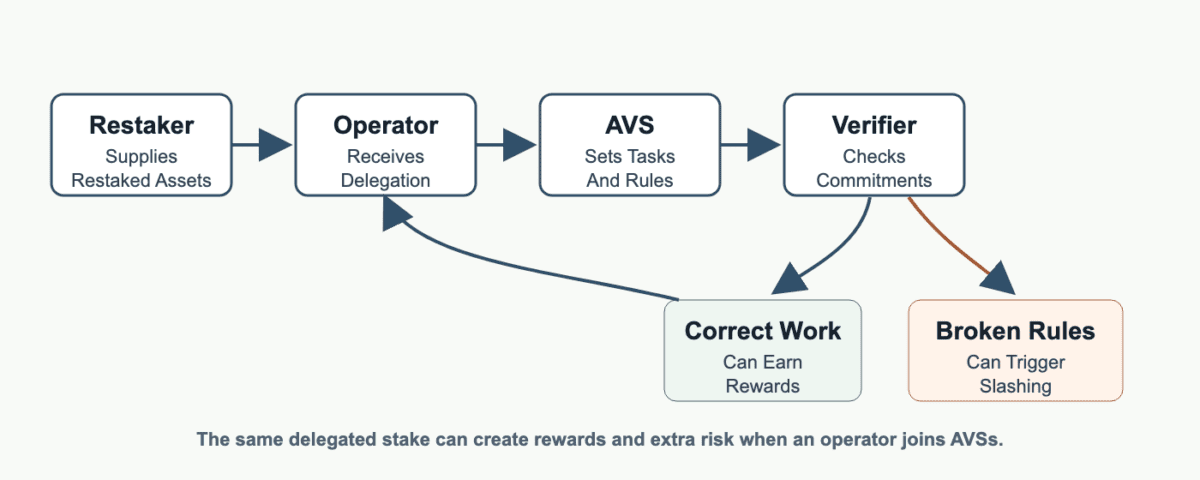
The operator sits in the middle of the machine. If you delegate directly, choose an exchange route, or hold an LRT, operator choices still sit somewhere in the stack. That is why AVS restaking is not just a deposit button with better-looking yield.
An Actively Validated Service (AVS) exists because new crypto infrastructure needs security before it has its own large network. A bridge, oracle, data layer, sequencer, or proving service may need honest operators long before it has enough native stake or fees to stand alone.
Building a fresh validator set is expensive. It also asks users to trust a new token, a new group of operators, and a new security budget. Restaking offers another route. But the design still has to be clear enough for operators and restakers to understand.
The common use cases are infrastructure jobs that need verifiable work.
The economic idea is simple. Instead of bootstrapping trust from zero, an AVS can rent or share security from restaked assets. The catch is just as simple: shared security can also mean shared consequences.
Actively Validated Service (AVS) examples are usually infrastructure services, not consumer apps. EigenDA is the clean named example because it focuses on data availability, a job that rollups and other systems may need before they can run smoothly.
Categories teach more than a long project roster. Live AVS lists change, and a name without context does not explain the risk. Start by asking what the service verifies.
| AVS Category | What It Verifies |
|---|---|
| Data Availability | Data was published and can be retrieved when needed. |
| Oracle Network | External data was gathered or reported under defined rules. |
| Bridge Or Messaging Layer | Cross-chain messages or commitments followed the service rules. |
| Sequencer Network | Transactions were ordered or processed as promised. |
| ZK Proving Service | A proof or computation was produced for a requested task. |
| Automation Network | Keepers or bots performed scheduled or conditional actions. |
| Verifiable Compute | Offchain computation produced an output that can be checked. |
These examples show why an AVS is not one product type. The same structure can support different jobs, from data to proofs to cross-chain messages. The task changes. So do the verification method, reward source, and penalty design.
This is also why “AVS exposure” can hide detail. One AVS may have clear demand and conservative slashing rules. Another may depend on incentive campaigns and vague future usage. Same acronym, very different plumbing.
Actively Validated Service (AVS) rewards work only when the service, operator, and route define who gets paid and why. “Rewards” can mean several things. Blending them is how yield screens get people into trouble.
Some rewards may come from actual service demand. Others may come from token incentives, EigenLayer programs, operator terms, exchange products, or LRT routing. Any serious AVS yield claim should name the source, token, timing, and party taking a cut.
Check the reward source before you compare numbers.
| Reward Source | What To Check |
|---|---|
| AVS User Fees | Whether real users pay the service and how fees reach restakers. |
| AVS Token Rewards | Token supply, vesting, liquidity, and selling pressure. |
| EigenLayer Incentives | Campaign rules, eligibility, duration, and reward token. |
| Operator Commission | The share kept by the operator before rewards reach you. |
| Exchange Product Terms | Custody, region limits, payout token, and exit timing. |
| LRT Yield Routing | How the LRT provider selects operators and distributes rewards. |
Temporary incentives can look like farming rewards when the main attraction is a campaign rather than durable service revenue. That can still be rational, but it is a trade, not a bedtime story.
> AVS rewards are not guaranteed. They can change by service, route, operator, asset, region, incentive program, and market liquidity.
The reward token matters too. If an AVS pays in a thin token, the posted reward can look better than the exit. That is where exit liquidity risk stops being theory.
Actively Validated Service (AVS) risk starts with one plain fact: extra yield can mean extra rules. Normal ETH staking already has validator and market risk. AVS restaking can add service-specific penalties and more parties standing between you and the exit.
EigenCloud explains that AVS slashing is tied to broken operator commitments and Unique Stake allocated to an operator set. The same docs list three conditions that must line up before an AVS may slash that allocated stake. For users, the takeaway is simpler: delegated exposure may depend on what the operator agreed to run.
Separate the big risks first.
The boring risk is often the real one. Users may understand slashing as a headline, then miss operator concentration, reward-token volatility, or an unclear exit path. That is how a promising thesis can become a bagholder story with better vocabulary.
Operator choice deserves special attention. An operator can support several AVSs. One bad commitment may affect delegated stake under that operator’s exposure. Direct restakers need to inspect that choice. Exchange and LRT users need to understand who makes it for them.
Exposure to an Actively Validated Service (AVS) can come through several routes. The route changes custody, control, liquidity, supported assets, reward handling, and how much operator risk you can see.
Direct restaking gives you more control, but it also adds more work. Exchange restaking can be simpler, but platform terms control custody and exits. LRT exposure can be liquid and DeFi-friendly, but token pricing and provider routing add their own risk.
Compare the route before comparing the reward.
| Route | Main Trade-Off |
|---|---|
| Direct EigenLayer Route | More visibility and control, but more wallet, operator, and contract responsibility. |
| Exchange Restaking | Easier setup, but custody, eligibility, reward tokens, and exits depend on the platform. |
| LRT Exposure | Liquid market access, but depeg, liquidity, provider, and integration risk enter. |
| Operator-Run Setup | More technical control for advanced users, but operational mistakes become your problem. |
None of these routes is best for everyone. The right route depends on what you are actually trying to do: hold ETH, earn incentives, support a specific AVS, trade an LRT, or run infrastructure.
The route also changes your checklist. A direct restaker can inspect operator choices more closely. An exchange user may only see the product’s supported terms. An LRT holder may need to read the provider’s operator policy, liquidity venues, and withdrawal design.
Checking an Actively Validated Service (AVS) starts with the route, then moves to the operator, rules, rewards, and exit. Do not start with the biggest displayed yield. That is how the spreadsheet starts making product decisions.
Start with the basics that can save real money.
Wallet hygiene belongs here too. Use official links, keep seed phrases offline, avoid help DMs, and review approvals through trusted wallet safety tools. A fake restaking front end can do more damage than a mediocre APR.
Sizing is safety too. If a reward screen makes you want to full port, pause long enough to name what can go wrong. If you cannot name the slashing path, the operator, the exit path, and the reward token, you are not ready to size the position.
Actively Validated Service (AVS) terms can blur because restaking stacks several concepts in one product flow. EigenLayer is the protocol layer that coordinates restaking. An AVS is the service asking operators to do verifiable work.
A restaker supplies supported assets. An operator runs software and accepts delegated exposure. Slashing is the penalty path when commitments are broken. Unique Stake is the stake allocated to a specific operator set, which helps define what can be penalized.
> Useful shortcut: restaking is the route, and an AVS is the work being secured.
LST and LRT are easy to mix up. A liquid staking token represents a staked asset position. A liquid restaking token represents exposure routed through restaking strategies. Both can be useful, and both can add market and contract risk.
EIGEN can appear in reward and protocol discussions, but it is not the same thing as an AVS. EigenDA is one AVS example, not the whole category. That distinction keeps the map clean.
These concepts help when AVS research moves from definitions into risk, market chatter, and position sizing.
Restaking can still be real infrastructure. The risk is that the market often wraps it in a faster, louder story. Keep both in view before letting an acronym carry the thesis.
AVS can appear as both Actively Validated Service and Autonomous Verifiable Service. Actively Validated Service remains common in older third-party pages, while EigenCloud now uses Autonomous Verifiable Services to describe the category.
The model is the same broad one: operators perform verifiable work, and restaked assets help enforce the commitments. The naming change should not distract from the risk check.
No. Restaking is the mechanism that lets supported assets secure extra services. An Actively Validated Service (AVS) is one of those extra services.
Think of restaking as the funding and security route. Think of the AVS as the job being secured. If the job has bad rules, bad operators, or weak demand, the route does not magically fix it.
An Actively Validated Service (AVS) can create slashing exposure when your restaked position is delegated to an operator that accepts slashable AVS commitments. The exact exposure depends on the asset, route, operator set, and AVS rules.
Direct restakers need to inspect the operator and AVS terms. Exchange and LRT users need to inspect the product or provider route, because someone else may be making operator choices.
No. Actively Validated Service (AVS) rewards are not guaranteed. They can change with service demand, token incentives, operator participation, product terms, region rules, and market liquidity.
Also check what the reward is paid in. A large token reward is less useful if the token has weak liquidity, high selling pressure, or a long claim path.
Yes. EigenDA is commonly used as a clear Actively Validated Service (AVS) example because it focuses on data availability. It helps show how an AVS can verify a specific infrastructure job.
That does not mean every AVS works like EigenDA. Other AVSs may verify oracle data, bridge messages, sequencing, proofs, automation, or compute.
An Actively Validated Service (AVS) operator is the party running the software that performs AVS tasks. The operator accepts delegation and opts into service rules.
For restakers, the operator is a major risk point. Operator quality, supported AVSs, commission, uptime, and slashing exposure can all affect the final position.
Start with an Actively Validated Service (AVS) by mapping exposure before reward. The acronym matters less than the route, rules, operator, token, and exit.
Use this order.
Then decide whether the upside is worth the extra parties. A direct route puts more responsibility on you. An exchange or LRT route may hide more choices inside product terms.
Small sizing is not timid here. It buys time to watch reward tokens, operator behavior, withdrawal mechanics, and any early signs that the service is useful beyond incentives.
The cleanest AVS setup is not the one with the loudest yield. It is the one where you can explain what work is being secured, who performs it, how rewards flow, and what breaks if the operator fails.