Physical Address
304 North Cardinal St.
Dorchester Center, MA 02124
Physical Address
304 North Cardinal St.
Dorchester Center, MA 02124


Account abstraction turns wallet rules into programmable logic, which can help UX while changing your risk.
Account abstraction is a crypto wallet design that moves signing, recovery, gas payment, spending limits, and batching into programmable wallet rules.
Traditional wallets make one private key carry too much responsibility. Account abstraction can support passkeys, social recovery, sponsored gas, batch transactions, and session keys.
The hard check stays the same: does the smart wallet make normal crypto actions safer and easier, or does it hide new risk behind a smoother screen?
Account abstraction in crypto separates what an account does from one fixed signing method. A normal wallet usually depends on an externally owned account, or EOA, controlled by one private key. When that key signs, the account acts.
A smart account can check rules before it approves an action. It may allow one payment, reject another, require recovery approval, or limit an app’s reach.
Think of a normal wallet as a door with one master key. Account abstraction turns the door into a small security desk. The desk can ask who is entering, what they can do, how much they can spend, and whether the action fits the account’s rules.
The important pieces are validation and execution:
Account abstraction belongs in wallet and account design, not coin categories. The goal is to make crypto accounts behave more like programmable software while keeping the sharp edges of code visible.
Account abstraction works on Ethereum by adding smart-account logic around a user’s transaction intent. The Ethereum account abstraction roadmap describes two main routes: smart accounts through ERC-4337 and EOA delegation through EIP-7702. It also says the ERC-4337 EntryPoint has facilitated over 26 million smart wallets.
In either route, the user starts with an action. It might be a swap, a stablecoin transfer, a game move, or a batch of steps. The wallet checks the account’s rules before anything reaches final on-chain execution.
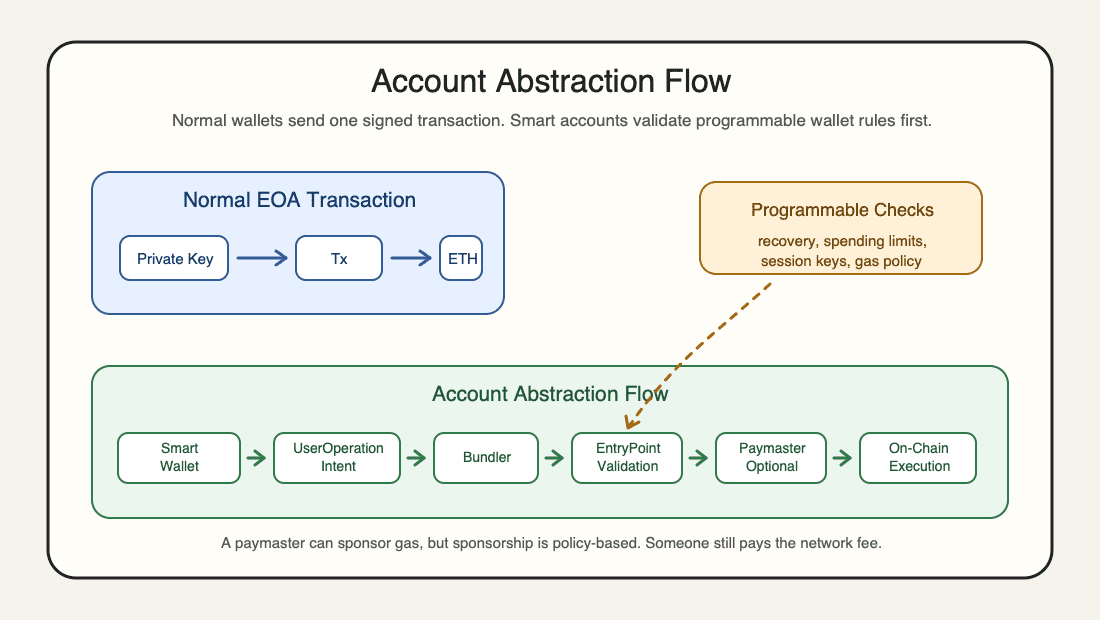
A smart account is the programmable account that holds assets and enforces rules. Under ERC-4337, the wallet often packages the user’s intent into a UserOperation instead of a normal Ethereum transaction.
The ERC-4337 reference defines core pieces such as UserOperation, EntryPoint, bundlers, and paymasters. For beginners, the key point is easier: a UserOperation is a structured request that says what the user wants the smart account to do.
A bundler collects valid UserOperations and submits them on-chain. The EntryPoint contract coordinates validation and execution. It checks whether the smart account accepts the action, then runs the approved call.
A paymaster can sponsor gas or let fees be handled in a different way. That is where “gasless” language comes from. It is convenient, but not magic. The app, sponsor, account, or some other party still pays network fees.
Passkeys can make sign-in feel closer to a normal app. Guardians can help with recovery if a device or key is lost. Session keys can give limited permission to an app for a set time, asset, or action.
Passkeys, guardians, and session keys are where account abstraction becomes visible to users. The plumbing is technical. The result should feel simple: fewer blind signatures, fewer repeated approvals, and clearer limits before your wallet does something expensive.
Account abstraction changes how wallet control works. On-chain actions can still move real assets. A smart wallet can also remain self-custodial, but recovery, permissions, addresses, and compatibility can look different from a seed phrase wallet.
The confusion often starts here. A passkey, a smart-wallet contract address, a recovery phrase, and an underlying EOA may not all be the same thing. Before moving funds, check how that wallet explains control and recovery.
| Normal EOA Wallet | Account Abstraction Wallet |
|---|---|
| One private key usually controls the account. | Programmable rules can control the smart account. |
| Lost seed phrase often means lost access. | Recovery can use guardians, backup keys, or passkeys. |
| Gas is usually paid in the chain’s native token. | Gas may be sponsored or paid through another flow. |
| One action often needs one transaction. | Several actions can be batched together. |
| Apps usually ask for direct signatures or approvals. | Session keys can limit app permissions. |
| Spending limits need external tools or discipline. | Spending limits can be built into wallet rules. |
| Upgrade risk is usually lower at the account layer. | Upgrade keys and wallet contract logic matter. |
| Most dApps understand EOAs. | Some older dApps may not support smart wallets cleanly. |
The cleanest use case is wallet setup and recovery. If you are comparing wallet options, CryptoProcent’s wallets category is a better next stop than a random smart-wallet ad with a shiny button.
Address confusion needs the same caution. If a smart wallet displays a different address or zero balance after import, do not assume the funds vanished. Stop and confirm which account, passkey, seed phrase, and contract address the wallet is actually showing.
ERC-4337 and EIP-7702 solve different account abstraction problems. ERC-4337 built smart-account infrastructure without changing Ethereum’s consensus rules. EIP-7702 lets existing EOAs temporarily delegate behavior to smart contract logic.
Existing balances make the distinction important. One path may use a smart account. Another may let an existing EOA gain smart-wallet features through delegation. Older EIP-3074 discussions still appear, but the cleaner current split is ERC-4337 for smart-account flows and EIP-7702 for EOA delegation after Pectra.
| ERC-4337 | EIP-7702 |
|---|---|
| Application-layer account abstraction. | Protocol-level EOA delegation feature. |
| Uses smart accounts and UserOperations. | Lets an EOA act through delegated smart logic. |
| May involve a smart-account address. | Can keep the existing EOA address in scope. |
| Uses bundlers for UserOperations. | Uses a new transaction capability for delegation. |
| Paymasters can sponsor gas in ERC-4337 flows. | Wallets can combine delegation with smart-account features. |
| Common for smart wallets and embedded wallets. | Useful for adding smart behavior to existing EOAs. |
| Main limit is extra infrastructure and compatibility. | Main limit is safe delegation and wallet implementation. |
The Ethereum Pectra page lists EIP-7702 as part of the Pectra upgrade, which activated on Ethereum mainnet on May 7, 2025. EIP-7702 is current wallet infrastructure, not an old proposal drifting around in a forum tab.
For users, migration is the check. Ask whether the wallet creates a new smart account, changes behavior around your current EOA, or uses both. If the answer is fuzzy, keep the first deposit small.
Account abstraction changes the small wallet chores that make crypto feel hostile. It can reduce repeated signatures, remove the need to hold tiny gas balances for every action, and make recovery less dependent on one seed phrase.
The most visible feature is gas sponsorship. A dApp may pay gas for a first action, or a wallet may let the fee be handled through another token. This helps when a user has a stablecoin but no native gas token, or when tiny dust balances make a wallet look messier than the trade is worth.
Common user improvements include:
Recurring payments and stablecoin transfers can also get cleaner. A wallet may batch approval and transfer, or let an app sponsor the first action so a new user is not stranded without gas. Fancy concept, basic problem.
For a trading example, you could give a swap tool a session key that works only for one token pair, below a daily size limit, with an expiry time and a revoke button. That beats handing an app broad approval and hoping it behaves.
> Easier flow can create faster mistakes. A sponsored transaction that fails still wastes time, and a session key with no real limits is just a private key with nicer packaging.
Account abstraction can reduce one-key fragility, but it does not remove wallet risk. It shifts part of the risk from a private key to smart contracts, wallet policies, upgrade rights, paymasters, bundlers, and the user’s permission choices.
That shift is not automatically bad. Multisig wallets already use smart-contract logic for serious custody. But smart-account design puts more weight on implementation quality. A slick interface cannot audit itself, whatever the marketing department implies.
Run this checklist before trusting meaningful funds:
> Use one hard rule when permissions are unclear. If the wallet cannot show what an app can do, for how long, and how to revoke it, do not give that app meaningful access.
Team and control transparency deserve the same scrutiny. If a wallet or wallet-adjacent project hides who controls upgrades, that can resemble the same anon dev risk traders already watch in token launches.
The sharpest phishing risk is permission confusion. A malicious site may ask you to delegate account behavior, approve a broad module, or create a session key that can spend more than you intended. Large balances deserve extra friction, separate wallets, and smaller test deposits.
Account abstraction helps investors when it improves the way people actually use crypto. Better wallet onboarding can support Ethereum activity, L2 apps, stablecoin transfers, DeFi access, games, and consumer payments.
The token angle still needs discipline. Account abstraction is infrastructure first. A wallet provider, bundler provider, paymaster service, app, or L2 may benefit from adoption. But the phrase itself is not something you can buy.
Investors should separate product use from market narrative:
Account abstraction can become a crypto meta because it gives traders a clean story: easier wallets, smoother apps, more mainstream use. That story connects to normie inflow when real users can sign in, recover, and transact without a seed-phrase initiation ceremony.
Still, a market story is not proof. Before any account abstraction token earns a conviction play label, check the product, fees, users, contracts, and treasury. A narrative coin with no working wallet product can age badly when the only infrastructure is a loud Telegram channel.
Real wallet behavior makes account abstraction easier to judge. Features differ by product, but the pattern is the same: the account follows programmable rules before it signs or executes.
The best examples have both a user benefit and a risk to check:
The rule across all examples is simple. Account abstraction should make risk visible before action, not hide it behind a nicer button. If a wallet gives you fewer chances to understand a permission, that is not progress.
Check an account abstraction wallet like you would check any tool that can move funds. Start small, verify recovery, and inspect permissions before the wallet gets a balance that would hurt to lose.
Do not stop at “it has passkeys” or “it is gasless.” Those are features, not guarantees. The control model tells you more than the product screenshot.
Use this first-use checklist:
Then split your use cases. A smart wallet can work well for apps, games, stablecoins, and frequent trading. Long-term storage may still deserve separate custody, stricter multisig rules, or a colder setup.
A boring pattern works because boring works. Keep experimental smart-wallet permissions away from your main holdings. If a feature asks for broad access, slow down.
Several wallet and market terms sit near account abstraction. They are useful only when they explain a risk, a user behavior, or an investor mistake raised by smart wallets.
Keep these terms separate when reading wallet screens:
Externally owned account, or EOA, means the older Ethereum account type controlled by a private key. EntryPoint means the contract that checks and executes UserOperations in the ERC-4337 flow.
Wallet custody is the broader category. If the next question is “which wallet setup fits this risk,” start with wallet control, backup, dApp compatibility, and permission tools, not a token chart.
Market narratives are separate. Account abstraction can be a serious wallet upgrade and still be used as marketing bait by unrelated tokens. Keep the technical claim and the trade claim in separate boxes.
No. Account abstraction is the design idea that makes programmable wallet rules possible, while a smart wallet is a user-facing product or app that may use those rules.
Not always. Some account abstraction wallets reduce seed-phrase reliance through passkeys, guardians, or backup keys, but each wallet has its own recovery model.
No. Gasless usually means someone else pays gas, or the fee is handled through another path. Paymasters can set rules, limits, allowlists, and fallback requirements.
No. Account abstraction can help recover access after key loss in some wallet designs, but it cannot reverse a valid theft or undo a bad on-chain transaction.
It can be safe only with strong wallet design, audits, recovery settings, permission limits, and tested dApp support. Large balances should use stricter controls and small tests first.
No. Account abstraction is wallet infrastructure, not a coin by default. Any token using the theme still needs normal product, liquidity, contract, and team checks.