Physical Address
304 North Cardinal St.
Dorchester Center, MA 02124
Physical Address
304 North Cardinal St.
Dorchester Center, MA 02124
A practical guide to rug checks, scanner scores, and token red flags.
A rug check is a pre-trade crypto risk review that looks for warning signs a new token could trap, drain, or dump buyers.
The term gets used two ways. Some traders mean the general process. Others mean RugCheck.xyz, a Solana-focused scanner. The broader process is the one to learn: verify the contract address, inspect on-chain permissions, check liquidity and holders, then decide whether the trade still makes sense.
A rug check in crypto is a quick but layered review before buying a token. It asks whether the token has obvious rug-pull warning signs, such as removable liquidity, dangerous permissions, blocked selling, or concentrated insider supply.
That makes it different from a price call. A rug check does not tell you a chart will go up. It shows where buyers may be trapped, diluted, drained, or dumped on.
Keep the tool-versus-process split clear before you trust a score:
Imagine a new DEX token appears in a chat. Before buying, you copy the contract address from the project’s official channel, run a scanner built for that chain, compare liquidity and holders on a DEX view, and check whether the team’s claims match what you can see. That is a rug check.
The routine is boring on purpose. It gives you a pause between “everyone is buying” and “I just signed a trade I barely understand.”
A rug check comes before a new token buy because fresh DEX launches often move faster than normal due diligence. Memecoin markets can turn a link, chart, and group chat into a trade before anyone asks who controls the liquidity.
That speed creates a nasty information gap. Insiders may know the deployer wallet, launch plan, wallet clusters, or sell settings while public buyers only see a rising candle. If you skip basic checks, you can become someone else’s exit liquidity when earlier buyers already planned their exit before you arrived.
Start with the basics that decide whether the scan is even useful:
That list is not a full investigation. It is the minimum screen before money gets involved.
It also keeps the first question simple: can normal buyers leave if the trade goes wrong? If the answer depends on trusting a stranger in a Telegram chat, the trade is already asking for more faith than a new token deserves.
FOMO is the enemy here because it asks for speed, not clarity. A rug check gives you enough friction to notice obvious traps before the chart makes caution feel expensive.
A rug check looks for on-chain signals that show who can change the token, who controls supply, and whether buyers can enter and exit normally. The point is not to accuse every new token. The point is to separate normal launch risk from red flags that deserve a hard pause.
Scanners translate raw blockchain data into labels. Those labels are useful only if you know what they mean. “Liquidity locked” sounds good, but shallow liquidity can still make exits ugly. “Mint revoked” is helpful, but holder clusters can still dump.
Use this table as a translation layer:
| Rug Check Signal | What It Can Mean |
|---|---|
| Removable LP tokens | A team or insider may be able to pull liquidity. |
| Shallow liquidity | Small sells can move price hard. |
| Active mint authority | More tokens may be created after launch. |
| Freeze or blacklist controls | Transfers or sells may be restricted. |
| Concentrated holders | A few wallets may dominate supply. |
| Bundled or linked wallets | One actor may control many addresses. |
| Failed sell simulation | Buyers may struggle to exit. |
| Suspicious deployer history | The same wallet may have launched risky tokens before. |
Each signal is a clue, not a court verdict. The strongest warnings appear when several signals stack together, such as removable liquidity, privileged permissions, and clustered top holders.
Liquidity and LP control show whether buyers can trade without trusting the team to keep the pool alive. In a hard rug, the damaging move can be fast: liquidity disappears, trading breaks, and holders are left staring at a chart that no longer has real exits.
LP tokens represent control over liquidity in many pool designs. If the team holds those LP tokens freely, it may be able to remove the pool’s paired assets. If LP tokens are burned or locked, that specific risk can fall, but the token is not automatically safe.
Depth belongs in the same check. A pool can be locked and still be thin. If liquidity is tiny compared with top-holder supply, a few sells can crush the price. Your rug check should ask both questions: who controls liquidity, and is there enough liquidity for real exits?
Mint, freeze, and owner permissions show whether privileged wallets can change supply or transfer behavior after launch. For Solana tokens, Solana documentation defines authority changes for token mints and token accounts, so scanner labels around mint or freeze control deserve close attention.
Mint authority can allow new tokens to be created. Freeze authority can restrict specific token accounts. Update authority, proxy controls, upgrade controls, blacklist features, and transfer-tax settings can also change what holders experience.
Different chains expose these risks differently. On EVM chains, a scanner may flag owner privileges, proxy contracts, blacklist functions, high taxes, or unverified code. On Solana, scanners often focus on mint authority, freeze authority, metadata control, and token-program details.
Ask one plain question: what can a privileged wallet still change after you buy? If the answer is “a lot,” the clean labels deserve less weight than the remaining admin power.
Holder concentration shows whether supply is spread across real market participants or parked in a few dangerous places. A token can show many holders while still having related wallets, bundled buys, sniper wallets, or a deployer-linked cluster.
This is where beginner checks often miss the plot. Ten wallets with similar balances can look like distribution. If they were funded by the same source, bought in the same launch window, and sell together, they may act like one large holder with better camouflage.
Check top holders, deployer history, funding paths, and early buyer behavior. A scanner may summarize that pattern, but an explorer or bubble map can help you see whether the warning is obvious or speculative.
Honeypot and sell-restriction checks ask whether buyers can actually exit. A token can be easy to buy and nearly impossible to sell because of contract logic, transfer rules, taxes, blocklists, or launch settings that change after trading begins.
Sell simulation helps, but it has limits. Some bad tokens allow small test sells, then block larger sells. Others change taxes or restrictions after liquidity and attention arrive. A check that passes before launch conditions change can still miss later behavior.
Watch for stacked warnings:
A rug check should make those signals plain before you decide whether any possible upside is worth the control risk.
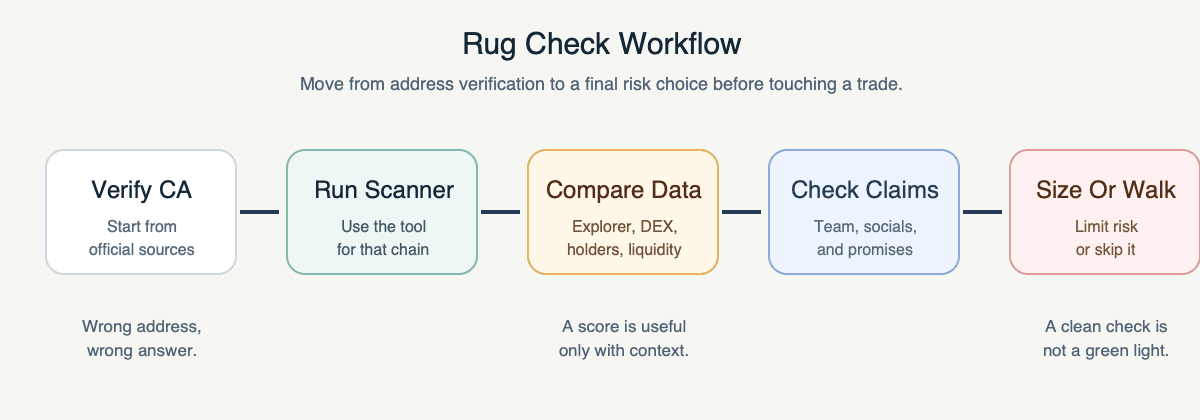
To rug check a token, start with the contract address, then move from scanner output to manual verification. The goal is a repeatable routine that slows the trade down without turning every check into a research thesis.
Use the workflow before you buy, not after the chart has already made the decision feel urgent.
Start with these steps:
For Solana tokens, that may mean checking RugCheck.xyz, Solana Tracker, DEXScreener, a block explorer, and holder maps. For Ethereum, Base, BNB Chain, or Polygon tokens, it may mean Token Sniffer, De.Fi Scanner, GoPlus-backed tools, Etherscan-style explorers, and DEX dashboards.
Do not connect a wallet just to run a basic scan unless the tool has a clear reason. A read-only check should not need spending approval, a rushed signature, or a seed phrase. If the “scanner” asks for wallet power before showing risk data, you have learned something useful already.
A rug check cannot tell you whether a token will rise, whether a team is honest, or whether insiders will behave well after launch. It can reduce specific technical and on-chain risks. It cannot remove market risk or make people honest.
False confidence is the real trap. A token can pass basic scanner checks and still become a soft rug if insiders dump slowly, the team abandons the project, promised work never arrives, or social hype dries up while retail holders wait.
That is why a rug check should separate technical safety from trade quality. A token can have revoked mint authority and locked liquidity, yet still launch with weak demand, fake momentum, or insiders waiting to sell into the first wave of buyers.
There are several blind spots to keep in mind:
The best use of a rug check is risk reduction. It tells you whether obvious warning signs exist now. It does not promise that new information, team behavior, market conditions, or coordinated selling will stay friendly later.
So never turn a good score into a full-position excuse. If the trade only feels safe because one tool says “low risk,” the check is doing less work than your hope is.
Rug check signals are easier to read when you compare patterns, not isolated labels. A single green or red flag can mislead. A stack of related signals is usually more useful.
The examples below are hypothetical. They show how a cautious buyer might interpret common combinations without accusing a live token.
| Signal | How To Read It |
|---|---|
| Liquidity is locked, mint authority is revoked, and holders look spread out. | Lower risk, but still not safe. Check depth, team claims, and trade size. |
| Liquidity is locked, but top holders are clustered and the team is anonymous. | Mixed warning. The lock helps one risk, while holder control and trust risk remain. |
| Mint authority remains active, sell simulation fails, and LP control is unclear. | Walk-away pattern. Too many controls sit against buyers. |
| The team is public, liquidity is thin, and launch wallets still hold large supply. | Better accountability, but weak exits and insider supply can still dominate. |
The pattern carries more weight than one label. Locked liquidity can reduce one exit path, but it does not fix concentrated supply. A public team can reduce identity risk, but it does not deepen the pool or stop weak launch wallets from selling.
“Safer” means fewer obvious traps, not safe. The right response to a lower-risk pattern may still be a smaller position, a slower entry, or no trade.
Mixed results deserve a slower read. If the positive signal is narrow and the warning signal affects exits, permissions, or supply control, give the warning more weight.
Common rug check mistakes usually come from wanting one clean answer. New-token trading rarely gives that. The safer habit is to use each result as a clue and ask what still needs checking.
The most expensive mistakes are simple:
That last one deserves special caution. If you think a token may rug but plan to sell first, you are competing in a hostile game against people with better timing, better wallet data, and likely more control. That is not clever due diligence. It is volunteering to be late with extra confidence.
Team identity is another place beginners overcorrect. Anonymous developers are a risk factor, not automatic proof of fraud. Public teams are not automatic protection either.
Keep the team check practical:
The same logic applies to scanner scores. A score can summarize risk, but it cannot make a tiny pool deep, make linked wallets independent, or make a vague roadmap real.
The end result of ignoring weak liquidity, holder clusters, and obvious permission risk is often becoming a bagholder. You may still own tokens, but the market you expected to sell into has already left.
Rug check, rug pull checker, and token scanner overlap, but they are not identical. The cleanest split is process, tool, and broader analysis.
A rug check is the workflow. A rug pull checker is a tool category built to flag rug-pull risks. A token scanner is broader and may inspect contract code, taxes, holders, permissions, liquidity, trading behavior, and known-risk databases.
That distinction helps when a tool page promises speed. Fast output is useful only when you know what the tool checks, which chain it supports, and what it cannot see.
Keep the terms straight:
A scanner can make the first pass faster, but it cannot replace address verification, holder review, liquidity checks, or basic skepticism.
Start with the workflow, then choose the tool. A Solana token may need a Solana-focused scanner, while an Ethereum or Base token needs tools that understand EVM contract patterns. The wrong scanner can produce false comfort because it is looking at the wrong problem.
When people say “rugcheck crypto,” they may mean the named tool, casual shorthand, or the whole safety routine. In trading chats and due diligence notes, it is clearer to say “run a rug check” for the process and name the scanner only when you mean that exact tool.
Related rug check concepts help you understand scanner warnings and trader comments without turning every phrase into drama. The words often describe different failure shapes, so using them loosely can create bad decisions.
A hard rug is the sharp version. Liquidity disappears, selling gets blocked, or malicious control leaves holders with little real exit. A soft rug is slower damage, often through insider selling, abandoned promises, or a team quietly letting the project die.
Two team-signal terms are worth separating:
Bagholder describes someone left holding an asset after the market has moved against them. Exit liquidity describes the buyers who give earlier holders a way out. Both terms show why a rug check should happen before buying, not after a token chat starts explaining why the dump is “healthy.”
Honeypot, mint authority, freeze authority, and holder concentration are scanner terms that point to different risks. Learn the difference before ranking one warning above another. A token can have one clean label and one ugly label in the same scan.
No. A rug check means you reviewed specific warning signs before buying. It can reduce risk, but it cannot prove honest team behavior, future liquidity, price performance, or insider restraint.
Use a clean result as permission to keep checking, not permission to ignore position size.
The best rug check tool is the one that supports the chain you are checking and explains its warnings clearly. Solana traders may use Solana-focused scanners, while EVM traders need tools that read Ethereum, Base, BNB Chain, Polygon, or the chain in question.
Do not rely on one tool when the trade is meaningful. Compare scanner output with an explorer, DEX data, and holder behavior.
A rug check can flag honeypot risk when a scanner tests selling, transfer rules, taxes, blocklists, or contract restrictions. That helps, especially before buying a fresh token.
It still may miss later changes or conditions that only appear after launch. If selling looks uncertain, skip the trade.
Mint authority means a wallet or program may have the power to create more tokens. In a rug check, active mint authority can be a warning because extra supply can dilute holders or support abusive launch behavior.
Revoked mint authority is helpful, but it is not enough by itself. You still need to check liquidity, holders, freeze controls, and deployer history.
No. Locked liquidity helps with one classic rug path because it can reduce the risk of the pool being pulled. It does not stop insider dumping, holder clusters, mint permissions, freeze controls, fake partnerships, or bad team behavior.
Locked liquidity is one positive signal, not a safety certificate.
If your rug check shows mixed signals, slow down and separate the warnings by severity. A minor metadata warning is different from failed sell simulation, unclear LP control, or active mint authority.
When the serious warnings stack together, walk away. There will be another chart, and most of them will also claim urgency.
Start with a rug check routine you can repeat quickly. The goal is not perfect certainty. The goal is refusing to buy a fresh token while the obvious risks are still blurry.
Use this short workflow:
The last step is the quiet edge. If a token requires you to explain away failed sells, hidden control, thin liquidity, clustered wallets, and vague team claims, the rug check has already done its job.
That routine will still miss some risks. But it catches enough obvious problems to stop the worst kind of trade: the one you enter because everyone else seems faster than you.
If time is short, do fewer trades instead of weaker checks. A token that survives one more minute without your order is usually still there. A token that cannot survive one minute of basic review was not offering a fair setup in the first place.
The final decision is not “safe” or “unsafe.” It is whether the visible risks match the amount you are willing to lose. That is a calmer question, and it is much harder for hype to answer for you.