Physical Address
304 North Cardinal St.
Dorchester Center, MA 02124
Physical Address
304 North Cardinal St.
Dorchester Center, MA 02124

Avoid risky RPC endpoint mistakes before changing wallet network settings.
An RPC endpoint is the URL a crypto wallet, app, or script uses to talk to a blockchain node. You usually meet one when a wallet asks for a network URL, a dApp stalls, or a provider dashboard gives you a custom RPC link.
It is not your wallet, not your seed phrase, and not the blockchain itself. It is the route your software calls when it needs chain data or wants to submit a signed transaction.
That small URL can still create big confusion. A slow RPC endpoint can make a wallet look stale, a failed request can make a swap look broken, and a random custom URL from social media can turn a simple fix into a bad afternoon.
An RPC endpoint in crypto is the address your wallet, dApp, bot, or script calls when it needs blockchain information. RPC stands for remote procedure call. The name is dull, but the idea is simple: one piece of software asks another piece to do something.
Think of the endpoint like a service desk address. Your wallet sends a request there, and the connected node handles the blockchain work behind it. The analogy stops there, because this desk can answer thousands of automated questions per second, and nobody is wearing a little headset.
A clean split helps:
This split also keeps wallet safety in perspective. Changing the RPC URL changes where the wallet asks questions. It does not move the coins, replace the wallet, or give the endpoint your recovery phrase.
The risk sits in bad data, bad instructions, and bad sites wrapped around the setting. That is less dramatic than “the endpoint stole my wallet,” but it is much closer to real life.
You will see the same term in several places. Wallet network settings may call it an RPC URL. Developer tools may call it an endpoint. Provider dashboards may call it a public, private, shared, or dedicated endpoint.
For most users, the important part is simpler. The RPC endpoint is how a crypto app asks the chain what is happening before your screen shows a balance, a contract read, a gas estimate, or a transaction result.
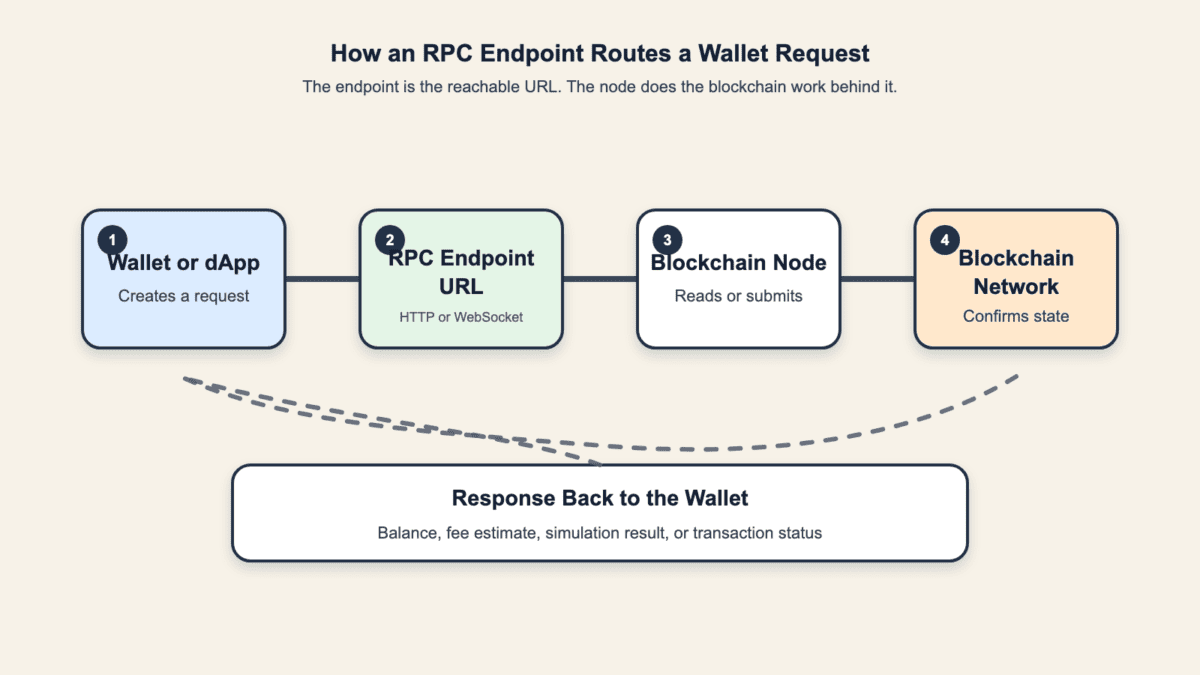
An RPC endpoint works by carrying requests between user software and a blockchain node. The wallet or dApp does not magically know your balance. It asks an endpoint, the node checks chain data, and the response comes back to the interface.
On Ethereum, the Ethereum.org JSON-RPC API reference maps common request types for reading blockchain data and sending transactions through a node. Other chains, including Solana, use their own RPC method sets, but the user-facing idea is similar.
The path usually looks like this:
_A simplified request path from wallet or dApp to endpoint, node, network, and back._
Read requests are the quiet ones. Your wallet may ask for token balances, a nonce, a block number, contract data, or a gas estimate. A dApp may ask for pool data before showing a swap quote.
Write requests are different. Your private key stays in your wallet, and the endpoint should receive only the signed transaction. That signed transaction can then be broadcast to the network. If the endpoint is overloaded, blocked, or out of sync, the wallet may show errors even when your funds are still on-chain.
Some endpoints also support live subscriptions over WebSocket. That lets apps watch new blocks, account changes, or events without asking the same question again and again. When those streams lag, the app can feel late even if the chain keeps moving.
RPC endpoint, RPC node, and API describe related pieces, but they are not the same thing. The confusion is understandable because crypto users often use the terms loosely when they really mean “the place my wallet connects.”
Here is the clean version:
| Term | What it means in practice |
|---|---|
| RPC endpoint | The URL or network address an app calls. |
| RPC node | The server or node software that reads chain data and answers requests. |
| API | The broader interface or method set an app uses to request data or actions. |
The RPC endpoint is the contact point. The RPC node is the system doing the chain-side work. The API is the rulebook for what can be requested and how the reply is shaped.
That is why a provider can offer an RPC endpoint without giving you a private blockchain. It is providing access to a route. The quality of that route depends on the node, provider limits, caching, location, and whether the service is healthy when you need it.
This distinction helps when troubleshooting. If a wallet shows the wrong balance, the endpoint may be slow, the node may be behind, the token may need manual display, or the dApp may have a separate indexing problem. Calling all of that “RPC is broken” feels good for two seconds, then leaves you stuck.
It also helps when comparing public and private options. A private endpoint can still sit in front of shared infrastructure. A dedicated node can still expose more than one endpoint. The label only makes sense when you ask what is behind the URL.
RPC endpoints affect wallets and DeFi because they shape what the interface can fetch, estimate, and submit. Your assets live on-chain, but wallets need reliable requests to display them clearly.
That is why endpoint trouble often looks like wallet trouble. A balance may fail to refresh, a token list may lag, a fee estimate may look odd, or a swap screen may spin without a useful message.
Common symptoms include:
The endpoint is only one suspect. Browser extensions, wallet permissions, chain congestion, dApp front ends, RPC rate limits, contract errors, and token display settings can all create similar friction.
So do not assume the chain is broken just because a wallet screen is sulking. First check whether the same address looks normal in another wallet, block explorer, or official app interface. Then check the dApp and provider status if those exist.
For DeFi users, the endpoint sits near the start of many workflows. It may help simulate a swap, read lending account health, fetch oracle data, or submit a signed action. If that route is slow or unreliable, the interface can fail before the chain ever gets a fair chance to include your transaction.
Public, private, shared, and dedicated RPC endpoints describe who can use the endpoint and what kind of infrastructure may sit behind it. These labels are useful, but they are not magic privacy spells.
A public RPC endpoint is open for broad use. It is handy for testing, light wallet setup, and quick access, but it may have stricter limits. If too many users hammer it at once, requests can slow down or fail.
The main types are easier to compare side by side:
| Endpoint type | Best plain-English use |
|---|---|
| Public | Testing, light use, quick wallet setup, more likely to hit limits. |
| Private | Personal or restricted URL from a provider, usually better reliability. |
| Shared | Multiple users or apps using shared infrastructure. |
| Dedicated | Higher-control infrastructure for production, bots, or heavy apps. |
A private RPC endpoint usually means you have a restricted URL, often with an API key, account, allowlist, or provider project. It may be more stable than a public endpoint because fewer people can use that same address.
But private does not mean anonymous. On a public blockchain, the final transaction is still public once included. The endpoint may change the route your request takes, but it does not erase the on-chain record.
Shared and dedicated are about resources. Shared endpoints can be fine for normal wallet use. Dedicated endpoints become more relevant for apps, dashboards, bots, and teams that need tighter limits, uptime controls, logs, or predictable performance.
RPC endpoint risks come from what the endpoint can see, fail to return, or route incorrectly. The scary version gets overstated, but the boring version is still worth respecting.
An endpoint can fail requests, return stale data, apply rate limits, log metadata, or make your wallet show that a transaction route is unavailable. It may see that a wallet address asked for certain account data from a certain IP address or app session, depending on the provider setup.
Privacy concerns sit in layers:
That last point is where many users get hurt. A custom RPC endpoint alone should not ask for a recovery phrase. Fake support pages, fake wallet prompts, and malicious approval flows are closer to rug pulls and phishing than to normal RPC setup.
Address visibility is separate from endpoint privacy. Anyone can inspect public wallet activity on-chain, and suspicious token transfers or wallet tagging can create their own headaches. That is why dust belongs in the broader privacy conversation, even though dusting attacks are not the same thing as RPC logging.
Use this safety checklist before changing a custom RPC endpoint:
The clean rule is simple. An endpoint can mislead your interface or leak metadata. It should not directly control your private key. If a page says RPC setup requires your recovery phrase, close it and let the tab think about what it has done.
You should change your RPC endpoint only when you have a specific problem and a trusted replacement URL. Random tinkering can turn a small wallet issue into a bigger mess.
Default wallet endpoints are usually fine for ordinary use. They may not be the fastest route, but they reduce the chance that you paste a fake network URL, unsupported chain setting, or strange provider link into a live wallet.
Before changing anything, run a quick check:
Changing the endpoint can help when the default route is down, rate-limited, slow, or unsupported for the network you need. It can also help developers who need devnet, testnet, archive, or higher-volume access.
But it will not fix everything. A failed transaction may come from insufficient gas, slippage, contract logic, oracle updates, liquidity, wallet permissions, or chain congestion. If the dApp itself is broken, a shinier endpoint just gives the broken app a faster ride.
For a normal user, the safest path is cautious and dull. Keep defaults for everyday wallet use. Switch only when you can name the reason, verify the URL, and undo the setting if results get worse.
RPC endpoints become more important for traders and builders because high-volume workflows ask more from the chain. A casual holder may refresh a wallet a few times. A bot, dashboard, or active DeFi strategy may fire constant reads, simulations, and submissions.
The pressure points are different at that level:
Solana users talk about endpoints often because high-throughput apps, fast markets, and live account changes make lag visible. In Solana culture, where speed and retail tools are part of the brand, a delayed account update gets noticed fast.
For EVM DeFi, the issue often shows up around simulations, nonce management, mempool routing, and repeated reads across contracts. A slow or limited endpoint can make a dashboard late, a liquidation bot useless, or a mint screen miss the window.
Endpoint quality also shows up in PvP trading. When many participants chase the same on-chain opportunity, late data is not a small inconvenience. It can be the whole trade.
Builders may outgrow a basic endpoint before investors do. They may need multiple providers, fallbacks, local nodes, dedicated endpoints, or indexers. The user-facing lesson is still useful: when an app feels slow, the endpoint is one layer to check, not the whole stack.
Start with RPC endpoints by leaving your wallet defaults alone until you have a clear reason to change them. Most users do not need a custom endpoint for normal holding, swapping, or checking balances.
The goal is not to collect endpoint URLs like trading cards. Keep one known-good route for normal use and one trusted fallback when the default provider has a bad day.
If you do need to troubleshoot, keep the process boring:
If the change improves loading, keep notes about what you changed. If it only moves the error around, restore the old URL and look elsewhere.
RPC fixes are useful when the route was the problem. They are noise when the failure comes from a contract, app, wallet permission, or congested network.
Use public endpoints for light testing, not serious production work. Use private or dedicated endpoints only when your usage needs better reliability, stronger limits, or a controlled route.
And keep one rule taped to the inside of your brain: RPC setup never needs your recovery phrase. If a page, support account, or random “helper” asks for it, the problem is no longer an endpoint problem. It is a walk-away problem.
An RPC endpoint is the URL your wallet, dApp, or script calls when it needs blockchain data or wants to submit a signed transaction. The endpoint is not the chain itself. It is the route to a node that can answer requests such as balances, fee estimates, contract reads, and transaction status.
No. An RPC endpoint is the reachable URL or address, while an RPC node is the server or node software that answers requests behind that address. Users often say “RPC node” when they mean “RPC endpoint” because the endpoint is the part they can see and paste into settings.
A custom RPC endpoint can be safe when it comes from official wallet, chain, or reputable provider material. It becomes risky when it comes from DMs, fake support pages, or random social posts. Never enter a seed phrase or private key because of any RPC setup instruction.
An RPC endpoint may see wallet addresses included in requests, along with technical metadata such as network, method, timing, or IP-related information depending on the setup. That does not give it custody of your coins, but it can create privacy concerns for users who want less metadata exposure.
No. A private RPC endpoint usually means a restricted or personal URL, not a private public-chain transaction. It may improve reliability, rate limits, or routing. Once a transaction is included on a public blockchain, the address activity and transaction details remain visible under that chain’s normal rules.
If an RPC endpoint goes down, your wallet or dApp may fail to show fresh balances, estimate fees, simulate actions, or submit signed transactions. Your funds are still controlled by your keys on-chain. The interface is having trouble reaching reliable chain data or broadcast access.