Physical Address
304 North Cardinal St.
Dorchester Center, MA 02124
Physical Address
304 North Cardinal St.
Dorchester Center, MA 02124

A plain guide to Ethereum's rollup-centric roadmap, blobs, ETH, and L2 risks.
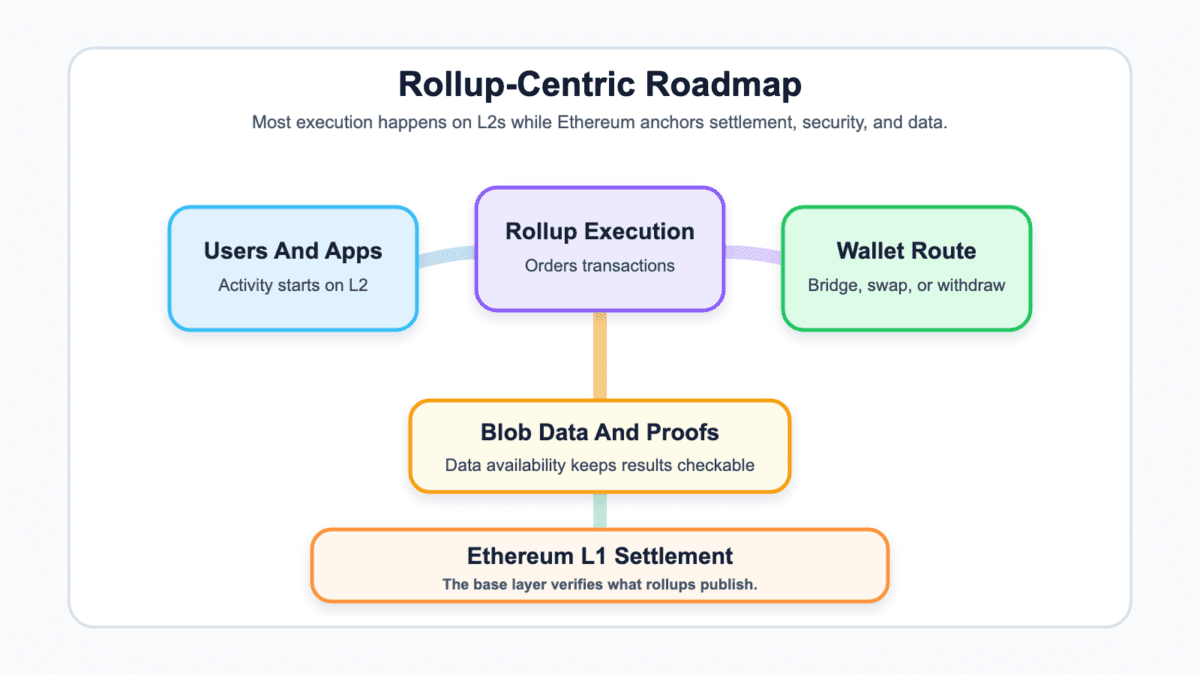
The rollup-centric roadmap is Ethereum’s scaling plan in which L1 handles settlement, security, and data availability while rollups handle most execution.
Ethereum is not simply handing transactions to random side networks. It splits the job: the base layer stays conservative and verifiable, while L2s process more user activity at lower cost.
The catch is that users now have more moving parts to check. Fees can be lower, but wallets, bridges, sequencers, withdrawal paths, token incentives, and liquidity can still make the experience confusing. Cheap gas is nice. Sending funds to the wrong network is not a personality-building exercise.
The rollup-centric roadmap is Ethereum’s plan to scale through rollups instead of making every Ethereum L1 node execute every user action. Rollups run transactions off the base layer, bundle the results, and connect back to Ethereum for settlement and verification.
In a simple flow, you use an app on an L2. The rollup processes the transaction. Then it publishes enough information to Ethereum so the result can be checked or challenged, depending on the rollup design.
This gives Ethereum a division of labor:
On the surface, it can still feel like ordinary crypto: pick a network, approve a transaction, watch the fee, and hope the wallet is pointing at the right place. Underneath, the job split has changed. Ethereum is no longer trying to host every small action directly.
The roadmap is a design tradeoff. Ethereum avoids turning the base layer into a high-throughput machine that only large operators can comfortably verify. Rollups take on more execution work and more product complexity.
That is why “Ethereum scaling through L2s” can feel odd. You may not touch mainnet for a swap, mint, or game action. But a real rollup still depends on Ethereum for settlement and data guarantees.
Ethereum chose a rollup-centric roadmap because scaling every transaction directly on L1 would make the base layer heavier to verify. More throughput sounds simple until ordinary nodes need stronger hardware, bandwidth, and storage just to keep up.
That would weaken one of Ethereum’s main defenses: many independent users can verify the chain. If only large operators can run meaningful infrastructure, the system becomes faster but less neutral.
Rollups are the compromise. They let Ethereum keep L1 cautious while L2s experiment with execution speed, fee markets, app design, and user interfaces. The base layer does less direct execution, but it still anchors the parts that make the rollup more than a separate fast chain.
The tradeoffs show up quickly:
None of that makes the plan bad. It makes it specific. Ethereum did not choose the rollup-centric roadmap because L1 scaling stopped mattering. It chose this path because scaling and decentralization pull against each other.
In a 2024 Surge roadmap essay, Vitalik Buterin framed Ethereum scaling as a combined L1 and L2 project, with rollups doing heavy execution work while Ethereum improves data availability, proof maturity, and interoperability. One concrete Surge target in that roadmap is 100,000+ transactions per second across L1 and L2.
So do not stop at the marketing label. Ask what Ethereum can enforce when the rollup, bridge, or sequencer has a problem.
Rollups, blobs, and data availability power the rollup-centric roadmap by separating execution from verification. Rollups execute transactions, while Ethereum receives the data or commitments needed to keep the result checkable.
Start with the user. You send a transaction on a rollup, such as an optimistic rollup or a ZK rollup. The rollup orders and executes the activity, then posts a batch back toward Ethereum.
The details differ by rollup type. An optimistic rollup usually treats batches as valid unless someone challenges them during a dispute window. A ZK rollup uses validity proofs to show that a batch moved from one valid state to another.
Data availability is the less flashy part, but it is central. If others cannot access enough transaction data, they cannot reconstruct the rollup state or verify what happened. A rollup that hides critical data asks users to trust more off-chain actors.
Blobs are Ethereum’s cheaper temporary data lane for rollups. They are not normal file storage. They give rollups a way to publish batch data without stuffing it into the more expensive part of Ethereum transactions.
The moving parts fit together like this:
| Roadmap Part | What It Does |
|---|---|
| L1 settlement | Gives rollups a base layer for final settlement and dispute resolution |
| Rollup execution | Processes user transactions away from Ethereum mainnet |
| Blobs | Carry rollup data more cheaply for a limited time |
| Proofs | Help Ethereum or users verify that rollup state changes are valid |
| Bridges | Move assets and messages across L1, L2s, and apps |
The table hides one important caveat. A rollup can use Ethereum for some guarantees while still keeping other controls in operator hands. Sequencers, upgrade keys, proof systems, and bridge contracts decide how much trust remains.
That is why the rollup-centric roadmap is not just “L2s are cheaper.” It is a stack of promises, and each promise needs a different check before funds move.
Dencun changed the rollup-centric roadmap by making blobs available to rollups. That gave L2s a cheaper way to publish data to Ethereum, which helped move the roadmap from early theory into everyday fee competition.
The important word is “helped.” Dencun did not make every rollup cheap forever. It changed one major cost input: the cost of posting rollup data to Ethereum.
A simple user example shows the difference. You may swap on an L2 and pay less than you would on Ethereum mainnet. But if you must bridge first, wait for a withdrawal, route through thin liquidity, or pay another app fee, the full trip can still feel clunky.
Dencun also shifted the debate. Before blobs, many users saw rollups as promising but expensive during busy periods. After blobs, the conversation moved toward bigger questions:
Infrastructure tends to move that way. One bottleneck improves. Then the next one gets louder.
For Ethereum, Dencun was a milestone rather than the finish line. For users, lower L2 fees still need to be weighed against the full route, not the swap fee alone. The next work is less about proving that rollups can be cheaper and more about making them safer, easier to verify, and less fragmented.
The rollup-centric roadmap is being debated now because the original promise met messy production reality. Rollups brought cheaper execution, but decentralization, interoperability, and value flow did not mature at the same speed.
Some of the debate is healthy. Ethereum L1 has also kept improving, so users ask whether more execution should return to the base layer. L2 teams ask how much independence they need. ETH holders ask whether rollups create enough demand for Ethereum itself.
The loud version says the roadmap is dead. The calmer version is more useful: the roadmap is being refined. Rollups still matter, but the bar for calling something “Ethereum scaling” is higher than “fast EVM chain with a bridge.”
Markets blur that distinction. A project can wrap itself in the L2 story and still trade mostly as a narrative coin if the token runs ahead of usage, security, and liquidity.
The main debate points are concrete:
None of this means every L2 is weak. It means the roadmap now needs better filters. A rollup should show what it posts to Ethereum, how users can exit, how upgrades work, and what happens if the operator disappears or censors transactions.
For a user, that is better than drama. You do not need to decide whether the roadmap is alive or dead. You need to know which guarantees exist before you move money.
The rollup-centric roadmap means ETH can benefit from Ethereum’s role as the settlement, security, and data availability layer. It does not mean ETH automatically goes up because rollups get busier.
That distinction gets lost fast. If L2s make Ethereum easier to use, more activity may touch Ethereum through settlement, blob demand, staking security, and monetary premium. But the strength of each link depends on actual usage, fee design, and how much value stays on L2s.
The main ETH connections are:
Each mechanism comes with a catch. Cheap blob space can help users while producing less direct fee pressure. Rollup adoption can grow while L2 operators capture some revenue. App activity can move to L2s without every trade touching mainnet.
So ETH exposure is not the same as owning every toll road in the L2 stack. It is closer to holding the neutral settlement asset and security layer that serious rollups still need.
The stronger ETH case is not “L2s must pay a huge bill tomorrow.” It is that Ethereum becomes more useful if many rollups, apps, and assets rely on it for credible settlement and data.
The weaker case is just as important. If users live on L2s, blob fees stay low, and value mostly accrues to apps, sequencers, or tokens, ETH holders may see less direct capture than the adoption story suggests.
The rollup-centric roadmap does not make every L2 token a clean bet on Ethereum scaling. An L2 can gain users while its token captures little value, unclear value, or value that arrives later than the market expects.
That is where many traders get caught. “Rollups win” is a technical statement. “This token wins” is a token-design, revenue, governance, supply, and liquidity statement.
Compare the exposures before treating them as one trade:
| Exposure | What It Actually Depends On |
|---|---|
| ETH | Ethereum settlement demand, security demand, data fees, and monetary premium |
| L2 governance token | Governance rights, fee capture, incentives, supply, and demand |
| Sequencer revenue | Who runs ordering, who receives fees, and whether the token participates |
| App token | Actual app usage, emissions, retention, and market liquidity |
| Airdrop farming | Eligibility rules, dilution, lockups, and exit demand |
An L2 token can also become a sector trade. Capital may rotate into L2 names after a roadmap milestone, then leave when attention moves to another theme. That is normal sector behavior, not proof that the roadmap failed.
Watch the exit path too. If a token pumps on L2 hype but depth is thin, later buyers can absorb sales from early holders, insiders, or farmers. The chart may say “scaling thesis.” The order book may say “good luck.”
Before buying an L2 token, ask what the token actually controls. Does it receive fees? Does it govern upgrades? Does it only vote on grants? Is more supply scheduled to hit the market? Does real app activity require the token?
That check keeps the roadmap in the right box. Rollups can be important infrastructure while some L2 tokens remain weak trades.
The main risk in the rollup-centric roadmap is assuming every rollup inherits Ethereum security in the same way. Rollups can inherit strong guarantees only when their design, maturity, data availability, and exit paths let Ethereum enforce those guarantees.
The phrase “L2s are centralized” is too broad. Some risks involve ordering. Some involve upgrades. Some involve bridges. Some involve proof systems that are not fully live or not yet relied on.
Keep this warning close before moving serious funds:
> Low fees are a feature. They are not a security audit, bridge guarantee, or promise that withdrawals will be painless.
The risk buckets are easier to manage when separated:
| Risk | What To Check |
|---|---|
| Sequencer control | Who orders transactions and whether censorship exits exist |
| Upgrade keys | Who can change contracts and how fast changes can happen |
| Security council | Who can intervene during emergencies and what powers they hold |
| Bridge contracts | What contract secures deposits and how withdrawals work |
| Proof maturity | Whether validity or fault proofs are live and used |
| Data availability | Whether transaction data is posted to Ethereum or elsewhere |
| Liquidity fragmentation | Where assets trade and whether exits have depth |
| Wallet mistakes | Whether the asset, chain, and bridge route match |
L2BEAT’s Stage 0, Stage 1, and Stage 2 labels are one useful maturity lens. They can help you see how much control has moved away from the operator. They are not a full security score.
Sidechains and validiums also need different treatment. A sidechain may connect to Ethereum through a bridge but use its own validator set. A validium may use validity proofs but keep transaction data somewhere other than Ethereum.
Those differences change the failure mode. If data is unavailable, exits can become harder. If a sequencer censors, forced inclusion may matter. If upgrade keys are too powerful, a multisig can become the real trust anchor.
The roadmap works best when users can verify, exit, and recover. If those paths are vague, the cheap transaction is not the whole story.
To evaluate a rollup in the rollup-centric roadmap, check what Ethereum actually enforces before you bridge, trade, or buy the token. The label “L2” is the start of the review, not the end.
Start with the asset path. Know whether you are using Ethereum L1, an L2, a sidechain, a validium, or an appchain. Then check whether the wallet, network, token contract, and bridge route match the official path.
Use this checklist before using a new rollup:
Wallet network selection deserves special care. The right token on the wrong network can become a support problem, a delayed recovery, or a permanent loss. A verified wallet setup is not glamorous, but neither is pleading with a bridge form at 2 a.m.
Scam risk sits beside technical risk. Fake bridge pages, fake airdrop claims, and fake support accounts can steal funds before the real rollup design ever gets tested. That can feel like a hard rug to the user, even when the real protocol was not involved.
The boring move works. Use official links, avoid search ads for bridges, test with small amounts, and keep enough ETH or gas token on the right network to exit.
Related rollup-centric roadmap concepts help separate Ethereum’s scaling plan from similar-sounding chain designs. The words are close enough to confuse normal users, and crypto is not famous for naming restraint.
Rollups execute transactions away from Ethereum L1, then connect back through proofs, commitments, and data publication. Optimistic rollups use a challenge model. ZK rollups use validity proofs.
Sidechains are different. They may bridge to Ethereum, but they usually rely on their own security model. That can be useful, but it is not the same as Ethereum enforcing rollup state.
Validiums sit in another bucket. They can use validity proofs while keeping data availability away from Ethereum. That can lower costs, but it changes what users must trust if data disappears.
Other terms show up often, and they are worth separating:
Blobs are temporary Ethereum data space for rollup batches. Data availability is the ability to access the data needed to verify state. A sequencer is the actor that orders transactions on many L2s. Based rollups try to use Ethereum validators more directly for ordering.
Interop is the work of making L2s feel less like separate islands. Blockspace is the scarce transaction or data capacity users pay for. Liquidity fragmentation is what happens when assets and buyers scatter across too many venues.
Two market terms also help when the roadmap turns into a trade. Market rotation explains why L2 names can run after a scaling catalyst and fade when attention leaves. Exit liquidity explains why late buyers can still get trapped even when the technology story is real.
The common thread is enforcement. Ask what part of the system Ethereum secures, what part another operator controls, and what path users have when something breaks.
Start with the rollup-centric roadmap as a map of responsibilities. Ethereum L1 anchors settlement and data, rollups handle most execution, and users still need to check the route before moving funds.
Before you bridge, decide what job you are doing. A small app transaction, a long-term ETH holding, an L2 token trade, and a liquidity move all expose you to different risks. The same roadmap can look cheap, useful, or fragile depending on that job.
That gives you a practical order of operations:
For users, the first win is avoiding network confusion. For traders, it is not confusing technical adoption with token capture. For ETH holders, it is understanding that value accrual has several paths and none of them are automatic.
Then keep the stakes proportional. Testing a small transfer teaches you the route without risking the whole position. If a rollup cannot explain its proof system, upgrade controls, withdrawal path, and data availability choice in plain language, assume you still have homework.
The rollup-centric roadmap is still one of Ethereum’s defining scaling choices. Read it as architecture, not a slogan. Slogans do not get your funds back from the wrong bridge.
Yes, the rollup-centric roadmap is still central to Ethereum scaling, but it is being refined. Current debate focuses on better L1 scaling, L2 decentralization, interoperability, and whether rollups are meeting the security expectations behind the original plan.
The rollup-centric roadmap can make Ethereum activity cheaper when users move transactions to L2s. Costs still depend on rollup demand, bridge routes, app fees, data costs, and liquidity.
The rollup-centric roadmap can help ETH holders if rollups increase demand for Ethereum settlement, data availability, staking security, and ETH as a neutral asset. It does not guarantee price appreciation or high fee burn.
L2 tokens are not automatically the best way to invest in the rollup-centric roadmap. A token’s value depends on utility, fee capture, governance, supply, demand, and whether the market is paying for hype or real usage.
The biggest risk in the rollup-centric roadmap is assuming every L2 has the same Ethereum security. Sequencers, upgrade keys, bridges, proof maturity, data availability, and withdrawals all change the trust profile.
Dencun affected the rollup-centric roadmap by introducing blobs for rollup data. That made a major rollup cost input cheaper, while leaving bridge UX, L2 decentralization, liquidity, and value-accrual questions open.