Physical Address
304 North Cardinal St.
Dorchester Center, MA 02124
Physical Address
304 North Cardinal St.
Dorchester Center, MA 02124

A plain-English guide to rehypothecation, collateral reuse, and crypto lending risk.
Rehypothecation is when a platform reuses collateral you posted, so one asset can back more than one loan or obligation.
In crypto, rehypothecation can affect withdrawals, legal claims, and who controls collateral when you borrow against BTC, leave assets with a lender, use margin, or chase yield through a platform. The danger rarely announces itself on your account screen.
Your balance may look normal while the asset behind it has been pledged, lent, or routed into another obligation. Healthy collateral markets can use reuse rules openly. Hidden reuse creates the expensive question: can the party holding your crypto use it again?
Rehypothecation in crypto means a lender, exchange, broker, or yield platform reuses collateral that a user already pledged. The original user may still see a clean account balance, but the platform has used the asset to support another loan, trade, or funding need.
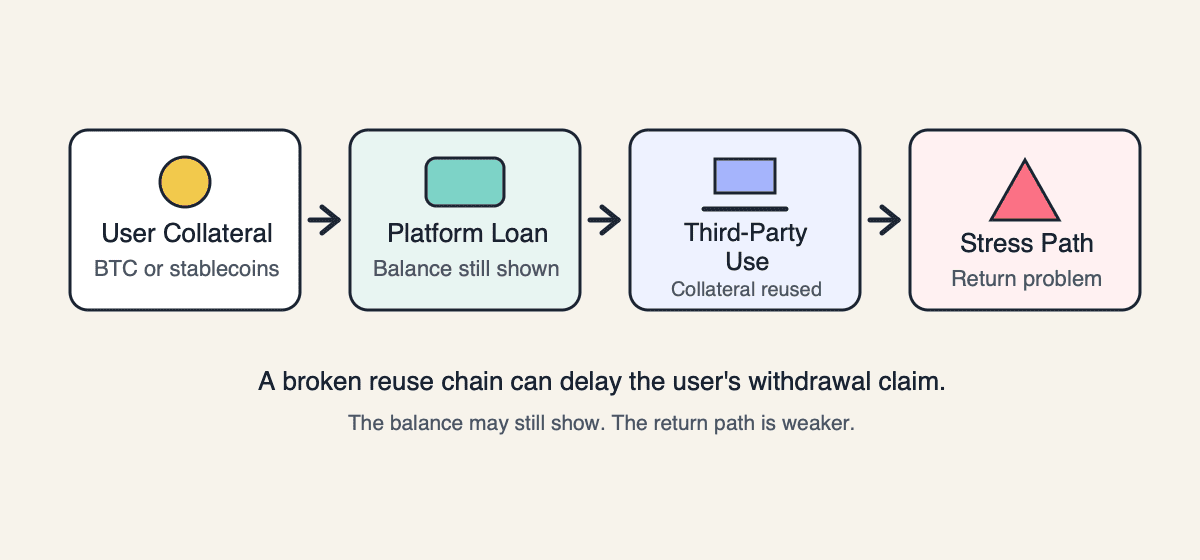
Hypothecation is the first step. You pledge collateral, but you still own the asset unless the agreement says otherwise. Rehypothecation adds the second step: the party holding that collateral uses it again. It might lend the collateral to another desk, post it elsewhere, or use it to support its own borrowing. Now one asset sits under more than one promise, and the chain usually has four moving parts:
The tension starts with that mismatch. A user may think, “My bitcoin is just locked for my loan.” The platform may think, “This collateral can fund another activity because the terms allow it.” Both views can exist until withdrawals, defaults, or margin stress force everyone to ask who actually gets the asset back first.
Read the term narrowly. Rehypothecation means collateral reuse. Ordinary custody, outright theft, and sloppy recordkeeping are different problems. The damage starts when users do not know reuse is happening, cannot measure the chain of claims, or find the fine print only after the exit door gets crowded.
Rehypothecation works by turning deposited collateral into a funding tool for someone else. The asset starts as a user’s pledge, then becomes part of a second transaction controlled by the platform or another counterparty.
Imagine you borrow stablecoins against BTC. The lender holds your BTC and gives you a loan. If the agreement allows reuse, the lender can move that BTC into another arrangement while still owing you the right to get collateral back after repayment.
The risk chain can look simple at first:
The screen balance can stay tidy through most of that process. The unsettling part sits in the operating model, not the price chart.
Now add timing. You may expect instant collateral return after repaying a loan. The platform may be waiting for another party to return the same asset or enough equivalent value. If the third party delays, defaults, or faces its own withdrawal pressure, the original user becomes exposed to a problem they never saw. The asset is the same. The promises around it have multiplied.
Rehypothecation shows up anywhere crypto collateral is controlled by a party that may reuse it. The highest-risk zones are crypto lending, margin systems, yield accounts, and products where the user gives up direct control of assets for borrowing, convenience, or return.
CeFi lenders are the clearest case. A Bitcoin-backed loan may sound simple: deposit BTC, borrow dollars or stablecoins, repay, retrieve BTC. But the safety of that flow depends on custody terms, collateral title, loan-to-value limits, liquidation rules, and whether the lender can use the BTC while the loan is open. Use this quick split before depositing:
| Where It Appears | What To Check |
|---|---|
| CeFi lending | Can the lender reuse collateral, and who holds it? |
| Exchange margin | Are account assets pledged, lent, or pooled under margin terms? |
| Yield accounts | What creates the yield, and can withdrawals pause? |
| DeFi lending pools | Are borrowing rules visible onchain, and what can liquidate? |
| Wrapped assets | Who controls the backing asset and redemption path? |
| Bitcoin-backed loans | Does “no rehypothecation” appear in the actual agreement? |
Yield products can carry similar exposure. If a platform pays yield because it lends deposits onward, runs a trading strategy, or routes assets through third parties, users need to know who has the asset and what claim they hold. In that setting, crypto farming can blur into broader collateral and strategy risk. The advertised return may be the easy part to read. The asset-control map is usually harder.
DeFi changes the shape of the problem. A lending protocol may show collateral, borrowing, rates, and liquidation rules onchain. That transparency is useful. It does not make the risk vanish. Smart contracts, oracle prices, collateral factors, liquidity depth, and admin controls can still decide whether a position survives stress. Restaking and wrapped-asset designs can also feel like rehypothecation because one base asset supports several layers of claims or rewards. They are not always the same legal mechanism, but they raise the same user question: how many promises depend on the same asset?
Rehypothecation risk can freeze withdrawals because the platform may not have immediate control of the collateral users expect back. It may have lent, pledged, or routed the asset into another obligation that must clear first.
The painful part is that nothing has to look broken at the start. Your account may show a balance. The platform may show a normal dashboard. Then a borrower defaults, a trading desk gets squeezed, a liquidity provider pulls back, or too many users ask for assets at once. If the platform cannot retrieve reused collateral quickly, users become one claim among many claims. Watch for signals that a reuse chain may be getting thin:
Withdrawal stress is where rehypothecation risk starts to resemble exit liquidity. Users who thought they had a direct claim can become the last group trying to leave a crowded trade. The asset may still exist somewhere, but the route back to the user is no longer simple.
Insolvency makes the problem harsher. If the platform fails, the user may need to rely on legal priority, contract wording, custody records, and asset segregation. A neat balance page does not decide access. The contract and custody structure do. The real failure mode is simple: the asset has been promised into a second place, and the original user needs it back first.
Rehypothecation is often confused with nearby terms because all of them involve assets someone else controls. Each term creates a different kind of claim.
Hypothecation starts when you pledge collateral for your own borrowing. Custody means someone holds assets for safekeeping or account access. Commingling means assets are pooled together instead of kept clearly separate. Rehypothecation is the specific reuse of collateral that was already pledged. The split looks like this:
| Term | Plain Meaning |
|---|---|
| Hypothecation | You pledge collateral for your own loan or margin account. |
| Rehypothecation | The holder reuses that pledged collateral for another obligation. |
| Custody | A party holds assets or controls access for a user. |
| Segregated Custody | Assets are tracked and separated from platform property. |
| Commingling | Customer assets are pooled or mixed in a way that can blur claims. |
| Unauthorized Misuse | Assets are used outside the rights granted by users or law. |
Commingling can make rehypothecation harder to spot, but the words do different jobs. A platform could pool assets without reusing pledged collateral. A platform could also reuse collateral while still tracking records carefully. The user risk changes with the legal rights and operational controls.
The distinction keeps the term useful. Rehypothecation is about reuse. Commingling is about mixing. Custody is about control. Unauthorized misuse is a different and more severe problem. When you read a lending agreement, do not stop at the product label. Look for words such as pledge, lend, transfer, grant security interest, omnibus account, rehypothecate, reuse, or title transfer.
Rehypothecation rules can protect certain customers in regulated brokerage settings, but legality does not make every crypto product safe. The protection depends on the asset, account type, jurisdiction, platform type, and contract.
In traditional U.S. securities brokerage, customer protection rules draw lines around fully paid securities, excess margin securities, and reserve calculations. The current eCFR Rule 15c3-3 text shows how mechanical that protection is.
Broker-dealers with average total credits of at least $500 million must calculate customer reserve requirements daily. The linked reserve formula also includes a 140% margin-collateral calculation for specified securities in margin accounts.
Crypto users need to keep that gap visible. A lender, offshore exchange, DeFi protocol, wallet app, or informal borrowing desk may sit under different rules. Start with a few plain checks:
“Allowed” and “safe” are not twins. Rehypothecation may reduce funding costs or support market activity, but the user still needs to know whether collateral can leave the original account structure.
For crypto users, the best protection is not memorizing one rule number. It is matching the product to the control structure. If you want custody, check whether assets are segregated and cannot be lent. If you want a loan, check whether the collateral can be reused. If you want yield, ask what activity pays for it.
Spot rehypothecation before you deposit by reading the actual agreement, not the sales page. Marketing phrases like “secure custody” and “institutional-grade” do not answer whether your collateral can be reused.
Start with the asset-use clause. Look for whether the platform can pledge, lend, transfer, borrow against, or otherwise use your crypto. If the wording grants broad rights, assume the platform has room to move assets unless another clause clearly limits it. Use this checklist before serious deposits:
| Check | What It Reveals |
|---|---|
| Asset-use rights | Shows whether collateral can be pledged, lent, or transferred. |
| Custody account name | Reveals whether assets sit with the user, platform, or custodian. |
| Segregation wording | Helps separate customer assets from platform property. |
| Omnibus wallet terms | Pooled wallets can make claim tracking harder. |
| Proof of reserves scope | Assets alone do not show liabilities or reuse rights. |
| Withdrawal gates | Terms may allow pauses during stress or reviews. |
| Insolvency treatment | Recovery depends on the user’s legal claim. |
| “No rehypothecation” clause | The promise should appear in the binding agreement. |
Then check custody. A promise of “no rehypothecation” is stronger when assets are held with a named custodian, segregated from platform property, and excluded from lending or trading activity. It is weaker when assets sit in an omnibus wallet and the agreement gives the platform wide discretion. Proof of reserves may show assets at one point in time, but it may not show every liability, lien, customer claim, or reuse right.
If you do not need borrowing or yield, direct custody may be cleaner. CryptoProcent’s crypto wallets category is the better next stop when the real question is how to hold assets without giving a lender or venue control. For a loan, ask the direct question in writing: “Can my collateral be rehypothecated, lent, pledged, transferred, or used to secure another obligation?” If the answer is vague, you have your answer.
Rehypothecation is a trade-off when collateral reuse lowers borrowing costs, improves market liquidity, or helps a platform offer services users actually want. The danger comes from hidden reuse, weak disclosure, and poor failure priority.
In traditional collateral markets, reuse can make financing cheaper because assets do more work. In crypto, the same idea can support loans, margin activity, or yield products. A platform that can reuse collateral may charge less, pay more, or run a more active lending book.
The trade can make sense only when the user understands it. Limited exposure may be acceptable when several controls line up:
The worst version is silent risk with cheerful yield. Users get the downside of collateral reuse without knowing what price they were paid for accepting it. That is not risk sharing. It is risk discovery after the fact.
A reuse offer needs four plain checks: visible, priced, limited, and recoverable. Visible means the agreement says reuse is allowed. Priced means the user gets a better rate or return for accepting it. Limited means the platform cannot reuse everything everywhere. Recoverable means the return path still works under stress.
If the platform cannot answer these checks in plain language, the lower loan rate may be doing the oldest finance trick in the book: moving the cost somewhere users notice too late.
Rehypothecation examples help because the abstract phrase is painfully dry. The pattern is easier to see when the same asset supports more than one claim.
In a traditional margin account, a broker may have rights over securities that secure a customer’s borrowing. The customer gets margin access. The broker gets collateral rights under the account agreement. Rules and limits decide what can be reused and what must remain protected. A crypto loan creates a more familiar version: you post BTC, borrow stablecoins, and carry extra risk if the lender can reuse the asset before you repay. Here is the simple test:
Now consider a crypto platform failure. Users may point to FTX in conversations about rehypothecation because it made customer-asset misuse and commingling impossible to ignore. But FTX is not a clean textbook rehypothecation example. It belongs nearby as a warning about custody rights, internal controls, and claims on customer property.
Keep the distinction clear because the fix is different. A hard rug is deliberate theft or a designed exit. Rehypothecation can be legal collateral reuse that still creates ugly user outcomes. Both can freeze users out. They are not the same mechanism. Most real failures are messy, so the pre-deposit checklist does more work than the label on the homepage.
Start with rehypothecation risk by deciding whether you actually need to give up control of the asset. Borrowing, margin, and yield can be useful, but each one turns clean ownership into a claim with terms attached.
For long-term holdings, self-custody may be the cleaner route. For borrowing, keep loan-to-value conservative and read the agreement before thinking about rate. For yield, ask what activity pays the return and who can touch the asset.
Use the next actions to keep the chain of claims small:
Full port thinking becomes dangerous in this exact spot. Borrowing against the whole bag may feel efficient while prices are calm. It becomes brittle when collateral value falls, withdrawals slow, or a platform needs time to unwind reused assets.
Also separate product promises. Custody should answer who controls the asset. Borrowing should answer what happens to collateral. Yield should answer who pays the return and why. When one product tries to answer all three, read slowly.
The useful habit is boring: split custody from borrowing, split borrowing from yield, and size every claim so one frozen platform does not decide your whole portfolio. Rehypothecation risk is manageable only when the chain of claims is small enough to survive being wrong.
Rehypothecation means a platform reuses collateral that someone already pledged. In crypto, that can mean your posted BTC, ETH, or stablecoins support another loan, trade, or funding arrangement while you still expect the asset back.
The simple image is one asset with several claims on it. That can work while everyone performs. It becomes dangerous when one party in the chain cannot return the asset on time.
Rehypothecation can be legal in some settings when the agreement allows it, but crypto rules vary by product and jurisdiction. A regulated broker, offshore lender, exchange margin account, and DeFi protocol can all sit under different rules.
Do not rely on the word “legal” as a safety test. The useful question is whether the agreement allows reuse, whether assets are segregated, and what claim you have if the platform fails.
Rehypothecation is not the same as commingling. Rehypothecation means reused pledged collateral. Commingling means customer assets are pooled or mixed in a way that can blur ownership and claims.
The two risks can overlap. Pooled wallets and weak records can make collateral reuse harder to track. But the terms describe different problems, so keep them separate when reading platform terms.
Rehypothecation can happen around DeFi when collateral, receipt tokens, wrapped assets, or lending positions are reused across several layers. The mechanics are often more visible than in CeFi because balances and smart contracts may be inspectable onchain.
Visibility does not mean safety. DeFi users still need to check collateral factors, liquidation rules, contract controls, oracle risk, liquidity depth, and whether one asset now supports several promises.
FTX is better understood as a broader customer-asset misuse and commingling case than as a clean textbook rehypothecation example. It is relevant because it showed how custody terms, asset segregation, and internal controls decide who can recover assets.
Use FTX as a cautionary comparison, not as the definition. Rehypothecation is specifically collateral reuse. FTX-adjacent discussions include wider failures around customer property and platform control.
You can reduce rehypothecation risk by keeping long-term assets in self-custody, avoiding vague yield products, and using lenders that clearly prohibit collateral reuse in the binding agreement.
Also keep loan sizes conservative, avoid one-platform concentration, and test withdrawals early. The best time to learn a platform’s exit process is before everyone else is trying to use it.