Physical Address
304 North Cardinal St.
Dorchester Center, MA 02124
Physical Address
304 North Cardinal St.
Dorchester Center, MA 02124


A plain-English guide to Ethereum ephemeral blobs and L2 fee tradeoffs.
An ephemeral blob is temporary Ethereum data used mainly by rollups. It stays available long enough for checks, but ordinary nodes do not store it forever.
The word “ephemeral” can make the data sound flimsy. It is not. In Ethereum scaling, temporary data is a feature. Rollups need public availability for a limited verification window, not permanent storage of every byte by every ordinary node.
Most users meet ephemeral blobs indirectly. They show up behind Layer 2 fee quotes, blob gas charts, Dencun upgrade commentary, and ETH value-capture debates. This is infrastructure language, not a coin, wallet product, or secret storage trick.
An ephemeral blob in crypto is temporary blob data attached to an Ethereum blob-carrying transaction. Rollups use it to publish transaction data more cheaply. The phrase appears around EIP-4844, Dencun, proto-danksharding, blob gas, and Ethereum Layer 2 scaling.
The key word is “temporary.” Ethereum makes the blob data available long enough for rollup checks, then ordinary nodes are not expected to store the full blob forever. The commitment to the data stays in the on-chain record, but the large data payload does not become permanent calldata.
That split is the point. The blob is temporary, but the transaction still belongs to Ethereum’s record. Rollups get a cheaper public data lane, while ordinary nodes avoid carrying every rollup byte forever.
The term can still feel odd. A normal user may see “blob” and wonder if it is a token. A trader may see it in an ETH thread and wonder if it is a new narrative. A builder may think about blob transactions and KZG commitments.
For most people, the clean version is this:
An ephemeral blob reduces the storage burden of scaling Ethereum with rollups. It lets rollups publish data in a cheaper lane while still giving verifiers time to check what happened. That tradeoff is boring in the best possible way.
An ephemeral blob is temporary because Ethereum only needs the blob data available for a bounded checking period. Rollups need enough time for verifiers, challengers, and infrastructure to inspect the data. They do not need every ordinary Ethereum node to carry the full blob history forever.
Ethereum.org explains that blob data is available for 4096 epochs, roughly 18 days, before ordinary nodes can prune it. That window gives rollups and watchers time to reconstruct or verify state. It also avoids permanent storage of large rollup data loads. The same roadmap frames full Danksharding as an expansion to 64 blobs attached to blocks, the scale-up target behind today’s temporary data lane.
The commitment remains after pruning. Think of it as a permanent receipt tied to temporary public data. The receipt does not reopen the whole package, but it keeps the blob transaction anchored to Ethereum’s record.
Keep that split clear because availability and storage are different promises:
Ephemeral blob data is not private just because ordinary nodes can discard it later. If data is available to the network, other parties can observe, copy, index, and archive it during the window.
That warning applies to demos, tooling, and careless experiments. Do not put private notes, customer details, trading strategy, or sensitive app data in a public blob context and assume pruning makes it vanish. “Temporary” is not a shredder.
Ephemeral blob data can be reliable for the job it was designed to do. The job is bounded data availability, not permanent file hosting.
A rollup only needs the data available long enough for the relevant checks, challenges, or reconstruction work. After that, the rollup, explorers, archives, and indexers may handle longer history. Ethereum does not have to store every rollup byte forever to make the recent batch verifiable.
So do not stop at “why does the data disappear?” Ask whether the system had enough time, tooling, and participants to check it before pruning.
Rollups use ephemeral blobs because they need to publish transaction data without paying the heavier cost of putting every byte into permanent calldata. The user sees an L2 action. The rollup sees a batch, a data-availability requirement, and a fee market for posting that data.
Start with a normal L2 action. You swap, bridge, mint, send funds, or use an app on a rollup. The rollup sequencer orders many actions, batches them, and posts data back to Ethereum through a blob-carrying transaction.
That blob data gives other parties a way to verify or reconstruct what the rollup did. It is visible for the availability window, then ordinary nodes can prune it. The commitment stays, and archive services may keep the full data for history.
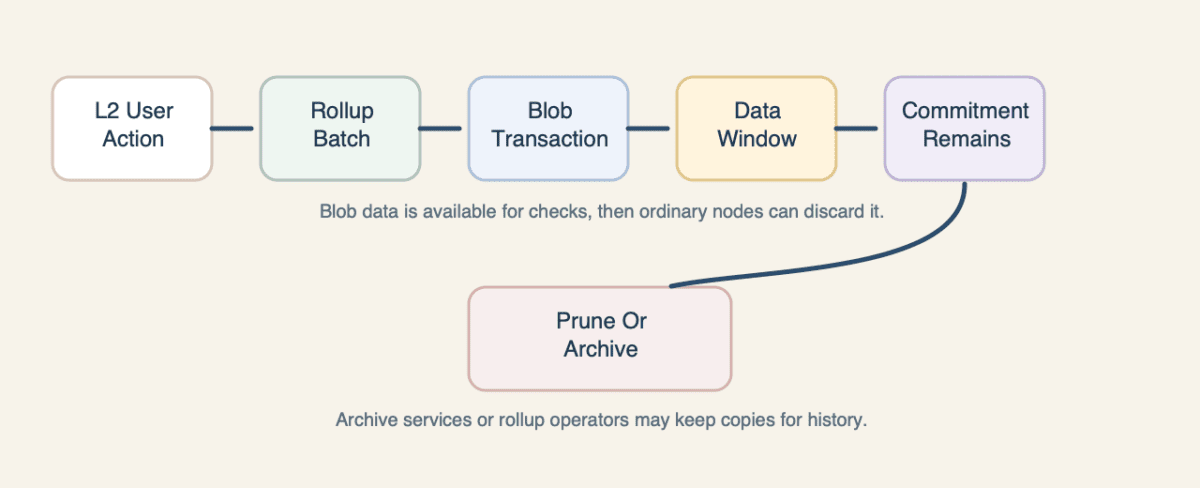
This is the path in plain terms:
Normal users usually do not send ephemeral blobs directly. They experience them through L2 fees, rollup behavior, explorers, and dashboards.
Builders can interact more directly with blob transactions, KZG tooling, RPC support, and blob inspection tools. That is a developer path, not a normal wallet workflow. If a random site asks you to connect a wallet “to try blobs,” slow down and read every prompt before signing.
The user takeaway is simple. Ephemeral blobs can shape the price you pay on an L2, but they are not a button you need to press before every rollup transaction.
An ephemeral blob is the temporary data unit. Calldata is more permanent transaction data on Ethereum’s execution layer. Blobspace is the available capacity for blobs, and blob gas is the separate fee market that prices that capacity.
These terms often travel together, so the confusion is fair. One person says “blob fees are low.” Another says “blobspace is full.” A third asks whether calldata is dead. They may all be talking about different layers of the same rollup cost problem.
Use this table before the jargon turns into soup:
| Term | What It Means Here |
|---|---|
| Ephemeral Blob | Temporary Ethereum blob data used mostly by rollups for data availability. |
| Calldata | Execution-layer transaction data that is stored more permanently than blob data. |
| Blobspace | The limited Ethereum capacity available for blobs. |
| Blob Gas | The separate fee market used to price blob data. |
| KZG Commitment | A compact cryptographic reference tied to blob data. |
| Data Availability | The condition that needed rollup data was published for checks. |
The most important split is EVM access. Smart contracts cannot read blob data like normal calldata. They can access commitments and related transaction information, but the full blob data lives outside normal EVM execution.
So an ephemeral blob is not a cheaper version of every Ethereum transaction field. It is a purpose-built rollup data lane. Calldata still has a role, especially when execution-layer data, permanence, or fallback behavior is required.
An ephemeral blob can lower the data-posting cost behind some L2 transactions. It does not make Ethereum mainnet gas cheap by itself. It also does not erase app fees, bridge costs, sequencer pricing, or liquidity problems.
This is the fee path many users miss. A rollup pays for data availability, execution, settlement, infrastructure, and its own pricing policy. Blob gas affects one important piece of that stack. Your wallet may still show one blended quote.
The cleaner split looks like this:
| What Blobs Can Change | What Blobs Do Not Fix |
|---|---|
| Rollups can post data through blobs instead of relying only on calldata. | Ethereum L1 swaps and contract calls still pay normal execution gas. |
| Blob gas can make rollup data cheaper during loose capacity. | L2 apps, bridges, and routers can still add their own costs. |
| A separate blob fee market can isolate rollup data pressure. | Sequencers still choose batching and pricing policies. |
| Lower data cost can improve some L2 user quotes. | Wallet screens may hide which cost actually changed. |
Blob fees can also spike. If many rollups compete for the same blobspace, the separate blob fee market can get tighter. That does not mean ephemeral blobs failed. It means useful capacity attracted demand.
Do not lock one live blob-fee number into your view. Blob gas, utilization, targets, and limits can change with network demand and Ethereum upgrades. Any current chart needs a capture date.
Before blaming an ephemeral blob for a high fee, ask the right questions:
That checklist keeps one bad wallet quote from becoming a full theory of Ethereum. A rare win for restraint.
Ephemeral blobs affect ETH holders because they change the cost and demand story for rollup-heavy Ethereum activity. They can help L2s publish data more cheaply, which can support more activity. But cheap blobs can also make fee-burn and value-capture debates messier.
The optimistic view is straightforward. If rollups become cheaper to use, more apps and users may settle activity through Ethereum-aligned infrastructure. Ethereum can remain the base layer for settlement and data availability while users spend less per L2 action.
The skeptical view is also real. If blob fees stay very low, some holders ask whether rollups are paying enough back to Ethereum. That is why ETH holder culture can get loud around blob charts, L2 margins, and fee burn.
Ephemeral blob activity can signal several things:
The missing word is “proves.” Blob usage does not prove ETH will rise. Low blob fees do not prove Ethereum is doomed. High blob fees do not prove every L2 is healthy.
A technical metric can become a trading narrative fast. Traders may turn blob fees, rollup revenue, or upgrade timelines into a story before the infrastructure picture has settled. Fine for debate. Weak as a buy button.
For ETH holders, ephemeral blobs are best read as a scaling metric with tradeoffs. Watch usage, fee pressure, rollup adoption, and competing data routes. Do not expect one blob chart to settle the whole ETH thesis.
The biggest ephemeral blob risks are not that blobs are secretly broken. The main risks are overreading what temporary data changes, ignoring L2 assumptions, and turning Ethereum scaling jargon into lazy market confidence.
Temporary data does not remove bridge risk. It does not decentralize a sequencer. It does not fix an upgrade key. It does not make a weak app safe. And it does not make wallet approvals harmless.
> Temporary public data is still public data. Cheap rollup data is still only one layer of the risk stack.
The warning is practical because blobs sit underneath many user-facing systems. A rollup can use Ethereum blobs and still have liquidity fragmentation, withdrawal delays, centralized sequencing, bridge constraints, or app-level contract risk.
Use this risk check:
Ephemeral blobs also do not make user wallets safer. If a site asks for a wallet connection, the usual wallet safety checks still apply. Check the URL, permissions, spending approvals, and transaction preview before signing.
Then there is the trading mistake. Some posts use technical terms to create urgency. “Blobs are cheap” becomes “this L2 trade is obvious.” “Blob demand is rising” becomes “ETH must move now.” That is how infrastructure talk turns into someone else’s rushed exit.
The fix is boring and effective. Separate protocol mechanics from market pressure. Ephemeral blobs help rollups with data availability and cost. They do not guarantee safety, liquidity, privacy, or price direction.
You can check ephemeral blob activity with blob explorers, block explorers, rollup dashboards, and data tools. You do not need to memorize every metric. You need to know which part of the fee and data stack you are looking at.
Blobscan and Blockscout can show blob transactions and related details. Dune dashboards may show blob usage, fee trends, or rollup behavior. Rollup-specific dashboards can add the missing context, such as how much of a user’s fee comes from data posting versus execution or app costs.
Use a simple checklist when looking at ephemeral blob activity:
Live numbers need care. Blob fees, utilization, and target discussions can change with demand and upgrades. A chart from last week may still be useful, but it is not an evergreen law.
Use dashboards as evidence, not prophecy. If blob activity rises, ask which rollups are driving it. If blob fees spike, ask whether demand, capacity, or a temporary event explains it. If fees are low, ask whether that means efficient capacity, weak demand, or both.
Related terms explain why an ephemeral blob works without sending you through every Ethereum acronym ever minted.
EIP-4844 is the Ethereum upgrade proposal that introduced blob-carrying transactions. It created the structure that lets rollups use blobs for cheaper data availability.
Proto-danksharding is the roadmap step that brought blobs before full danksharding. It is a scaling bridge, not the final form of Ethereum data availability.
Blobspace is the capacity available for blobs. If ephemeral blobs are the data packages, blobspace is the limited room they compete for.
Blob gas is the fee market for blob data. It moves separately from normal Ethereum execution gas, which is why L2 and L1 fee stories can diverge.
Calldata is execution-layer transaction data. Rollups used it heavily before blobs, and it still has a role when data needs to sit in the execution layer.
KZG commitments are cryptographic references tied to blob data. You do not need the math to understand the user-facing point: Ethereum can keep a compact commitment without ordinary nodes storing every full blob forever.
Data availability is the broader security condition. It asks whether the data needed to verify a rollup state was actually published for others to check.
Two CryptoProcent concepts are useful once blob talk turns into market behavior:
No. An ephemeral blob is not a crypto token, coin, wallet product, or asset you can buy. It is temporary Ethereum blob data used mainly by rollups for data availability.
Ethereum blobs are called ephemeral because the full blob data is only expected to be available for a limited window. After that, ordinary Ethereum nodes can prune it, while commitments and possible third-party archives remain.
Ethereum’s common blob availability window is 4096 epochs, roughly 18 days. After that, ordinary nodes can prune the full blob data, though rollups, indexers, and archive services may keep copies.
No. Ephemeral blobs are temporary, not private. If blob data is available to the network, observers can copy or archive it before ordinary nodes prune it.
Ephemeral blobs do not directly lower normal Ethereum mainnet execution gas. They can lower rollup data-posting costs, which may reduce some L2 fees when rollups pass those savings through.
No. An ephemeral blob is the temporary data package. Blobspace is the Ethereum capacity available for those blobs, and blob gas is the fee market that prices that capacity.
Start with the plain meaning: an ephemeral blob is temporary Ethereum blob data for rollups. That one sentence prevents most bad takes.
Then use the term as a checklist, not a signal to rush. Ephemeral blobs can explain part of L2 fee behavior, but they do not remove L1 gas, bridge risk, app fees, wallet approvals, or market hype.
The next step depends on what claim you are checking. If someone is talking about lower L2 fees, look for the rollup, route, bridge, and blob gas context. If someone is talking about Ethereum value capture, separate usage from fee burn. If someone is talking about privacy, remember that temporary public data can still be copied.
Use these next steps:
For a normal L2 user, the action is modest. Check the network, inspect the wallet prompt, and compare the fee quote against what the app is actually doing. A cheap blob lane does not make a bridge safe or a contract approval harmless.
For an ETH holder or trader, keep the signal in its lane. Rising blob usage may show rollup demand. Low blob fees may show spare capacity. Neither one gives a complete price thesis by itself.
That is enough for most users. You do not need to become a KZG specialist to understand the tradeoff. Ephemeral blobs make rollup data cheaper to publish for a time, then let ordinary Ethereum nodes move on with their lives.