Physical Address
304 North Cardinal St.
Dorchester Center, MA 02124
Physical Address
304 North Cardinal St.
Dorchester Center, MA 02124


Understand Ether.fi before chasing restaking yield.
Ether.fi is a non-custodial Ethereum liquid staking and liquid restaking protocol. It issues eETH and weETH, and also offers Liquid, Cash, and ETHFI.
In plain English, Ether.fi turns ETH exposure into movable tokens and product routes. That flexibility helps only when users also understand exits, contracts, rewards, and product friction.
Ether.fi is a protocol for ETH holders who want staking exposure without locking every option away. You deposit ETH or a supported ETH-like asset, and the protocol issues liquid tokens tied to the staked position.
Start with the product split. Ether.fi Stake handles staking and restaking routes. ETHFI is the governance and utility token. Cash is a card and spending product. Liquid vaults are automated DeFi strategy products.
For a user, the first question is not “what is the highest yield?” It is “which Ether.fi product am I touching?” Stake, Liquid, Cash, and ETHFI sit beside each other, but they do different jobs.
Each part answers a different user question.
That split keeps the decision clean. Someone may like Ether.fi Stake and ignore Cash. Another person may care about ETHFI and never deposit ETH.
It also keeps risk from blurring. Cash can add account and card checks. Liquid can add strategy risk. ETHFI can move like a market token while the staking product works normally.
A weETH collateral user may learn a harder lesson: “liquid” does not mean “effortless exit.”
Ether.fi Stake pools user deposits, routes them through protocol-managed staking and restaking infrastructure, and gives users liquid token exposure through eETH or weETH.
In the product map, eETH is the token tied to the staked ETH claim. weETH is the wrapped version built for fixed-balance DeFi accounting.
That split changes how wallet balances, rewards, collateral rules, and tax records can look across the two tokens.
Here is the core product map.
| Ether.fi Component | What The Writer Must Explain |
|---|---|
| Stake | ETH enters a managed staking and restaking route. |
| eETH | A rebasing liquid restaking token tied to the staked ETH position. |
| weETH | A wrapped, non-rebasing version that is easier to use in DeFi. |
| ETHFI | Governance and utility token exposure, separate from staked ETH. |
| Liquid | Automated vault routes that deploy assets across DeFi strategies. |
| Cash | Card and spending product with identity, region, and issuer checks. |
Use the table as a product map, not a recommendation. The right route depends on the goal: simple staking exposure, DeFi collateral, automated strategy exposure, card access, or ETHFI token exposure.
Ether.fi Stake is the base route for users who want ETH staking and restaking exposure through the protocol. Users give up the simplicity of plain ETH and receive a liquid token position instead.
That liquid token can sit in a wallet, move through supported markets, or connect to DeFi. But the convenience also means users depend on Ether.fi contracts, validator operations, restaking infrastructure, and the exit route available at the time.
Ether.fi eETH is the rebasing liquid restaking token. A rebasing token changes its balance or accounting to reflect rewards, so the position can look different from a fixed-balance token in some wallets and apps.
For a beginner, eETH is the closer receipt for the staked position. It keeps staking exposure liquid, but it is still a protocol token.
Before exiting, users need to know the route. It may be redemption, a market swap, or another supported process.
Ether.fi weETH is the wrapped version of eETH. It is designed to keep a steadier token balance while the token’s exchange rate handles the reward accounting.
That can make weETH easier for many DeFi integrations. It can also make risk easier to underestimate.
If weETH is used as collateral, users must track oracle pricing, lending-market rules, liquidation thresholds, liquidity depth, and the unwind route.
The flow is easier to read when the tokens sit beside the products.
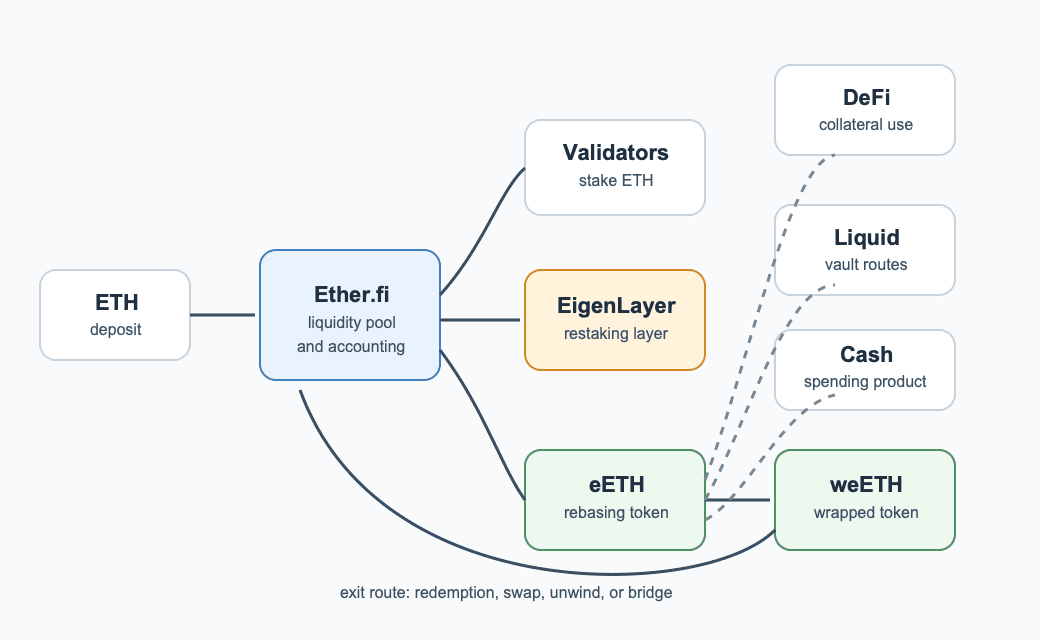
So the useful takeaway is simple. eETH and weETH can keep ETH exposure movable. Users still need to check liquidity, approvals, routes, and risk.
Ether.fi changes the ETH staking tradeoff from “hold or stake” into a menu of liquidity, restaking, DeFi, and token choices.
That menu can help when liquidity matters. Solo staking gives high control, but it needs operational work and enough ETH to run a validator cleanly. Exchange staking is easier, but platform custody becomes the main tradeoff.
Liquid staking adds a transferable token. Liquid restaking adds another reward layer and another set of dependencies.
The right route also depends on how often the user expects to move assets. A long-term ETH holder may prefer fewer moving parts. A DeFi user may accept more integrations because the token can be used elsewhere. A trader may only care that ETHFI reacts to restaking narratives.
> Restaking attention can rise and fade with market rotation. A hot category can make every liquid restaking token look obvious, until yield compresses and incentives change.
| Route | Main Tradeoff |
|---|---|
| Holding ETH | Cleanest exposure, but no staking rewards. |
| Solo staking | More control, but more setup and operational burden. |
| Exchange staking | Easier access, but custody and platform risk dominate. |
| Liquid staking | Movable receipt token, plus contract and liquidity risk. |
| Liquid restaking | Extra reward routes, plus restaking and integration risk. |
| Buying ETHFI | Token-market exposure, not direct staked ETH exposure. |
None of these routes removes risk. They move it. Ether.fi can be a useful middle ground when liquidity and composability are worth the extra checks.
It fits poorly when the goal is quiet ETH exposure with the fewest possible dependencies. In that case, the product menu may be more complexity than the user needs.
Ether.fi exposure can lose money, trade at a discount, or become harder to exit than the word “liquid” suggests.
That does not make Ether.fi uniquely dangerous. It means the risk sits in layers.
Users trade some exchange-custody risk for smart-contract, validator, restaking, market, wallet, and integration risk.
> If your exit depends on five systems working at once, test the exit before you size the entry.
The major checks are practical, not philosophical.
| Risk | What To Check |
|---|---|
| Smart contracts | Which contracts hold or route the assets. |
| Validator performance | How staking rewards and penalties affect the position. |
| Restaking exposure | Whether extra services add penalty or failure risk. |
| eETH or weETH depeg | Whether market price differs from expected ETH value. |
| Withdrawal queues | Whether redemption is immediate, queued, or market-based. |
| Secondary liquidity | Whether a swap can handle your position size. |
| Bridges and chains | Whether the token route depends on a bridge or L2. |
| Collateral use | Whether liquidation can hit before you unwind. |
| Wallet approvals | Whether old permissions can still touch assets. |
| Cash limits | Whether card access depends on issuer, KYC, or region rules. |
The clearest danger is exit confusion. A user may expect an instant exit, then learn that direct withdrawal, DEX liquidity, bridge support, and lending-market unwind rules are separate things.
That is where exit liquidity stops being meme language and becomes wallet math.
Sizing is part of the same risk. Going full port into a stacked yield route can turn a small operational issue into a portfolio problem.
If a position uses weETH as collateral, a depeg or oracle move can hit before the underlying protocol has actually failed.
Ether.fi rewards are not one magic APY. They can come from staking, restaking, incentives, vault strategies, token programs, card rewards, or market speculation.
Blending those sources is how yield pitches get messy. Ethereum staking rewards are not restaking rewards. Protocol points are not cash income. ETHFI token benefits are not ETH yield.
Separate the buckets before judging the route.
Ask what pays the reward, what token receives it, and whether the route requires holding, staking, locking, spending, or taking vault risk. The same headline number can describe very different economics.
| Reward Source | What To Know |
|---|---|
| Ethereum staking rewards | Base reward exposure from ETH validator activity. |
| Restaking rewards | Extra exposure tied to services beyond normal staking. |
| Protocol points | Incentives that may or may not become valuable. |
| Liquid vault yield | Strategy return from automated DeFi positions. |
| ETHFI staking benefits | Token-program benefits that can change. |
| Cash rewards | Card or membership rewards with terms and availability checks. |
| Buyback claims | Tokenholder narrative that needs official verification. |
This is where Ether.fi gets more complicated than ordinary staking. A user might be staking ETH, holding weETH, earning points, using Liquid, and watching ETHFI headlines at the same time.
That mix needs a simple ledger. Base staking rewards are one bucket. Restaking rewards are another. Points, card rewards, and token programs should sit in their own rows until the user can explain how each one is earned and exited.
At that point, the position starts to look more like the crypto meaning of farm than passive staking. Farming is fine when users know the rules. Trouble starts when temporary incentives get mistaken for durable yield.
ETHFI is the governance and utility token connected to Ether.fi, but it is not the same exposure as eETH, weETH, or staked ETH.
ETHFI sits in the governance, staked-token benefits, membership, rewards, and protocol-value bucket. Those features can be useful. They still belong in the token bucket.
Before looking at an ETHFI chart, split utility from speculation.
For a token buyer, the clean check is whether the benefit is current, documented, and worth the market risk. If the answer depends on a future program, a future buyback, or a future wave of attention, it belongs in speculation.
The hardest part is psychological. Ether.fi can grow as a protocol while ETHFI trades poorly. ETHFI can also run on a restaking narrative before product value catches up.
That is how a strong story can still leave a late buyer as a bagholder.
ETHFI can also behave like a narrative coin when liquid restaking, onchain finance, or token buyback themes are hot. A narrative can help liquidity and attention. It cannot create durable demand by itself.
Ether.fi Liquid vaults and Cash show that Ether.fi is no longer only a staking interface. Liquid adds automated DeFi strategy exposure. Cash adds a card and spending route.
Liquid is for users who want a managed strategy instead of manually moving assets through protocols. That can reduce daily clicking, but it does not remove DeFi risk.
Strategy selection, liquidity, fees, rebalancing, and withdrawal timing still matter.
Check the product before treating either one as a default next step.
| Product | What To Verify First |
|---|---|
| Liquid vaults | Assets supported, strategy exposure, fees, APY changes, and withdrawal timing. |
| Cash | KYC status, region support, issuer rules, card limits, and tax records. |
Cash is different because it pushes the Ether.fi account toward spending, membership, card limits, collateral, and payment-network rules. Ether.fi Help Center states that identity verification is required to use the Cash card and fiat services.
Its KYC flow lists five checks: phone verification, identity document, selfie verification, personal information, and a possible issuer questionnaire.
Cash can be useful if the user’s goal is spending or collateral-backed access. It can be irrelevant if the user only wants ETH staking exposure.
Liquid can be useful if the user wants automation. It can be a poor fit if the user cannot explain which strategy holds the assets, how it exits, or what happens when liquidity thins.
The best Ether.fi check happens before the deposit. Verify the product, token, chain, and exit route while the position is still small.
Start with the boring controls. They are cheaper than learning under pressure.
The small test is not a formality. It shows which token arrives, whether wallet labels make sense, and whether the app route matches the plan.
If anything feels unclear at tiny size, bigger size will not make it clearer. Pause before adding collateral, bridges, lending markets, or card use.
Wallet hygiene deserves its own line. A fake front end can beat a careful investor before protocol risk even enters the room. CryptoProcent’s wallet safety coverage is more useful here than a random yield comparison.
Also watch for fake claims, fake support accounts, and malicious airdrop links. A fast hard rug does not need the real Ether.fi protocol to fail. It only needs one rushed signature.
Ether.fi becomes easier to understand when its neighboring concepts are separated. The protocol touches staking, restaking, DeFi collateral, payments, token governance, and wallet safety. Those are not interchangeable.
Keep these nearby ideas separate.
The map also prevents category drift. A staking route is judged by rewards, exits, validator operations, and token liquidity. A Cash route is judged by account access, identity checks, issuer rules, and spending records.
Work through that map in reverse before taking action. If the goal is simple ETH staking, Cash and ETHFI may be noise.
If the goal is DeFi collateral, the weETH unwind path and lending-market rules should come before any reward headline.
If the goal is ETHFI exposure, the staking token mechanics do not answer the whole investment case. Token demand, utility programs, liquidity, and market narrative can pull in different directions.
The same logic works for risk review. Ask which product you are touching, which token you will hold, which contract or issuer sits in the middle, and which route gets you out.
That separation keeps the decision useful. Ether.fi is not one bet. It is a set of routes, and each route asks a different risk question.
Start with the Ether.fi route that matches your actual goal. The highest quoted reward should come later, after the route and exit path are clear.
A clean starting path looks like this.
If the thesis becomes a real conviction play, write down why. If the reason is only “yield looks good,” the position probably needs more research and less swagger.
Then run one small lifecycle check. Deposit or receive a tiny amount, confirm how rewards appear, find the exit route, and make sure records are easy to follow.
Keep that first run boring on purpose. Use it to read the wallet prompts, balances, route labels, and records before adding lending, bridges, or card use.
That checklist sounds dull because it is supposed to. Expensive mistakes usually come from skipping the boring step and learning the product only after the position is already large.
Ether.fi can be a useful route for ETH holders who understand the stack. It becomes much harder to evaluate when staking, restaking, vault yield, card perks, and token speculation get blended into one shiny number.
Ether.fi is a liquid staking and liquid restaking protocol for Ethereum. It lets users deposit ETH exposure and receive liquid tokens such as eETH or weETH, while also offering products such as Liquid vaults, Cash, and ETHFI.
Ether.fi is not risk-free. The main risks include smart contracts, validator performance, restaking dependencies, eETH or weETH depeg risk, withdrawal timing, secondary liquidity, wallet approvals, bridges, and any DeFi venue where the tokens are used.
No. Ether.fi is the protocol and product suite, while ETHFI is the related governance and utility token. Buying ETHFI gives token-market exposure, not the same exposure as staking ETH or holding eETH or weETH.
Ether.fi eETH is the rebasing liquid restaking token, while weETH is the wrapped version designed for steadier balance accounting. weETH is often easier to use in DeFi, but collateral use adds liquidation and liquidity risk.
Ether.fi exits may be fast in some routes, but they are not always guaranteed to be instant. A user may rely on protocol redemption, a queued withdrawal, a market swap, a bridge route, or a DeFi unwind.
Yes. Ether.fi Cash and fiat services require identity verification. Users should also check region availability, issuer rules, spending limits, app access, and tax records before relying on Cash as a spending route.