Physical Address
304 North Cardinal St.
Dorchester Center, MA 02124
Physical Address
304 North Cardinal St.
Dorchester Center, MA 02124


A plain-English guide to liquidity fragmentation and hidden trade costs.
Liquidity fragmentation is when buyers, sellers, and usable market depth are split across many exchanges, chains, pools, and token versions.
That split can make crypto look more liquid than it feels. A token may have active markets in total, but your exact trade can still hit a thin pool, a wider spread, a bridge delay, or the wrong token version.
Liquidity fragmentation in crypto means the market for the same asset or exposure is split into separate places that do not share one pool of depth. You might see a token trading on Binance, Coinbase, Uniswap, Base, Arbitrum, Solana, and a bridge route, yet only one of those routes may handle your trade size well.
That is the beginner trap. More places to trade does not always mean more usable liquidity for your route.
Picture a simple swap. The CEX quote looks tight, but your funds are on-chain. The DEX pool on your current chain is thin. A deeper pool sits on another chain, but reaching it needs a bridge, a delay, and a different token version.
The market is not dead. It is scattered.
That scatter turns a price check into a route check. You need to know where the depth sits, whether you can reach it, and what the route costs before the quote expires.
Keep the phrase practical:
The useful takeaway is simple. Liquidity fragmentation is not just “low liquidity.” It is liquidity in the wrong place, wrong format, or wrong route for the trade you want to make.
Crypto liquidity fragmentation happens because crypto does not have one market center. It has exchanges, DEXs, L1s, L2s, app chains, bridges, stablecoin issuers, pool designs, and wallet access rules all pulling depth into separate buckets.
That structure gives users choice. It also makes execution messier than a single order book.
Venue fragmentation starts when the same asset trades on separate centralized exchanges, OTC desks, and DEXs. Binance, Coinbase, Kraken, and on-chain pools can all show different depth because each venue has its own users, market makers, fees, custody rules, and withdrawal limits.
A CEX can make trading feel cleaner because orders meet inside one venue. But that does not mean the whole crypto market is unified. It means that venue has its own internal depth, and you accept its custody, KYC, withdrawal, and access tradeoffs.
Chain fragmentation appears when assets and users spread across Ethereum, Base, Arbitrum, Optimism, Solana, Polygon, Avalanche, and other networks. Lower fees on an L2 can help, but cheap gas does not create deep liquidity by itself.
A pool on Base and a pool on Arbitrum may both trade the same economic exposure. Unless a route can connect them well, each pool still has its own depth and price impact.
Pool fragmentation can happen even inside one DEX. Liquidity can split across pool types, fee tiers, hooks, or versions of the same trading pair.
In DEX market-structure research, Lehar, Parlour, and Zoican show how liquidity can divide across Uniswap fee tiers when transaction costs and trader behavior differ. The plain-English version is less scary than the model: LPs do not always choose the same bucket, so traders may not get one deep pool.
Token-version fragmentation is where beginners often get ambushed. Native USDC, bridged USDC, wrapped BTC, synthetic assets, and chain-specific versions can look similar in a wallet while trading through different pools and carrying different risks.
That version mismatch can turn a normal swap into a routing problem. The token ticker may be familiar, but the exit route, bridge backing, and destination depth can be very different.
So fragmentation is not one failure. It is the combined result of crypto’s modular design, venue competition, chain growth, and user choice. Useful, yes. Free lunch, absolutely not.
Liquidity fragmentation changes trade cost by making the best visible price only one part of the answer. A route can look cheap before spread, slippage, gas, bridge fees, price impact, MEV, delay, and settlement risk get counted.
Total execution cost gives the cleaner read. It asks what the trade costs by the time you receive the asset, can move it, and can exit again.
Here is the cost map to keep in mind:
| Cost Or Risk | What Liquidity Fragmentation Can Change |
|---|---|
| Bid-ask spread | Separate venues can quote different prices and wider spreads. |
| Slippage | Thin pools can move against the trade size. |
| Price impact | A trade can push one route harder than the broader market. |
| Gas and route fees | Cheaper networks can still require extra hops. |
| Bridge delay | Waiting can expose the trade to price movement. |
| MEV or ordering risk | On-chain routes can be reordered or sandwiched. |
| Settlement uncertainty | A route can depend on bridge, venue, or chain assumptions. |
This is why high TVL can disappoint. TVL may sit in the wrong asset, wrong pool, wrong chain, or wrong incentive program for the trade in front of you.
A token can be easy to buy and painful to sell. That is where exit liquidity becomes part of the real risk, especially when everyone finds the same narrow doorway at once.
Thin venues also change behavior. Traders compete harder for the same usable depth, and the route can start to feel like PVP rather than a calm market. That does not mean every trade is adversarial. It means bad routes make the market less forgiving.
A simple check helps. Compare the quoted output with the expected output after all fees and route assumptions. If the number only looks good before the bridge, gas, delay, or slippage setting, the route is selling you a prettier story than it can settle.
Liquidity fragmentation across CEXs, DEXs, L2s, and stablecoins can happen at several layers at once. The fastest way to diagnose the problem is to ask which layer is actually thin for your trade.
Do not blame “crypto” as one market. Check the venue, chain, protocol, pool, token version, and access route separately.
CEX order books can concentrate liquidity inside one venue. That helps when you can trade there, the asset is listed, withdrawals work, and the venue has enough depth near the current price.
But CEX liquidity is still venue-specific. A deep Binance book does not automatically help if you must trade through a smaller exchange, a restricted region, or a wallet route. Custody and access are part of the cost.
DEX pools keep execution on-chain, but each pool has its own inventory and pricing curve. Uniswap, Curve, Aerodrome, Raydium, Orca, and smaller protocols do not merge depth just because they list similar pairs.
Fee tiers and pool designs can split depth further. A stable pair may concentrate in one pool, while a volatile pair may spread across several pools because LPs want different fees or risk exposure.
L2 and app-chain pools can make transactions cheaper and faster. They can also create more places where liquidity has to be supplied, incentivized, monitored, and exited.
That tradeoff is easy to miss. A low-fee L2 route can still be worse if the pool is thin, the bridge is slow, or the best depth lives somewhere else.
Stablecoins make fragmentation concrete. Native USDC on one chain, bridged USDC on another, and a wrapped version inside a protocol may not share the same redemption path or pool depth.
Wrapped BTC and synthetic assets create similar questions. The exposure may track the same asset, but the wrapper, custodian, bridge, and pool can all change the route’s risk.
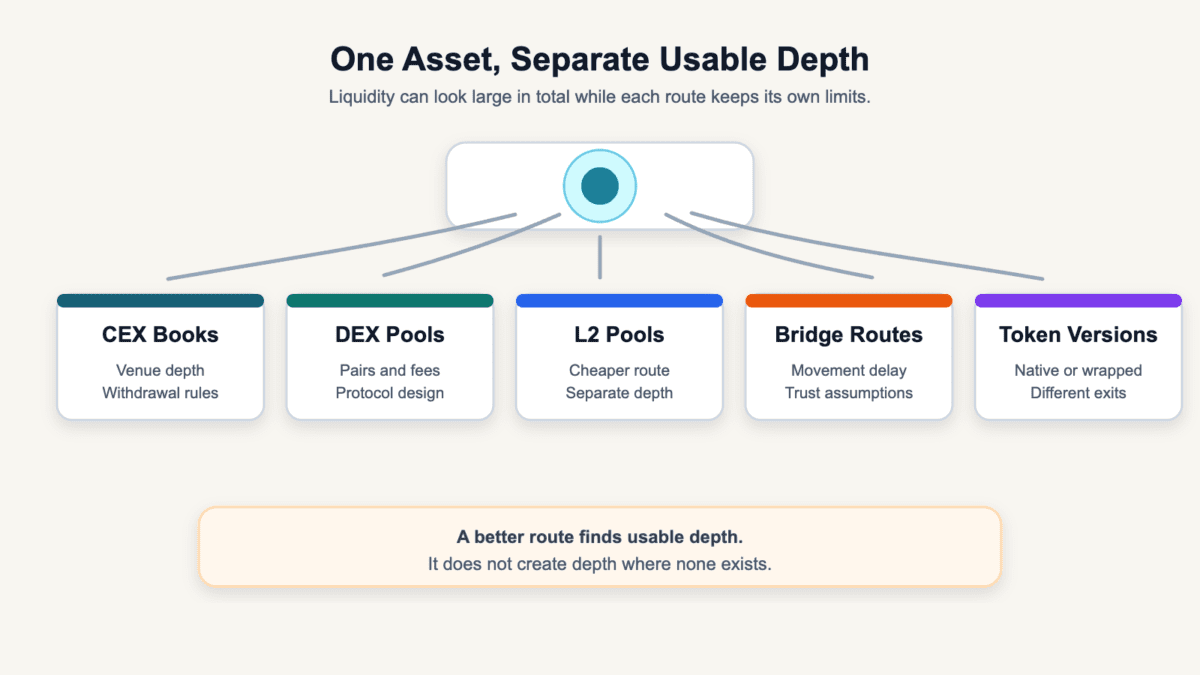
The practical habit is to name the layer before acting. If the problem is a thin DEX pool, a bridge will not magically create depth. If the problem is a wrapped token version, a better-looking ticker may still leave you holding the wrong claim.
Bridges and aggregators reduce liquidity fragmentation pain, but they do not erase the underlying split. They can help users move value, discover routes, or outsource execution, yet every route still depends on available depth and acceptable risk.
That distinction is the trap. You see one button. The market may see five pools, two chains, a bridge, and a quote that expires before the route settles.
Compare the common tools this way:
| Tool | What It Fixes And What Remains |
|---|---|
| Bridge | Moves value or messages, but destination depth still matters. |
| DEX aggregator | Finds better available routes, but cannot create missing depth. |
| CEX order book | Internalizes venue liquidity, but adds custody and access tradeoffs. |
| Smart order routing | Splits orders across routes, but still pays route costs. |
| Intent-based execution | Lets solvers compete for execution, but depends on solver quality. |
| Shared liquidity layer | Aims to pool depth, but adds design and trust assumptions. |
A bridge is not a liquidity machine. It can move assets from one chain to another, but the destination still needs buyers, sellers, pool inventory, and a clean exit path.
A DEX aggregator is closer to a map. It can search routes across pools and split a swap into better pieces. But the map cannot add depth to a road that is already narrow.
Intent-based execution changes the trade experience. Instead of choosing every route step, you state the desired outcome and solvers compete to fill it. That can reduce route friction, but it raises fresh questions about solver competition, transparency, failed fills, and who captures the spread.
So ask the sharper question: which part of the route does this tool improve, and what risk remains after that improvement?
Spotting liquidity fragmentation before a trade means checking the route, not just the token. You want to know whether your exact trade size can enter and exit through the route you plan to use.
Start with the quote, then interrogate it a little. A quote is a promise with a timer attached.
Use these checks before meaningful size:
“Meaningful size” depends on the wallet. For a small test swap, one aggregator quote may be enough. For a treasury move, a large exit, or a yield rotation, compare a CEX quote, a DEX route, and an aggregator route before treating the first screen as truth.
TVL and volume need context. TVL can sit in unrelated pools. Volume can come from incentives, wash-like churn, or one venue that you cannot access. The useful question is narrower: how much depth sits near the current price for your trade size?
Also check concentration. A full port into one thin venue, one bridge route, or one wrapped version can turn a routing inconvenience into a portfolio problem. Fragmentation hurts more when every exit runs through the same narrow path.
Here is a practical pre-trade read:
| Check | Useful Question |
|---|---|
| Route preview | Which venues, pools, chains, or bridges does this touch? |
| Expected output | What arrives after fees, slippage, and route costs? |
| Token version | Is this native, bridged, wrapped, or synthetic? |
| Depth near price | Can this route handle my size without moving hard? |
| Settlement path | What has to work before I can use or exit the asset? |
If the answer gets fuzzy, shrink the trade or test the route first. Crypto routes are very good at making small problems visible only after the wallet has signed.
Liquidity fragmentation can be useful when separate venues create competition, specialization, local access, and arbitrage. Not every split is a disaster. Sometimes a new chain, pool design, or market maker gives users a better route than the old center.
The catch is that useful fragmentation needs understandable routing and honest risk. If traders cannot see where depth sits, the benefit becomes confusion with a nicer dashboard.
There are real upsides:
Capital also moves between narratives, chains, and venues. That kind of rotation in crypto can refill depth in one place while draining it somewhere else. Fragmentation makes those shifts show up faster in spreads, route quality, and exit depth.
Useful fragmentation also gives smaller markets a way to start. A new chain may not win the deepest global book on day one, but it can build local liquidity around a specific app, user base, or fee profile.
The line breaks when choice becomes fog. If the route needs five hops, a fragile wrapper, and one market maker staying awake, the extra venue is not giving users freedom. It is hiding a fragile exit path.
So the test is simple:
Useful fragmentation gives choice. Harmful fragmentation gives hidden cost.
Crypto is trying to reduce liquidity fragmentation with routing, bridges, native-mint transfers, aggregators, intents, solvers, and shared liquidity designs. Each category improves one part of the problem, but none removes every tradeoff.
That is the honest map. The industry keeps building better pipes, yet depth still has to exist where execution happens.
The main approaches are easy to separate:
Native-mint stablecoin transfers are useful because they can reduce the need to hold a wrapped version with weaker liquidity. But they still require supported chains, issuer rules, and destination markets.
Solver-based systems can make execution feel cleaner. You state the outcome, and competing solvers decide how to deliver it. That can reduce route fatigue, but you still need to trust that solver competition is real, transparent enough, and priced fairly.
Shared liquidity designs aim at the deepest version of the problem. Instead of scattering capital across many isolated pools, they try to make liquidity available across applications or chains. The tradeoff is design complexity, smart-contract risk, and new assumptions about settlement.
Progress is real, but the old check still applies. A tool that improves discovery, movement, or abstraction does not guarantee the final route has deep, durable liquidity.
Liquidity fragmentation in crypto is the split of usable market depth across many exchanges, chains, DEX pools, bridges, and token versions. It means a token can look liquid overall while your exact route still gives a worse fill.
No. Liquidity fragmentation is not the same as low liquidity. Low liquidity means there is not much usable depth. Fragmented liquidity means depth may exist, but it is scattered across places that do not share one market.
Liquidity fragmentation can increase slippage because your trade may hit a thinner pool or order book than the broader market suggests. The trade moves the local route harder, even if better depth exists somewhere else.
DEX aggregators do not fully solve liquidity fragmentation. They can find and split routes across available pools, but they still depend on the depth, fees, token versions, and settlement quality those pools already have.
Bridges can reduce liquidity fragmentation friction by moving assets or messages between chains. They do not create destination liquidity by themselves, and they can add delay, trust assumptions, and token-version risk.
L2s can create liquidity fragmentation because each L2 needs its own users, pools, market makers, incentives, and bridges. Lower fees help, but depth still has to gather on each route.
Start with the route you actually control. Liquidity fragmentation is easier to handle when you stop asking whether a token is liquid “somewhere” and ask whether your trade can execute cleanly from your wallet, venue, and chain.
Then compare the route against the trade size. A small swap and a large treasury move deserve different standards.
Use these next actions:
If a route needs a bridge, a wrapper, a thin pool, and a fast market to behave perfectly, size it like a fragile route. The market may be active, but fragmented depth can still turn one careless click into an expensive lesson.
For active traders, the pre-trade habit is speed plus skepticism. Refresh the quote, check whether the route changed, and avoid raising slippage just to force the trade through. A filled order is not a win if the fill only worked because you gave the route permission to punish you.
For yield users and treasuries, the check is slower. Ask how the position exits after incentives fade, whether the stablecoin version is still useful elsewhere, and whether withdrawals depend on one bridge or venue staying healthy.
Good execution starts with a boring habit. Find the usable depth first. Trade second.