Physical Address
304 North Cardinal St.
Dorchester Center, MA 02124
Physical Address
304 North Cardinal St.
Dorchester Center, MA 02124


A plain-English guide to liquidity vampires, vampire attacks, and DeFi reward risk.
A liquidity vampire in crypto is a protocol, campaign, or market setup that pulls users, capital, liquidity, volume, or revenue away from another venue by offering a better short-term deal.
The phrase sounds like a hack headline, but it usually points to incentive competition. A new DeFi venue offers richer rewards, lower fees, easier migration, or a shinier story, then tries to pull liquidity providers away from the place they already use.
So the first check is simple. Who pays for the reward, what actually moves, and can you leave cleanly when the campaign cools?
Liquidity vampire in crypto means a venue or campaign is attracting capital away from another market by making the new venue look more rewarding right now. The pull can come from token rewards, lower fees, better execution, airdrop expectations, or simple hype around a new place to farm.
The more formal DeFi phrase is vampire attack. That term usually describes a challenger protocol targeting an incumbent’s liquidity providers. The challenger offers rewards so LPs move assets, LP tokens, volume, or attention to the new venue.
Crypto slang is looser than a legal filing, so keep these meanings separate before the risk gets blurred:
A liquidity vampire can be legal, voluntary, and open. Users choose to move. That does not make it safe. It only means the risk is usually economic, operational, and timing-based rather than direct wallet theft.
The direction of the pull is the key point. Funds are not necessarily stolen or frozen. They are being lured. From there, the user still has to check whether the incentive survives slippage, contract risk, token emissions, and the exit route.
A liquidity vampire attack works by giving LPs a reason to move their capital from an established protocol to a challenger. The challenger wants the old venue’s depth, users, volume, and reputation without waiting years to grow them naturally.
From the user’s side, the process often looks simple. A new farm appears. The headline reward is higher. The migration path looks easy. The new token starts getting attention. Then LPs decide whether the extra yield pays for the extra risk.
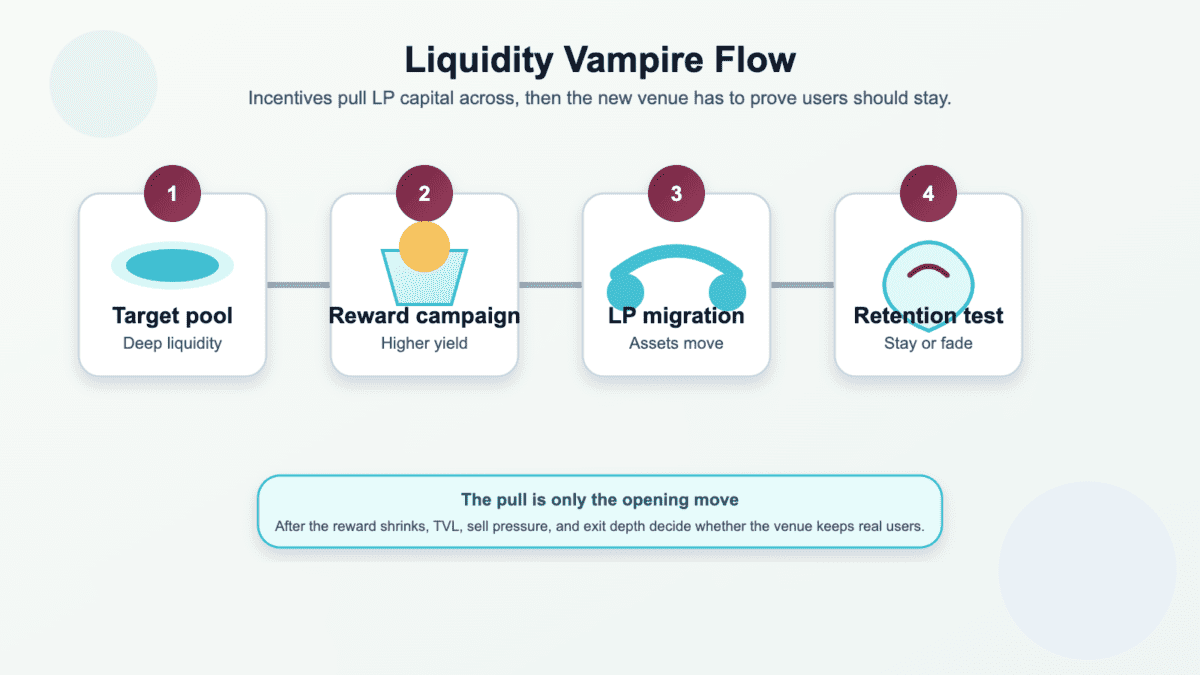
The flow usually has four stages.
| Step | What The User Sees |
|---|---|
| Find valuable liquidity | A challenger targets a DEX, farm, marketplace, or chain with active users and deep pools. |
| Offer better rewards | LPs see richer token emissions, lower fees, points, airdrop hints, or boosted yield. |
| Make migration easy | The new venue reduces friction through wrappers, LP-token staking, or a guided migration route. |
| Try to retain users | The venue needs real volume, fees, product quality, and trust once the reward premium fades. |
The reward is the magnet. In many DeFi cases, the campaign pays LPs in a new token. That can work if the token has demand and the product keeps users. It can break fast if farmers sell rewards as soon as they receive them.
That is where a liquidity vampire overlaps with crypto farming rewards. Farming can bootstrap usage, but it can also rent attention. When the rent stops, the mercenary capital may stop pretending it lives there.
A liquidity vampire attack starts with a target worth copying or competing against. The target may have deep pools, loyal LPs, strong routing, active traders, or a large user habit.
The challenger does not need to steal private keys. It needs to make LPs believe moving capital is worth the trouble.
Rewards are the sales pitch. A new protocol may offer token emissions, boosted yield, fee rebates, points, or airdrop expectations that make the old venue look sleepy.
This is where users need to slow down. A high reward can be a subsidy, not proof of sustainable demand.
Migration friction decides whether the campaign reaches enough LPs. If LPs must unwind positions, bridge assets, approve contracts, and rebuild pools by hand, fewer will bother.
So vampire campaigns often simplify the route. That ease is convenient, but each approval, wrapper, bridge, and contract adds another place to check.
The hard part comes after the headline yield drops. Real retention needs traders, fees, useful routing, credible contracts, and a reason to stay.
Without that, the campaign becomes a rental market for liquidity. Nice while the music plays. Awkward when someone reaches for the aux cord.
A liquidity vampire changes trading risk by moving depth from one venue to another. When that happens, spreads, slippage, routing quality, and fee revenue can all shift.
For a trader, the first impact is practical. A pool that was easy to enter yesterday may become thinner today. A new pool may quote better size, but only while rewards keep LPs there. A route can look attractive until everyone tries to exit through the same doorway. Watch the parts that can move separately:
Liquidity movement also affects token holders. TVL can rise while the reward token still falls. That happens when a campaign attracts capital with emissions, then farmers sell those rewards faster than the market can absorb them. TVL is a clue, not a verdict, because it cannot prove durable users, fee capture, token demand, or long-term value accrual.
Traders often describe part of this as capital rotation. Money moves from one venue, chain, or narrative to another because the next reward looks better. That move can be rational, but it can also be temporary. It can punish anyone who only tracks the headline APY.
Liquidity vampire, exit liquidity, rug pull, and hack are not the same risk. They can appear near each other in chaotic markets, but the mechanism is different. A liquidity vampire pulls capital toward a new venue. Exit liquidity describes buyers or liquidity that let someone else sell. A rug pull removes trust, liquidity, or support from under users. A hack involves unauthorized compromise.
Use this comparison before every scary label gets thrown into the same bucket.
| Term | What Is Actually Happening |
|---|---|
| Liquidity vampire | A campaign pulls users, liquidity, volume, or revenue away with better short-term incentives. |
| Exit liquidity | Someone needs buyers or pooled liquidity so they can sell or unwind a position. |
| Hard rug | Liquidity, funds, or contract control is abused suddenly, often leaving users trapped. |
| Soft rug | The project slowly fades through neglect, insider selling, weak delivery, or abandoned support. |
| Hack or exploit | An unauthorized actor compromises a contract, key, bridge, oracle, or protocol assumption. |
| Ordinary competition | A better product wins users without relying mainly on temporary incentives. |
The terms can overlap in ugly campaigns. A high-reward farm may pull users in, then late entrants can become exit liquidity for earlier farmers selling rewards.
That still does not turn every liquidity vampire into a hard rug. The vampire label tells you capital is being pulled. It does not prove stolen funds, malicious code, or a guaranteed collapse. Name the actual mechanism before panic turns every risk into the same word.
LPs can lose money in a liquidity vampire campaign even when the campaign works exactly as advertised. Fraud is only one problem. The bigger gap is between headline rewards and net results. The first risk is reward decay, where early APYs look huge because few people are farming, emissions are high, or the token price is still excited.
The second risk is position cost. LPs face impermanent loss, slippage, gas, bridging fees, approvals, taxes, and the time cost of monitoring the campaign. Before chasing liquidity vampire rewards, check the parts that usually decide the outcome:
Protocol risk is separate. New contracts may be unaudited, upgradeable, or controlled by admin keys. Assets may be bridged, wrapped, or staked through extra layers. Lockups may stop users from leaving when the reward falls or the market turns.
Timing can also turn the campaign into a PVP-style trade. Early farmers harvest rewards while later LPs absorb weaker exits. A slow-fade campaign can even rhyme with a soft rug when rewards shrink, updates slow down, and liquidity leaves.
The boring checks are the useful ones. Know the reward source, the exit route, and the contract risk before you move funds. “Vampire” is a colorful word. Your wallet balance is less theatrical.
A liquidity vampire can be useful when competition forces stale venues to improve rewards, pricing, routing, or product design. A protocol that has relied on habit may need a rival with sharper incentives before it responds. In that case, the vampire campaign is a market test, not automatically a moral failure.
The catch is payment. Free yield usually has a bill. It may come from emissions, treasury subsidies, lower fee revenue, or later buyers who absorb reward-token sell pressure. A liquidity vampire can help when:
A liquidity vampire gets dangerous when the reward is the whole product. If the campaign needs constant emissions to hold TVL, users are not watching adoption. They are watching a subsidy meter.
If the venue keeps real order flow after emissions fall, the campaign did more than rent deposits. If liquidity leaves the minute rewards shrink, the TVL chart was advertising spend with a wallet attached.
For LPs, the campaign can be worth studying without being worth joining. A better product may win. A reward-only product may only rent your deposit until someone else arrives. That difference shows up when incentives shrink and users choose where to trade without being paid to care.
The sane answer is to welcome competition while separating product progress from temporary bribery. The better deal still needs sustainable demand, clean contracts, honest controls, and an exit that works after the crowd loses interest.
The classic liquidity vampire example is SushiSwap targeting Uniswap liquidity in 2020. SushiSwap offered SUSHI rewards to LPs who deposited Uniswap LP tokens, then aimed to move that underlying liquidity into similar pools on SushiSwap.
That case became the standard DeFi example because it showed how open-source protocol design, token rewards, and portable LP capital could create fast platform competition. Users did not need a bank transfer or a private backroom deal. They needed a wallet, approvals, and a reason to chase the reward. For users, the pattern is more useful than the name:
Journal of Operations Management research later studied the SushiSwap and Uniswap vampire-attack event as a platform competition case. The paper notes that decentralized exchanges reached 80% of on-chain market share by trading volume at their 2021 peak, which is why a vampire attack against a major DEX was more than forum theater. Its key lesson for everyday users is not “vampires always kill incumbents.” It is that incentive attacks can have mixed effects across liquidity, volume, and user behavior.
That is why the phrase deserves care. A campaign can pull attention and still fail to create lasting value. It can also pressure the incumbent to respond, improve incentives, or defend its user base. Similar incentive battles can appear across marketplaces, L2s, and trading apps, though some are ordinary competition with sharper marketing teeth. If the final retention test fails, the vampire campaign becomes a temporary yield event. If it passes, the market may get a stronger competitor.
You spot a liquidity vampire by looking past the APY and mapping the full campaign. Ask where liquidity is moving from, where it is going, why users are being paid, and what happens when the payment shrinks. Real fees, treasury incentives, token emissions, points, and airdrop promises behave differently.
Then check the route. Moving liquidity may require swaps, bridges, approvals, LP-token staking, wrappers, or lockups. Each step changes the risk and the cost. Use this table before moving funds.
| Check | What Can Go Wrong |
|---|---|
| Reward source | Fees, emissions, points, and subsidies have different staying power. |
| Reward duration | Short campaigns can fade before late LPs recover costs. |
| Vesting and lockups | Delayed rewards or locked LP tokens can trap users during market moves. |
| Pool depth | Thin pools can punish entry, rebalancing, and exit. |
| Exit route | You need enough liquidity to leave, not only enough hype to enter. |
| Contract controls | Admin keys, pause powers, and upgrades can change user risk. |
| Bridge path | Cross-chain moves add bridge, delay, and wrapped-asset assumptions. |
| Token distribution | Insider-heavy supply can add sell pressure during reward campaigns. |
The table is a filter, not a magic shield. A campaign can pass several checks and still disappoint if the market changes, rewards collapse, or users leave faster than expected.
The best warning sign is often simple. If the whole pitch depends on being early, ask what late users are supposed to earn. If the answer is vague, you may be looking at a migration campaign where the fastest wallets get the cleanest exit.
Related terms help because crypto uses vampire language loosely. The right next page depends on the risk you are trying to separate.
Vampire attack, vampire mining, incentivized liquidity, and TVL are concept labels here. They explain how rewards, deposits, and attention move. The CryptoProcent pages below are more useful when the liquidity vampire risk turns into a specific trading problem:
The point is to name the mechanism, not collect scary labels. A liquidity vampire is about pull. A rug is about betrayal or abandonment. A sell-into-the-crowd setup is a different problem again.
A liquidity vampire is the broader slang term, while a vampire attack is the more specific DeFi mechanism. In casual crypto speech, people often use them together when a campaign pulls liquidity away with rewards.
That separation keeps loose liquidity-drain chatter from being mistaken for a formal vampire attack. If LP incentives are doing the pulling, the terms are much closer.
A liquidity vampire attack is usually not a hack. It normally uses incentives to persuade users to move funds voluntarily, rather than compromising wallets or contracts.
That does not make it harmless. LPs can still face smart-contract risk, bridge risk, reward-token sell pressure, lockups, and weak exits.
A liquidity vampire can hurt a token price if it drains useful liquidity, weakens fee capture, or creates heavy reward-token selling. The effect is not automatic.
Sometimes competition increases volume or forces better incentives. Other times, TVL rises while token holders get diluted by emissions and sell pressure.
High APYs attract liquidity vampires because rewards can move LP capital faster than slow product adoption. If the reward looks rich enough, farmers may move before the venue has proven durable demand.
The catch is that APY can fall quickly. More LPs split the reward, and the reward token itself can lose value as farmers sell.
SushiSwap targeting Uniswap is the most famous early DeFi liquidity vampire example. It became the reference case because it used token rewards to attract LP capital from a major incumbent.
It is not the only form the idea can take. Similar incentive battles can appear across DEXs, marketplaces, chains, and apps, though not every competitive reward campaign deserves the same label.
You avoid becoming exit liquidity in a liquidity vampire campaign by checking who is likely to sell after you enter. Look at reward emissions, insider supply, vesting, pool depth, and whether early farmers already captured the best yield.
Also test the exit before sizing up. If the route out is thin, bridged, locked, or dependent on one reward token holding its price, the headline APY is doing too much charm work.
When you see a liquidity vampire claim, slow the label down into plain questions. What is being pulled, from where, to where, and why are users being paid to move?
That map beats reacting to the word “attack.” Some campaigns are aggressive competition. Some are risky yield bait. Some are just loose slang for capital leaving one venue. Start with these checks:
After that, compare the promised reward with the cost of getting in and out. Gas, slippage, bridge delays, reward vesting, taxes, and reward-token sell pressure all eat into the headline APY. If the numbers only work when everything stays perfect, size down or pass.
Also decide what would make you leave before you enter. A falling reward token, shrinking pool depth, paused withdrawals, governance changes, or a rushed contract upgrade can change the deal fast.
Run the same check on your own position size. Small experimental size can make sense when the risks are visible and exits are tested. Serious size needs a stronger reason than a large APY screenshot or a busy Discord thread.
Finally, avoid judging the old and new venues only by TVL. A pool can look deep while exits, rewards, and reward-token liquidity are all weakening.
If the campaign still makes sense after those checks, it may be a calculated DeFi move. If the reward only looks good before costs, locks, exits, and token sell pressure, let someone else audition for the cape.