Physical Address
304 North Cardinal St.
Dorchester Center, MA 02124
Physical Address
304 North Cardinal St.
Dorchester Center, MA 02124


A plain-English guide to meme coin trenches, rugs, bots, liquidity traps, and FOMO.
Meme coin trenches means the fast, risky corner of crypto where traders chase fresh meme coins before mainstream attention arrives.
The phrase sounds dramatic because the market often earns it. It usually points to tiny on-chain tokens, launchpad coins, wallet swaps, Telegram calls, X hype, thin liquidity, bots, and traders trying to exit before the crowd notices the risk.
This is not the same as buying DOGE or PEPE on a large exchange and waiting through volatility.
In crypto, meme coin trenches are where traders hunt early meme coins before broad attention arrives. The phrase is slang, but it describes a real trading environment shaped by speed, weak information, and uneven incentives.
In broader crypto slang, the trenches are the messy front line of active speculation. Meme coin trenches narrow that idea to fresh or tiny meme coins, especially tokens found through launchpads, DEX screens, wallets, social posts, or private groups.
The phrase usually shows up in moments like these:
Someone who buys before the token has history, deep liquidity, or proven demand is in the trenches.
The repeat problem is the information gap. The buyer often has less confirmed information than the seller, the deployer, and the fastest wallets. That gap is where most trench mistakes begin.
The important distinction is timing. Buying a famous meme coin after it has exchange listings, market makers, and years of trading history can still be volatile. Buying a fresh token five minutes after launch adds creator risk, bot risk, liquidity risk, and social-hype risk at the same time.
> Early can mean opportunity. It can also mean nobody has tested the exit.
So the phrase works as both a badge and a warning label. For the wider slang, crypto trenches covers the broader trading culture. Meme coin trenches are the narrower, faster version.
Meme coin trenches are different because you are often trading before the market has settled into anything predictable. Listed meme coins can be wild, but fresh trench tokens usually have less liquidity, less history, and fewer reliable signals.
The shift is not subtle. You move from studying a known asset to reacting inside a thin, social, on-chain market. A chart can move fast because only a small amount of buying or selling is needed to change the price.
| Meme Coin Type | What Changes For The User |
|---|---|
| Large listed meme coin | Easier access and deeper liquidity, but hype cycles can still hurt late buyers. |
| DEX-traded meme coin | Wallet swaps add slippage, holder concentration, and contract-check pressure. |
| Fresh launchpad token | The user faces rugs, bots, insiders, fake demand, and almost no trading history. |
This is why “early” should not automatically sound good. Early can mean the token has not yet been tested by sellers, has no real community, or depends on a handful of wallets staying polite.
In normal meme coin investing, you can usually inspect longer price history and market depth. In the meme coin trenches, you may be deciding while bots, deployers, influencers, and copy traders all move at once.
That speed can create real upside, but it can also turn a small mistake into a complete loss before the next chart candle finishes.
Traders call meme coin trenches the trenches because the experience can feel tiring, fast, and hostile. The phrase carries pride, warning, and gallows humor at the same time.
When someone says they are “in the trenches,” they may be grinding through fresh launches, missed runners, rugs, fake socials, dead chats, and charts that go from euphoric to useless in minutes. It is not always a boast. Sometimes it is just a cleaner way to say the market has been chewing glass again.
The phrase usually signals these conditions:
That community meaning helps explain why the word stuck. Meme coin trenches are about price movement, but they are also about the emotional loop around it.
The phrase can carry different tones depending on who says it:
The culture also rewards stamina. People post wins, losses, wallet screenshots, and jargon to show they survived the mess. But survival stories can hide survivorship bias. Users who disappear after bad trades rarely write the loudest threads.
That is why the phrase should not impress you by itself. Someone can sound fluent in trench slang and still be one rushed buy away from becoming the next cautionary screenshot.
Meme coin trenches usually work through a loop of attention, token creation, early wallet activity, DEX trading, and exits. Launchpads make token creation easier, while DEXs and aggregators make trading fast once liquidity appears.
On Solana, Pump.fun became a common reference point because it made fresh meme-coin launches simple and social. Other chains have their own versions of fast token creation and wallet-led trading. The core pattern stays the same: attention arrives first, liquidity follows, and risk hides inside the rush.
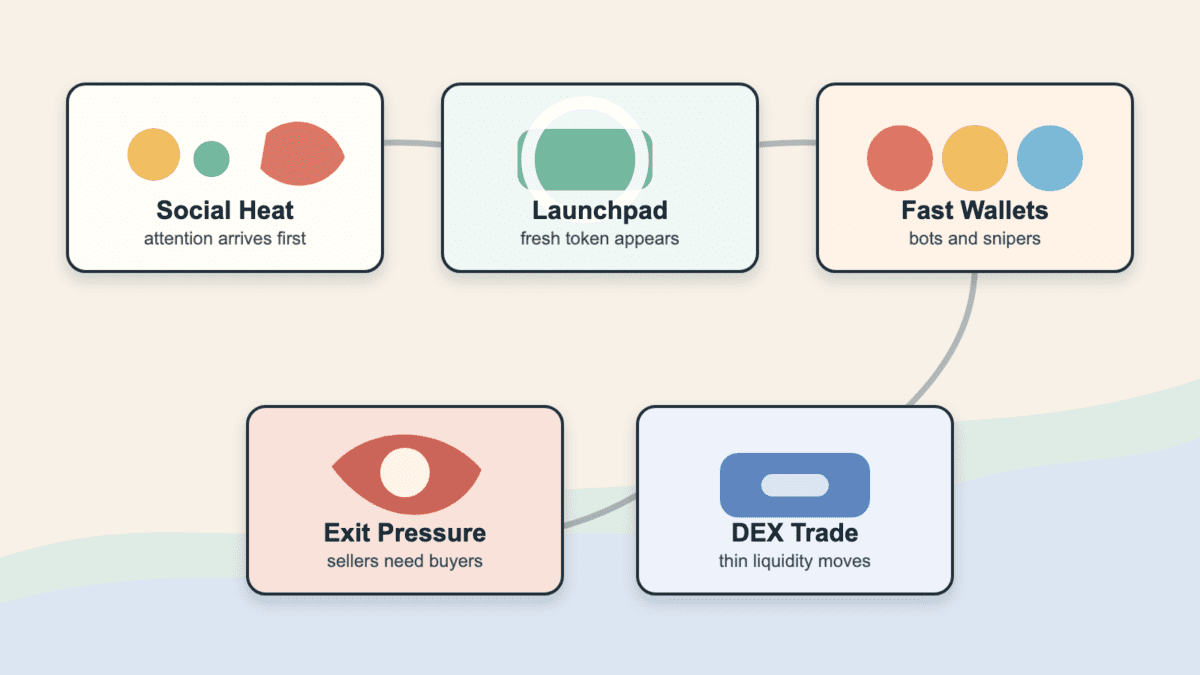
The usual flow looks like this:
The attention economy explains why meme coin trenches can move on mood before fundamentals exist. Social attention can feel like temporary liquidity, but it can vanish as soon as the next ticker starts trending.
Wallet tools, DEX screens, and aggregators can help users see pairs, liquidity, holders, and routes. They do not make the trade fair. A clean screen can still hide thin liquidity, bundled supply, or a team preparing to sell into excitement.
The takeaway is simple: launchpads reduce friction, not risk.
The main risks in meme coin trenches are not just normal volatility. The bigger danger is that the market structure can work against the slow, late, or under-informed buyer.
Fresh meme coins often depend on thin liquidity, fast attention, and a small number of wallets. That mix can make a chart look alive while the exit conditions remain terrible.
Liquidity risk means you may not be able to sell near the price shown on the chart. In meme coin trenches, a token can pump hard while the actual pool remains too shallow for larger exits.
A hard rug is the blunt version, where a creator or insider move can destroy trading confidence quickly. The softer version can still hurt when early holders sell in waves or liquidity dries up.
> A chart shows where the last trade happened. It does not promise you can exit there.
Bots can buy, sell, and reorder activity faster than most humans can read a token page. That means the price you think you are chasing may already belong to faster wallets.
Snipers can hit fresh launches early, while other bots react to liquidity changes, contract events, or social signals. By the time a human sees a “new runner,” the easy entry may already be gone.
This does not mean every bot wins. It means your edge should not depend on being the fastest click in a market built for machines.
Holder concentration can make one wallet more important than the story, meme, or chart. If a few wallets control enough supply, their sales can define the market.
Bundled supply makes this harder to read because several wallets can appear separate while still behaving like one coordinated position.
Useful checks include top holders, creator-wallet history, liquidity depth, and recent transfer patterns. None of them prove safety. They only show where the obvious pressure points may sit.
Meme coin trenches run on attention, so fake attention is a serious risk. A loud Telegram, paid caller, raid group, or recycled meme can make demand look larger than it is.
Paid noise becomes dangerous when users mistake it for durable buyers.
Watch whether people discuss the token beyond price. If every post is just “send it,” “last chance,” or a screenshot of someone else’s unrealized gain, the social proof is doing heavy lifting.
Copy trading can make meme coin trenches feel easier because a wallet’s past wins look clean on a dashboard. But the copy usually arrives after the original wallet already acted.
That creates a timing problem. You may copy an entry after liquidity has moved, then copy nothing when the original trader exits through private routing, split wallets, or faster execution.
Copying a wallet is not the same as copying its information, sizing, risk limit, or exit plan. Sometimes you are just copying the smoke after the firework already went off.
Checking a token before entering meme coin trenches means looking for obvious red flags before price excitement takes over. Tools can help, but they should slow you down, not convince you that risk disappeared.
Start with the basics. Make sure the chain, contract, ticker, and token page refer to the same asset. Fake tickers and copied names are common enough that one wrong click can turn a risky trade into a self-own.
Before buying, run through a short checklist:
Creator identity deserves care. An anon dev is not automatically a scammer, and a public founder is not automatically safe. The useful check is behavior: previous launches, wallet funding, contract changes, and whether the project communicates clearly when pressure rises.
Also check whether your planned position makes sense for the pool. A $50 test can behave very differently from a larger buy in a shallow market. If your exit would move the chart hard, the chart is not as liquid as it looks.
A good checklist will not make a meme coin safe. It can only help you reject the worst setups before FOMO starts doing math badly.
Most beginners should study meme coin trenches from the edge before risking capital. Watching live launches, failed pumps, and rug patterns can teach more than jumping in with a wallet funded by adrenaline.
The beginner problem is not only ignorance. It is pacing. Fresh-token markets reward speed, but beginners need time to check contracts, liquidity, holders, social claims, and exits.
If you cannot explain slippage, holder concentration, creator wallets, and your own sell plan in plain English, the trade is probably moving faster than your process. That mismatch is expensive.
Better beginner choices are boring on purpose:
A beginner can also learn the rhythm without funding a wallet. Watch which calls fade, which charts recover, and which accounts delete posts after a bad launch. That pattern recognition is useful even if you never buy a fresh meme coin.
If you do participate, decide the loss before the buy. That prevents the classic trench mistake: turning a tiny speculative trade into a personal rescue mission.
It also helps to separate learning from earning. A small planned loss can be tuition. A repeated unplanned loss is just a subscription to chaos with worse customer support.
Meme coin trenches are often PvP trading because different groups enter with different information, timing, and exit needs. A rising chart does not prove broad demand if a few early actors can sell into attention.
Early buyers may have watched the deployer wallet. Snipers may have entered before social hype peaked. Influencers may earn attention by posting the ticker. Late retail may arrive after the chart already looks obvious.
The usual roles are easy to miss while the candle is green:
That is how someone becomes exit liquidity. They buy when earlier holders need buyers, then discover that the crowd behind them is smaller than expected.
Consider a simple scenario. A token launches quietly, a few wallets buy early, a caller posts it, and the chart spikes. New buyers enter because the green candle looks convincing. Then early wallets sell in pieces while the social feed keeps shouting.
The trade can look healthy right until the sell pressure appears. That is the cruel part of PvP markets: the chart can reward late confidence for a moment, then punish it when earlier wallets take the other side.
No single action in that chain proves fraud, but the incentives are still uneven. PvP meme coin trading asks who needs your buy, who can sell before you, and whether real demand remains after the first wave exits.
Regulation can punish some misconduct in meme coin trenches, but it cannot make a thin token liquid or a bad trade reversible. Legal labels do not remove fraud risk, bot risk, holder risk, or plain old poor timing.
In 2025, an SEC staff statement addressed how certain meme coins may be analyzed under U.S. federal securities laws. That does not mean every meme coin is lawful, safe, protected, or immune from enforcement.
For traders, the point is narrower:
Regulation usually works after facts exist. Meme coin trenches often punish users before facts are clear.
Promotion also changes the picture. A token pushed with profit promises, hidden compensation, fake endorsements, or misleading supply claims can create problems that a simple “meme” label does not erase.
Jurisdiction can also change the answer. A launch, promotion, exchange listing, or influencer post can be viewed differently depending on where the actors and buyers are. That is why blanket legal takes age badly.
So legal awareness belongs in the checklist, but it cannot replace basic risk checks. You still need to inspect the token, the wallets, the liquidity, the social incentives, and your own exit.
Start with meme coin trenches by observing the market before joining it. The goal is to spot the pattern before someone else’s urgency sets your risk.
You can learn a lot without buying anything. Follow a few launches from first social mention to final chart state. Note who posted early, how liquidity changed, when top wallets moved, and whether the community stayed active after the first dump.
Do not start with a caller list, a paid tool stack, or a belief that every low-cap token is early. Start with a small sample of launches and watch how the claims age. That gives you context before your wallet becomes part of the experiment.
Use this starting plan:
Keep notes while you watch. Write down the first account you saw, the launch time, the liquidity level, the top-holder pattern, and what happened after the first big candle.
A few saved examples will teach more than a feed full of victory laps.
If you still want to experiment, keep it tiny and documented. Write the entry reason, loss limit, and sell plan before the buy.
Set a cooldown after each trade or paper trade. Meme coin trenches push users toward constant action, and constant action turns small mistakes into habits.
That small pause is the whole edge for most beginners. Meme coin trenches reward speed, but they punish confusion faster.
Meme coin trenches means the high-risk part of crypto where traders chase fresh or tiny meme coins before they reach broad attention. It usually involves on-chain launches, DEX trading, thin liquidity, social hype, and fast exits.
No. Solana is a common meme coin trenches context because low fees and launchpads made fresh-token trading popular there, but the phrase can apply on Base, BNB Chain, Ethereum, and other chains with active meme coin launches.
No. Buying DOGE or PEPE on a major exchange usually means trading a more established meme coin with deeper history and access. Meme coin trenches usually means chasing much smaller on-chain tokens with weaker liquidity and less reliable information.
Meme coin trenches attract rugs and bots because fresh tokens can launch quickly, gain attention quickly, and trade with limited oversight. Thin liquidity, anonymous creators, concentrated wallets, and fast launch mechanics create room for bad actors.
Beginners can make money in meme coin trenches, but that does not make the area beginner-friendly. A few visible wins can hide many small losses, bad exits, copy-trading mistakes, and rug exposure.
Meme coin trenches are not a single legal category. The legality depends on the token, promotion, jurisdiction, disclosures, and conduct involved. Even when a trade is legal, the user can still face fraud, liquidity, and execution risk.