Physical Address
304 North Cardinal St.
Dorchester Center, MA 02124
Physical Address
304 North Cardinal St.
Dorchester Center, MA 02124


Merkle claims, airdrop proofs, and wallet risk in plain English.
A Merkle claim is a crypto claim process where a wallet proves it is included in a committed allocation list, usually to claim an airdrop, reward, migration token, vesting allocation, or allowlist spot.
You usually meet one through a claim page. It might say your wallet is eligible, ask you to connect, then ask for a signature or transaction. The useful part is the proof. The risky part is everything around it: fake links, rushed deadlines, vague wallet prompts, locked tokens, and tokens that exist but trade like wet cardboard.
A Merkle claim in crypto is a way to let one wallet prove it belongs to a larger allocation list. The project does not need to publish or store every full entry on-chain. It stores a compact commitment, then your wallet submits a proof for its own entry.
That sounds abstract, so use an airdrop example. A project takes a snapshot of eligible wallets, assigns each wallet an amount, and creates a Merkle root from that allocation list. When you claim, your wallet submits its address, amount, and proof. The contract checks whether that entry fits the root.
The phrase often appears around airdrops, DeFi rewards, NFT allowlists, token migrations, and vesting claims. In each case, the claim button is not magic. It is a contract check that asks, “Does this wallet belong in the committed list, and has this allocation already been used?”
You will usually see a Merkle claim in a few familiar places:
That check is useful, but narrow. A valid Merkle claim does not prove the token is valuable. It does not prove the team picked a fair list. It does not prove the portal is official. And it definitely does not mean you should approve a strange wallet request at 2 a.m. because a Telegram account shouted “last chance.”
The takeaway is simple: know what your wallet is proving before you connect. Then check what the page asks you to sign.
A Merkle claim works by turning a large eligibility list into a small on-chain commitment. Your wallet later submits a proof that reconstructs the path back to that commitment. If the proof fits, the claim contract can release tokens, record a vesting claim, or mark an allowlist spot as used.
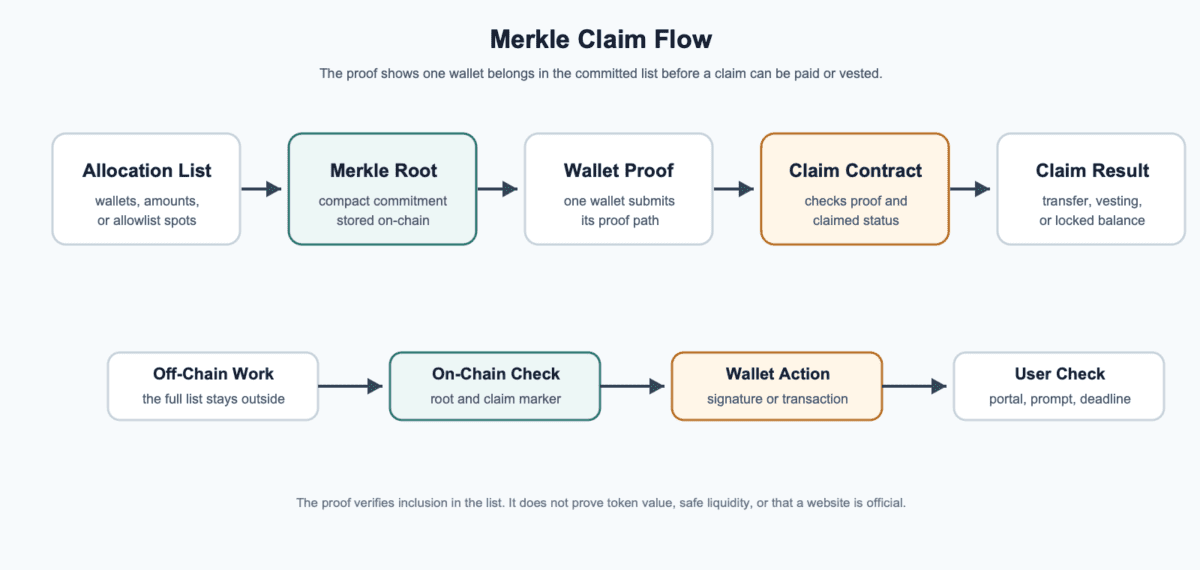
A snapshot freezes the state used for eligibility. That state might be wallet balances, app activity, staking records, bridge use, NFT ownership, or a project-specific allowlist. After that cutoff, the project builds an allocation list.
The core vocabulary is easier when each term has one job:
| Term | Plain Meaning |
|---|---|
| Leaf | One wallet’s entry, often address plus amount. |
| Merkle root | A compact commitment to the full list. |
| Merkle proof | The path that proves one leaf belongs. |
| Claim contract | The contract that checks the proof. |
The list can stay off-chain, while the root sits on-chain. That split helps projects distribute to many wallets without storing a giant recipient table in the contract.
After the root is set, an eligible wallet submits a claim transaction with its proof. The claim contract checks the proof against the root. It also checks whether that allocation has already been claimed.
A normal claim check usually has to answer four narrow questions:
A Merkle distributor pattern from OpenZeppelin uses a unique index, or equivalent claim marker, so a valid entry cannot be claimed twice. The contract verifies the proof and marks the claim as used in one flow.
If the proof is invalid, the claim should fail. If the allocation was already claimed, the claim should fail again. If everything checks out, the contract can transfer tokens, record a vesting amount, issue an NFT, or update claim status.
That is the clean version. The user version still includes gas, wallet prompts, deadlines, and confusion over what was actually received.
A Merkle claim itself should not drain your wallet just because your address appears in a proof. The danger usually comes from the claim page, the transaction it prepares, or a signature that authorizes something unrelated to the claim.
Fake claim pages work because they copy real claim language. They do not need to break the Merkle proof. They only need you to approve the wrong action while you are thinking about free tokens.
The mechanism and the website are separate. A real Merkle proof can be harmless. A fake claim page can display a fake allocation, rush you with a deadline, and ask your wallet for a toxic approval. That is where a claim can slide into hard rug territory.
A Merkle proof only shows that one entry belongs in a committed list. It should not need your seed phrase. It should not need private keys. It should not need broad permission to spend unrelated tokens.
Legitimate claim flows vary by chain, but the safe pattern is narrow. The prompt should match the action. If you are claiming one reward, the transaction should not ask for unlimited stablecoin spending rights.
A malicious claim page can ask for approvals, permit signatures, or contract calls that move assets you did not mean to touch. It can also push urgency so you skip checks. Scammers love a ticking clock because panic is cheaper than code.
Use these red flags before you continue:
If a claim requires wallet interaction, use good wallet setup habits. Keep valuable long-term funds away from random claim experiments. A small mistake can be bigger than the airdrop.
Checking a Merkle claim before you connect means confirming the source, the contract, the wallet prompt, and your ability to sign from the eligible address. You do not need to read every line of Solidity. You do need to slow the click.
The goal is to separate three steps: checking eligibility, connecting a wallet, and signing or sending a transaction. A page can be low risk while it only reads a public address. The risk rises when it asks for wallet permissions.
Start from the project’s official website, official social profile, governance forum, or verified documentation. Do not start from a sponsored search result or a random reply. If the project publishes a contract address, compare it with the address shown by the claim page or block explorer.
Run through this short pre-click checklist:
This is not glamorous work. Recovering from a bad approval is worse.
A Merkle claim often requires control of the wallet that qualified. If the eligible assets were held by a centralized exchange, the exchange may control the actual address. You may not be able to sign from it.
Hardware wallets add a different friction point. They can improve key security, but the claim page, chain, message format, or wallet software still has to support the action. Test early when there is a deadline. A five-minute check beats a midnight support-thread spiral.
If you are unsure, look for official instructions about supported wallets and manual claim routes. Advanced users may claim through a verified contract or block explorer, but that path is not automatically safer. It only moves the risk from a website interface to your own input accuracy.
A Merkle claim proves inclusion in a committed list. It can show that a specific wallet, amount, index, or allowlist spot matches the Merkle root used by the claim contract.
That proof is powerful, but it has a small job. It does not audit the list. It does not prove the team treated users fairly. It does not prove the claim page is official. It does not prove the token will trade well after everyone presses the same button.
Here is the clean split:
| A Merkle Claim Can Prove | A Merkle Claim Cannot Prove |
|---|---|
| One entry belongs to a committed list. | The website is the official portal. |
| The proof matches the stored root. | The allocation rules were fair. |
| The allocation has not been claimed yet. | The token has lasting value. |
| The contract accepted that proof. | The market will provide liquidity. |
The split becomes painful when a project delivers the claim but still disappoints users. A claim can work while release timing is poor, liquidity is thin, or the rollout becomes a soft rug in user experience.
So do not overread the word “proof.” In crypto, proof often means one precise thing. Everything outside that thing still needs normal skepticism.
That includes the project decisions behind the list. A Merkle root can commit to whatever allocation the team created. If the snapshot missed active users, favored insiders, or used rules nobody understood, the proof can still verify cleanly.
It also includes the market after the claim. The contract can accept your proof and transfer tokens, while buyers, liquidity, exchange support, and release timing remain weak. Respect the proof, then inspect everything around it as a separate risk.
Merkle claim status words describe different stages of access. They are not interchangeable. A wallet can be eligible but unable to claim today. It can claim tokens that remain locked. It can hold unlocked tokens that still have poor liquidity.
Status affects gas, timing, tax records, and wallet exposure. Paying to claim a locked or thinly traded token may still be reasonable. But you should know what you are getting before you pay.
Use the dashboard language carefully:
| Status | What To Check |
|---|---|
| Eligible | The wallet appears in the allocation list. |
| Claimable | The contract currently allows a claim. |
| Claimed | The wallet already used its claim. |
| Locked | The allocation exists but cannot move yet. |
| Vested | The allocation releases over time. |
| Unlocked | Tokens are no longer restricted by schedule. |
| Liquid | There is real trading depth for exits. |
A claimable airdrop is not always a sellable airdrop. The token may need a later unlock. A pool may exist but be shallow. Heavy claim-day selling can also turn late buyers into exit liquidity for earlier recipients.
The other trap is emotional ownership. Once the dashboard shows a number, users can act like the money is already theirs. If the token unlocks into weak demand, that number can become a souvenir. Not every claimed allocation becomes profit, and some become bagholder inventory.
Before claiming, check the unlock terms, trading venues, pool depth, and whether there is any reason to hold after the claim. Free tokens can still be expensive if the transaction exposes a valuable wallet or burns gas for dust.
Projects use Merkle claims because sending tokens to every eligible wallet can be costly, noisy, and wasteful. A claim flow lets eligible users decide whether to take action, while the project keeps the full allocation list mostly off-chain.
This is useful when the list is large. Many wallets are inactive. Some allocations are tiny. Some users do not want dust. A claim flow lets active recipients show up, pay or time their own transaction, and receive only when they care enough to claim.
Common project reasons include:
The trade-off lands on users. They must find the correct portal, connect the correct wallet, and act before any deadline. That extra surface creates scam risk, support tickets, and confusion.
Merkle claims also fit recurring reward systems. Liquidity mining, staking incentives, and farming campaigns may calculate rewards off-chain, then let wallets claim after a distribution period closes.
That setup can also make small rewards less wasteful. A project does not have to push dust to wallets that never asked for it. Active users can decide whether the allocation is worth gas, timing, and wallet exposure.
So the pattern is efficient, but not automatically friendly. It saves contract storage and distribution work. It asks users to become careful operators for a few minutes.
For a normal holder, the project-side logic should not change the pre-click routine. Efficiency is the reason the portal exists. It is not a reason to trust every link, deadline, or wallet prompt wrapped around it.
If you miss a Merkle claim window, the result depends on the contract and project terms. Some projects extend claims. Some return unclaimed tokens to a treasury. Some burn them. Some leave them in a contract for later governance decisions.
The contract may enforce a hard deadline, or the deadline may live mostly in project policy. Those are different risks. A visible countdown on a website is not enough. Check official terms, announcements, and any verified contract deadline before assuming you have more time.
When a deadline is close, use a slower checklist, not a faster click:
Missed windows are fertile ground for fake recovery pages. A scammer can copy old branding, claim there is an emergency extension, and ask for a wallet approval. The phrase “final chance” should make you read more carefully, not less.
If you truly missed it, look for official follow-up. Do not sign a mystery transaction just because it promises to recover tokens the original contract no longer supports.
Also separate policy from code. If the contract has a deadline, no support agent can wish your transaction through after that condition fails. If the deadline is managed off-chain, the team may have more room to reopen claims, but only official channels can confirm that.
Unclaimed tokens can go several ways. They may return to a treasury, fund future incentives, stay in a contract, or get burned. The right answer depends on the original rules, so screenshots from a random late-claim page are not enough.
Merkle claim examples show up anywhere a project needs to distribute rights or tokens to many wallets without directly sending everything first. The same mechanism can feel different depending on what the claim represents.
An airdrop may use a Merkle root for a snapshot list. A reward program may use one for weekly or monthly incentive claims. A migration may use one to let old token holders claim a new token. An allowlist may use one to let selected wallets mint or reserve spots.
The user-facing difference is what changes after the claim:
| Use Case | What Changes For The User |
|---|---|
| Airdrop | The wallet claims a token allocation. |
| Rewards | Earned incentives become claimable. |
| Migration | Old eligibility maps to a new asset. |
| Allowlist | The wallet proves access to a mint or spot. |
| Vesting | A locked allocation becomes partly claimable. |
These flows can also combine. A token migration may include a claim window. A reward claim may include vesting. An allowlist claim may require a signature but no token transfer yet.
That is why the button label is not enough. “Claim” can mean receive now, register eligibility, start vesting, reserve access, or mark an allocation as used. Read the surrounding terms before assuming the asset is immediately yours.
For any example, ask what changes after the transaction lands. If the wallet receives transferable tokens, the next question is liquidity. If the wallet starts vesting, the next question is schedule. If the wallet only reserves access, the next question is what action comes later.
This is also where copycat pages create confusion. A fake portal can mimic the same labels without the real contract behind them. When the example looks familiar, still compare the source, contract, and wallet prompt before signing.
Start a Merkle claim by proving the page is real before proving your wallet is eligible. The best claim is boring: official link, matching contract, clear prompt, known deadline, and a result you actually understand.
Use this order when a claim page appears:
If the claim is tiny, rushed, or unclear, skipping it can be rational. Free does not mean risk-free. It only means the cost is hiding somewhere else.
The strongest habit is separation. Use one process to check eligibility, another to inspect the claim action, and another to decide whether the token is worth holding. That keeps a proof from turning into permission for bad decisions.
Start with the least risky action. Reading a public address or checking an official announcement is different from connecting a wallet. Connecting is different from signing. Signing is different from approving token spending.
If the page jumps straight to urgency, slow down. A legitimate Merkle claim should survive a few minutes of checking. A bad one often relies on you treating the countdown as a command.
Then decide whether the result is worth acting on. A claim can be real and still be too small, too expensive, too locked, or too exposed to weak liquidity. That is not paranoia. It is just math with a wallet attached.
For larger claims, write down the source, contract, deadline, and token status before you sign. That gives you a simple record if you need to track the transaction later, report taxes, or explain why a claimable number did not become spendable value.
No, a Merkle claim is not the same as an airdrop. An airdrop is the distribution event or reward. A Merkle claim is one method used to prove which wallets can receive that distribution.
Many airdrops use Merkle claims because they let each eligible wallet claim its own allocation. But a Merkle claim can also support rewards, migrations, vesting, allowlists, and NFT distributions.
A legitimate Merkle claim proof should not drain your wallet by itself. The risk comes from the page or transaction around it, especially if it asks for unrelated approvals, broad spending rights, or a suspicious signature.
Check the domain, source, contract address, and wallet prompt before signing. Reject any page that asks for your seed phrase or private key. That request is never part of a normal claim.
You often need to pay gas for a Merkle claim when the claim requires an on-chain transaction. The exact cost depends on the chain, contract, network demand, and whether the project subsidizes fees.
Some flows only check eligibility off-chain first. That may be free. The actual claim, transfer, vesting action, or registration step can still require a transaction.
Usually, you need control of the eligible address to complete a Merkle claim. If the qualifying assets sat on a centralized exchange, the exchange may control the address that appears in the allocation list.
That means you may not be able to sign from it yourself. Check the project’s official rules and the exchange’s policy. Do not assume exchange balances qualify the same way as self-custody wallets.
If you miss a Merkle claim window, the outcome depends on the contract and project terms. The unclaimed tokens might return to a treasury, stay unclaimed, get burned, become claimable later, or require a governance decision.
Check official announcements and contract information before acting. Be careful with late-claim links, because fake recovery pages often appear after real windows close.
No, Merkl and Merkle are not the same thing. Merkle refers to the cryptographic tree, root, and proof pattern used in many claim systems. Merkl is a separate platform brand name.
This naming overlap can confuse search results and scam warnings. When you see a Merkle claim, check whether the page is describing the cryptographic claim method, a specific platform, or a fake page copying a familiar name.


